
What is glutathione?
Glutathione is a small molecule made of three amino acids (glutamate, cysteine, and glycine).
Supplements sell it in three main forms: reduced glutathione (often labeled “L-glutathione”; Setria is one branded ingredient), liposomal glutathione (wrapped in fat bubbles), and S-acetyl glutathione. Capsules usually hold 250 to 500 mg.
People take glutathione to raise their antioxidant levels, for immune support, and to lighten skin.
Every cell makes its own, and it is one of the body's main antioxidants: it neutralizes reactive molecules and helps the liver and other tissues process foreign chemicals. The body builds glutathione from protein in the diet.
What glutathione does in your body
Cells make glutathione from glutamate, cysteine and glycine. Its reduced form has electrons available to give up as enzymes deal with peroxides and other reactive substances produced during metabolism. In the process, two glutathione molecules can become linked in an oxidized form. Other enzymes supply electrons again to recycle them into the working reduced form.
Glutathione also participates in reactions that attach a chemical group to certain foreign compounds and their breakdown products. This can help the body process and eliminate them.
Much of this work depends on glutathione produced and recycled within tissues.
What people take glutathione for
| Claimed benefit | Dose / form studied | Research verdict | Evidence strength |
|---|---|---|---|
| Raise blood glutathione | Reduced glutathione 250 or 1,000 mg/day for 6 months versus a separate 1,000 mg/day, 4-week trial; healthy adults | The longer trial reported higher levels; the shorter did not find a clear difference | Limited |
| Lighten skin pigment | Oral glutathione 250–500 mg/day in small trials; a separate 2026 comparison tested 200 mg/day S-acetyl glutathione | Some pigment readings improved, but results differ by site and study | Limited |
| Prevent infections or slow aging | No established dose or course for a clinical benefit | Blood and immune-marker changes do not establish better health | Insufficient |
When to ask a doctor before taking glutathione
- You are having chemotherapy or radiation. We found no studies of glutathione supplements during cancer treatment; ask your oncologist before taking any antioxidant.
- You are considering IV glutathione. It is a clinic product, with different risks from a capsule, and the one placebo-controlled skin trial did not show a clear benefit.
What forms can you buy?
Reduced, liposomal and S-acetyl glutathione differ in how they are made and packaged. There is no reliable ranking of the forms for sustained blood levels or health outcomes; the blood-level studies explain what has been measured.
Reduced glutathione (L-glutathione, Setria)
The plain form, usually 250 or 500 mg per capsule. The full six-month trial report[1] identifies the tested ingredient as Setria, supplied by Kyowa Hakko; matching the ingredient name still does not make every current Setria product or dose equivalent to the trial regimen. Sample label line: "Setria Glutathione 500 mg" per capsule.
Liposomal glutathione
Glutathione wrapped in tiny fat bubbles, sold as capsules or liquids. Liquids often provide 100 mg per serving. Sample label line: "Glutathione 100 mg" per 2 pumps.
S-acetyl glutathione
A modified form designed to survive digestion better. In 2026, the European Food Safety Authority judged it safe at specified food-supplement amounts (a safety review, not a test of benefit). Its summary of a blood-level comparison and a separate skin trial do not establish a general form ranking. Sample label line: “S-Acetyl Glutathione 200 mg” per capsule.
All glutathione forms at a glance
| Form | Typical amount | Tested in people | What the evidence shows |
|---|---|---|---|
| Reduced (L-glutathione; Setria is one branded ingredient) | 250–500 mg per capsule | 4-week trial found no rise; 6-month trial found a rise; small skin trials | The form with the most data, but only changes in laboratory or instrument measurements |
| Liposomal capsules | 350 mg per 2 capsules | 12-person pilot, no placebo | No proven advantage over reduced glutathione |
| Liposomal liquid | 100 mg per 2 pumps | Pilot used 500–1,000 mg a day but did not identify this retail liquid | Usually far below the pilot amount |
| S-acetyl | 200 mg per capsule | Single-dose comparison with reduced glutathione; a 2026 skin trial compared 200 mg/day with 500 mg/day reduced glutathione and placebo | Higher plasma readings but lower red-cell readings than reduced glutathione in the comparison summarized by EFSA; skin results are preliminary |
| NAC | Separate supplement | Its own trials | A glutathione building block, not a form of glutathione |
Compare products in milligrams of the named form. Skip intravenous (IV) drips for skin lightening, retail liquids marketed through unrelated pilot amounts, and NAC sold as though it were glutathione.
What to pay attention to on the label
There is no recognized recommended daily amount or official upper limit for glutathione. Trials gave it once or twice a day; none compared times of day or taking it with or without food.
Find milligrams of the named glutathione form per serving and the labeled number of daily servings. Compare like with like: a reduced-glutathione trial does not validate a liposomal liquid or an S-acetyl capsule.
Which number on the label is the amount?
One reduced glutathione capsule lists 500 mg of Setria, a branded reduced-glutathione ingredient, taken once a day. One liposomal capsule product lists 350 mg per 2 capsules. One S-acetyl capsule lists 200 mg of a related form; a skin trial used that daily amount, but matching the amount alone does not establish that the retail capsule reproduces the trial result.
Misleading labels
Liposomal liquids dosed below the trials
One liposomal liquid lists 100 mg of glutathione per 2 pumps, taken twice a day: 200 mg a day. That is 300 to 800 mg below the 500 to 1,000 mg used in the uncontrolled pilot. The shared “liposomal” description can obscure this difference when that pilot is used to promote lower-serving liquids; the pilot also lacked a control group.
A front number that is not per capsule
One product that combines broccoli extract and glutathione lists 1,000 mg of Setria glutathione, but each capsule holds 250 mg, and the directions say up to four capsules a day. The 1,000 mg is the total for four capsules.
Confusing servings and items per serving
Some manufacturers put 180 capsules on the front, and the back says 3 capsules per serving and 60 servings. The amount on the Supplement Facts panel is for the whole 3-capsule serving.
Manufacturer claims and the studies they may be based on
A claim that a product raises glutathione levels should name the study, the product tested, the dose, and whether the difference was against placebo or only against participants' starting levels. The six-month trial did test Setria, but it measured blood and cell levels rather than a health benefit. A "superior absorption" claim for liposomal or micellar glutathione, which uses another fat-based carrier, needs a direct comparison that matches the product and dose. "Reduced and active" describes the chemical form, not a demonstrated health benefit.
How NAC relates to glutathione
NAC
A glutathione capsule is not NAC (N-acetylcysteine). NAC is a different supplement that supplies cysteine, which the body uses to make its own glutathione; hospitals use high-dose NAC to treat acetaminophen (Tylenol) overdose. Some products combine the two, but we found no trial showing that taking both works better than either.
Drawbacks and side effects
| Potential drawback | When/who it affects | Research evidence | Practical implication |
|---|---|---|---|
| Uncertain long-term safety | Concentrated oral products | Incomplete adverse-event reporting; short blood-test reassurance is limited | Long-term safety remains uncertain. |
| Different risks with IV use or cancer treatment | Clinic infusions or chemotherapy/radiation | Oral studies do not establish infusion safety or safety during treatment | Discuss these uses with the treating clinician; do not substitute route or product. |
| Gas, loose stools or flushing | Reported in a small four-week oral trial | [2] | These are reported events, not a measured rate of effects caused by glutathione. |
Understanding these risks
There is no official upper limit for glutathione. Short trials cannot establish uncommon or long-term harms. A micellar study included a separate 30-day phase at 600 mg a day; liver and kidney blood tests did not change during that phase.
In a four-week trial of 1,000 mg a day[2], mild reports included gas, loose stools and flushing. The report did not separate those symptom counts by treatment group, so it cannot show how much more often glutathione caused them than placebo. Kohjin, a glutathione manufacturer, funded the trial; the authors also had NIH support.
The science behind glutathione
The studies below measured blood glutathione, immune and metabolic markers, skin pigment, and Parkinson symptoms. The route matters: nasal and intravenous studies answer different questions from oral supplements.
Blood glutathione levels
In 2011, 40 healthy adults entered a trial of 500 mg of reduced glutathione twice a day or placebo for 4 weeks; 39 were analyzed. The differences in red-blood-cell glutathione and urine markers of oxidative damage were not statistically clear.
The 2011 trial was funded by Kohjin, a glutathione manufacturer. The full six-month report[1] names Setria as the ingredient and Kyowa Hakko as its supplier and funder; one author reported research support and travel funds from that company. A published letter[3] challenged a discussion reference to a separate liposomal, cell-study result, and the authors replied[4]. That exchange did not dispute the trial's measured blood-level results, but neither those results nor its discussion prove a clinical benefit.
In 2015, 54 healthy adults took 250 mg, 1,000 mg, or a placebo daily for 6 months. In that trial:
- Whole-blood glutathione rose at 1, 3 and 6 months versus participants’ starting levels in both active groups, with no rise in the placebo group. Some red-cell changes also differed from placebo.
- Rises ranged from 17 to 35 percent depending on dose and the blood sample measured. At the higher dose, several measures rose 30 to 35 percent from participants’ own starting levels; that is not a 30 to 35 percent advantage over placebo.
- Levels generally moved back toward baseline a month after stopping, although the 1,000 mg group's whole-blood level remained significantly above its own baseline.
These blood-level changes do not show how much intact glutathione crossed the gut: higher levels could also reflect slower breakdown or greater retention. Nor do they establish a health benefit.
In 2018, 12 healthy adults took 500 or 1,000 mg/day of liposomal glutathione for a month without a placebo group, and whole-blood glutathione rose up to 40 percent by two weeks. One micellar product produced a larger blood-level rise than standard glutathione in a 14-person, single-dose comparison. Neither study establishes that liposomal or micellar products outperform ordinary reduced glutathione with daily use.
S-acetyl raised plasma readings more, but reduced glutathione raised red-cell readings more
The 2026 EFSA opinion[5] summarizes a crossover study: the same people took each form on separate occasions, at least seven days apart. Eighteen healthy adults enrolled and 17 completed it. Each dose was 3.5 g, given as S-acetyl powder or reduced-glutathione capsules. Those equal weights do not supply equal numbers of molecules because the forms have different molecular weights.
Both forms produced a small rise in glutathione in plasma, the liquid part of blood, and in red cells, followed by a decline over 24 hours. Plasma peaks and total exposure over those hours were higher after S-acetyl glutathione; red-cell peaks and exposure were higher after reduced glutathione. The S-acetyl compound itself was not detected in plasma. Results varied widely between people, and EFSA judged the overall time patterns similar. This is EFSA’s account of the trial; the underlying trial paper has not been assessed here. It does not settle sustained effects or health benefits.
One dose is a different test from months of use
A 1992 experiment[6] gave seven healthy volunteers one oral glutathione dose of 0.15 mmol/kg, described by the authors as approximately 3 g. Plasma glutathione did not rise significantly over the following 270 minutes. This is a small, short-term blood-level finding. It does not overturn the later multiweek studies, and neither an immediate blood rise nor its absence tells us by itself whether symptoms or long-term health improve.
Intravenous glutathione raises blood levels briefly
In a pharmacokinetic experiment in ten healthy volunteers[7], an intravenous dose of 2 g per square meter of body surface area—a dose adjusted for body size—raised mean total plasma glutathione from about 18 to 823 micromol/L. That concentration unit describes the amount of glutathione in each litre of plasma. Its estimated plasma half-life was approximately fourteen minutes, with wide variation: half-life describes a fall by half, not the time until all of it is gone. This establishes a large, brief blood exposure by that route. It does not establish improved energy, skin appearance or long-term health, and it cannot be used to predict what an oral capsule will do.
Immune and metabolic markers
In the 6-month trial, a laboratory test of natural-killer-cell activity changed at 3 months; the trial did not measure whether participants got fewer infections. In a 3-week trial of 20 obese men, 1,000 mg a day:
- How well the body responded to insulin improved.
- Markers of oxidative damage did not change.
Skin
Results are mixed across small trials. In a 60-person, four-week trial[8], 500 mg/day reduced glutathione lowered instrument-measured melanin more than placebo at two of six skin sites. In a 12-week trial[9] of 250 mg/day reduced or oxidized glutathione, the overall melanin comparisons with placebo were not statistically clear; a small age subgroup showed a difference at one sun-exposed site. A 2025 review[10] found further oral trials, but reported mixed risk of bias and did not establish how visible or lasting the changes were. A 2026 S-acetyl trial[11] compared 200 mg/day S-acetyl glutathione with 500 mg/day reduced glutathione and placebo. It reported a faster change in melanin index with S-acetyl glutathione, but its groups had different starting melanin readings and its separate pigmentation measure did not show a significant group difference. The one placebo-controlled trial of IV glutathione did not show a clear benefit.
None of these trials establishes a lasting, visibly meaningful change for a general buyer.
Parkinson disease: nasal studies did not establish symptom benefit
A three-month trial[12] randomized 45 people with Parkinson disease to saline placebo or glutathione delivered into the nose at 100 or 200 mg three times daily. Symptoms improved from baseline in the higher-dose group, but both active groups failed to outperform placebo. One participant receiving the higher dose developed cardiomyopathy, a heart-muscle disorder; this single event does not establish its cause. The Michael J. Fox Foundation funded the study, and one author disclosed founding NeurRx.
An earlier safety study[13] in 30 people used the same total daily amounts for three months and found no substantial difference in reported adverse events compared with saline. That short safety finding does not overcome the later null symptom comparison. Both trials used nasal delivery, so their results cannot be transferred to oral or liposomal capsules.
What is still open
No long-term head-to-head comparison of the forms at the same dose, or established health outcome such as fewer infections, supports a clear form choice. The S-acetyl comparison summarized by EFSA measured only single-dose blood exposure, with different results in plasma and red cells.
What you may have heard on podcasts
Rhonda Patrick (The Diary Of A CEO, 30 March 2026) said ordinary reduced glutathione is not going to make it inside your cells, because the body makes glutathione inside cells and has no good way to take it in from outside, and because it mostly does not survive digestion. She said to choose liposomal glutathione, which she said has been shown to get inside cells, and that liposomal is what she takes. She did not give an amount.
The 4-week trial's lack of a blood-level rise is consistent with part of her claim, but it does not prove the digestion mechanism she proposed. The 6-month trial found higher levels inside red and white blood cells, which cuts against an absolute claim that oral reduced glutathione cannot affect cell levels. Her liposomal recommendation rests on a 12-person study without a placebo group; the available direct form comparison measured single-dose exposure for a particular liposomal product, not a sustained cell-level or health advantage.
Glutathione measurements in research
There is no routine clinical test or recognized glutathione-deficiency diagnosis. Blood glutathione is measured in research studies, but a level in the blood does not show what is happening inside your organs.
Before the test if you already supplement
If a specialist orders a blood glutathione measurement, tell them your supplement dose and when you last took it, and follow their preparation instructions for that test. ARUP’s total-glutathione listing[14] does not provide a supplement-stop interval.
The bottom line
Some oral glutathione studies raised blood levels, and small skin studies found changes in pigment measurements. What remains much less clear is whether those changes produce a worthwhile, lasting benefit in health or appearance.
Liposomal, micellar and S-acetyl products do not all have the same evidence, and a higher blood level alone does not settle which one is worth paying for. If you are considering a product, decide what change you actually want to notice and whether the research measures it. The current findings do not establish an anti-aging or infection-prevention benefit.
Help us improve this article
Spotted an error or found a source we should consider? Tell us which part of this article needs another look and include a link if you have one. Please leave out personal health details and lab results; we can’t answer individual medical questions.
Explore more in skin, hair & nails



Nutrient connections worth understanding
 Disputed pairing
NAC: Medical Uses, Supplement Claims and Safety
Connection details
Context: oral glutathione sold as NAC
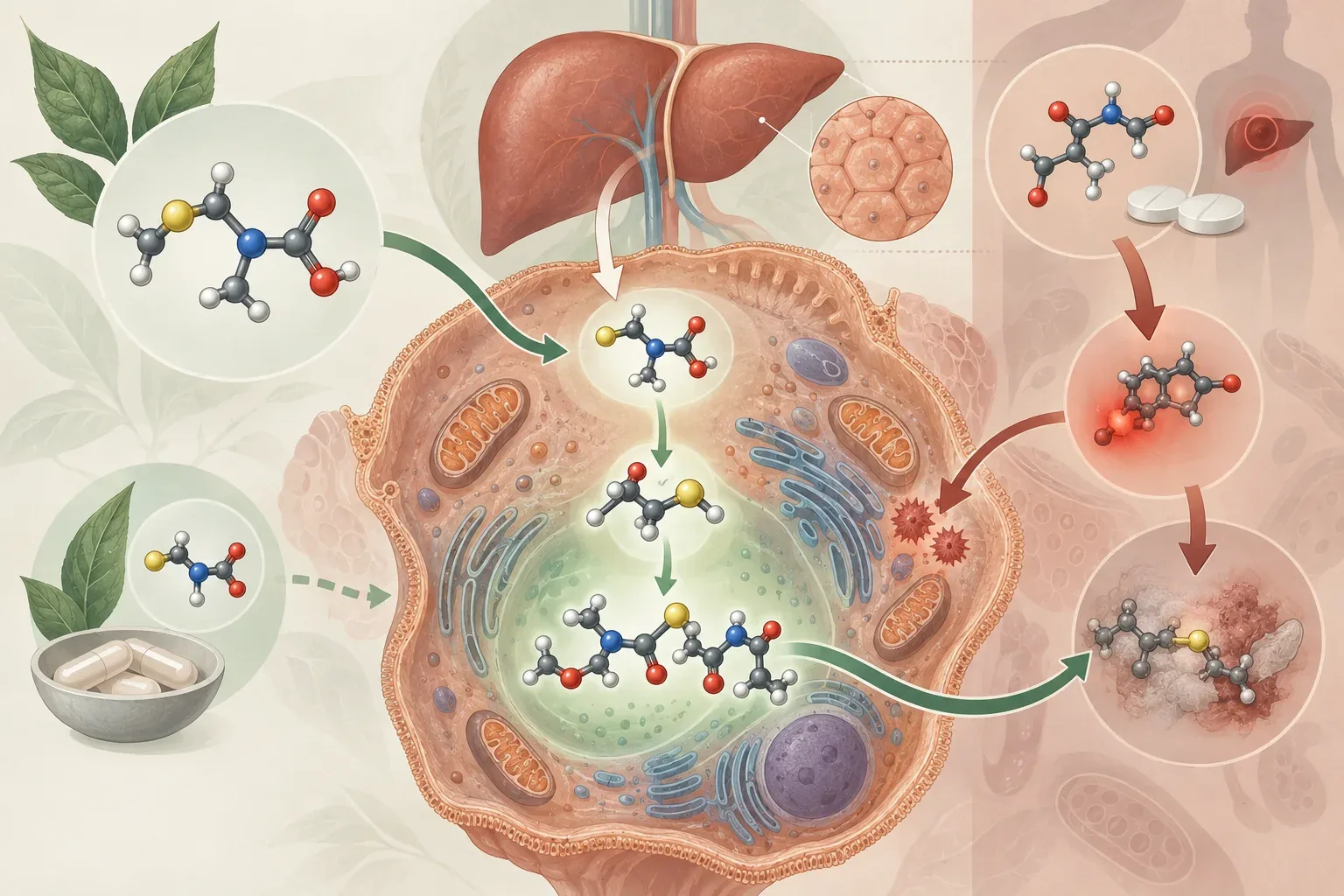
A glutathione capsule is not NAC. NAC is the cysteine-donor hub (hospital acetaminophen map).
Source for this connection
More in compounds


References
- Richie et al.: 6 months of oral glutathione and body stores, 2015 ↩
- Symptoms were mild; treatment-group counts were not supplied ↩
- published letter ↩
- authors replied ↩
- European Food Safety Authority: safety of S-acetyl glutathione as a novel food, 2026 ↩
- 1992 experiment ↩
- pharmacokinetic experiment in ten healthy volunteers ↩
- 60-person, four-week trial ↩
- 12-week trial ↩
- 2025 review ↩
- Kusumawardani et al.: S-acetyl versus reduced glutathione skin trial, 2026 ↩
- three-month trial ↩
- earlier safety study ↩
- ARUP’s total-glutathione listing ↩
- Allen and Bradley: oral glutathione and oxidative stress markers, 2011
- Sinha et al.: liposomal glutathione pilot study, 2018
- Søndergård et al.: 3 weeks of oral glutathione and insulin sensitivity, 2021
- Solnier et al.: single-dose absorption of three glutathione forms, 2026
- Arjinpathana and Asawanonda: four-week oral skin trial
- Weschawalit et al.: twelve-week oral skin trial
- Sarkar et al.: glutathione for skin lightening and melasma, systematic review, 2025
- Heard: acetylcysteine for acetaminophen poisoning, 2008
- The Diary Of A CEO: Rhonda Patrick, 30 March 2026
- NIH Dietary Supplement Label Database: a 500 mg reduced glutathione label
- NIH Dietary Supplement Label Database: a liposomal glutathione liquid label
- NIH Dietary Supplement Label Database: a liposomal glutathione capsule label
- NIH Dietary Supplement Label Database: an S-acetyl glutathione label
- NIH Dietary Supplement Label Database: a broccoli and glutathione label
Corrections & updates
- Update
Updated the evidence discussion and practical guidance after editorial review.