A complete supply and an extra ingredient solve different problems
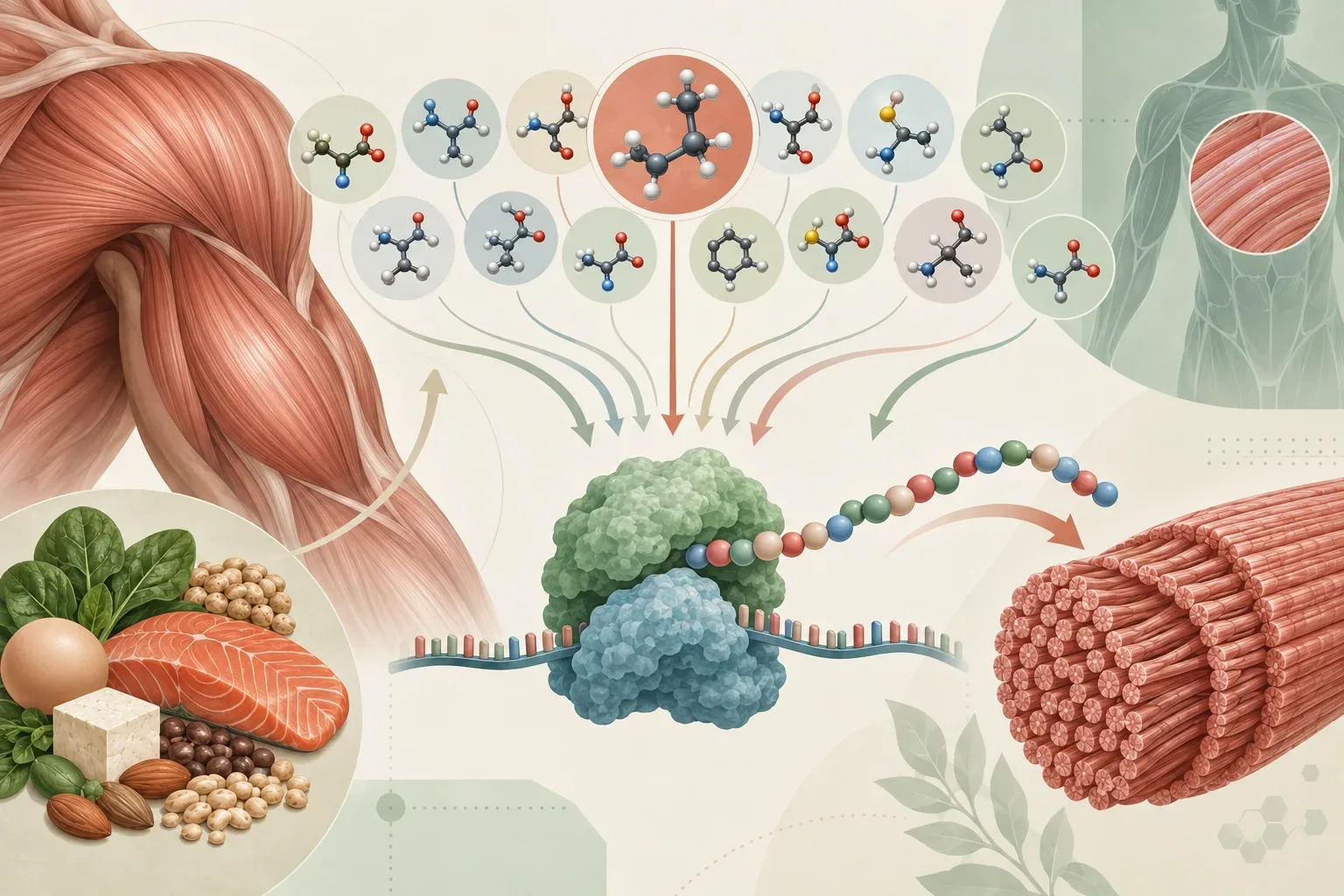
Building muscle protein requires multiple amino acids together. Nine are essential in the diet because the body cannot make enough of them. Complete proteins provide all nine in useful proportions. Leucine also helps signal the muscle-building process, but a stronger signal cannot supply missing building material.
If leucine is already available in sufficient amounts, an extra scoop may add little, or have no effect at all. If total protein intake is inadequate, supplying a balanced protein source addresses a broader need. That is why the benefit of protein does not have to be reproduced by each of its components taken alone.
The size of the protein benefit deserves perspective too. A review of 49 resistance-training trials, involving 1,863 adults, found that extra protein added about 0.30 kg of fat-free mass (muscle and other non-fat tissue) and a small strength advantage on average across programs lasting at least six weeks.
Getting enough protein is a supply problem
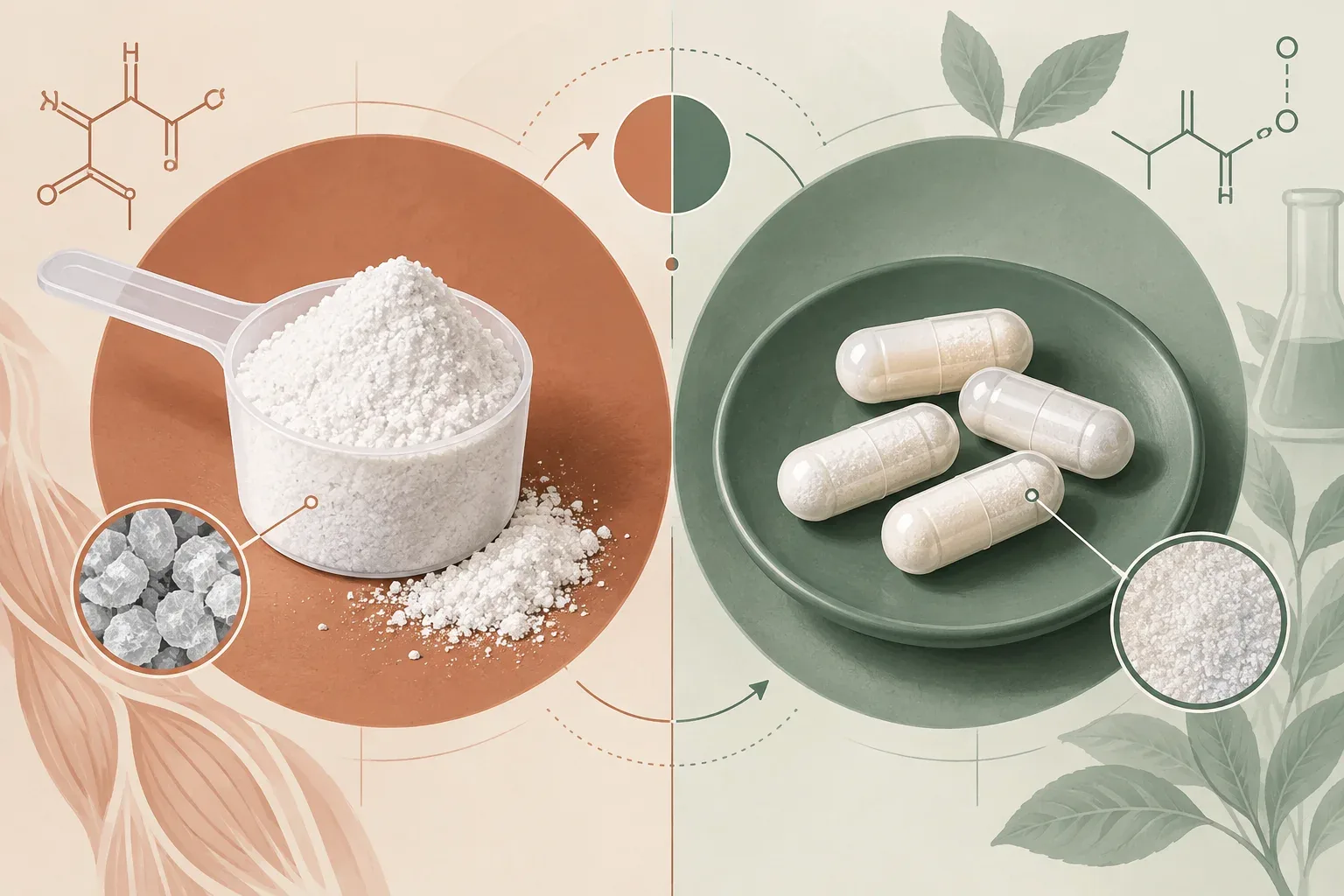
Protein powder is food in a convenient form. Its strongest everyday case is making an adequate intake easier to achieve when meals, appetite, cost or schedules get in the way. The relevant comparison is often more protein versus less protein during training. It is a different experiment to add leucine or BCAAs to a diet that already supplies enough complete protein.
The frequently quoted figure of about 1.6 grams of protein per kilogram of body weight per day comes from an analysis of the relationship between total intake and gains in fat-free mass in the Morton review. It was an estimated breakpoint with substantial uncertainty, rather than a biological ceiling established for every individual. It also describes total dietary protein—not the amount of powder to add on top of meals. [1]
Our preference for complete protein starts here: it addresses the overall supply. Buying its components separately requires an additional reason. A higher price, faster appearance in the blood or a stronger signal in a short experiment does not by itself supply that reason.
Leucine's signal is interesting. Longer trials still get a vote.
Leucine and BCAAs—the branched-chain amino acids leucine, isoleucine and valine—are often discussed through short-term measurements of how quickly muscle makes protein. Such measurements help explain biology. The buying questions are whether taking the product produces worthwhile changes over time, and which of those changes do you actually want.
The LACE trial tested isolated leucine for 12 months in adults aged 70 or older with sarcopenia, a condition involving low muscle mass and strength. It did not demonstrate better physical performance or muscle mass. Recruitment stopped at 145 participants against a target of 440, so the result was less precise than planned. It nevertheless deserves a place beside the more encouraging short-term and combination-product findings. [2]
We would not make isolated leucine or a BCAA mixture a default addition to an already adequate protein intake for muscle growth.
BCAAs leave six essential amino acids out
BCAA powders contain leucine, isoleucine and valine. Those are important nutrients, but they are only three of the nine essential amino acids needed to build human proteins. Complete protein already contains them, although possible at different ratios and total weight per serving.
We would therefore ask for evidence of an added benefit before recommending BCAAs to a well-fed lifter. Studies of post-exercise soreness deserve consideration on their own terms, but feeling less sore and gaining more muscle are different results.
An EAA formulation deserves credit for what was actually in it
Essential-amino-acid mixtures, or EAAs, supply all nine essential amino acids. In one 12-week study of older adults with low physical function, an EAA-based formulation improved six-minute walking distance more than a whey comparator. The EAA group increased its distance by about 35 meters. [3]
The positive older-adult walking trial is more complicated than “EAAs beat whey.” The paper describes a formulation containing citrulline and carnitine as well as essential amino acids. Its dose and ingredient list differ from the public protocol[4], leaving the delivered preparation unresolved. We would credit the reported walking improvement while holding off on a broad verdict about EAA powders versus protein.
We would leave room for EAA formulations where a small, easily consumed serving is useful—for example, in research involving older adults with low physical function. We would still want direct comparisons with practical alternatives, including sufficient complete protein, before making a broad superiority claim.
An older rehabilitation trial[5] provides another reason to take amino-acid mixtures seriously: infections affected 21 of 40 older patients receiving a mixture, compared with 33 of 40 receiving a calorie-matched placebo during the first hospital month. The patients were randomly assigned, and all 80 completed the trial. The daily 8 g mixture contained all nine essential amino acids plus two other amino acids. Whether this mixture also prevents infections in healthy people remains unanswered.
Some of the interesting uses for individual amino-acids are outside muscle building
We would distinguish conditional sports uses, positive clinical findings and promising changes in health markers. A permanent league table of “good” and “useless” amino acids would hide too much.
Beta-alanine illustrates a conditional sports use. Its role differs from that of the amino acids incorporated into ordinary proteins. A review of 40 studies found a small overall exercise effect, with more favorable results in tests of continuing until exhaustion than in tests of completing a set task, such as a fixed distance, faster. The competitive advantage remains less certain than the laboratory result. [6]
Arginine has a positive clinical finding. In a placebo-controlled trial, 98 men with erectile dysfunction linked to blood-vessel problems were randomized to arginine or placebo for 90 days; 95 completed it. Erectile-function scores improved more with arginine. That result gives us something substantive to discuss beyond generic “blood flow” language. [7]
Histidine and taurine offer promising changes in health markers. Histidine improved a measure of insulin resistance—reduced responsiveness to the hormone that helps control blood sugar—in a 12-week trial of 100 women, of whom 92 completed the study. They had obesity and metabolic syndrome, a cluster of problems involving blood sugar, blood pressure, blood fats and abdominal fat. Taurine has newer findings on blood pressure and vascular measurements in type 2 diabetes. The taurine trial also lost more participants from the supplement group than the placebo group, which makes the handling of missing results important to its interpretation. [8], [9]
A clinical result can be useful without becoming a wellness claim
Glutamine also has a positive symptom trial, in patients with diarrhea-predominant irritable bowel syndrome after an infection. They also had increased intestinal permeability: tests showed that substances passed through the gut lining more readily than expected. Symptoms improved more than with a whey-protein control powder over eight weeks. [10]
A second randomized trial tested glutamine alongside a low-FODMAP diet, which reduces certain fermentable carbohydrates, in people with IBS. It found greater improvement in the overall symptom score than the diet with a whey-powder comparison. The more detailed analysis did not find clear differences for most individual symptoms. Together, these studies justify investigating specific IBS uses rather than promising general gut repair. [11]
Sleep and stress findings are another category
Tyrosine has been studied for preserving mental performance under demanding conditions, including sleep loss. A trial in which rested adults tried both tyrosine and placebo at separate visits found no average improvement on its task, although performance changes differed according to how well participants performed initially. That makes the result more specific than a general daily-focus claim. [12]
In a study where 98 people tried both tryptophan and placebo during separate periods, a movement-based sleep estimate showed about five fewer minutes awake during the night and a roughly one-percentage-point increase in sleep efficiency—the proportion of time in bed spent asleep. Participants' overall subjective sleep ratings did not improve. Glycine's smaller studies include improvements in selected sleep ratings and earlier entry into sleep stages, without establishing a dependable long-term insomnia treatment. These are reasons for further interest, with effects and limitations that the phrase “supports sleep” conceals. [13], [14]
Collagen has to earn its place too
Collagen also comes as a protein powder, but its amino-acid balance differs from complete proteins such as whey: it lacks the essential amino acid tryptophan. It therefore cannot replace a complete protein source by itself. Choosing it for skin or joints raises another question, and its skin evidence contains a consequential disagreement. [15]
A 2025 review of 23 trials involving 1,474 participants found benefits for hydration, elasticity and wrinkles when results from all trials were combined. But the analyses limited to higher-quality trials or trials without pharmaceutical-company funding did not show those benefits. That weakens confidence in the overall result. [16]
Newer reviews have not removed that disagreement. A 2026 review reported favorable skin results when trial findings were combined, while a separate technical reanalysis questioned methods used in influential earlier analyses combining collagen trials. We would not describe collagen's benefits as uniformly clear while the estimates themselves remain contested. [17], [18]
Muscle results also resist a simple verdict. A 2026 network meta-analysis[19] estimated greater gains in fat-free mass with collagen than with whey. Fat-free mass includes muscle, water and other tissue. Most of the comparison was indirect, combining different trials; only one trial directly compared the two proteins. That result deserves a place beside whey’s stronger short-term protein-building response.
We would therefore ask what someone wants collagen to do—improve skin, relieve joint symptoms or contribute to muscle growth—and examine that evidence separately.
The categories we would actually use
We would organize an amino-acid review around the following questions:
| Category | What earns a place here | How we would interpret it |
|---|---|---|
| Useful nutritional support | Supplying an inadequate overall protein intake | Complete protein is the starting point; powder is one convenient source. |
| Conditional sports use | A performance benefit in a particular type of effort | Beta-alanine deserves a narrower discussion than “more muscle.” |
| Positive clinical evidence | Relevant improvements in selected patients | Arginine and glutamine trials warrant attention to the actual condition and comparison. |
| Promising or mixed findings | Small trials, inconsistent results or changes in health markers | Histidine, taurine, and sleep/stress uses need outcome-specific judgments. |
| No demonstrated added benefit for the proposed use | Relevant trials have not shown that adding the product improves the outcome | Isolated leucine for physical performance in LACE is an example |
| Review unfinished | Important sources or fields have not been checked | The research remains open; the compound has not been shown ineffective. |
Table note: These are categories of uses. One amino acid can appear in more than one row. A combination-product result can be encouraging while leaving the contribution of each ingredient unresolved.
More muscle does not automatically imply better immunity or more energy
The intuitive chain is attractive: protein helps muscle, muscle supports health, therefore protein powder should improve immunity and everyday energy. Each step sounds plausible. The supplement claim, however, concerns whether taking extra protein changes those later outcomes in the person using it.
Correcting poor nutrition and adding a supplement to an already adequate diet are different situations. So are getting stronger, experiencing less fatigue and having fewer infections. We'll do a longer follow-up article on this topic later.
Our choice would follow the outcome
For muscle building, we would prioritize resistance training and an adequate supply of complete protein. Powder can make that convenient. We would want a particular reason before adding an isolated amino acid on top.
Editor's note: For a daily shake, we prefer whey protein as the base with a smaller addition of collagen peptides or a collagen-pattern beef isolate over separate EAA or BCAA products. Our whey-and-beef mix article explains the amino-acid comparison and its limits.
For a specific clinical problem, we would take the relevant amino-acid trials seriously, including positive findings that a sports-focused review might miss. Some justify further investigation; others may inform care in a carefully matched setting. Their value should be judged on those terms.
What would change our view is a well-conducted trial showing that the extra amino acid improves the outcome we care about against an appropriate comparison—for example, added muscle or strength beyond an already adequate protein intake. Until then, “this is what protein is made of” is a reason to understand an amino acid, not a sufficient reason to buy it separately.
Help us improve this article
Spotted an error or found a source we should consider? Tell us which part of this article needs another look and include a link if you have one. Please leave out personal health details and lab results; we can’t answer individual medical questions.
Explore more in exercise & muscle


References
- Morton and colleagues ↩
- LACE trial ↩
- Azhar and colleagues ↩
- public protocol ↩
- rehabilitation trial ↩
- Saunders and colleagues ↩
- Menafra and colleagues ↩
- Feng and colleagues ↩
- Li and colleagues ↩
- Zhou and colleagues ↩
- Rastgoo and colleagues ↩
- Rested-adult tyrosine study ↩
- Tryptophan trial ↩
- Glycine sleep trial ↩
- Paul and colleagues' protein-quality analysis ↩
- Myung and Park ↩
- 2026 skin review ↩
- Grimes and Mahto reanalysis ↩
- 2026 network meta-analysis ↩
Corrections & updates
- Update
Updated the evidence discussion and practical guidance after editorial review.
- Update
Updated the evidence discussion and practical guidance after editorial review.
- Update
Tightened the EAA trial discussion after editorial review.