
What is glycine?
Glycine is an amino acid the body uses to make proteins and other compounds. The body can make it, and food supplies more, especially gelatin, collagen and cuts of meat rich in connective tissue. Unlike an essential amino acid, it has no established daily intake target for healthy adults.
In supplements it is sold mainly as plain powder or capsules. People also encounter glycine as part of collagen, as the amino acid attached to magnesium in magnesium glycinate, or alongside N-acetylcysteine in products called GlyNAC. Those products contain different amounts and have different purposes.
What glycine does in your body
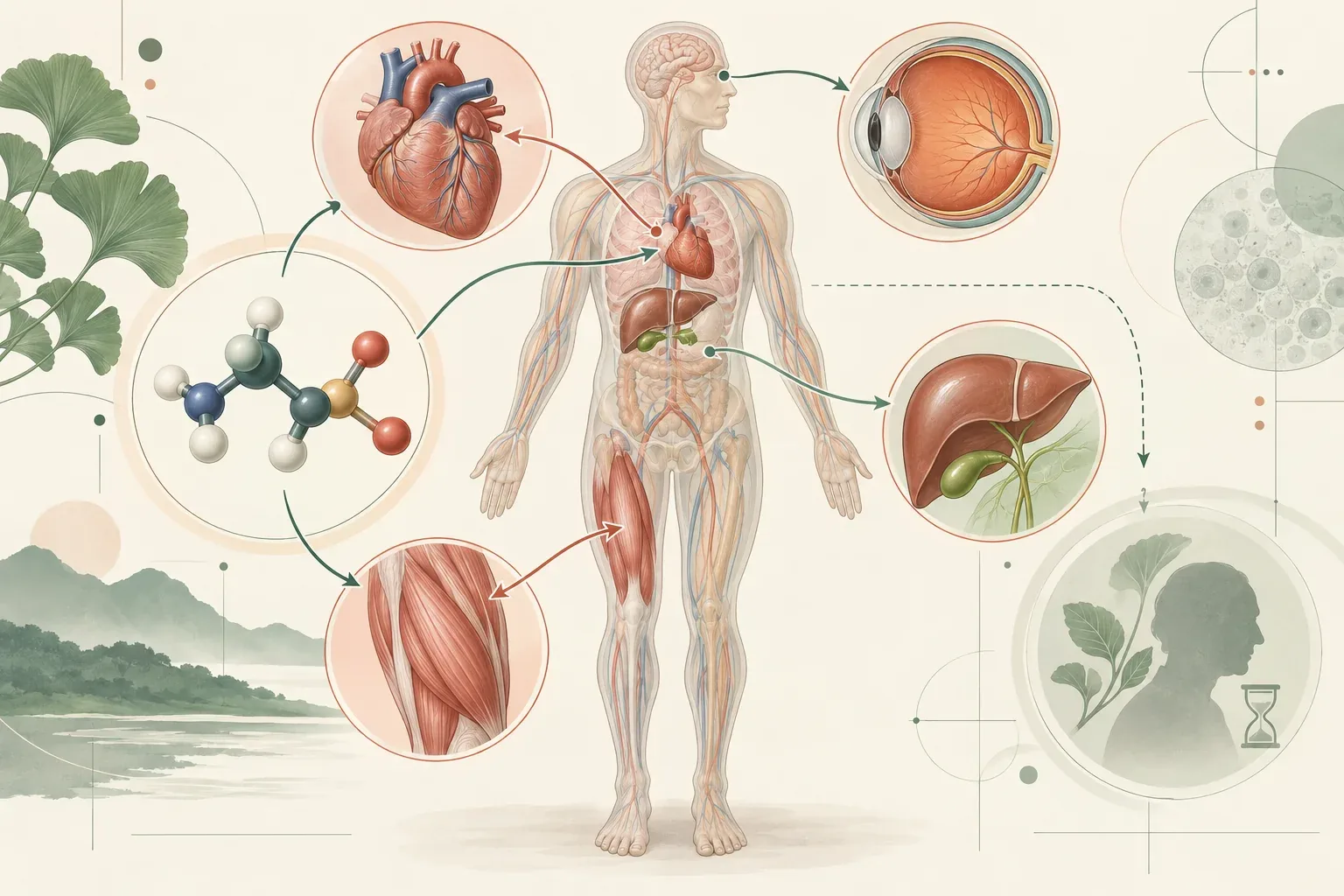
Glycine is used to build proteins and is particularly abundant in collagen. Its small size helps collagen's strands pack into their characteristic structure, contributing to connective tissues such as skin and tendons. The body also uses glycine to make substances including creatine, glutathione and the heme component of hemoglobin.
In the nervous system, glycine has more than one role. It can inhibit nerve activity through one receptor system and help activate another receptor involved in excitatory signaling. Calling it simply a calming amino acid leaves out that distinction.
What people take glycine for
| Claimed benefit | Dose / form studied | Research verdict | Evidence strength |
|---|---|---|---|
| Sleep and next-day alertness | 3 g plain glycine 30–60 minutes before bed for a few nights; very small poor-sleeper or sleep-restriction studies | Several sleep and next-day measures improved | Limited |
| Improve aging-related markers with GlyNAC | About 100 mg/kg/day glycine with NAC for 24 weeks in an uncontrolled older-adult study; controlled studies used different amounts and treatment lengths | Combination findings conflict and cannot be assigned to glycine alone | Limited |
All three sleep studies reported some benefit, but each was very small and had authors from Ajinomoto, a company that makes glycine. No larger independent sleep trial has confirmed the result. GlyNAC trials asked a different question and do not strengthen the sleep evidence.
When to ask a doctor before taking glycine
- You are pregnant or breastfeeding. Supplement amounts have not been studied in pregnancy.
- You have a long-term illness and want to try GlyNAC at the amount used in the 24-week aging study, 100 mg/kg of glycine daily—7 g for a 70 kg adult, more than twice the sleep dose.
- You take regular medicines. Supplement-level interaction studies are sparse, so ask a pharmacist about the specific combination.
Which foods supply glycine?
These ordinary foods contain glycine as part of their protein. The amounts are calculated from the USDA FoodData Central SR Legacy records[1] for the stated edible portions and rounded to 0.01 g.
| Food and preparation | Source | Serving | Glycine (g) |
|---|---|---|---|
| [2] | Meat | 3 oz (about 85 g) | 1.46 |
| [3] | Meat | 3 oz (about 85 g) | 1.30 |
| [4] | Fish | 3 oz (about 85 g) | 1.08 |
| [5] | Plant | ½ cup (about 126 g) | 0.92 |
| [6] | Plant | 1 cup (about 198 g) | 0.73 |
| [7] | Plant | 1 oz (about 28 g) | 0.52 |
| [8] | Plant | 1 oz (about 28 g) | 0.40 |
| [9] | Egg | 1 large (about 50 g) | 0.21 |
| [10] | Dairy | 1 cup (about 244 g) | 0.15 |
Food values are estimates; amino-acid content varies by product and preparation.
Can I be low in glycine?
There is no routine test or accepted cutoff that diagnoses a glycine deficiency in otherwise healthy people. A plasma amino-acid panel ordered for a suspected metabolic condition measures glycine in the sampled blood; it does not tell a healthy person whether a glycine supplement would help.
What you can buy
Glycine is sold as powder, stick packs, capsules, and sleep blends. Compare the glycine amount per labeled serving and the number of units in that serving.
| Listing | Example amount | What to check |
|---|---|---|
| Glycine powder | Often 3 g per serving | The serving weight and included scoop |
| Glycine stick packs | 3 g per stick | Whether one stick is one serving |
| Glycine capsules | 500–1,000 mg per capsule | Capsules per serving and daily directions |
| Sleep blends with glycine | Sometimes only a few hundred mg | The separate glycine amount and all other active ingredients |
.
What to pay attention to on the label
Which number on the label is the amount?
Look for glycine in grams or milligrams on the Supplement Facts panel. One powder label lists 3 g per serving; a capsule labeled 1,000 mg supplies 1 g, and a 500 mg capsule supplies 0.5 g.
Misleading labels
Sleep blends with a little glycine
Some sleep products list a few hundred milligrams of glycine alongside other ingredients. That is a fraction of the 3 g used in the sleep studies; those lower-dose multi-ingredient blends were not the products tested.
Magnesium glycinate sold as a glycine source
Magnesium glycinate labels emphasize elemental magnesium, not the weight of the attached glycine. In a pure bisglycinate product, 200 mg of elemental magnesium is calculated to carry about 1.2 g of glycine; that glycine amount usually is not printed on the label. “Buffered” products mix in other magnesium salts, and lysinate-glycinate replaces some glycine with lysine, so the calculation no longer applies. None is the measured 3 g dose of plain glycine used in the sleep trials.
Collagen counted as glycine
Collagen and gelatin are rich in glycine, but it is spread through the protein, and unless the label lists glycine in grams, you cannot tell how much a serving actually gives.
Confusing servings and items per serving
If a bottle says 180 capsules but defines a serving as 3 capsules, it contains 60 servings. The Supplement Facts amount applies to all three capsules together.
Manufacturer claims and the studies they may be based on
A “supports restful sleep” line may point to the three small 3 g bedtime trials, all with authors from a company that makes glycine. A “supports healthy aging” line on a glycine and NAC product may point to the GlyNAC trials, which disagree with each other.
Common Myths about Glycine
Is glycine an established insomnia treatment?
The small sleep trials covered only a few nights and did not test treatment for chronic insomnia. Their positive findings do not establish glycine as a treatment for that condition.
Is magnesium glycinate better than glycine?
We do not have a trial directly comparing the two for sleep. The small positive glycine studies gave 3 g of plain glycine before bed. A 2025 trial of magnesium bisglycinate[11] instead gave 250 mg of elemental magnesium daily for four weeks to adults reporting poor sleep; insomnia-severity scores improved slightly more than with placebo. It did not isolate the effect of the attached glycine.
Magnesium glycinate labels usually state the elemental magnesium amount, not the glycine amount. A pure bisglycinate product supplying 200 mg of magnesium would carry about 1.2 g of glycine; a buffered product could carry less. If you are choosing it to increase magnesium intake, judge it by the magnesium amount and your reason for taking magnesium.
Can glycine cause weight gain?
A 3 g serving provides about 10 to 12 calories, too little by itself to explain meaningful weight gain.
Why do some people feel better the day after taking glycine?
In one 2006 study, participants taking 3 g at bedtime reported less next-morning fatigue and more clear-headedness. This was a short-term, self-reported finding.
Drawbacks and side effects
| Potential drawback | When/who it affects | Research evidence | Practical implication |
|---|---|---|---|
| Unknown safety of long-term nightly use | Sleep use over months or years; larger GlyNAC regimens | Tiny short sleep studies and a small longer combination study cannot establish a safe ceiling | Long-term nightly safety remains uncertain. |
| Unstudied medicine combinations | People taking regular medicines | Supplement-level interaction and pregnancy data are sparse | Ask a pharmacist about the specific combination. |
| Soft stools or abdominal pain | Reported after 9 g bedtime servings in a small safety study | [12] | Symptoms occurred at the higher tested amount. |
Understanding these risks
There is no official recommended supplement amount or upper limit. Small studies using 3 g at night for a few nights, 100 mg/kg a day with NAC for 24 weeks, and a short 9 g/day safety study did not identify a pattern of serious side effects. Those samples are too small and short to establish the safety of nightly use for months or years. Supplement-level drug interactions have not been adequately studied.
The 12-person glycine safety study[12] also reported soft stools and abdominal pain when 9 g was taken at bedtime. These possible side effects were not serious. The study tested 9 g a day over seven days using different schedules, and its authors worked for Ajinomoto.
The science behind glycine
The central sleep question rests on three very small, manufacturer-linked studies. The sections below then examine separate questions about GlyNAC, anxiety, psychiatric care, metabolic conditions, dialysis nutrition and joints; their different preparations and patient groups matter to what the results can tell us.
Sleep
The sleep research has three related findings: how people rate a night, what a sleep recording detects, and how they perform after deliberately shortened sleep. They are not interchangeable.
In a small 2006 crossover study[13], adults who slept poorly took 3 g of glycine or placebo before bed in separate periods. They reported less next-morning fatigue and more clear-headedness with glycine.
The 2007 study[14] added overnight sleep recordings in 11 adults with unsatisfactory sleep. Each person received 3 g of glycine and a flavor-matched placebo on two nights per condition, separated by at least a week. The first night was for adapting to the equipment; the analysis used the second. Participants reported greater sleep satisfaction and less difficulty falling asleep. The recordings showed earlier entry into stage 2 sleep and slow-wave sleep, but no change in the proportions of the sleep stages.
The 2012 study[15] asked whether glycine reduced the next-day cost of losing sleep. Ten healthy men enrolled and seven were analyzed after a dropout and medication-related exclusions. Their usual time in bed fell from about 7.3 to 5.5 hours for three nights. Without being told which treatment they received, they took 3 g glycine or matched placebo 30 minutes before bed, then repeated the other condition after a recovery interval.
After the first restricted night, average afternoon fatigue was about 35 with glycine versus 53 with placebo on a 0–100 scale. By the third day, the subjective fatigue advantage was no longer clear. Reaction time on a sustained-attention task improved on the first and third days, but memory, simple reaction-time and arithmetic tasks did not clearly improve.
All three studies involved Ajinomoto-affiliated authors, and the 2012 volunteers were employees. The samples and number of nights were small. Their positive findings justify further study, but do not establish treatment for chronic insomnia or the best amount and timing.
Glycine with NAC (GlyNAC)
Glycine and NAC, a form of the amino acid cysteine, are the raw materials for glutathione, an antioxidant the body makes. In older adults:
- A 2023 trial[16] supported by the National Institutes of Health and a philanthropic gift gave 24 older adults GlyNAC or a placebo for 16 weeks. The daily GlyNAC amount was 100 mg per kg of body weight each of glycine and N-acetylcysteine. On GlyNAC, glutathione rose and several markers of aging, including oxidative stress (a measure of damage associated with reactive molecules), inflammation, and insulin resistance (reduced responsiveness to insulin), improved, along with walking speed and muscle strength.
- A 2022 trial of 114 healthy older adults gave two weeks of GlyNAC at three amounts. It did not raise glutathione, although a subgroup that started with low glutathione saw it rise on the higher amounts.
The trials differed in length, amount, and who took part. An earlier 24-week study by the 2023 team, without a placebo group, used 100 mg/kg of glycine daily—7 g for a 70 kg adult with NAC.
Calming effects and use in children
There is a physiological reason to investigate a calming effect: glycine can inhibit signaling through one type of nerve receptor. That mechanism does not establish that a supplement relieves anxiety. In a 2012 Russian placebo-controlled trial[17], 64 adults with adjustment disorder and anxiety symptoms were assigned 100 mg of a microencapsulated glycine medicine under the tongue three times a day, or placebo, for 28 days. The authors reported larger improvements on anxiety and clinician-rating scales in the glycine group. This tested a specific medicine in adults with a diagnosed condition, not ordinary glycine powder for day-to-day calm.
A later Russian-language paper's bibliography[18] names pediatric glycine research reports from 1990 and 1991. We could not obtain the original reports to verify their methods or outcomes, so they do not support a claim that glycine benefits children. The adult study and the sleep studies cannot supply that missing pediatric evidence.
Schizophrenia: early findings did not hold up consistently
An early crossover trial[19] in eleven people with treatment-resistant schizophrenia tested 0.8 g/kg/day glycine for six weeks alongside their antipsychotic treatment. It reported improvement in negative symptoms, such as reduced motivation and expression, and some cognitive and mood symptoms. The much larger CONSIST trial[20] randomized 157 people across glycine, D-cycloserine and placebo for 16 weeks. Glycine did not outperform placebo on the primary negative-symptom or cognition measures.
Medication context also matters. A 12-week trial[21] in nineteen people taking clozapine found no added symptom benefit from 30 g/day glycine. The authors raised concern about interference with clozapine’s effect, although this small trial does not settle that interaction.
Alcohol dependence alongside schizophrenia
A 12-week placebo-controlled trial[22] included twenty people with both schizophrenia and alcohol dependence. Glycine did not reduce heavy-drinking days, alcohol craving, negative symptoms or cognitive difficulties more than placebo. The report describes a weight-based 0.8 g/kg amount supplied in solution.
High psychiatric doses had more adverse effects
In the 16-week CONSIST trial[23], glycine was increased from 15 to 60 g/day over two weeks. New or worsening nausea occurred in 20 of 52 glycine recipients versus seven of 52 on placebo; dry mouth occurred in seventeen versus seven. Five people stopped glycine because of side effects. Those effects accompany the trial's lack of overall symptom or cognitive benefit. They concern much larger doses than the small sleep trials, whose brief duration also cannot establish long-term safety.
Metabolic studies: mixed laboratory findings
A three-month placebo-controlled study[24] tested 15 g/day oral glycine in sixty adults with metabolic syndrome; 52 completed it. Some oxidation-related measurements improved. The metabolic results were mixed: comparisons with placebo favored glycine for systolic blood pressure and A1C—a blood test reflecting average blood sugar over about three months—in men, but also showed greater increases in glucose in women and total cholesterol in men. These small sex subgroups were explored after examining sex effects.
A three-month trial in 74 people with type 2 diabetes[25] reported lower A1C and some inflammatory measurements with glycine than placebo. Its abstract's dose wording is ambiguous about grams per day versus three daily administrations, so it should not be used to choose a dose. A separate experiment in twelve healthy relatives of people with diabetes[26] found that a single 5 g dose increased insulin secretion without improving insulin action. Increased insulin release, improved A1C and prevention of diabetes complications are different outcomes; these small reports do not settle glycine's clinical role.
Dialysis: body-composition measurements disagreed
A dialysis crossover trial[27] compared 7 g glycine twice daily with 7 g of branched-chain amino acids (BCAAs: leucine, valine and isoleucine) twice daily. Each treatment lasted four months, with a month off both supplements before participants switched to the other one. Thirty-seven malnourished patients were randomized and 36 started; the analysis included 27 who finished and took more than 80 percent of their supplements in each period.
A later analysis of the trial favored glycine for fat-free mass, meaning body weight other than fat, estimated from the body's resistance to a small electrical current. A separate X-ray scan method, called DXA, did not show a clear benefit in lean mass. In this study, the scan measure included lean soft tissue and bone mineral. Neither method measures muscle alone; the researchers could not identify which part of fat-free mass had changed. Physical function and quality of life also showed no clear benefit. There was no untreated control.
Joint claims: cell experiments and an amino-acid mixture
The often-cited joint-collagen experiment[28] tested cow cartilage cells in culture, not people taking glycine. More collagen production in a dish does not establish less joint pain or better walking. Its supporting institute disclosed a patent application related to glycine for osteoarthritis. A clinical joint-benefit conclusion needs human outcome evidence.
A twelve-week human trial[29] did test a six-amino-acid mixture in fifty adults with knee discomfort who did not have a diagnosed joint disorder. Each of three daily sachets contained 0.56 g glycine plus alanine, aspartate, glutamate, serine and proline. Pain and several knee-function scores improved more than with maltitol placebo. Results differed for a clinician-rated knee score covering pain during walking and stairs, movement range and swelling: the comparison with placebo at week 12 was not statistically clear, although another analysis using measurements across visits found a difference.
The bottom line
Glycine is a plausible, relatively simple sleep supplement, but the positive trials were very small, brief and linked to one manufacturer.
The sleep findings concern plain glycine. Magnesium glycinate, collagen and GlyNAC contain other ingredients and have different evidence.
Help us improve this article
Spotted an error or found a source we should consider? Tell us which part of this article needs another look and include a link if you have one. Please leave out personal health details and lab results; we can’t answer individual medical questions.
Explore more in sleep

More in compounds



References
- USDA FoodData Central SR Legacy records ↩
- Ground beef patty, 90% lean, cooked ↩
- Chicken breast, roasted ↩
- Sockeye salmon, cooked ↩
- Firm tofu, calcium-set, raw ↩
- Lentils, boiled ↩
- Pumpkin seed kernels, dried ↩
- Almonds ↩
- Egg, hard-boiled ↩
- Whole milk ↩
- Magnesium bisglycinate and poor sleep: randomized trial, 2025 ↩
- Possible mild adverse effects in a manufacturer-linked study ↩
- Inagawa et al.: glycine and subjective sleep quality, 2006 ↩
- Yamadera et al.: glycine and sleep recorded in the lab, 2007 ↩
- 2012 study ↩
- Kumar et al.: GlyNAC in older adults, randomized trial, 2023 ↩
- 2012 Russian placebo-controlled trial ↩
- later Russian-language paper's bibliography ↩
- early crossover trial ↩
- CONSIST trial ↩
- 12-week trial ↩
- 12-week placebo-controlled trial ↩
- 16-week CONSIST trial ↩
- three-month placebo-controlled study ↩
- three-month trial in 74 people with type 2 diabetes ↩
- experiment in twelve healthy relatives of people with diabetes ↩
- Glycine in malnourished dialysis patients, 2021 ↩
- joint-collagen experiment ↩
- twelve-week human trial ↩
- Glycine metabolism and its alterations in obesity and metabolic diseases
- Bannai et al.: glycine after sleep restriction, 2012
- Bannai and Kawai: glycine and sleep quality review, 2012
- Inagawa et al.: high-dose glycine safety, 2006
- Kawai et al.: how glycine promotes sleep in rats, 2015
- Scoping review of glycine, collagen, and sleep, 2026
- Kumar et al.: GlyNAC in older adults, open-label trial, 2021
- Lizzo et al.: GlyNAC doses in healthy older adults, 2022
- Glycine in schizophrenia and alcohol dependence, 2019
- NIH Dietary Supplement Label Database: a glycine powder label
Corrections & updates
- Update
Updated the evidence discussion and practical guidance after editorial review.