
What is 5-HTP?
5-HTP, short for 5-hydroxytryptophan, is the step your body makes when converting tryptophan into serotonin, a messenger involved in mood and the gut. 5-HTP supplements are usually extracted from Griffonia simplicifolia seeds. They are sold in capsules and tablets, alone or mixed with vitamin B6, valerian, or other ingredients that claim to affect mood.
People take it for low mood, sleep, appetite and weight, and fibromyalgia pain. The studies behind those uses are few and small. Taking it with antidepressants or other serotonin-raising drugs can be dangerous.
What 5-HTP does in your body
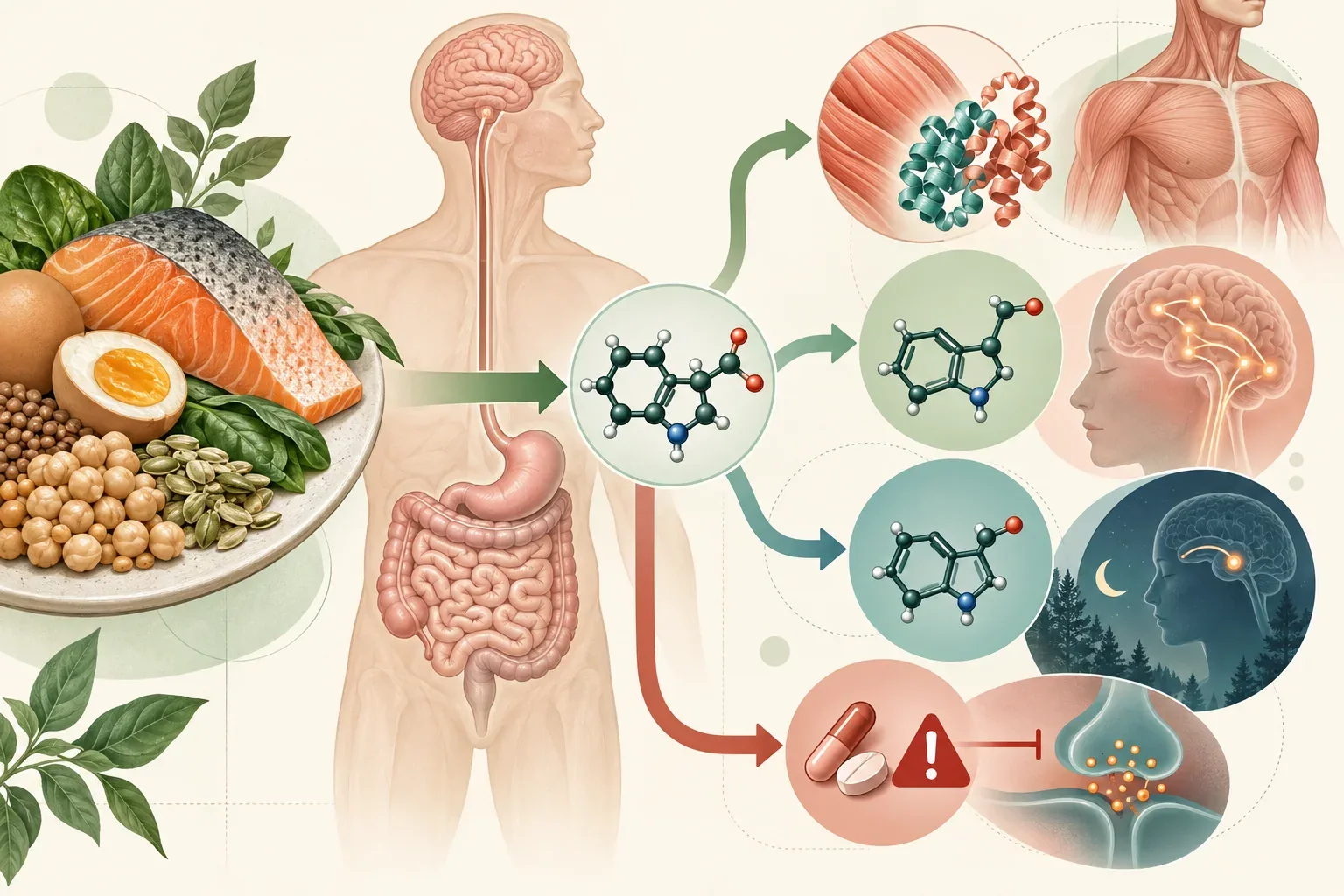
5-HTP is an intermediate the body makes while converting tryptophan into serotonin. An enzyme adds a chemical group to tryptophan to make 5-HTP; another enzyme then converts 5-HTP into serotonin. Serotonin is a messenger with different jobs in the nervous system, gut and other tissues.
Serotonin made outside the brain does not simply move into it, while 5-HTP can cross the barrier between blood and brain. Some swallowed 5-HTP is also converted outside the brain.
This explains both the interest in mood effects and the concern about combining it with serotonin-raising medicines. [1]
What people take 5-HTP for
| Claimed benefit | Dose / form studied | Research verdict | Evidence strength |
|---|---|---|---|
| Depression | No established dose or course; the reviews pooled different regimens | Positive signals come mainly from weak studies | Limited |
| Fibromyalgia symptoms | 100 mg three times daily for 30 days; 50 adults with fibromyalgia | Symptoms improved in one small, old trial | Limited |
| Appetite and weight | About 8 mg/kg/day for 5 weeks in women with obesity; 900 mg/day for 12 weeks in adults with obesity; far above usual labels | Small trials found less appetite and weight loss | Limited |
| Sleep | 100 mg/day for 12 weeks; 30 older adults | Subjective sleep improved, especially in poor sleepers, without a placebo comparison | Limited |
When to ask a doctor before taking 5-HTP
- You take an antidepressant or another drug that raises serotonin. Do not combine them unless your doctor approves. That includes selective serotonin reuptake inhibitors (SSRIs), serotonin-norepinephrine reuptake inhibitors (SNRIs), tricyclic antidepressants, monoamine oxidase (MAO) inhibitors, lithium, and triptans for migraine. Direct evidence on 5-HTP drug combinations is sparse, so this is a precautionary warning. Canada's prescription tryptophan label warns that combining that serotonin precursor with these drugs can cause serotonin syndrome, a dangerous excess of serotonin with agitation, confusion, fever, and twitching muscles; 5-HTP is the next step toward serotonin.
Is there a recommended daily amount?
As of 2026, there is no recognized recommended daily amount for 5-HTP, and no official upper limit. Neither the NIH supplement fact sheets nor the official nutrient tables from the National Academies list it, because it is not a nutrient you need from food.
What you can buy
5-HTP is sold as capsules and tablets, alone or in blends, and the table shows the common listings.
| Listing | 5-HTP per serving on the label | Notes |
|---|---|---|
| Capsules | 50 or 100 mg each; some servings use two capsules for 200 mg | Most directions total 50 to 200 mg a day; check capsules per serving |
| Capsules naming Griffonia extract | Usually 50 to 100 mg of 5-HTP | Same 5-HTP; the label names the plant source, and some add valerian or B vitamins |
| Tablets | 50 mg each | One label allows 2 to 10 a day |
| Mood blends | Around 200 mg | Some add tryptophan or SAMe |
Label directions vary between split doses and bedtime use. One starts at 50 mg three times a day and says to increase slowly over two weeks to limit stomach upset. Those are product directions, not an established treatment course.
What to pay attention to on the label
Which number on the label is the amount?
The milligrams of 5-HTP per serving matter more than the plant name or a mood claim on the front. Find the 5-HTP or 5-hydroxytryptophan line on the Supplement Facts panel and its milligrams per serving. If the label says "Griffonia simplicifolia extract," look for the 5-HTP milligrams listed with it.
Misleading labels
Blends with other serotonin ingredients
One 200 mg 5-HTP product also adds L-tryptophan and SAMe, another supplement sold for mood. Stacking several serotonin-active ingredients in one capsule raises the same concern as combining 5-HTP with serotonin drugs.
Open-ended directions
One tablet label says "2 to 10 tablets daily," which ranges from 100 mg to 500 mg of 5-HTP. That is a fivefold range with no guidance on where to start.
Confusing servings and items per serving
A label may list 200 mg per serving, but the serving is two capsules, so each capsule is 100 mg.
Manufacturer claims and the studies they may be based on
"Supports a positive mood" claims probably rest on 5-HTP's role in making serotonin and on small depression trials, most without placebo groups. "Supports healthy weight" or "curbs cravings" claims may be based on two small Italian trials that used about 550 to 900 mg a day. A 2024 sleep trial used 100 mg/day and reported better subjective sleep, especially in poor sleepers, but its control group took no supplement rather than a placebo.
Common Myths about 5-HTP
The common claims run ahead of the evidence, especially for depression and weight loss.
Is 5-HTP the same as tryptophan?
No. Tryptophan is the essential amino acid in protein food; your body turns it into 5-HTP, then serotonin. They are sold as separate supplements with separate milligrams, and 5-HTP skips the step the body uses to limit how much serotonin it makes.
Can 5-HTP replace an antidepressant?
No. The 2002 Cochrane review, a formal summary of the best trials, found only two trials good enough to judge, one of them of tryptophan. Adding it to an antidepressant raises a serotonin-syndrome concern. Direct evidence on these 5-HTP combinations is sparse, so the warning is precautionary; a prescriber should review the combination.
Does 5-HTP help weight loss at the doses sold?
Not shown. The trials that found less appetite and weight loss used about 550 to 900 mg a day for 5 to 12 weeks in 19 and 20 people. Labels sell 50 to 200 mg.
Drawbacks and side effects
| Potential drawback | When/who it affects | Research evidence | Practical implication |
|---|---|---|---|
| Nausea, diarrhea, dizziness or drowsiness | Supplement users; no established dose threshold | Reported side effects; an official upper limit has not been set | Stop and seek advice if effects persist. |
| Serotonin-related drug risk | Antidepressants and other serotonin-raising medicines | Direct combination evidence is sparse; precursor pharmacology and prescription tryptophan warnings support caution | Have a pharmacist check combinations; fever, confusion and twitching need urgent care. |
| Contaminated products | Historical batches; present-day frequency unknown | A family illness investigation and laboratory tests found contaminants | A label alone cannot verify purity; old findings do not measure current product risk. |
Understanding these risks
Common side effects include nausea, diarrhea, dizziness, and drowsiness. The serious concern when combining it with serotonin-raising drugs is serotonin syndrome—agitation, confusion, fever, and stiff or twitching muscles. The warning rests on the serotonin pathway and related prescription tryptophan warnings; direct 5-HTP combination evidence remains sparse. There is no official upper limit.
The contamination history is a separate concern. In the 1990s, one family developed an eosinophilia-myalgia-like illness involving severe muscle pain and high counts of eosinophils, a type of white blood cell, after taking a contaminated batch. Tests in 1999 found related contaminants in all eight store samples examined. We found no recent independent testing of current products, and none of the labels we read says it tests for these contaminants.
The science behind 5-HTP
Small studies report benefits, but weak controls and unusually high doses keep them from establishing a routine use.
Depression: positive signals from weak studies
The depression evidence is old, small, and mostly without placebo groups. A 2002 Cochrane review found that only two trials, with 64 patients in all and one of them testing tryptophan, met its quality bar; together they did better than placebo. The authors considered these supplements of limited use because better-studied antidepressant treatments were available. A 2020 meta-analysis, which pools the results of several studies, looked at 13 studies and reported that about 65% of patients reached remission, meaning their symptoms fell below the level that defines depression, but the authors said the studies were weak and few had placebo groups.
Fibromyalgia: symptom relief in one small trial
A 1990 double-blind trial assigned 50 people with fibromyalgia to 100 mg of 5-HTP three times daily or placebo for 30 days. Pain, tender points, and symptom ratings including sleep improved more with 5-HTP. The small, old study does not establish a standard treatment, and one person in each group stopped because of a side effect.
Appetite and weight fell in small high-dose trials
Two small Italian trials found less appetite and some weight loss. In 1989, 19 women with obesity took about 8 mg per kilogram a day (roughly 550 mg for someone weighing 154 lb) or placebo for five weeks; they ate less, while mood did not change. In 1992, 20 adults with obesity took 900 mg a day or placebo for two six-week periods; they lost weight, ate less carbohydrate, and reported earlier fullness.
Contamination
In 1994, US government researchers traced an eosinophilia-myalgia-like illness in one family to an impurity in their 5-HTP; after they switched to a clean product, two family members' blood counts returned to normal. In 1999, all eight store-bought 5-HTP samples tested contained contaminants from the same chemical family as the case-linked batch, and in 2003 researchers identified one as a suspected nerve toxin, present in store samples at 0.5% to 10% of the level in the case-linked product. Whether those levels cause harm is unknown.
Sleep: a subjective benefit without a placebo comparison
A 2024 trial[2] tested 100 mg/day for 12 weeks in 30 older adults. It reported better subjective sleep, particularly among poor sleepers, but compared supplements with no supplement rather than placebo.
Mood scores did not improve in the same older adults
A mood report from the same 12-week Singapore trial[3] describes 33 adults aged 60–85 assigned to 100 mg 5-HTP before bedtime or no capsule; thirty completed it. Depression and anxiety scores did not improve more with 5-HTP. Participants began with very low depression scores, so the study does not answer whether it treats clinical depression. Blood serotonin increased, but that is a different outcome from feeling better. One participant taking 5-HTP withdrew after increased appetite. This is the same trial population as the sleep report, not an independent replication.
Parkinson disease: preliminary mood benefit, no clear sleep benefit
Two small Parkinson-disease trials asked different questions. A mood trial[4] enrolled 25 people, who received both 50 mg/day 5-HTP and placebo in separate four-week treatment periods. The authors reported an advantage on the clinician-rated Hamilton depression scale, while apathy did not improve. The published abstract does not provide the result for the other depression scale it names, so the positive finding is best understood as a preliminary, scale-specific result in Parkinson disease.
A sleep trial[5] randomized 18 people with Parkinson disease and REM sleep behavior disorder, in which people act out dreams. Sixteen completed both treatment periods, receiving 50 mg/day 5-HTP and placebo for four weeks each. The main question was whether 5-HTP improved the sleep disorder, and the planned sleep measures did not establish a clear advantage over placebo: the loss of normal muscle relaxation during REM sleep did not improve significantly, and reported dream-enactment symptoms improved with both treatments. A score of movement-related difficulties in daily living favored 5-HTP. That was an additional outcome, separate from the main sleep question, and does not establish treatment of the sleep disorder. The study was supported by the University of Cagliari sleep center; authors declared no competing interests.
Where the sources disagree
A 2020 meta-analysis reported high remission rates, and small trials found benefits for fibromyalgia and appetite. The Cochrane review found only two trials good enough to judge, the meta-analysis authors said most studies lacked placebo groups, and the weight-loss trials used several times the label dose. The small Parkinson mood trial adds a newer placebo comparison, but does not settle treatment of depression outside that condition. Larger trials and independent testing of current products remain important gaps.
The bottom line
5-HTP has some positive findings for mood, fibromyalgia symptoms and appetite, but the studies are too small or weak to make it a dependable treatment. The sleep evidence is also much thinner than the confident claims on many bottles suggest.
The decision matters especially if you take an antidepressant or another medicine that raises serotonin. Have a doctor or pharmacist check the combination before considering a product.
Help us improve this article
Spotted an error or found a source we should consider? Tell us which part of this article needs another look and include a link if you have one. Please leave out personal health details and lab results; we can’t answer individual medical questions.
Explore more in mood

More in compounds

References
- Javelle et al.: 5-hydroxytryptophan and depression, meta-analysis, 2020 ↩
- 2024 trial ↩
- mood report from the same 12-week Singapore trial ↩
- mood trial ↩
- sleep trial ↩
- Shaw et al.: tryptophan and 5-hydroxytryptophan for depression, Cochrane review, 2002
- Caruso et al.: 5-hydroxytryptophan in primary fibromyalgia, 1990
- Ceci et al.: oral 5-hydroxytryptophan and feeding behavior in obese women, 1989
- Cangiano et al.: 5-hydroxytryptophan, eating behavior, and diet adherence in obesity, 1992
- Michelson et al.: eosinophilia-myalgia-like illness after L-5-hydroxytryptophan, 1994
- Klarskov et al.: contaminants in commercial 5-hydroxytryptophan, 1999
- Klarskov et al.: identification of "peak X" in 5-hydroxytryptophan, 2003
- Health Canada: Teva-Tryptophan product monograph, 2016
- NIH Dietary Supplement Label Database: a 50 mg 5-HTP label with start-low directions
- NIH Dietary Supplement Label Database: a 100 mg 5-HTP capsule label
- NIH Dietary Supplement Label Database: a 200 mg two-capsule 5-HTP label
- NIH Dietary Supplement Label Database: a Griffonia extract 5-HTP label
- NIH Dietary Supplement Label Database: a 5-HTP tablet label with 2 to 10 tablets daily
- NIH Dietary Supplement Label Database: a 5-HTP blend with tryptophan and SAMe
Corrections & updates
- Update
Updated the evidence discussion and practical guidance after editorial review.