
What is GABA?
GABA, short for gamma-aminobutyric acid, is the brain's main calming messenger: nerve cells release it to quiet the activity of other nerve cells. It is an amino acid, but not one of the building blocks of protein, and your brain makes its own supply.
The same GABA molecule occurs in some foods, but amounts vary by food, variety and processing. A meal is also a different preparation from a measured capsule dose. Supplements sell GABA as capsules, most often 100 to 750 mg, as powders, and in calming blends with L-theanine, herbs, or other amino acids. PharmaGABA is a branded version made by fermentation.
People take GABA to feel calmer, to handle stress, or to fall asleep. Swallowed GABA can enter the blood, but whether it gets into the brain is still an open question. The human trials behind the labels are small and use different preparations.
What GABA does in your body
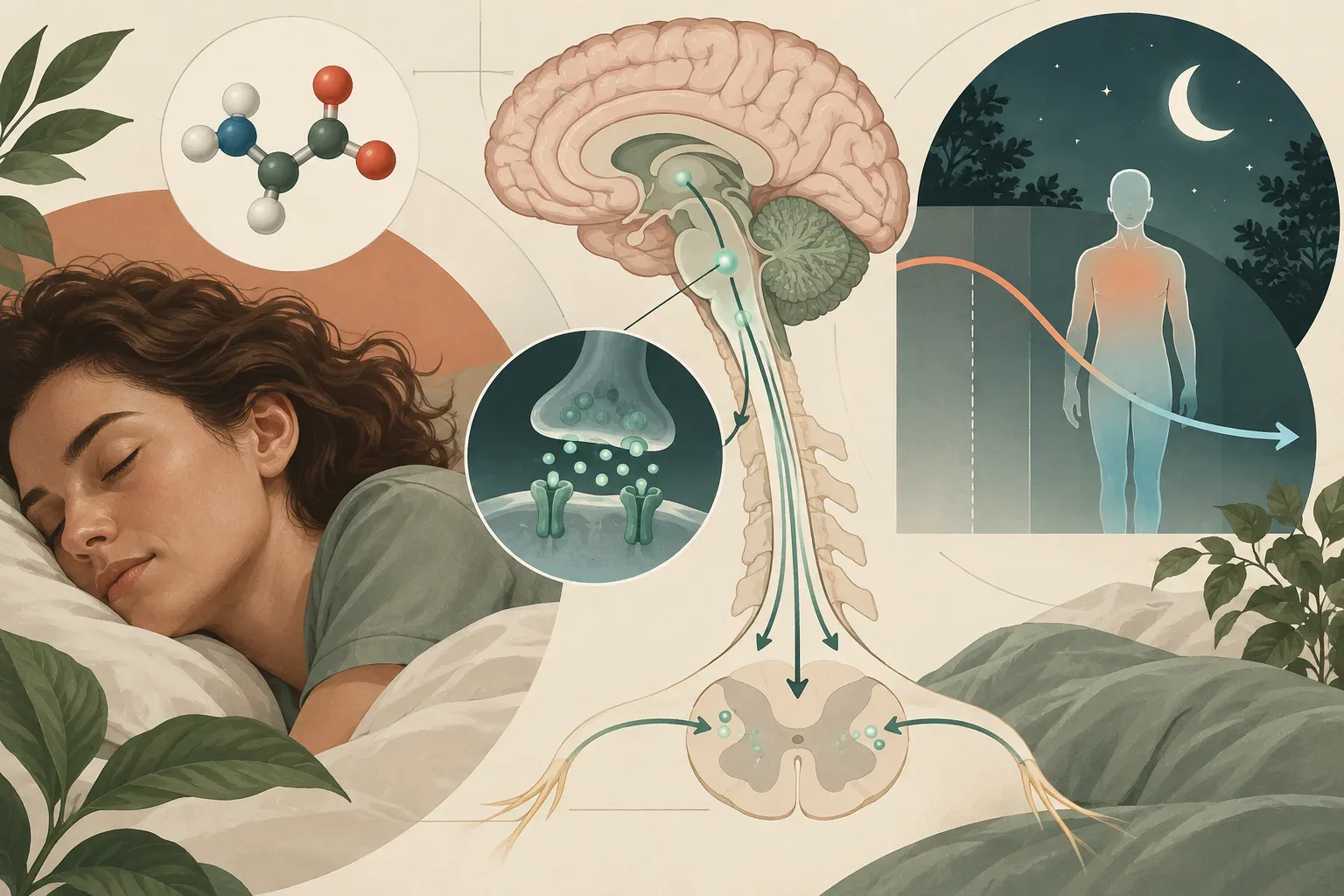
Nerve cells make GABA from glutamate and release it as a chemical messenger. GABA binds receptors on other cells and usually makes them less likely to fire an electrical signal. This inhibitory activity helps balance the nervous system's excitatory signals.
Different GABA receptors work through different cellular mechanisms. Some change the flow of charged particles across the cell membrane; others activate slower signaling processes. The effect depends on where the receptor is and how the surrounding nerve circuits are working.
This is well-established biology for GABA made within the nervous system. It does not settle how much swallowed GABA reaches the human brain or whether an oral supplement effect goes through another route. [1]
What people take GABA for
| Claimed benefit | Dose / form studied | Research verdict | Evidence strength |
|---|---|---|---|
| Ease stress | 100 mg once before a mental stress task in 63 adults | Some brain-wave signals changed; clinical stress benefit remains uncertain | Limited |
| Fall asleep sooner | 300 mg/day for 4 weeks; 40 adults with insomnia symptoms | Measured sleep onset improved in one small trial | Limited |
| Improve sleep or mood during an exercise program | 200 mg/day for 90 days; 30 women with overweight or obesity | A later trial reported improvements, with exercise in both groups | Limited |
| Lower blood pressure with a GABA-containing food | Chlorella containing 20 mg GABA twice daily for 12 weeks; adults with high-normal or borderline pressure | Pressure fell in a food trial; capsules were not tested this way | Limited |
No group has a well-established reason to take a GABA supplement. A 2020 review of 14 placebo-controlled trials found limited evidence for stress and very limited evidence for sleep. The later 90-day study adds a signal in women who also exercised, but does not settle a general recommendation. Brain entry remains unproven.
When to ask a doctor before taking GABA
- You take blood-pressure medicine. A safety review by the US Pharmacopeia, which sets quality standards for supplements, noted short-term blood-pressure drops in some studies, and two 12-week food trials lowered blood pressure.
- You take sleep drugs, sedatives, or anxiety medicine. One diabetes trial included GABA with alprazolam under clinical monitoring. That does not establish safety for combining retail GABA with sleep or anxiety medicines; have your prescriber check the combination.
- You are pregnant or breastfeeding. No studies exist, and GABA can raise growth hormone and prolactin, a hormone involved in breastfeeding; no one has studied whether that matters for a pregnancy or a nursing baby.
Which foods contain GABA?
One analysis of plant foods[2] measured GABA in fresh-weight samples. These are measurements of the named samples, not fixed values for every variety, processing method or prepared serving.
| Food analyzed | Source | GABA (mg per 100 g fresh food) |
|---|---|---|
| Potato | Plant | 44.9 |
| Yellow cherry tomato | Plant | 36.8 |
| Red cherry tomato | Plant | 29.7 |
| Red tomato | Plant | 17.7 |
| Cucumber | Plant | 2.6 |
Fermented foods may contain GABA too, but the amount depends strongly on the product and process.
All forms at a glance
| Listing | GABA per serving on the label | What the comparison means |
|---|---|---|
| Capsules | 100, 250, 500, or 750 mg | The amount can be compared directly; more milligrams do not establish a greater sleep or stress benefit |
| PharmaGABA capsules or chewables | 100 to 250 mg | A branded GABA made by fermentation, not a different molecule |
| Bedtime capsules | 1,500 mg per two capsules | Five times the amount in the small sleep trial |
| Powder | 3 g per scoop | Ten times the amount in the small sleep trial |
| Calming blends | About 100 to 200 mg | Mixed with L-theanine, glycine, taurine, magnesium, ashwagandha, or herbs, so the effect cannot be assigned to GABA |
Compare products in milligrams of GABA. The trials do not identify a reliably effective retail product or show that a higher amount works better. The findings below apply to the particular preparations and people studied. Skip “relaxer” blends with 200 mg of niacin per serving and blends whose multiple active ingredients make any effect impossible to attribute to GABA.
Daily amount and timing
There is no recognized recommended daily amount or official upper limit for GABA. The amounts in the benefit table describe research regimens, not established daily requirements.
Labels often say to take GABA on an empty stomach or 30 minutes to two hours before bed; the reviewed trials did not compare those timings.
What to pay attention to on the label
Which number on the label is the amount?
Find "GABA" or "gamma-aminobutyric acid" on the Supplement Facts panel and read its milligrams per serving. On PharmaGABA products the same line may say PharmaGABA; that number is the GABA amount.
Misleading labels
Blends with a lot of niacin
One "relaxer" tablet blend lists 200 mg of GABA and 200 mg of niacin per two-tablet serving. That niacin is almost six times the 35 mg official upper limit for niacin from the National Academies, a limit set because niacin causes flushing: redness, warmth, and itching of the skin.
Herb blends with a small GABA dose
One blend lists 125 mg of PharmaGABA alongside valerian, hops, passionflower, and a milk protein extract. A sleep claim tied to the 300 mg GABA trial would make a lower-dose mixture appear supported by research on GABA alone; that trial does not tell us what this combination contributes. “Clinically studied PharmaGABA” means the ingredient was tested, not that this finished blend was tested.
Big powder scoops
Some powders suggest 3 to 5 g before sleep, ten or more times the 300 mg in the sleep trial. One of them warns that "minor tingling of the skin and/or slight shortness of breath" soon after taking it is normal. We found no study that explains these effects; if you have trouble breathing after any supplement, stop taking it and get medical help.
Claims such as “supports restful sleep” may point to the smaller studies below. Several involved researchers working for the company that makes PharmaGABA; their results do not establish the effect of a much larger powder serving.
Confusing servings and items per serving
A label may say 750 mg on the front and suggest one capsule once or twice a day, which is up to 1,500 mg. Another lists 1,500 mg per serving, but the serving is two 750 mg capsules, so one capsule is 750 mg.
Common Myths about GABA
Does GABA you swallow reach your brain?
No one knows for sure. A small study found GABA in the bloodstream after people swallowed it, but a blood measurement cannot tell us whether it crossed the barrier that protects the brain. A publicly funded 2015 review found human brain-entry studies contradictory. An effect through nerves in the gut or other tissues is another possibility.
Is GABA the same as phenibut or gabapentin?
No. Phenibut is a different chemical built to act like GABA, sold online, with a risk of dependence. Gabapentin is a prescription drug for seizures and nerve pain whose name sounds similar. A GABA supplement is neither, and its milligrams do not compare with theirs.
Is GABA from fermented foods the same as a GABA capsule?
It is the same chemical, but not the same exposure or evidence. Fermented foods contain small amounts of GABA, while a capsule concentrates 100 to 750 mg. The blood-pressure trial of fermented milk tested the drink as a whole, so its result does not carry over to capsules.
Drawbacks and side effects
| Potential drawback | When/who it affects | Research evidence | Practical implication |
|---|---|---|---|
| Abdominal discomfort, headache or drowsiness | 300 mg/day sleep trial | Mild adverse events occurred in 10% of each group | Reported events are not proof that GABA caused each symptom. |
| Possible additional blood-pressure lowering | People taking blood-pressure medicine | Safety review noted transient pressure drops; drug combinations are untested | Review medicines before starting. |
| Unknown prolonged high-dose safety | Gram-level nightly products; pregnancy or breastfeeding | Short high-dose studies do not establish safety over months | Do not treat a four-day safety exposure as a nightly dose recommendation. |
Understanding these risks
Symptoms in the sleep trial. Mild adverse effects occurred in 3 of 30 GABA participants and 1 of 10 placebo participants in the 2018 trial: 10 percent in each group. Reported symptoms included abdominal discomfort, headache and drowsiness. Those equal percentages do not establish that GABA caused each symptom.
Blood-pressure changes. The US Pharmacopeia safety review noted short-term drops of under 10 percent in some studies. Those observations are separate from the food trials designed to lower blood pressure and explain the concern about adding GABA to blood-pressure medicine.
What short safety studies can tell us. The review reported no serious adverse events at up to 18 g (18,000 mg) a day for four days or 120 mg a day for 12 weeks in the studied groups. Those dissimilar exposures do not establish the safety of nightly doses of 1.5 to 5 g (1,500 to 5,000 mg).
Longer use and liver findings. Longer oral studies do exist: a prediabetes trial used 1.5 g/day in divided doses for 95 days, and a type 1 diabetes trial tested controlled-release GABA for six months. These differ from a large bedtime dose. The six-month trial included alprazolam during its first three months in one group. Liver-enzyme elevations occurred in nine participants across the trial, with two withdrawals. The findings raise concern about prolonged use without establishing which retail products or medicine combinations are safe. The diabetes section below gives the regimens and results.
The science behind GABA
Does it reach the brain?
Your brain makes GABA and uses it to quiet nerve signaling. That established role does not tell us what happens when GABA is swallowed. In a small 2016 crossover study[3], blood GABA peaked about 30 minutes after a dose and then declined. This shows absorption into the bloodstream; it does not show that the supplement entered the brain. All five authors worked for the maker of PharmaGABA. A publicly funded 2015 review[4] found the evidence on GABA crossing into the human brain contradictory. An effect through nerves in the gut or other tissues remains possible, but no human study cited here has pinned down the route.
Stress
The stress evidence is a handful of small studies measuring brain waves and other biological signals. In a 2006 study led by a researcher at Pharma Foods International, the Japanese company behind PharmaGABA, 13 people showed brain-wave patterns the researchers interpreted as more relaxed an hour after GABA. In 8 people afraid of heights crossing a suspension bridge, a salivary antibody used as a stress-response measure fell on placebo but stayed higher on GABA; this was a biological marker, not a report that anxiety improved. In a 2012 trial of 63 adults, 100 mg of GABA softened a mental-task-related drop in alpha and beta waves, two kinds of electrical activity recorded from the scalp; the authors read this as eased stress, but the volunteers were kept unaware of which treatment they received while the researchers were not. A 2020 systematic review of 14 placebo-controlled trials found the stress evidence limited. Its first author worked for Unilever, and 11 of the 14 trials it reviewed had industry-employed authors, so even this cautious verdict rests mostly on industry-run trials.
Sleep
A 2018 Korean trial randomized 40 adults with insomnia symptoms, 30 to GABA and 10 to placebo, for four weeks. With 300 mg/day:
- The full paper reports a greater improvement in measured sleep onset.
- Sleep questionnaire scores did not improve significantly more with GABA than with placebo.
- The comparison of changes in light, deep and rapid-eye-movement sleep also found no significant advantage over placebo.
- The manufacturer funded it, and the small, imbalanced groups limit confidence.
The 2020 review still judged the overall sleep evidence very limited.
The same 2016 study[3] reported shorter time to fall asleep and more time in non-REM sleep after a single GABA dose, measured by brain-wave recording. Non-REM includes both lighter and deeper sleep stages; more time in it does not specifically mean more deep sleep. The study was small, and treatment assignments were not concealed from everyone involved. Those limits and the company authors make it a useful signal rather than confirmation of a nightly treatment. A later 2024 randomized trial[5] assigned 30 sedentary women with overweight or obesity to 200 mg GABA or placebo daily for 90 days; both groups also exercised. The authors reported improved questionnaire scores for habitual sleep efficiency—the share of time in bed spent asleep—along with better mood-related scores. That adds a longer exposure and a different population, but the small trial cannot tell us how well the result applies to people with diagnosed insomnia or to GABA without the exercise program.
Blood pressure
Two Japanese trials found lower blood pressure. In 2003, 39 adults with mild high blood pressure drank a fermented milk containing GABA daily for 12 weeks. Systolic pressure fell by about 17 millimeters of mercury (mm Hg) from its starting level in the milk group, and the groups differed statistically, but the abstract does not give a 17 mm Hg difference versus placebo; the volunteers did not know which drink they received, while the researchers did. In 2009, 80 adults with high-normal or borderline blood pressure took Chlorella with 20 mg of GABA twice a day for 12 weeks, and systolic pressure fell more than on placebo. These were foods and low doses, not 500 mg capsules.
Prediabetes: no improvement in the main glucose result
A 2023 placebo-controlled trial[6] assigned 52 adults aged 50–70 with prediabetes and overweight to 500 mg GABA three times daily or placebo for 95 days. The main test measured glucose after a glucose drink. GABA did not clearly improve that response compared with placebo. After adjustment for testing many outcomes, the other measurements, including sleep quality, also showed no clear group-level benefit.
Type 1 diabetes: longer studies did not restore insulin production
A 2025 trial[7] randomized 35 men with longstanding type 1 diabetes to controlled-release GABA, 200 or 600 mg daily for six months, or 600 mg with 0.5 mg alprazolam for the first three months. All groups received GABA; there was no placebo group. C-peptide, a marker of the body’s own insulin production, and glucose-control measures did not improve. Liver-enzyme elevations occurred in nine participants, with two withdrawals; many elevations were temporary. Diamyd Medical, which developed the formulation, was among the funders.
A separate one-year trial in 97 children with newly diagnosed type 1 diabetes[8] compared oral GABA, GABA plus injections of GAD-alum, or placebo. GABA was supplied as capsules at 1 g per square meter of body surface area daily, capped at 1.5 g/day and divided between morning and evening. GAD-alum is an experimental immune treatment directed at a diabetes-related protein. Neither active regimen preserved C-peptide, the primary outcome. The combination lowered glucagon, another pancreatic hormone, without a clinically significant glucose-control benefit. The trial received public, charitable and industry support, and NOW Foods supplied GABA and placebo.
What the different sleep studies can tell us
The studies now include both short sleep-onset experiments and a 90-day exercise-linked trial, but they differ in dose, population and outcome. The 2020 review predates the 2024 trial, so its verdict cannot summarize that newer result. The newer study also does not resolve whether oral GABA reaches the brain. Larger independent trials that measure meaningful sleep outcomes and compare clearly identified preparations would help establish who, if anyone, benefits.
What GABA measurements can show
Your brain makes GABA. A research blood test can show that a swallowed dose reached the bloodstream; it cannot show what is happening in the brain. The brain scans that can measure GABA are research tools that cannot be ordered like regular biomarker tests at a clinic.
Before the test if you already supplement
If a specialist orders blood amino-acid testing, report GABA use and follow that test's collection and dose-timing instructions, especially if you are receiving prescribed treatment. A blood amino-acid result does not determine GABA activity in the brain.
The bottom line
Oral GABA has small positive sleep-onset experiments, a later 90-day trial with exercise, and some stress-related findings. The studies are too different and small to settle a general sleep or stress recommendation. Swallowed GABA enters the blood, but whether it reaches the brain or acts elsewhere remains uncertain.
Longer diabetes trials found no clear benefit for glucose control or the body’s insulin production; one controlled-release study also raised liver-enzyme concerns. A large bedtime scoop differs from the divided or controlled-release regimens in those trials. If you choose to try it, identify the actual GABA amount and avoid judging a multi-ingredient calming blend as though it tested GABA alone.
Help us improve this article
Spotted an error or found a source we should consider? Tell us which part of this article needs another look and include a link if you have one. Please leave out personal health details and lab results; we can’t answer individual medical questions.
Explore more in sleep



More in compounds

References
- Boonstra et al.: neurotransmitters as food supplements, the effects of GABA on brain and behavior, 2015 ↩
- analysis of plant foods ↩
- Yamatsu et al.: oral GABA, blood absorption and sleep, 2016 ↩
- 2015 review ↩
- Guimarães et al.: GABA during an exercise program in women, 2024 ↩
- 2023 placebo-controlled trial ↩
- 2025 trial ↩
- one-year trial in 97 children with newly diagnosed type 1 diabetes ↩
- Hepsomali et al.: effects of oral GABA on stress and sleep, systematic review, 2020
- Oketch-Rabah et al.: US Pharmacopeia safety review of GABA, 2021
- Yoto et al.: oral GABA and stress-induced brain-wave changes, 2012
- Abdou et al.: relaxation and immunity enhancement effects of GABA, 2006
- Byun et al.: GABA from fermented rice germ in insomnia, 2018
- Inoue et al.: fermented milk containing GABA in mild hypertension, 2003
- Shimada et al.: GABA-rich Chlorella and blood pressure, 2009
- Office of Dietary Supplements: Niacin, health professional fact sheet
- NIH Dietary Supplement Label Database: a 250 mg PharmaGABA capsule label
- NIH Dietary Supplement Label Database: a 750 mg GABA capsule label
- NIH Dietary Supplement Label Database: a 1,500 mg bedtime GABA label
- NIH Dietary Supplement Label Database: a 3 g GABA powder label
- NIH Dietary Supplement Label Database: a GABA relaxer blend with niacin
- NIH Dietary Supplement Label Database: a PharmaGABA and herb blend
Corrections & updates
- Update
Updated the evidence discussion and practical guidance after editorial review.
- Expansion
Expanded the human sleep and absorption evidence, and aligned the practical guidance with the added studies.