
What is L-theanine?
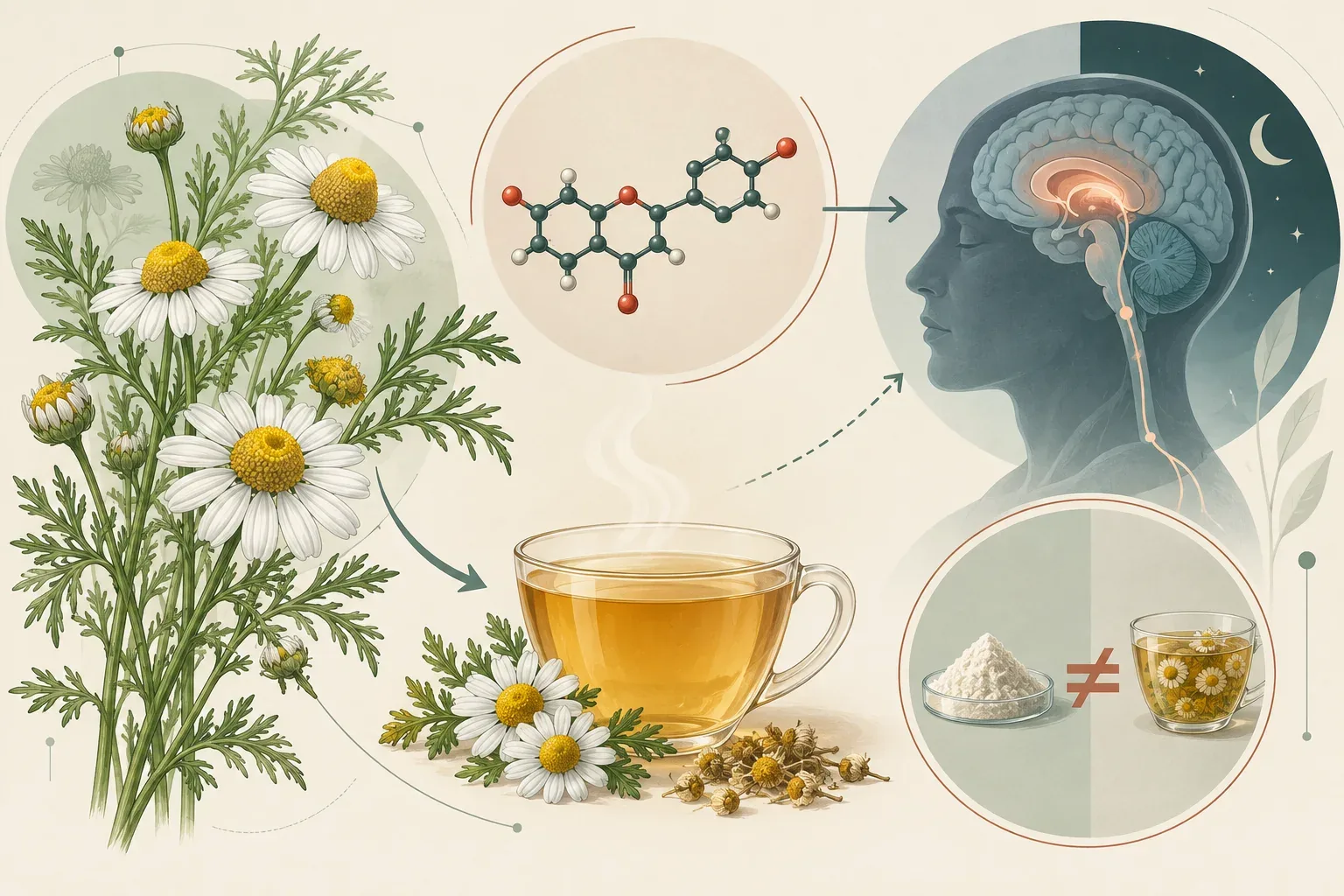
L-theanine is an amino acid found in tea leaves. It is not one of the building blocks the body needs from food; it is a plant compound people take for its effects on the brain.
Supplements come as 100 to 200 mg capsules, sometimes combined with caffeine. A cup of tea supplies far less than a capsule; the measured black- and green-tea amounts appear below. There is no official daily amount.
People take it to feel calmer, to smooth out the jitters from coffee, to focus, and to sleep better. What is established is limited: across combined trials, a single 200 mg dose produced a moderate but short-lived improvement in reaction time, while other attention results were mixed. People also rated their sleep a little better. In one trial in generalized anxiety disorder, L-theanine did no better than placebo.
What people take L-theanine for
| Claimed benefit | Dose / form studied | Research verdict | Evidence strength |
|---|---|---|---|
| Faster reaction time | 200 mg once, 30–60 minutes before testing; mainly healthy adults | Choice reaction time improved; other attention results were mixed | Moderate |
| Better sleep ratings | 200 mg/day Suntheanine for 4 weeks in 30 healthy adults; reviews also covered 200–450 mg/day over varied courses | Some sleep ratings improved modestly | Limited |
| Treat generalized anxiety disorder | 450–900 mg/day for 8 weeks added to antidepressants; 46 adults | No better than placebo for anxiety or insomnia | Limited |
| Ease stress in healthy adults | Suntheanine 200 mg/day for 4 weeks; 30 healthy adults in a crossover trial | Stress scores fell during use, but superiority to placebo was not clearly established | Limited |
The small focus, stress, and sleep effects come mainly from healthy adults taking 100 to 450 mg.
When to ask a doctor before taking L-theanine
- You have a diagnosed anxiety disorder or depression. In the one anxiety-disorder trial, it did not help, and it should not replace treatment.
- You are pregnant or breastfeeding. We found no studies of supplement amounts in pregnancy.
How much L-theanine is in a cup of tea?
A 2011 analysis of tea brewed by a standard method[1] measured the following average amounts per 200 ml cup.
| Tea brewed in the study | Source | Serving | L-theanine |
|---|---|---|---|
| Black tea | Plant | 200 ml | 24.2 mg |
| Green tea | Plant | 200 ml | 7.9 mg |
What you can buy
Products differ in their L-theanine amount and in whether they include other ingredients.
| Listing | L-theanine per capsule | Compared with a 200 mg trial amount |
|---|---|---|
| L-theanine capsules | 100 mg | Two capsules equal 200 mg |
| L-theanine capsules, including some branded forms | 150 mg | One capsule is 150 mg; no exact 200 mg match |
| L-theanine capsules | 200 mg | One capsule equals 200 mg |
| L-theanine plus caffeine | 200 mg with 100 mg caffeine | Also supplies 100 mg caffeine; combination trials used different pairings |
| “Calm” or sleep blends | Often small or not stated | Cannot be matched when the L-theanine amount is hidden |
One small trial used the branded ingredient Suntheanine, but no trial has shown that Suntheanine, AlphaWave, or another retail brand works better than the same amount of L-theanine.
What to pay attention to on the label
Find milligrams of L-theanine per capsule, then check whether the serving also contains caffeine, melatonin, or other calming ingredients.
Which number on the label is the amount?
Use the L-theanine line on the Supplement Facts panel and check the serving size beside it. If it says 200 mg per two capsules, each capsule supplies 100 mg; if it says 200 mg per one capsule, that single capsule supplies the full amount. A branded ingredient name does not change the milligram calculation. In a blend, the total blend weight is not the L-theanine amount unless the panel lists L-theanine separately. Also count any caffeine in the same serving before comparing it with a trial of L-theanine alone.
Labels that are easy to misread
Compared with anxiety medicine
A small acute trial[2] did compare 200 mg L-theanine, 1 mg alprazolam and placebo in 16 healthy volunteers. Neither active treatment clearly reduced anxiety during the experimental anxiety task. This was a single-dose laboratory comparison, not evidence that L-theanine matches prescription treatment for an anxiety disorder. The separate trial in diagnosed generalized anxiety found no advantage from adding L-theanine to antidepressants.
Tea as a dose
A 200 ml cup of black tea has about 24 mg and green tea about 8 mg. You would need about eight cups of black tea to reach one 200 mg capsule, along with all the caffeine in them.
Bottle count versus serving size
Some manufacturers put 180 capsules on the front, and the back says 3 capsules per serving and 60 servings. The amount on the Supplement Facts panel is for the whole 3-capsule serving.
Manufacturer claims and the studies they may be based on
A “promotes relaxation” or “reduces stress” line may point to small trials in healthy people, including a 4-week trial funded by the maker of Suntheanine. A “supports focus” line may point to single-dose attention trials, often with caffeine. A “supports restful sleep” line may point to a 2025 review that found small improvements.
What common claims leave out
Is L-theanine like Adderall?
No. Adderall is a prescription stimulant. A 200 mg dose of L-theanine made reaction time faster on a lab task, a moderate but short-lived effect; it is not a stimulant and has not been compared with one.
Does L-theanine work better with caffeine?
Sometimes. One acute trial found better attention switching with 100 mg L-theanine plus 50 mg caffeine. In another 2008 trial, theanine with caffeine beat theanine alone on several attention tasks, and participants gave higher scores on a headache-symptom rating after theanine alone. In a 2012 trial using 100 mg of theanine and 50 mg of caffeine, the two each reduced mistakes on a long attention task, and together they did no better than either alone.
Does L-theanine treat anxiety?
Not shown for an anxiety disorder. A 2019 trial added 450 to 900 mg a day to antidepressants in 46 people with generalized anxiety disorder, and anxiety did not improve more than on placebo. In healthy people, a 2026 review found a modest drop in stress after one dose, mostly from weaker studies.
Drawbacks and side effects
| Potential drawback | When/who it affects | Research evidence | Practical implication |
|---|---|---|---|
| Headache or worse task performance | 250 mg alone in one acute trial | Headache ratings rose and one arithmetic task worsened | A calming claim does not guarantee better performance on every task. |
| Uncertain long-term or combination safety | Daily use beyond 8 weeks, other medicines, pregnancy or breastfeeding | No serious signal in short trials; longer and combination evidence remains limited | Check medicines and avoid extrapolating short trials to indefinite use. |
Understanding these risks
There is no official upper limit. A 2026 review of 31 trials found no serious side effects, and a trial of up to 900 mg a day for eight weeks also reported no serious side effects. In one 2008 trial, participants gave higher scores on a headache-symptom rating after 250 mg of theanine without caffeine, and performance on one mental-arithmetic task was slightly worse. The daily-use trials we found lasted up to eight weeks.
The science behind L-theanine
The clearest finding is a moderate, short-lived improvement in reaction time after 200 mg; results for other attention tasks are mixed. Sleep-rating effects are small, stress evidence is weak, and one generalized-anxiety trial found no benefit over placebo.
Focus and attention
A 2026 review covered 31 trials with 1,168 people across its cognitive and mood questions. Within that review, the choice-reaction-time analysis favored a single 200 mg dose taken 30 to 60 minutes before testing. Choice reaction time means how quickly someone selects the correct response; the improvement was moderate. A 2025 review of tea studies found small-to-moderate attention and mood gains in the first two hours when theanine was paired with caffeine. Individual trials disagree on whether caffeine is needed.
Stress and anxiety
The same 2026 review found a modest drop in stress after one dose, mostly from less reliable studies, and no consistent effect on anxiety. In a 2019 trial of 46 adults with generalized anxiety disorder, adding 450 to 900 mg a day to their antidepressant for eight weeks did not reduce anxiety or insomnia more than placebo. In another 2019 trial, 30 healthy adults took 200 mg a day of Suntheanine for four weeks, and their stress, depression, and sleep-problem scores fell while they took it, though only some sleep measures beat placebo; the company that makes Suntheanine funded the trial, and its employees supplied the tablets. Whether L-theanine helps other diagnosed anxiety disorders or a diagnosed sleep disorder remains open.
What the older stress review actually combined
The 2020 systematic review[3] included nine studies and did not calculate a pooled treatment effect because their designs differed. Six tested acute exposures; the longer studies ran from seventeen days to eight weeks. The map included healthy volunteers under laboratory stress, pharmacy students during placements, and people receiving treatment for schizophrenia or generalized anxiety disorder. One study tested a nutrient drink. Selected stress measurements improved, while several anxiety comparisons were null. This supports a mixed, context-dependent account rather than a single proven “anti-anxiety” effect; the review is not another clinical trial.
Schizophrenia: an add-on trial
An eight-week trial[4] assigned 80 inpatients with chronic schizophrenia to 6 mg/day risperidone plus either 400 mg/day L-theanine or placebo. Sixty patients were included in the analysis. Negative symptoms, such as diminished motivation or expression, and general and total symptom-scale scores improved more with theanine. Depression scores and reported side effects did not clearly differ.
The result concerns theanine added to a specific antipsychotic regimen under inpatient care. The smaller analyzed group and short follow-up leave uncertainty about how reliably the additional benefit would persist.
Sleep
A 2025 review of 19 trials with 897 people found small improvements in how long people felt it took to fall asleep, how they functioned the next day, and how they rated sleep overall. Few trials tested L-theanine by itself. A 2026 review of 13 trials concluded that 200 to 450 mg a day appears safe and helpful for sleep in healthy adults.
Sleep reviews did not establish a best time to take it.
Sleep in boys with attention-deficit/hyperactivity disorder (ADHD)
A six-week trial[5] assigned 98 boys aged 8–12 to placebo or 400 mg/day Suntheanine: two 100 mg chewable tablets at breakfast and two after school. Researchers balanced stimulant-medication use between groups; 93 boys were analyzed.
Wrist monitoring found a greater percentage of the night spent sleeping restfully, called sleep efficiency, and fewer bouts of nighttime movement. Time taken to fall asleep and total sleep duration did not clearly improve. Parents' sleep ratings did not closely match the monitoring results. The paper set a strict statistical threshold because it made many comparisons, but reported these favorable findings against a less strict threshold; whether they met the stricter one remains unclear.
One boy with a history of tics withdrew after a minor facial tic; the investigator considered a treatment link unlikely. No other adverse events were reported. Two authors worked for the ingredient manufacturer. The trial addressed sleep in this group; effects on ADHD symptoms remain unestablished.
What you may have heard on podcasts
On 9 January 2023, on Huberman Lab, Andrew Huberman said theanine is typically taken at 100 to 400 mg to help fall asleep, and that people whose vivid dreams wake them should avoid it. His range lines up with the sleep trials, which mostly used 200 to 450 mg. The dream warning is his advice, not a trial finding. In later episodes he named theanine in his own sleep routine without giving a new amount.
The bottom line
L-theanine has some support for a short-lived improvement in reaction time and modest changes in sleep ratings. The generalized-anxiety trial was negative; sleep findings remain preliminary.
Help us improve this article
Spotted an error or found a source we should consider? Tell us which part of this article needs another look and include a link if you have one. Please leave out personal health details and lab results; we can’t answer individual medical questions.
Explore more in focus & memory


More in compounds



References
- Keenan et al.: how much theanine in a cup of tea?, 2011 ↩
- small acute trial ↩
- 2020 systematic review ↩
- eight-week trial ↩
- six-week trial ↩
- Gerolymos et al.: cognitive and affective effects of L-theanine, meta-analysis of 31 trials, 2026
- Sarris et al.: L-theanine added to treatment for generalized anxiety disorder, 2019
- Bulman et al.: L-theanine and sleep meta-analysis, 2025
- Cotter et al.: L-theanine and sleep systematic review, 2026
- Williams et al.: L-theanine, stress, and anxiety systematic review, 2020
- Payne et al.: tea, theanine, and caffeine on cognition, mood, and sleep, 2025
- Haskell et al.: L-theanine, caffeine, and their combination, 2008
- Owen et al.: L-theanine and caffeine on attention, 2008
- Foxe et al.: caffeine and theanine on sustained attention, 2012
- Hidese et al.: 4 weeks of L-theanine in healthy adults, 2019
- Huberman Lab: Developing a Rational Approach to Supplementation, 9 January 2023
- NIH Dietary Supplement Label Database: an L-theanine 200 mg label
- NIH Dietary Supplement Label Database: an L-theanine plus caffeine label
Corrections & updates
- Update
Updated the evidence discussion and practical guidance after editorial review.