
What is melatonin?
Melatonin is a hormone the brain releases in the evening as it gets dark. Supplements are made in a lab and sold over the counter in the US, while several other countries treat melatonin as a prescription drug.
Shelves mostly carry 3, 5, and 10 mg tablets and gummies, with smaller amounts also available. There is no official daily amount, and the right amount and timing depend on whether the aim is jet lag, a shifted sleep schedule, or insomnia.
People take it to fall asleep, to ease jet lag, or to address sleep problems in children. The evidence is clearest for correctly timed jet-lag use; the average benefit for long-term insomnia is small. Gummy labels are often wrong, and poison-center calls about children swallowing melatonin have climbed.
It tells the body that night has started; it does not knock you out like a sleeping pill.
What melatonin does in your body
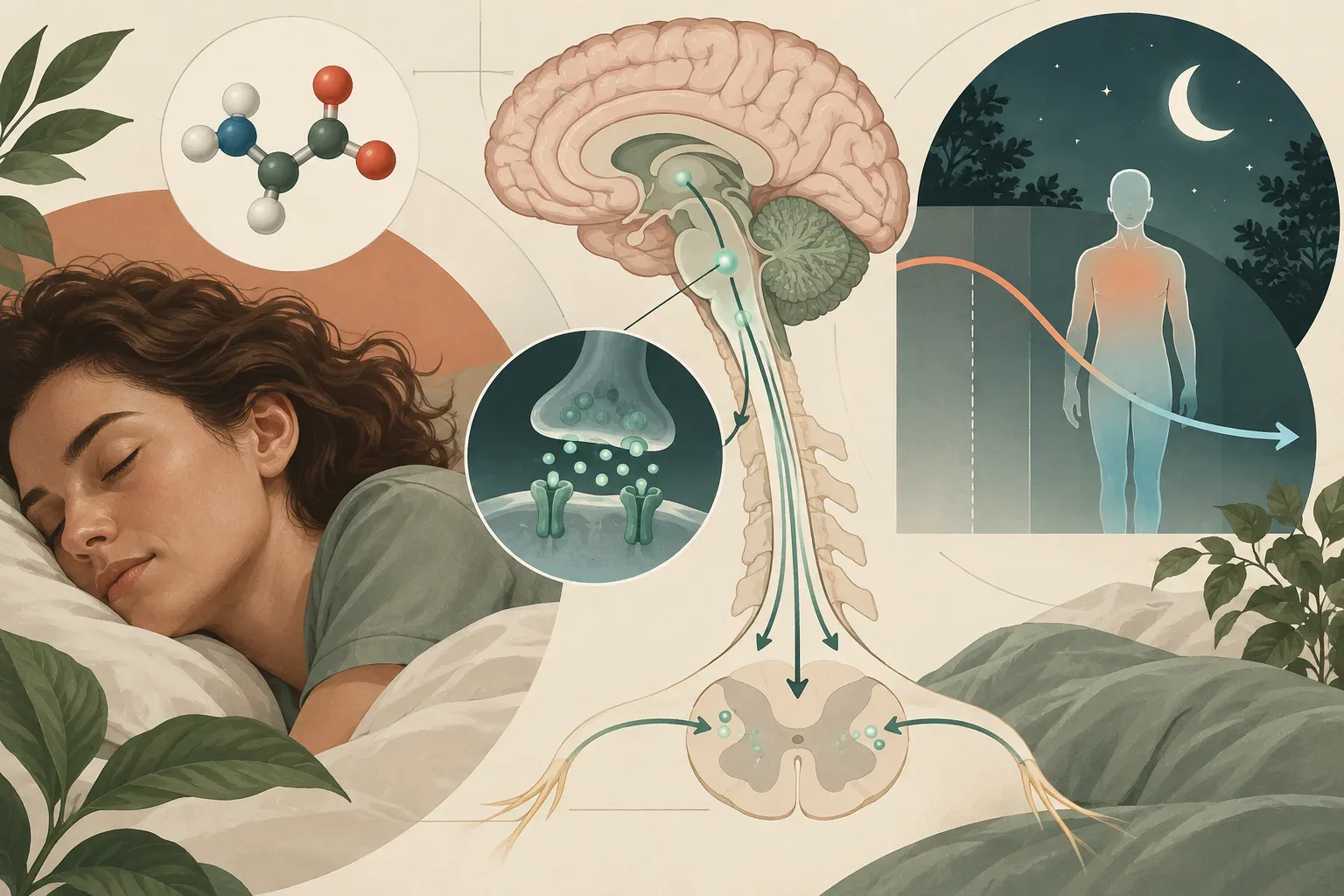
The brain's central clock coordinates a daily rhythm of melatonin production in the pineal gland. Light information reaching that clock helps control the timing: levels generally rise during the biological night and fall during the day.
Melatonin binds receptors that help communicate this nighttime signal to the body. Its effect therefore depends partly on when the signal arrives relative to the existing body clock. Taking it at different times can serve different purposes; it is not simply a stronger version of normal tiredness.
This explains why shifting a sleep schedule and treating chronic insomnia are different questions. A timed supplement may help communicate an earlier or later night, but it cannot remove every reason a person stays awake. [1]
The short version
Unit: milligrams (mg) or micrograms (mcg; 300 mcg is 0.3 mg).
Dose decision: there is no single best dose for every sleep problem. Jet-lag trials used 0.5 to 5 mg near bedtime at the destination. For a persistently late sleep schedule, ask a sleep clinician about timing; chronic insomnia needs its own treatment assessment.
Typical listings:
| Common supplement dosage | What that number means |
|---|---|
| 300 mcg | 0.3 mg; check whether the amount is per tablet or per serving |
| 1, 3 or 5 mg | Milligrams of melatonin per stated serving; release type also matters |
| 10 mg | A larger marketed amount, not an established best dose; a serving may contain more than one gummy |
What people take melatonin for
| Claimed benefit | Dose / form studied | Research verdict | Evidence strength |
|---|---|---|---|
| Ease jet lag | Adults crossing several time zones: 0.5–5 mg near destination bedtime; one trial compared 0.5 and 5 mg fast-release for 4 nights after travel | Usually reduced jet lag; timing mattered | Moderate |
| Fall asleep earlier with a persistently late sleep schedule | Confirmed delayed sleep-wake phase disorder: 0.5 mg fast-release, 1 hour before the desired bedtime, at least 5 nights/week for 4 weeks, with a fixed bedtime | Earlier sleep in a selected patient group | Moderate |
| Improve sleep in older adults with insomnia | Adults over 50: 0.1, 0.3 or 3 mg, 30 minutes before bed; each dose tested for 1 week | Sleep efficiency improved in a small trial; no universal best dose | Limited |
| Improve sleep in children with autism, ages 2–17.5 | Pediatric prolonged-release minitablets: 2 mg, increased to 5 mg if needed; 13 weeks under clinical supervision | Helped after behavioral sleep measures failed; not a general children's dose | Moderate |
People take melatonin for jet lag, a persistently late sleep schedule, or difficulty sleeping. These are different problems: the benefit depends on the timing, preparation and person being treated.
Fast-release, also called immediate-release, delivers the dose promptly. Prolonged-, extended- or slow-release products release it over a longer period.
For chronic insomnia, the American Academy of Sleep Medicine makes a weak recommendation against melatonin: the available evidence did not show enough reliable benefit to support its routine use. A type of talk therapy for insomnia, called CBT-I, is the recommended first step. That recommendation concerns chronic insomnia; timed treatment for jet lag or a delayed sleep schedule answers a different question.
When to ask a doctor before taking melatonin
- You take fluvoxamine, blood thinners, sedatives, or seizure medicine. Fluvoxamine, an antidepressant, raised melatonin levels about 17-fold in one study. The jet-lag review also collected reports of seizures in children with severe neurological conditions, and bleeding or changes in blood-clotting tests in people taking warfarin, a blood thinner. These reports do not establish that melatonin caused the events or how often they might occur. Sedatives add to the sleepiness.
- You have dementia, or care for someone who does. The American Academy of Sleep Medicine recommends against melatonin in dementia.
- You are pregnant or breastfeeding. There is little research on melatonin in pregnancy or breastfeeding.
- You are thinking of giving it to a child. The National Institutes of Health advises speaking with a health care provider first; there is little information on long-term effects in children.
Common dosage
There is no official recommended daily amount or upper limit for melatonin. The study amounts above concern particular sleep problems; they do not establish a routine daily dose.
Can I be low in melatonin?
There is no established melatonin deficiency diagnosis or routine test that selects a supplement dose. A sleep specialist can assess when the nightly melatonin rise begins; that measures timing, a different question from whether you are deficient. Evening light matters: bright screens and lamps at night lower the body’s own melatonin. In an inpatient study, ordinary room light before bed, not only a phone, delayed that nightly rise and shortened it, compared with a dim room. That finding supports reducing bright evening light as part of addressing a late sleep schedule.
Before the test if you already supplement
A timing test needs the sleep clinic’s protocol. For example, Salimetrics’ saliva DLMO instructions[2] say to avoid melatonin supplements for 3 days before collection. DLMO means the start of your evening melatonin rise in dim light. This is a saliva protocol, not a universal blood- or urine-test rule. Have the prescriber confirm a pause if melatonin is part of treatment, and follow the clinic’s light and collection-time instructions too.
What you can buy
The same hormone is sold in several formats. The format and serving size need separate checks.
| Listing | What to check |
|---|---|
| Tablets or capsules | Whether the amount is per item or per serving, and whether release is immediate or prolonged |
| Gummies | How many gummies make one serving; tested products have often differed from their labeled amount |
| Liquids | How much liquid makes one serving |
| Children’s products | A child-oriented label does not establish suitability; one gummy label lists 1 mg per serving, and use needs clinical advice |
Immediate-release and prolonged-release products deliver melatonin over different periods. A matching milligram amount does not establish that they have the same effect.
What to pay attention to on the label
The number to find is milligrams or micrograms per serving, and the problem is that the number may not match what is inside.
Which number on the label is the amount?
Look for melatonin in mg or mcg on the Supplement Facts panel, and check the serving size. One gummy product lists 10 mg per 2 gummies, so each gummy is 5 mg.
Misleading labels
Gummies that do not contain what they say
A 2023 study tested 25 melatonin gummy products sold in the US. One contained no melatonin at all. The rest ranged from 74 to 347 percent of the labeled amount, and only 3 were within 10 percent of the label. A product labeled 10 mg contained 13.1 mg. An earlier Canadian study found products ranging from 17 to 578 percent of the label, and 8 of 30 contained serotonin, a related brain chemical that was not on the label.
“10 mg for deeper sleep”
A 10 mg label is a larger amount, not a measure of how deeply you will sleep. The small older-adult trial found better sleep efficiency at 0.1, 0.3 and 3 mg than with placebo, while a later review estimated its largest average effects near 4 mg. Neither result makes 10 mg the best choice. Start with the reason you are taking melatonin and the timing and release type studied for that reason.
Confusing servings and items per serving
Some manufacturers put 180 capsules on the front, and the back says 3 capsules per serving and 60 servings. The amount on the Supplement Facts panel is for the whole 3-capsule serving.
Manufacturer claims and the studies they may be based on
A “supports healthy sleep” line may point to reviews that found people fell asleep a few minutes faster. A “jet lag relief” line may point to trials that gave melatonin at bedtime at the destination, not whenever you land. A “natural sleep hormone” line refers to the hormone your body makes in much smaller amounts than most pills contain.
How melatonin interacts with other supplements
Melatonin is often sold in sleep blends with other calming ingredients. Research on each ingredient separately does not establish whether combining them adds benefit or changes side effects.
Glycine
Glycine is an amino acid tested separately for sleep at 3 g (3,000 mg) before bed. Those studies did not test it together with melatonin.
L-theanine
L-theanine is a compound from tea leaves studied separately at about 200 mg. That research does not establish the effect of adding it to melatonin, or of a blend supplying only 50 mg.
Common Myths about Melatonin
Do smaller doses always work as well?
No universal dose ranking has been established. The low-dose argument has a real basis: in a small 2001 trial, 0.3 mg produced the largest observed improvement in sleep efficiency, measured as sleep time divided by the sleep period after sleep onset. But the study’s statistical comparisons were against placebo; they do not establish that 0.3 mg is reliably superior to 3 mg for everyone.
A 2024 review[3] modeled results from 26 adult trials and estimated the largest effects on falling asleep and sleep duration near 4 mg. That challenges a blanket “less works equally well” claim. It does not erase the older result: the studies measured different aspects of sleep, and an indirect model cannot confirm one best dose.
Whether a lower dose or 4 mg works best remains unsettled. Neither this model nor the older trial establishes one best dose across different sleep problems.
Does melatonin keep you asleep all night?
Mostly it helps you fall asleep. The 2013 review of 19 trials found about 8 minutes more total sleep than placebo in its main analysis, but that benefit was uncertain in an alternative analysis and absent in objective sleep measurements. It also pooled adults and children with several different sleep disorders. After an immediate-release oral dose of 1 to 5 mg, blood levels generally move back toward baseline within about 4 to 8 hours. An older-adult trial was an important exception: 3 mg kept levels elevated into daylight.
Is it safe to take melatonin every night?
For most adults, short-term use appears safe, according to the National Institutes of Health; long-term effects are not known.
Drawbacks and side effects
Melatonin can cause unwanted sleepiness and other short-term side effects. Excessive amounts, drug interactions and children getting into a bottle create different risks; there is no official upper limit that separates safe from unsafe use.
| Potential drawback | When/who it affects | Research evidence | Practical implication |
|---|---|---|---|
| Headache, dizziness, nausea or sleepiness | Adults in short-term studies; next-morning effects may matter more in older adults | Usually mild in short studies; longer-term safety is less clear | Avoid driving while drowsy; review persistent symptoms |
| Taking more or less than the label says | Buyers of supplements, especially the gummy products tested | Laboratory testing found substantial label errors | Check independent quality verification; a printed dose is not a guarantee |
| Stronger effects with medicines | Especially fluvoxamine; also people using sedatives or medicines needing interaction checks | Fluvoxamine markedly raised melatonin exposure in a small study | Ask a pharmacist before combining; do not change prescriptions yourself |
| Accidental ingestion by children | Children who can reach tablets, liquids or gummies | Poison-center reports include serious cases; most had no symptoms | Store out of sight and reach; use in a child needs clinical advice |
| Uncertain effects of long-term use | People taking it nightly, particularly children | Long-term safety remains unresolved; heart studies cannot establish causation | Reassess ongoing use with the clinician treating the sleep problem |
Short-term effects and morning drowsiness
There is no official upper limit. The side effects reported in short-term studies were mild: headache, dizziness, nausea, and sleepiness. Do not drive while drowsy, and skip alcohol, which adds to the sleepiness. In older people it may stay active longer and cause drowsiness the next morning.
No dose marks a universal boundary between useful and excessive. Even 3 mg left blood levels elevated into the next day in the older-adult trial.
Fluvoxamine is the best-documented drug interaction. People also ask about buspirone, an anxiety drug; no study of it with melatonin was found. Ask a pharmacist before combining melatonin with any prescription medicine.
Long-term safety
A 2025 study presented at a heart conference, not yet peer-reviewed, linked long-term melatonin use in adults with insomnia to heart failure. A 2026 analysis of a national US health survey[4] compared 267 recent melatonin users with 50,662 nonusers and found no link with existing heart disease. These studies measured different things; the second does not settle the first study's long-term question. Both were observational, so neither establishes cause.
Children getting into melatonin
US poison centers recorded 260,435 melatonin ingestions by children from 2012 to 2021, a 530 percent rise in annual reports, mostly children aged 5 or younger at home. Most reported ingestions caused no symptoms, but five children needed a breathing machine and two children under 2 died; the reports could not establish whether melatonin caused their deaths. Store it where children cannot see or reach it. [5]
The science behind melatonin
The evidence shows a real effect on jet lag, a small effect on insomnia, supplement labels that often state the wrong amount, and a sharp rise in reports of children swallowing melatonin.
Jet lag
The Cochrane review[6] reports less jet lag in 8 of 10 trials, usually when travelers took melatonin near destination bedtime after crossing five or more time zones. The two trials without a clear overall benefit involved people returning after a short stay abroad and sports travelers flying from London to Australia. Travel circumstances and the way symptoms were measured differed.
One trial already included in that review, Suhner's dose comparison[7], recruited 320 adults; 234 completed the four-night course after eastward travel across six to eight time zones. They took fast-release 0.5 or 5 mg, slow-release 2 mg, or placebo at bedtime. Both fast-release doses helped, with 5 mg better than 0.5 mg for sleep quality and time to fall asleep. The 2 mg slow-release preparation worked less well.
The review found no clear extra benefit above 5 mg. That higher-dose comparison was across different trials, so it is less certain than a direct dose comparison. Timing remains central: taking melatonin early in the day can cause sleepiness and delay adjustment to local time. These were short travel courses, not months of nightly treatment.
A persistently late sleep schedule
Delayed sleep-wake phase disorder means your sleep schedule runs persistently later than the times you need to sleep and wake. A four-week trial[8] randomized 116 diagnosed patients, aged 17–64, whose nightly melatonin rise was also confirmed to be late relative to their desired bedtime. They took 0.5 mg fast-release melatonin or placebo one hour before that bedtime, with both groups trying to sleep on the same fixed schedule at least five nights a week.
Compared with placebo and accounting for baseline, sleep onset measured by a wrist activity monitor occurred 34 minutes earlier with melatonin; the 95% confidence interval ranged from 8 to 60 minutes earlier. The selected population matters: 62 of the 186 patients who completed the rhythm assessment did not have the required misalignment and were excluded before randomization.
The supplement helped people sleep at the earlier bedtime. In the smaller group with repeat hormone measurements, however, the shift in the body's melatonin rhythm did not differ significantly from placebo. Four weeks does not establish whether improvement persists after treatment stops. The trial received public research support and recruitment advertising support from Philips Respironics.
Insomnia
In Zhdanova’s 2001 trial, 15 adults over 50 with insomnia and 15 good sleepers each tried placebo and 0.1, 0.3, and 3 mg for a week apiece. All three doses improved sleep efficiency versus placebo in the insomnia group, with the largest observed response at 0.3 mg. The good sleepers did not improve, and the insomnia group did not show a meaningful shortening of the time taken to fall asleep. Better sleep efficiency here means a greater share of the sleep period was spent asleep, measured from initial sleep onset to final awakening. The study had National Institutes of Health and charitable-trust support.
A 2013 review[9] pooled 19 trials involving 1,683 adults and children with insomnia or other sleep disorders, including delayed sleep phase. Its main analysis found sleep onset about 7 minutes faster than placebo and about 8 minutes more total sleep. The extra sleep was less certain: an alternative analysis allowing for differences between trials did not show a clear benefit, and neither did objective sleep measurements, although subjective reports were positive. The 1,683 people are the review total, not the number contributing to every outcome. The authors could not separate the age groups, so these averages are not estimates for adult chronic insomnia alone.
The 2017 American Academy of Sleep Medicine guideline[10] considered chronic insomnia separately. Its weak recommendation against melatonin was based on 2 mg trials; the three studies it could pool used prolonged-release melatonin for three weeks in adults over 55. The evidence was judged very low quality, and the pooled sleep-quality improvement did not reach the guideline's threshold for clinical importance. A weak recommendation reflects uncertainty about benefit; it does not mean every preparation and every patient has been shown to get no benefit.
The 2024 dose review searched through March 2021. Its timing model suggested about three hours before bed, but some trial times were estimated, the published studies may overrepresent positive results, and the proposed schedule still needs to be tested in a new trial. Support included the Arpa Foundation, the Italian Ministry of Health, and Stella Maris; one author disclosed a leadership role at Sleepacta.
Children
In a 13-week trial[11], 125 children aged 2–17.5 whose sleep had not improved with behavioral measures received pediatric prolonged-release minitablets or placebo. Most had autism; a small minority had Smith–Magenis syndrome, a genetic condition. The dose began at 2 mg and could rise to 5 mg. Compared with placebo, the adjusted improvements were about 32 minutes more sleep and 25 minutes less time to fall asleep. Sleepiness was more common with melatonin. Two authors were affiliated with the manufacturer, Neurim. The findings concern this prolonged-release preparation in children with autism or Smith–Magenis syndrome.
According to the National Institutes of Health, a 2019 review of 18 pediatric studies found that children with autism who received melatonin rather than placebo:
- took about 37 fewer minutes to fall asleep
- slept 48 minutes longer
Children with attention-deficit hyperactivity disorder took about 20 fewer minutes to fall asleep than with placebo. There is little information on long-term effects in children.
What is still open
Long-term safety is not known, including the heart question and effects on children’s development.
What you may have heard on podcasts
Guests disagree. Andrew Huberman (Huberman Lab, 9 January 2023) said he is “not a fan” of melatonin: it helps people fall asleep but not stay asleep, pills far exceed the body’s own levels, and it may affect reproductive hormones. He said it can be useful for jet lag and occasional use, and that he is not a fan of children taking it. Jeff Cavaliere (The Diary Of A CEO, 15 May 2025) said he believes it is safe and helpful and gives it to his children, though a consistent bedtime and wake time help more.
Satchin Panda (FoundMyFitness, 15 June 2021) raised concern that common 3 to 5 mg pills might leave melatonin in the blood two to three hours after waking. He presented that duration after waking as a concern, not a measured result. Roger Seheult (The Diary Of A CEO, 17 July 2025) proposed that infrared light may prompt cells to make melatonin inside their mitochondria, the structures that help supply energy. That is a hypothesis about melatonin produced inside cells, not evidence that an oral pill creates the same effect there.
The trials support benefit for jet lag. The 2001 trial also supports the possibility of morning carryover after 3 mg in older adults. Huberman’s reproductive-hormone claim was not tested in the studies here. On children, poison-center data support caution, while short-term trials in children with autism or ADHD found benefit.
The bottom line
The clearest evidence here is for short jet-lag courses near destination bedtime, with fast-release preparations performing better than slow-release in one direct comparison. A persistently late sleep schedule is a different clinical problem: low-dose melatonin helped a selected group when combined with a fixed bedtime.
For chronic insomnia, benefits remain small or uncertain, and the 2017 American Academy of Sleep Medicine guideline makes a weak recommendation against routine use. Giving melatonin to children remains a separate clinical decision.
Help us improve this article
Spotted an error or found a source we should consider? Tell us which part of this article needs another look and include a link if you have one. Please leave out personal health details and lab results; we can’t answer individual medical questions.
Explore more in sleep






Nutrient connections worth understanding
 Disputed pairing
Glycine for Sleep: Amounts, Evidence and Product Labels
Connection details
Context: stacked sleep bottles
Glycine is a different 3 g tool. It is not melatonin.
Source for this connection
 Disputed pairing
L-Theanine: Attention, Sleep and Anxiety Evidence
Connection details
Context: 50 mg theanine beside 10 mg melatonin
Fifty milligrams of theanine beside 10 mg melatonin is not either literature.
Source for this connection
More in compounds



References
- National Center for Complementary and Integrative Health: melatonin ↩
- Salimetrics’ saliva DLMO instructions ↩
- Cruz-Sanabria et al.: melatonin dose and timing models, 2024 ↩
- Khan and Lima: melatonin and heart disease in a national survey, 2026 ↩
- Lelak et al.: pediatric melatonin ingestions, CDC, 2022 ↩
- Cochrane review ↩
- Suhner's dose comparison ↩
- four-week trial ↩
- Ferracioli-Oda et al.: melatonin for primary sleep disorders, meta-analysis, 2013 ↩
- Sateia et al.: American Academy of Sleep Medicine guideline on insomnia drugs, 2017 ↩
- 13-week trial ↩
- Zhdanova et al.: melatonin doses in older adults with insomnia, 2001
- Gooley et al.: room light before bed and melatonin, 2011
- Auger et al.: American Academy of Sleep Medicine guideline on circadian rhythm disorders, 2015
- Herxheimer and Petrie: melatonin for jet lag, Cochrane review
- Tordjman et al.: melatonin pharmacology review, 2017
- Erland and Saxena: melatonin content of supplements, 2017
- Cohen et al.: melatonin in US gummies, 2023
- Härtter et al.: fluvoxamine and melatonin, 2000
- Huberman Lab: a rational approach to supplementation, 9 January 2023
- The Diary Of A CEO: Jeff Cavaliere, 15 May 2025
- FoundMyFitness: Satchin Panda, 15 June 2021
- The Diary Of A CEO: Roger Seheult, 17 July 2025
- NIH Dietary Supplement Label Database: a 300 mcg melatonin label
- NIH Dietary Supplement Label Database: a 10 mg melatonin gummy label
Corrections & updates
- Update
Updated the evidence discussion and practical guidance after editorial review.