
What is molybdenum?
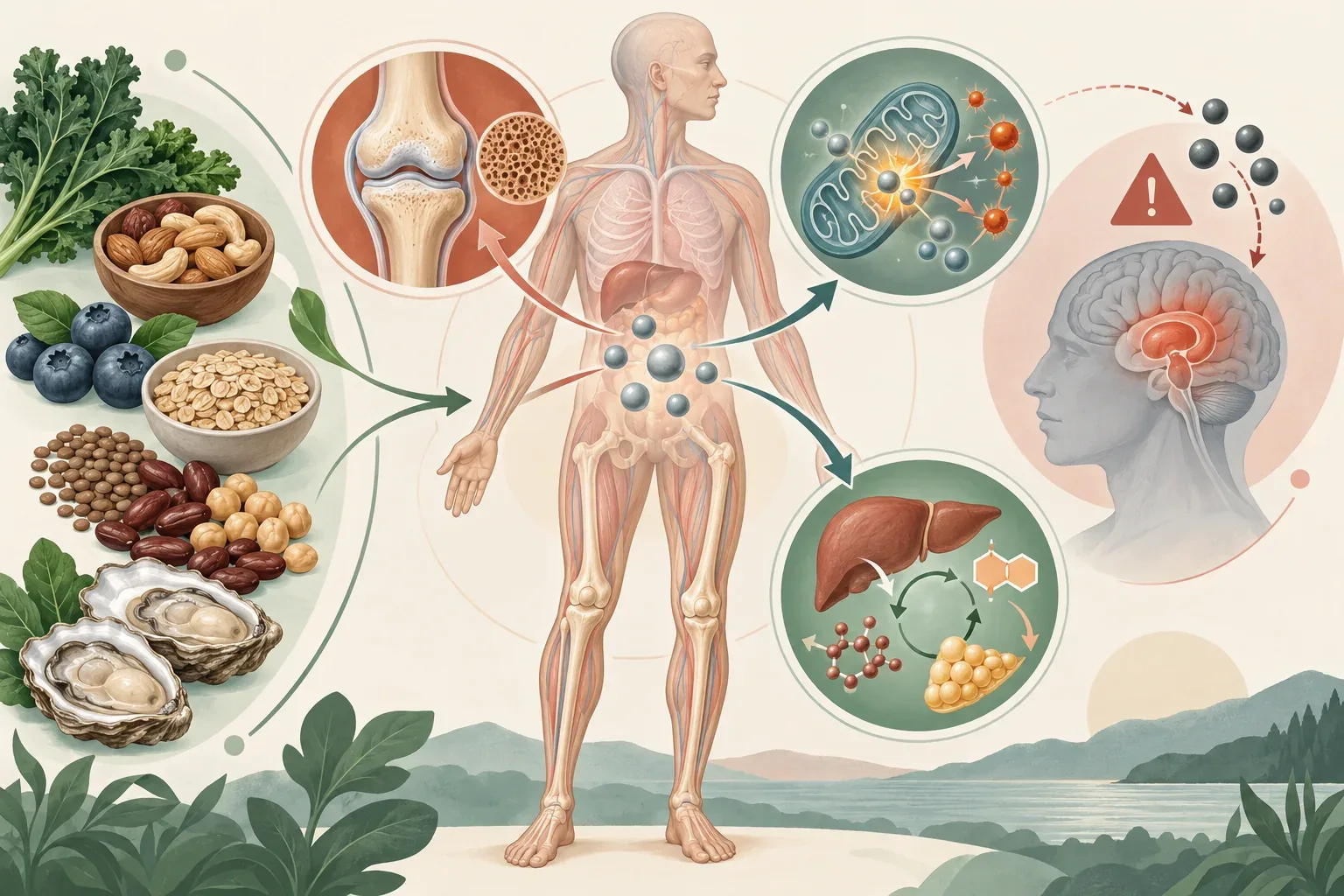
Molybdenum is an essential trace mineral that your body needs in tiny amounts. It is built into a helper molecule, the molybdenum cofactor, that four enzymes depend on. Those enzymes break down sulfur-containing amino acids, turn purines — building blocks of DNA that also come from food — into uric acid, and help process some drugs and toxins. Your kidneys keep the level steady by sending the extra into your urine.
Molybdenum comes mostly from beans, grains, nuts, dairy, and liver. Amounts in plants vary with soil and irrigation water, while animal foods reflect the animals' feed and the local food supply. Half a cup of black-eyed peas can hold several days’ worth.
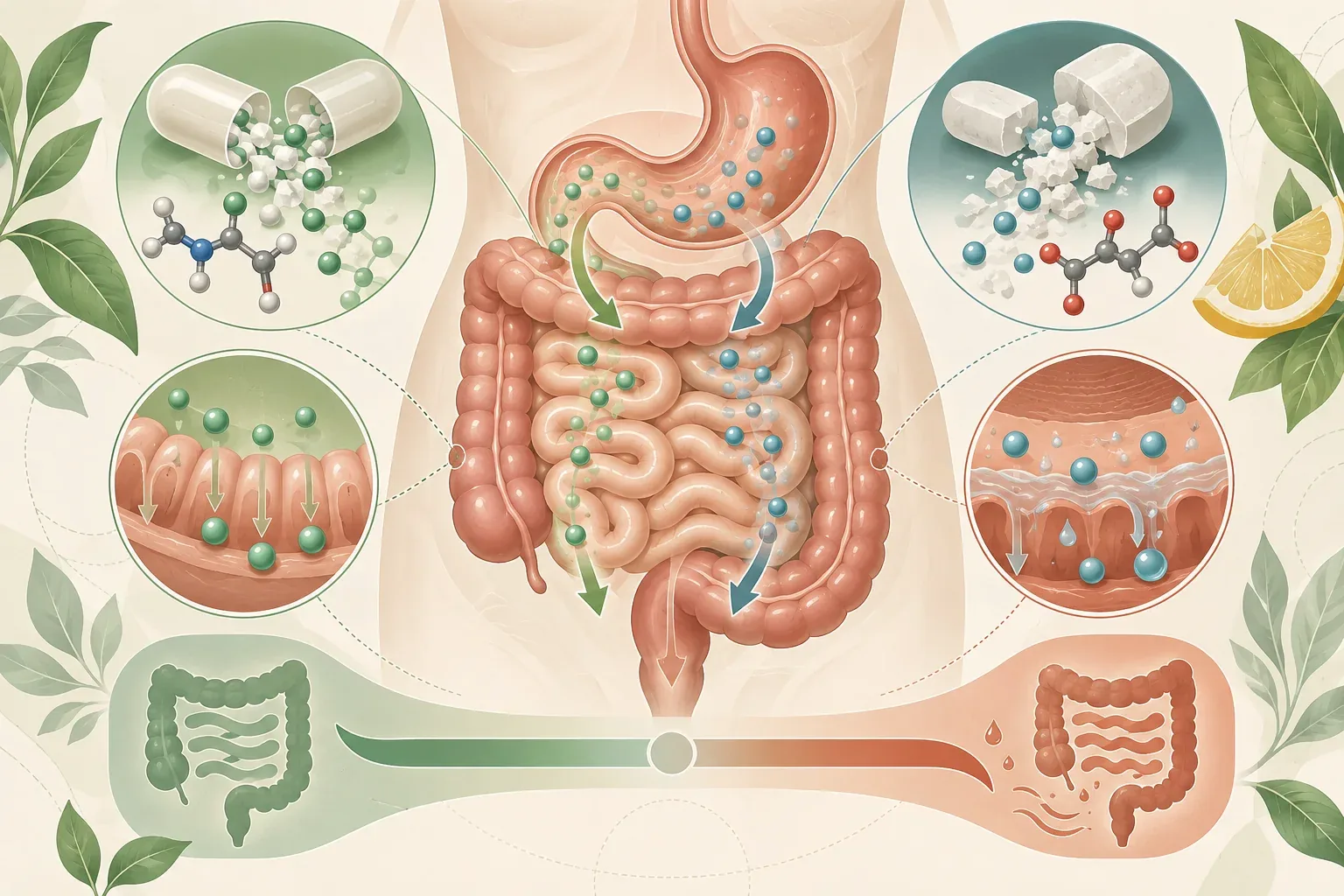
The recommended daily amount for adults is 45 mcg, and a multivitamin that includes molybdenum usually lists about that much. Standalone products run from about 50 to 500 mcg, as molybdenum glycinate, sodium molybdate, molybdenum chloride, or amino acid chelate.
People buy molybdenum for detox, for glutathione, for sulfite sensitivity, for mold illness, or for mood and sleep. What is well established is only that it is essential, that food covers it, and that deficiency has almost never been seen outside a rare genetic disease.
What molybdenum does in your body
The body incorporates molybdenum into a helper molecule used by a small group of enzymes. One, sulfite oxidase, converts sulfite into sulfate during the processing of sulfur-containing amino acids. This is part of ordinary metabolism, rather than evidence that extra molybdenum treats a person's reaction to a food or preservative.
Other molybdenum-dependent enzymes process purines, components of genetic material, and help handle particular chemicals and medicines. Xanthine oxidase, for example, participates in producing uric acid as purines are broken down. These are different reactions, rather than one general “detox” function.
The kidneys regulate much of the molybdenum leaving the body. Ordinary dietary intake usually supplies the small amount needed to build the enzyme system. [1]
The short version
Unit: micrograms (mcg) of molybdenum. One milligram is 1,000 mcg. If the Supplement Facts panel says 45 mcg of molybdenum, that is the amount.
Reasonable start: food. If you want it in a supplement, 45 to 50 mcg in a multivitamin is a full day’s amount.
| Product | Common supplement dosage | What that number means |
|---|---|---|
| Multivitamin with molybdenum | About 45–50 mcg | Micrograms of molybdenum |
| Molybdenum glycinate or amino acid chelate | 50–500 mcg | Micrograms of molybdenum |
| Sodium molybdate or molybdenum chloride | 50–500 mcg | Micrograms of molybdenum |
Skip: a product sold for detox, glutathione, mood, or sleep; a 500 mcg product sold as safe because it is under the official upper limit of 2,000 mcg; and any label that ranks one form above another.
What people take molybdenum for
| Claimed benefit | Dose / form studied | Research verdict | Evidence strength |
|---|---|---|---|
| Correcting the rare deficiency from inadequate intravenous nutrition | Clinical replacement in a documented prolonged intravenous-feeding case; no general oral treatment dose established. | The case supports essentiality, not routine supplementation in well-fed adults. | Limited |
| Detoxification, sulfite sensitivity, mood or sleep | No established effective dose or duration. | Enzyme roles have not established these claimed supplement benefits. | Insufficient |
Almost nobody needs a molybdenum supplement. The adult recommended amount is 45 mcg a day, US food intakes were measured at about 76 mcg for women and 109 mcg for men, and the National Institutes of Health’s molybdenum fact sheet says no group of people is known to fall short.
Deficiency has been reported in only two situations. One is a rare genetic disease of newborns in which the body cannot build the molybdenum helper molecule at all; a supplement does not treat it. The other is a single patient in 1981 who was fed intravenously for months with no molybdenum in the formula. If you eat ordinary food, neither applies.
When to ask a doctor before taking molybdenum
Ask first if you have kidney disease, because your kidneys are what clear extra molybdenum, or gout, because very high intakes have gone with high uric acid. The NIH fact sheet lists no medicines that interact with molybdenum and no rule for spacing it from other pills, and it says molybdenum is not a standard treatment for any disease. If a practitioner has suggested high-dose molybdenum for detox, sulfite problems, or mold illness, ask what trial supports the dose, because the fact sheet names none.
Common dosage
The recommended daily amount from the National Academies is 45 mcg for adults, men and women alike, from food and supplements together.
| Age | Daily amount | Official upper limit |
|---|---|---|
| Birth to 6 months | 2 mcg | Not set; no supplements for babies |
| 7–12 months | 3 mcg | Not set; no supplements for babies |
| 1–3 years | 17 mcg | 300 mcg |
| 4–8 years | 22 mcg | 600 mcg |
| 9–13 years | 34 mcg | 1,100 mcg |
| 14–18 years | 43 mcg | 1,700 mcg |
| 19 and older | 45 mcg | 2,000 mcg |
The baby amounts are what breast milk supplies. The official upper limit from the National Academies is 2,000 mcg a day for adults. The amount is not set by body weight, and there is no official time of day or food rule.
Am I getting enough molybdenum from food?
Almost certainly. US food intakes were measured at about 76 mcg a day for women and 109 mcg for men, above the 45 mcg recommended amount, and no group is known to fall short. The foods below, from the NIH fact sheet, show where it comes from; amounts vary with the soil.
Selected values from the NIH Office of Dietary Supplements food table[1] show the stated food and preparation. Amounts are per serving.
| Food and preparation | Source | Serving | Molybdenum (mcg) |
|---|---|---|---|
| Black-eyed peas, boiled | Plant | ½ cup | 288 mcg |
| Beef liver, pan-fried | Meat | 3 oz (about 85 g) | 104 mcg |
| Lima beans, boiled | Plant | ½ cup | 104 mcg |
| Plain low-fat yogurt | Dairy | 1 cup | 26 mcg |
| Potato, baked with skin | Plant | 1 medium | 16 mcg |
| Banana | Plant | 1 medium | 15 mcg |
Legumes, cereal grains, leafy vegetables, liver, and milk are major contributors across the US diet, not necessarily the richest items per serving in this table; for children and teens, milk and cheese contribute the most. A glass of milk and a slice of bread already cover most of a day, and a serving of beans covers several.
How can I tell if I'm low on molybdenum?
Dietary molybdenum deficiency is extraordinarily rare. There is no established progression of minor, moderate and severe symptoms in people eating ordinary diets.
What acquired deficiency has looked like
The NIH account[1] describes a patient receiving prolonged intravenous nutrition without molybdenum who developed a rapid heartbeat, rapid breathing, headache, night blindness and eventually coma.
An inherited disorder is a different problem
Molybdenum cofactor deficiency prevents the body from making the machinery its molybdenum-dependent enzymes need. It can cause severe neurological injury and seizures early in life. It is distinct from simply eating too little molybdenum.
What testing can and cannot show
There is no symptom checklist, home check, or routine clinical test that can tell an ordinary shopper they are low. Molybdenum deficiency is so rare that blood levels have been measured only in small research studies, and the NIH fact sheet says urine molybdenum does not reflect status. Beans, whole grains, dairy and nuts contribute molybdenum, but whether your intake reaches 45 mcg a day depends on portions and the whole diet. Running low takes something unusual, like months of feeding through a vein with no molybdenum in the formula. [1]
Before the test if you already supplement
If a specialist does order serum molybdenum, Mayo’s collection instructions[2] give no fixed supplement hold. Ask about the next dose and report any contrast scan: this assay requires at least 96 hours after gadolinium- or iodine-containing contrast. That contrast restriction is not a molybdenum-supplement washout, and the specialist test does not establish a routine dietary-shortfall screen.
Molybdenum forms you can buy
Molybdenum glycinate, amino acid chelate, sodium molybdate, and molybdenum chloride are not different minerals. Each one is molybdenum attached to a partner. The form changes what the molybdenum is bound to, not how much you get; the Supplement Facts panel already gives the molybdenum.
Molybdenum in a multivitamin
This is the ordinary way to get it in a supplement, usually at about 45 to 50 mcg. If your multivitamin lists that, you have a full day’s amount before food.
Molybdenum glycinate and amino acid chelate
These bind molybdenum to an amino acid. They are sold from about 50 to 500 mcg, and labels often call them better absorbed, though no study has compared them with other forms. A typical facts line reads Molybdenum (as molybdenum glycinate chelate) 150 mcg.
Sodium molybdate and molybdenum chloride
These are simple mineral salts, also sold from about 50 to 500 mcg. Molybdate was the form used alongside food in the studies that set the recommended amount. No study ranks it better or worse than glycinate.
Can you take two molybdenum products the same day?
Add the micrograms on the Supplement Facts panels exactly; food is only a rough context because its molybdenum content varies. A multivitamin with 50 mcg plus a standalone product with 500 mcg totals 550 mcg from supplements before food. That is below the 2,000 mcg adult upper limit, but the limit is not a reason to combine them and does not show a benefit.
Choosing a molybdenum product
For most people, the choice is not to buy one. If you take a multivitamin, it probably already lists about 45 to 50 mcg. If you still want a standalone product, a low-dose one near 50 mcg matches the recommended amount; higher doses increase exposure without a demonstrated added use. Skip products sold for detox, glutathione, mood, or sleep.
What to pay attention to on the label
The number that counts is micrograms of molybdenum on the Supplement Facts panel, and the check is how far above 45 mcg it goes.
Which number on the label is the amount?
Look for Molybdenum in micrograms, often with the form in parentheses: “Molybdenum (as molybdenum glycinate chelate) 150 mcg.” That 150 mcg is the molybdenum. The Daily Value, the reference amount labels use, is 45 mcg, so the Supplement Facts label says about 333 percent of the Daily Value.
Misleading labels
Detox, glutathione, mood, or sleep on the front
Some labels claim that molybdenum supports detoxification, glutathione recycling, a calmer mood, or better sleep. These are mechanism-based claims; the practical questions about glutathione, detox, and sulfite sensitivity are answered below.
“Safe because it is under the limit”
A 500 mcg product sits under the 2,000 mcg adult ceiling. That tells you it is below a line set from animal studies. It says nothing about whether 500 mcg does anything, and it is about ten times the recommended amount.
One form ranked above another
Some labels call glycinate or a chelate the best-absorbed form. The NIH fact sheet says no studies have compared how well the forms are absorbed.
Confusing servings and items per serving
Some manufacturers put 180 capsules on the front, and the back says 3 capsules per serving and 60 servings. The molybdenum on the Supplement Facts panel is for the whole 3-capsule serving.
Manufacturer claims and the studies they may be based on
A “detox” or “liver support” claim traces to enzymes that help process drugs and toxins. A sulfite claim traces to an enzyme that breaks down sulfite and to the rare genetic disease in which that enzyme fails. Those are the biological sources of the marketing language. The genetic disease is treated in newborns with a replacement for the missing helper molecule, not with molybdenum capsules.
How long should I take molybdenum supplements for?
For ordinary nutrition, this is usually a food question: deficiency from diet is very rare. If a restricted diet truly leaves a gap, cover the ordinary daily amount while that gap persists and reassess when eating changes. NIH's review[1] does not establish a useful store-drain interval, a general supplement course or a taper after a 'detox' product. A rare medical deficiency has a different cause-specific plan. There is no reason to turn an experimental or high-dose use into continuing maintenance simply because molybdenum is an essential mineral.
Common Myths about Molybdenum
Does extra molybdenum recycle glutathione while you detox?
No. The idea comes from molybdenum’s role in handling sulfur-containing amino acids, but researchers have not tested whether a supplement changes glutathione or any detox-related symptom in people.
Is a molybdenum supplement a fix for sulfite sensitivity?
Not on the evidence. The sulfite-processing enzyme needs molybdenum, but the devastating genetic disease that disables it is a failure to build the helper molecule, not a dietary shortage. That mechanism does not establish a treatment for everyday sulfite sensitivity.
Is 500 mcg fine because the ceiling is 2,000 mcg?
The ceiling is not a target. It was derived from animal studies because the available human evidence was inadequate to establish a causal harm threshold, and staying under it says nothing about benefit. With food already supplying more than 45 mcg, a 500 mcg product adds far more than anyone has shown a use for.
Drawbacks and side effects
| Potential drawback | When/who it affects | Research evidence | Practical implication |
|---|---|---|---|
| Uncertain safety across high supplement amounts | Chronic intake far above the 45 mcg adult requirement. | The 2,000 mcg adult upper limit comes from animal reproductive and developmental evidence. | Do not treat the ceiling as a beneficial daily target. |
| Gout-like symptoms at extreme exposure | Historical regional diets supplying 10,000–15,000 mcg/day. | Observations linked these diets with high uric acid and joint symptoms; no precise threshold follows. | These extreme-exposure reports cannot tell you what long-term use of a 500 mcg supplement will do. |
What is known about supplemental amounts
Too much molybdenum from ordinary food is rarely a problem, because your kidneys clear the extra quickly in urine unless the amounts are extreme. The official upper limit is 2,000 mcg a day for adults, 1,700 mcg at 14 to 18, and lower for younger children, with none set for infants. Studies do not establish what a 500 mcg supplement usually does; it adds more than ten times the adult recommended amount. The historical human harm signal involved diets of 10,000 to 15,000 mcg a day in a region with molybdenum-rich soil, not ordinary US food or a 500 mcg trial.
When too much is dangerous
That ceiling comes mainly from reproduction and fetal-development problems in rats and mice because human data cannot establish a safe upper threshold. Historical reports from a region of Armenia with molybdenum-rich soil linked diets estimated at 10 to 15 milligrams (10,000 to 15,000 mcg) a day with achy joints, gout-like symptoms, and high uric acid. Other small human studies and case reports exist, but they do not establish a causal intake threshold. Acute poisoning has also happened with mining and metalworking exposure.
Molybdenum during pregnancy and breastfeeding
The recommended daily amount for pregnant and breastfeeding women is 50 mcg, from the National Academies as listed on the NIH fact sheet. The official upper limit is 1,700 mcg at 14 to 18 and 2,000 mcg from 19, the same as for other adults, and it rests on the animal reproduction studies. Food normally covers 50 mcg, and a prenatal that lists molybdenum counts toward that total.
The science behind molybdenum
The 45 mcg adult daily recommendation traces back to intake-and-excretion studies in eight young men. The 2,000 mcg upper limit was derived from reproductive effects in animals because human studies could not establish a threshold for harm. These figures address adequacy and safety; they do not show that taking more molybdenum helps with detoxification, mood or sleep.
Where the 45 mcg comes from
The recommended amount rests on two carefully controlled studies at a US Department of Agriculture research unit in 1995, with four young men each. The men ate measured diets at several molybdenum levels while researchers tracked how much they absorbed and excreted. In those studies:
- One five-intake study reported 88 to 93 percent absorption; the broader 40 to 100 percent range comes from the NIH summary of several sources, not just these two studies.
- The kidneys adjusted excretion to intake.
Children’s amounts were extrapolated from those adults. Eight men is a small base for a national number, and no newer study has replaced it.
Where the 2,000 mcg ceiling comes from
With human harm data too limited to set a threshold, the National Academies derived the ceiling from reproduction and fetal-development problems in rats and mice, divided by a safety factor. The Armenian diet report is a historical human signal, but other small human studies and case reports also exist. None establishes where harm begins across ordinary and high intakes. Molybdenum-dependent enzymes are involved in uric-acid production; that mechanism does not prove the historical symptoms were caused by molybdenum alone.
When molybdenum truly runs out
In 1981, a patient fed intravenously for a long time with no molybdenum developed a racing heart, fast breathing, headache, night blindness, and coma, and recovered once molybdenum was added. This single case documented deficiency after molybdenum-free intravenous feeding. The genetic molybdenum cofactor deficiency, in which newborns cannot build the helper molecule, causes seizures and brain damage and is usually fatal within days; it has been treated in infants with a replacement for the missing molecule, not with molybdenum.
If a podcast mentions molybdenum
Ask two questions: what amount did the guest name, and what human outcome trial supports it? No named guest amount is available to compare here, so the concrete references remain the 45 mcg adult recommendation and the label math above.
The bottom line
Molybdenum is needed in tiny amounts, and ordinary food intake usually covers that need. Its role in processing sulfur compounds does not establish that extra molybdenum treats sulfite sensitivity, improves mood or provides a useful “detox.”
A supplement can supply much more than the daily requirement without offering a demonstrated extra benefit. Use the daily requirement to assess intake; investigate unexplained symptoms separately.
Help us improve this article
Spotted an error or found a source we should consider? Tell us which part of this article needs another look and include a link if you have one. Please leave out personal health details and lab results; we can’t answer individual medical questions.
Explore more in detox claims
More in minerals


References
- NIH Office of Dietary Supplements: Molybdenum — Health Professional Fact Sheet ↩
- Mayo’s collection instructions ↩
- National Academies: molybdenum requirements and upper-limit assessment, 2001
- Turnlund et al.: molybdenum depletion and repletion in young men
- Turnlund et al.: molybdenum absorption at five intakes
- Abumrad et al.: molybdenum deficiency during intravenous feeding
- Veldman et al.: treating molybdenum cofactor deficiency in an infant
Corrections & updates
- Update
Updated the evidence discussion and practical guidance after editorial review.
- Update
Revised the article after editorial review, with clearer evidence explanations and practical guidance.