
What is calcium D-glucarate?
Calcium D-glucarate is a salt of glucaric acid, a compound the body makes and that also occurs in fruits and vegetables. It is sometimes labeled calcium saccharate.
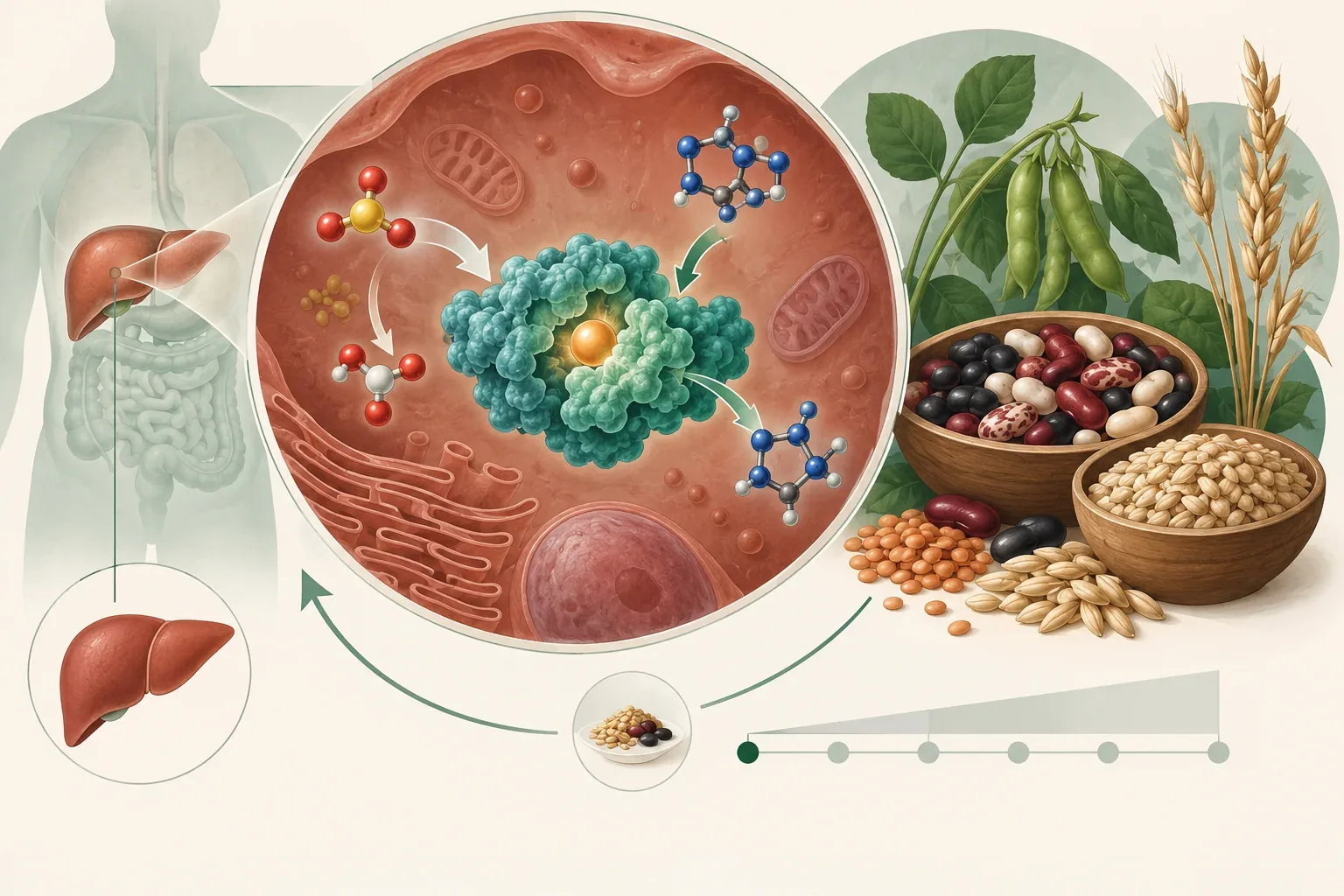
Supplements are sold for “estrogen detox,” hormone balance, liver support, and cancer prevention. The proposed mechanism concerns how the body removes substances: the liver attaches a chemical tag to estrogen, some medicines, and other substances so they can leave the body. An enzyme called beta-glucuronidase can remove that tag and allow some of a substance to be reabsorbed. During digestion, glucarate forms a compound that can block that enzyme.
That chemistry comes from enzyme experiments and animal studies. Human studies have measured estrogen metabolites—the products formed as the body processes estrogen—after combination supplements containing calcium D-glucarate. They do not isolate its contribution or establish that calcium D-glucarate alone lowers estrogen, relieves symptoms or prevents cancer.
What is the difference between calcium D-glucarate and a calcium supplement?
A calcium carbonate or citrate supplement is sold to supply calcium, usually hundreds of milligrams per tablet. Calcium D-glucarate is sold for the glucarate. A 500 mg serving supplies roughly 60 to 80 mg of calcium; it would take about 13 to 17 capsules containing 500 mg each to supply 1,000 mg of calcium, far beyond label directions.
Its calcium still counts if you take another calcium product. Adults need 1,000 to 1,200 mg daily from food and supplements together. The official upper limit is 2,500 mg a day at ages 19 to 50 and 2,000 mg from age 51. Add the separately declared calcium amount on each label to your food intake, and follow any calcium restriction from your clinician.
What people take calcium D-glucarate for
| Claimed benefit | Dose / form studied | Research verdict | Evidence strength |
|---|---|---|---|
| Lowering estrogen or improving hormone symptoms | No established effective dose or duration for calcium D-glucarate alone. | Combination studies measured metabolites but have not established symptom relief or lower total estrogen. | Insufficient |
| Detoxification or cancer prevention | No established effective dose or duration. | Animal tumor results do not show that capsules prevent human cancer. | Insufficient |
When to ask a doctor before taking calcium D-glucarate
- You use hormone therapy or birth control. The proposed mechanism could alter how the body clears hormones, but this has not been tested in people.
- You receive cancer treatment or have had a hormone-sensitive cancer. Ask the clinician managing that care before using a product sold for estrogen effects.
- You are pregnant or breastfeeding. Safety has not been studied.
Common dosage
There is no recognized recommended daily amount or upper limit for glucarate. No study in people has established an effective dose or time of day. The 500 to 1,500 mg a day found on labels reflects what companies sell, not an amount shown to work.
Can I be low in glucarate?
There is no recognized glucarate deficiency. The body makes glucaric acid, and apples, citrus fruit, broccoli, cabbage, Brussels sprouts, spinach, and other produce contain it. Researchers can measure glucaric acid in urine, but no validated cutoff identifies someone who needs a supplement.
What you can buy
The supplement is sold alone or in “estrogen balance” and “detox” blends. The useful difference between the common listings is whether the glucarate amount is disclosed.
| Listing | Calcium D-glucarate per serving | Calcium per serving | What else |
|---|---|---|---|
| Calcium D-glucarate capsules | Usually 500 mg | Roughly 60–80 mg | Nothing else |
| “Estrogen balance” or “detox” blend | Often not stated separately | Varies | Mixed with other herbs or compounds, sometimes in a proprietary blend |
A single-ingredient label reveals the amount of glucarate; a proprietary blend may give only the total weight of all its ingredients.
What to pay attention to on the label
Which number on the label is the amount?
Find two numbers: milligrams of calcium D-glucarate, the marketed ingredient, and milligrams of calcium, the mineral supplied with it. A label may list 500 mg of calcium D-glucarate and then list calcium separately. Use that separately declared calcium amount when available; the ingredient’s exact chemical form changes its calcium proportion.
Misleading labels
A blend that hides the amount
Some “estrogen balance” blends put calcium D-glucarate inside a proprietary mix with one total weight. You cannot tell how much glucarate you get.
Confusing servings and items per serving
If a bottle says 180 capsules but defines a serving as 3 capsules, it contains 60 servings. The Supplement Facts amount applies to all three capsules together.
Drawbacks and side effects
| Potential drawback | When/who it affects | Research evidence | Practical implication |
|---|---|---|---|
| Uncertain long-term adverse effects | Anyone using it repeatedly. | No long-term human safety study or official upper limit establishes a safe boundary. | Long-term safety remains unstudied. |
| Possible treatment interaction | Hormone therapy or medicines affected by the proposed clearance pathway. | The concern is theoretical; human interaction studies have not established its size or direction. | Review the specific treatment with the prescriber; human interaction effects and timing are unstudied. |
There is no official upper limit for glucarate and no long-term human safety study, so the amount that becomes harmful is unknown. A small preliminary human report described the supplement as well tolerated, but that is too little evidence to define long-term safety. In a 28-day trial of a multi-ingredient formula, headache and stomach pain were reported more often with the formula than with placebo; the mixture prevents attributing those symptoms specifically to calcium D-glucarate.
The main concern is theoretical interaction. If glucarate changes the clearance of hormones or medicines as proposed, it could change their effects. Human interaction studies have not tested that possibility.
The science behind calcium D-glucarate
The evidence includes enzyme and animal experiments, a preliminary single-ingredient human report, and two studies of combination products that measured estrogen metabolites. The combinations provide human data, but do not reveal what calcium D-glucarate itself contributed.
Enzymes and rats
Beta-glucuronidase can remove the chemical tag the liver adds to estrogen, some medicines, and other substances before excretion. In the stomach, glucarate forms D-glucaro-1,4-lactone, which blocks that enzyme. A 1990 review and a 1997 rat study from the same group mapped this chemistry and proposed that it might increase the removal of estrogen and cancer-causing compounds.
In rat and mouse studies, animals fed glucarate after exposure to known cancer-causing chemicals developed fewer or slower tumors in breast, colon, lung, and skin models. That is not the same as people taking capsules to prevent naturally occurring cancer.
Human Studies
A 1995 Memorial Sloan Kettering review used the shortened name “calcium glucarate” for calcium D-glucarate and proposed testing it for breast-cancer prevention. A later 2004 conference report described changes in beta-glucuronidase and blood glucaric acid and no observed toxicity.
Human studies of combination products
The two studies below examined a “2:16” ratio between estrogen metabolites. The numbers identify chemical positions where estrogen molecules have been altered: the ratio compares 2-hydroxylated metabolites with 16-alpha-hydroxyestrone. The researchers investigated whether shifting that balance might relate to breast-cancer risk.
The first study measured 2-hydroxyestrogens in urine; the second measured 2-hydroxyestrone in blood serum, the liquid remaining after blood clots. Their numerical ratios should be compared within each study because the samples and metabolite measurements differ. [1]; [2]
A 2010 randomized, placebo-controlled trial[1] recruited 98 pre- and postmenopausal women who were not taking hormonal contraception or hormone replacement. For 28 days they took a formula providing 150 mg calcium D-glucarate daily alongside indole-3-carbinol, lignans and several other ingredients, or placebo. The main metabolite analysis included 68 women after exclusions for missing or unsuitable samples and low adherence. Urinary 2-hydroxyestrogens rose within the formula group. Its overall 2:16 metabolite ratio increased from 2.52 to 3.33, but that within-group change was not statistically clear; the premenopausal subgroup had a clearer change. The tables' within-group tests do not establish a treatment-versus-placebo benefit. The formula maker paid the research company to conduct the work. A 2012 erratum[3] corrected several ingredient descriptions, including the lignan amount, without changing the calcium D-glucarate amount or outcome tables.
A 2013 retrospective study[2] compared 65 women taking Lucentia Peak with 11 who chose not to take it. A four-capsule serving contained 150 mg calcium D-glucarate plus diindolylmethane (DIM, formed from compounds in cruciferous vegetables), resveratrol and other ingredients; average recorded treatment lasted 196 days. The blood-serum 2:16 metabolite ratio rose from 0.38 to 0.57 in users and changed from 0.65 to 0.64 in nonusers, with a statistically significant difference in change. The groups started at different ratios and had substantially different follow-up intervals, and treatment was self-selected. One author held shares in the distributor.
Both products contained several ingredients, so these findings cannot identify the contribution of calcium D-glucarate.
The bottom line
Calcium D-glucarate has a plausible biochemical story, but human research has not established that it improves hormone symptoms, prevents cancer or provides a useful “estrogen detox.”
We would not treat a general hormone-balance claim as a reason to take it indefinitely. If you are considering it alongside hormone treatment or another medicine, the possible effect on hormone clearance needs its own review.
Help us improve this article
Spotted an error or found a source we should consider? Tell us which part of this article needs another look and include a link if you have one. Please leave out personal health details and lab results; we can’t answer individual medical questions.
Explore more in hormones & libido




Nutrient connections worth understanding
 Disputed pairing
Vitamin D: Daily Needs, Blood Tests and the Limits of Higher Doses
Connection details
Context: calcium plus D3
Not calcium plus D3.
Source for this connection
More in minerals
References
- 2010 study methods ↩
- 2013 study methods ↩
- 2012 erratum ↩
- NIH Office of Dietary Supplements: Calcium — Health Professional Fact Sheet
- Memorial Sloan Kettering Cancer Center: Calcium Glucarate (About Herbs)
- Walaszek: potential use of D-glucaric acid derivatives in cancer prevention, 1990
- Walaszek et al.: metabolism and excretion of a D-glucaric acid salt in rats, 1997
- Dwivedi et al.: calcium glucarate, beta-glucuronidase, and glucarate in vegetables and fruits, 1990
- Heerdt et al.: calcium glucarate as a chemopreventive agent in breast cancer, 1995