
What is calcium fructoborate?
Calcium fructoborate is a compound of boron, fructose (fruit sugar), and calcium. Boron is a trace element found in fruit, nuts, beans, and coffee. Some food boron is also bound to sugars.
The supplement version is made commercially, often under the ingredient name FruiteX-B, and is the boron-sugar compound with the most human research behind it.
The knee trials used about 216 to 220 mg of calcium fructoborate a day. That supplies about 6 mg of boron and only a few milligrams of calcium, a small contribution beside the 1,000 to 1,200 mg of calcium adults need daily.
People take it mainly for achy knees and joints, and sometimes for inflammation or bone health. The evidence consists of two short placebo-controlled knee trials run by the ingredient’s maker and small studies of blood markers of inflammation. The trial registered by Auburn has no results posted and also records manufacturer involvement.
What people take calcium fructoborate for
| Claimed benefit | Dose / form studied | Research verdict | Evidence strength |
|---|---|---|---|
| Less knee discomfort | Calcium fructoborate 110 mg twice daily for 14 days or 216 mg/day for 90 days; about 6 mg/day boron, in adults with self-reported discomfort. | Two short trials found better scores; independent confirmation is missing. | Limited |
| Lower inflammation markers | 56–112 mg/day calcium fructoborate for 30 days in adults with raised C-reactive protein (CRP), a blood marker of inflammation; roughly 1.5–3 mg/day boron. | Some markers fell, but disease prevention was not tested. | Limited |
No one needs calcium fructoborate to prevent a deficiency. An adult with persistent knee discomfort might discuss it after ordinary causes and care options are addressed, but the only favorable trials are short, company-run, and not independently confirmed.
The trials measured knee comfort, not joint repair.
When to ask a doctor before taking calcium fructoborate
Ask first if you are pregnant or breastfeeding, since the boron limit was set from animal reproduction studies and this supplement has not been studied in pregnancy, or if you have kidney disease, since boron leaves the body in urine. The National Institutes of Health’s boron fact sheet names no known medicine interactions. If you take other joint or mineral products, check their boron before adding this one.
The boron ceiling
There is no recognized recommended daily amount for calcium fructoborate or boron.
The limit that matters is boron. The official upper limit from the National Academies is 20 mg of boron a day for adults from food and supplements together.
| Age | Official upper limit for boron |
|---|---|
| Birth to 12 months | Not set; food and formula only |
| 1–3 years | 3 mg |
| 4–8 years | 6 mg |
| 9–13 years | 11 mg |
| 14–18 years (including pregnancy and breastfeeding) | 17 mg |
| 19 and older (including pregnancy and breastfeeding) | 20 mg |
The 6 mg of boron in 216 mg of calcium fructoborate is well under the adult limit. For a child aged 4 to 8, it uses up the whole limit, and it has not been studied in children, so do not give it to a child without a doctor’s advice.
Can I be low in calcium fructoborate or boron?
Calcium fructoborate is a commercial compound, not something the body can be deficient in. For boron, medicine has not established a deficiency diagnosis, a recommended daily amount, or a routine status test. Ordinary diets supply about 1 to 1.5 mg of boron a day from fruit, beans, nuts, coffee, and milk.
What you can buy
| Listing | Calcium fructoborate per serving | Boron per serving | How it compares with the trials |
|---|---|---|---|
| Calcium fructoborate (often FruiteX-B) capsules | 108–220 mg | About 3–6 mg | FruiteX-B was the branded ingredient in the knee trials; the daily total depends on the serving size and directions |
| Joint blend with calcium fructoborate | Varies; sometimes not stated | Varies | Mixed with other ingredients the trials did not test |
| Other boron forms (boron citrate, glycinate) | None; listed as boron | As listed | Not the form used in the knee trials |
What is known about absorption
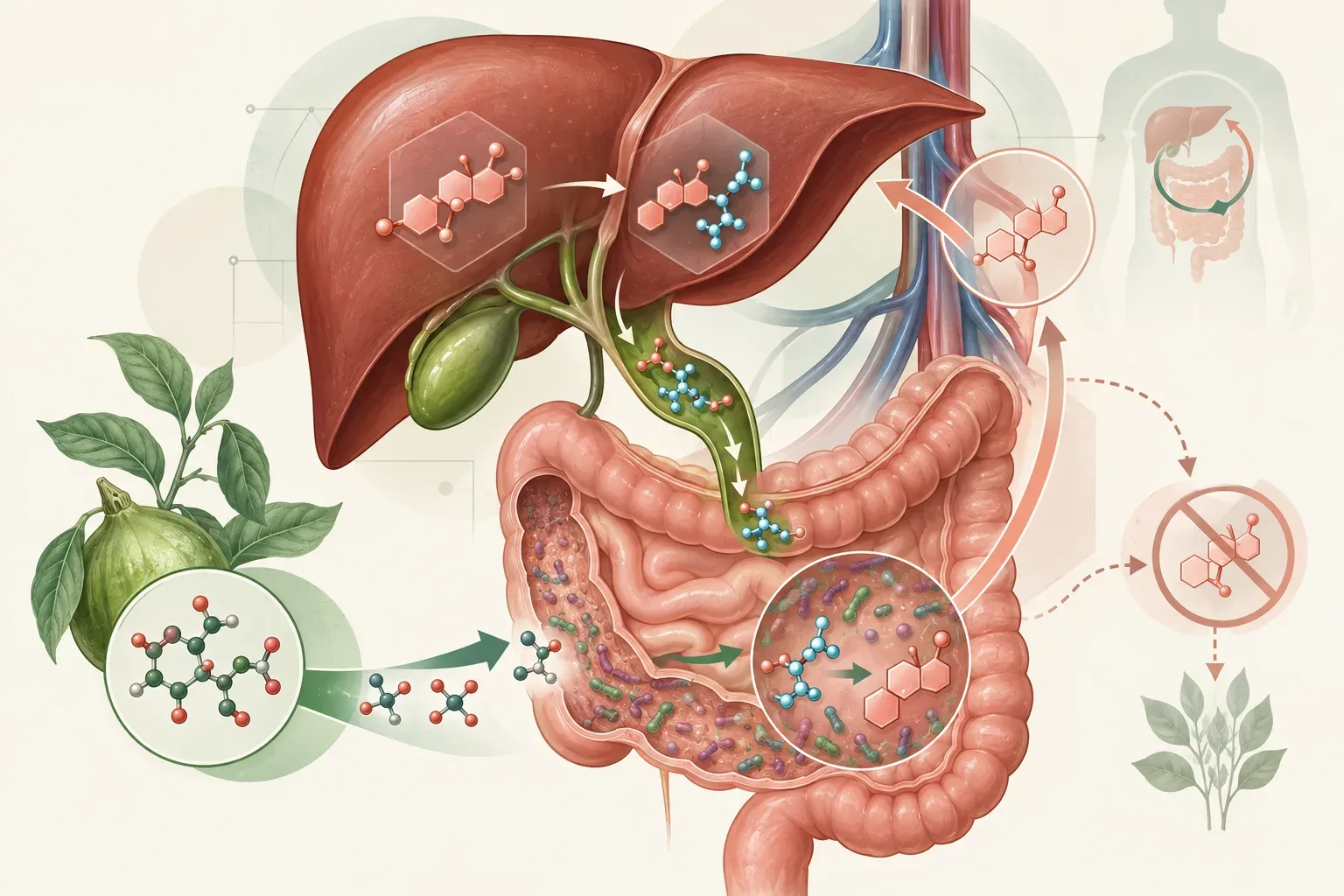
After you swallow calcium fructoborate, most of its boron is released as boric acid in the gut and absorbed. No study cited by the NIH fact sheet directly compares absorption across boron forms.
Can you take two boron products the same day?
The boron total tells you how the combination compares with the upper limit; it does not tell you whether taking both helps. Two 216 mg calcium-fructoborate servings supply about 12 mg of boron before food or other supplements. That is below the 20 mg adult ceiling but twice the daily amount in the placebo-controlled knee trials. Those trials do not show a benefit from doubling up, and longer-term safety remains uncertain. Count boron from all sources and use the age-specific ceiling above.
What to pay attention to on the label
The number to find is milligrams of calcium fructoborate, and the one to work out is the boron it supplies.
Which number on the label is the amount?
A label usually lists calcium fructoborate in milligrams, such as 110 mg, and may list boron separately. About 216 mg of calcium fructoborate gives about 6 mg of boron, so 110 mg gives about 3 mg. Add that boron to any other boron you take. The calcium in a serving is only a few percent of the compound’s weight.
Misleading labels
Boron hidden in a blend
Joint blends may include calcium fructoborate or another boron form inside a mix. A disclosed calcium-fructoborate amount lets you estimate its boron contribution using the conversion above, even without a separate boron line. If the blend hides both the boron amount and the amount of its boron-containing ingredient, you cannot calculate the contribution. The calcium-fructoborate conversion does not apply to other boron forms.
Confusing servings and items per serving
Some manufacturers put 180 capsules on the front, and the back says 3 capsules per serving and 60 servings. The amount on the Supplement Facts panel is for the whole 3-capsule serving.
Manufacturer claims and the studies they may be based on
A “clinically studied for joint comfort” line may point to the two knee trials run by the ingredient’s maker, in people with self-reported knee discomfort. A FruiteX-B label providing 108 mg per serving reaches the 2018 trial’s 216 mg daily total with two servings; a 216 mg serving reaches it with one. The serving amount alone does not describe the daily total. A joint blend adds ingredients that these knee trials did not test together.
A “supports healthy inflammation response” or heart-health claim may point to small trials that measured blood markers. Lower markers do not establish fewer heart attacks or strokes; those outcomes were not tested.
Drawbacks and side effects
| Potential drawback | When/who it affects | Research evidence | Practical implication |
|---|---|---|---|
| Unknown longer-term safety | Use beyond the short trials. | Trials lasting two weeks to three months cannot establish chronic safety. | A few weeks of trial data cannot tell you whether years of use are safe. |
| Excess boron | Stacking boron-containing products; pregnancy or impaired kidney clearance needs particular care. | The adult total-boron limit is 20 mg/day and rests on animal developmental evidence. | Count boron, not just the compound weight; borax and boric acid are not supplement substitutes. |
Safety evidence at supplemental amounts
The trials at about 216 mg a day lasted two weeks to three months, so long-term safety has not been studied. Apart from accidental poisonings, there are no data in people on harm from high boron intake, so the limit was set from animal studies instead.
Boron is the limit to watch. The official upper limit is 20 mg a day for adults, 17 mg at 14 to 18, and lower for younger children, set from reproductive and developmental problems in animals.
When household boron products are swallowed
The studied supplement supplied about 6 mg of boron; poisonings have involved boric acid or borax from cleaning or pest-control products and exposures as high as several thousand milligrams. Symptoms included nausea, vomiting, diarrhea, flushing, rash, and seizures, and extremely large amounts can kill. After a suspected ingestion, contact a poison-control center or emergency service immediately rather than waiting for symptoms.
The science behind calcium fructoborate
The studies address two different questions. Two placebo-controlled trials run by the ingredient’s maker reported better knee-comfort scores. Smaller studies found lower blood markers of inflammation but did not measure health outcomes. The university-sponsored trial has no result posted in the registry.
Knee comfort
In a 2014 trial, 60 adults aged 35 to 65 with self-reported knee discomfort took 110 mg of calcium fructoborate or a placebo twice a day for 14 days. On the WOMAC, a standard questionnaire about knee pain, stiffness, and function, both groups started with average scores of about 53, where lower is better. By day 14:
- the calcium fructoborate group averaged about 38, a drop of about 29 percent from where it started, while the placebo group averaged about 51, a drop of about 3 percent; the gap was unlikely to be chance
- and a second pain questionnaire moved the same way
At day 7, the WOMAC difference could still have been chance; the McGill pain comparison already favored calcium fructoborate. Three things limit the result. The authors worked for the ingredient’s maker. The participants did not need an X-ray diagnosis, so some may not have had osteoarthritis at all. And the authors described the placebo group’s scores as unchanged — they dipped at day 7 and were back near the start by day 14 — which is unusual in pain studies, where people given a placebo usually report some improvement; a flat placebo group can make a treatment look better than it is.
A 2018 trial funded by FutureCeuticals[1] compared 108 mg twice daily, 216 mg once daily and placebo for 90 days in adults with self-reported knee discomfort. Participants could use up to 1 g of rescue acetaminophen daily, withheld for 48 hours before visits. The primary analyses concerned day-7 and day-14 changes in WOMAC and McGill scores. McGill comparisons favored both active schedules from day 7. The authors also claimed a day-14 WOMAC difference. But their printed uncertainty ranges, called confidence intervals, include zero advantage over placebo, conflicting with their reported significance tests and leaving that result uncertain.
Later analyses found lower WOMAC scores with both schedules at days 30, 60 and 90. At day 90, the reported 95% confidence intervals for the advantage over placebo were 17.62–32.13 points for twice daily and 22.03–36.45 for once daily, on the 0–96 WOMAC scale where lower scores mean less pain, stiffness and difficulty functioning.
The trial found no clear difference between taking 216 mg once daily and 108 mg twice daily. That is not enough to establish that the schedules work equally well. Participant accounting is inconsistent: the abstract says 120 randomized, completion counts total 121, and the methods describe replacements for dropouts. A 2021 erratum[2] corrected the disclosure to name five authors employed by the funder and recorded the journal's request for retrospective trial registration.
The NIH fact sheet also describes a small unblinded study of 20 people with osteoarthritis who took 6 or 12 mg of boron a day as calcium fructoborate (about 216 or 430 mg of the compound) for 8 weeks and used less ibuprofen, and concludes that boron, particularly as calcium fructoborate, “might hold promise” but needs more controlled trials.
Inflammation markers
In a 2011 trial[3], 60 of 72 starters with osteoarthritis completed two weeks of calcium fructoborate supplying 1.5, 3 or 6 mg of boron daily, or placebo. Two blood markers of inflammation, CRP and fibrinogen, fell most from their starting values in the lowest-dose group. The printed significance tests compared each group with its own baseline, so they do not establish how reliably those changes differed from placebo.
In a 2015 placebo-controlled trial[4], middle-aged adults selected for raised inflammation markers and an unfavorable pattern of blood fats, including cholesterol and triglycerides, received 112 or 56 mg calcium fructoborate daily, split into two doses, for 30 days. The final analysis included 78 people, 26 per group. At 112 mg, CRP fell from an average 3.6 to 2.4 mg/L, compared with 3.5 to 3.0 mg/L on placebo; the between-group comparison of relative change was statistically significant. The 56 mg group did not differ clearly from placebo on that comparison, despite its decrease from baseline. Both active doses improved some blood-fat and inflammation measurements.
The paper reports 90 randomized but its allocation counts total 81; its final analyzed count is clearer than its account of exclusions. Several authors were affiliated with FutureCeuticals or the BioBoron Research Institute.
The Auburn trial has no posted results as of October 2026
Auburn University registered a trial of 216 mg of calcium fructoborate against placebo in an estimated 300 people, measuring the same knee questionnaires, starting in July 2022 with completion estimated for June 2024. The registry, checked on October 8, 2026, still has an August 2023 update, an unknown status and no posted results. It lists Auburn as lead sponsor, but names VDF FutureCeuticals as the party holding the code that reveals who received the ingredient and who received placebo. Because the manufacturer retained that role, the university name alone does not establish an independent test. What is still open is whether the knee benefit holds up when someone other than the manufacturer tests it.
The bottom line
Calcium fructoborate has some encouraging short-term knee-comfort findings, but the trials were closely linked to the ingredient’s maker and do not establish a dependable long-term joint treatment. Lower inflammation markers are also a different outcome from feeling or functioning better.
The placebo-controlled knee studies tested FruiteX-B at about 216 to 220 mg daily, supplying about 6 mg of boron. Those findings concern this ingredient; they do not establish the effects of other boron forms or joint blends containing several ingredients.
Help us improve this article
Spotted an error or found a source we should consider? Tell us which part of this article needs another look and include a link if you have one. Please leave out personal health details and lab results; we can’t answer individual medical questions.
Explore more in joints



More in minerals

References
- 2018 trial funded by FutureCeuticals ↩
- 2021 erratum ↩
- 2011 trial ↩
- 2015 placebo-controlled trial ↩
- NIH Office of Dietary Supplements: Boron — Health Professional Fact Sheet
- NIH Office of Dietary Supplements: Calcium — Health Professional Fact Sheet
- Pietrzkowski et al.: calcium fructoborate and knee discomfort, 14 days, 2014
- Pietrzkowski et al.: calcium fructoborate once versus twice daily, 90 days, 2018
- Scorei et al.: calcium fructoborate and inflammation markers in osteoarthritis, 2011
- Rogoveanu et al.: calcium fructoborate, CRP, and lipids, 2015
- Auburn University Joint Health Study registry record (NCT05438979)