
What SAMe is—and what it is not
SAMe—short for S-adenosyl-L-methionine (sometimes also named Ademetionine) is a chemical the body makes. Supplements usually contain a manufactured version in enteric-coated tablets, which are designed to pass through the stomach before dissolving.
People usually buy SAMe for depression or osteoarthritis. The evidence does not produce a clean answer: one small depression trial was positive, a larger one found no clear benefit, two 2024 reviews disagreed, and the joint evidence did not reliably beat placebo. The National Center for Complementary and Integrative Health (NCCIH) says benefit for depression, osteoarthritis, and liver disease remains inconclusive.
What SAMe does in your body
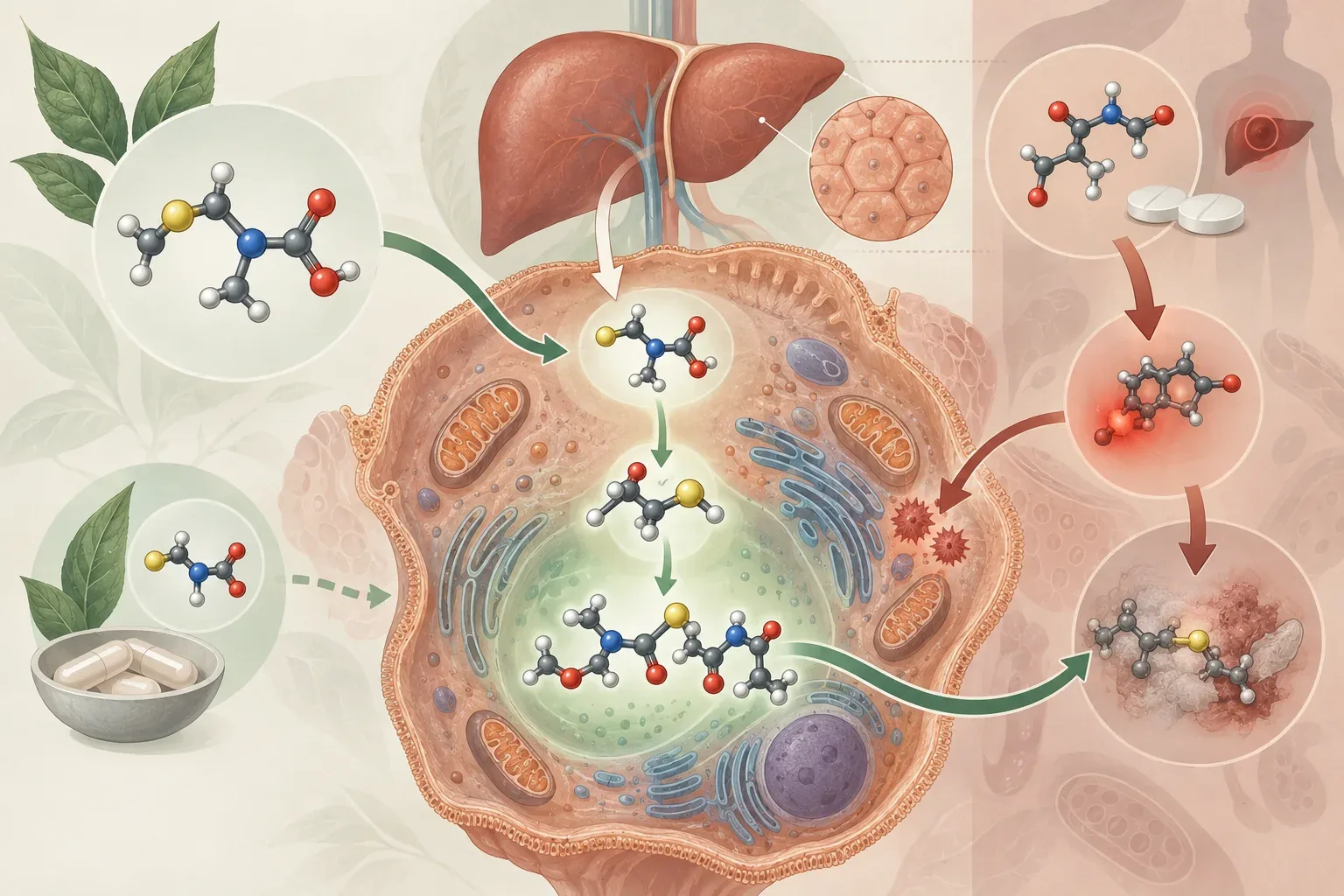
The liver and other cells make SAMe from methionine, an amino acid supplied by protein foods, using ATP, a molecule that supplies usable energy for cellular work. SAMe then donates small chemical units called methyl groups to other molecules. These transfers contribute to the processing of DNA, proteins, membrane components and other substances.
After a methyl group has been donated, the pathway leads to homocysteine. Recycling routes involving folate, B12 or betaine can return that material to methionine, while another route leads toward cysteine. Vitamin B12 or folate deficiency can be tested and treated directly; taking SAMe does not replace either nutrient.
The body controls production, use and recycling within tissues. A manufactured SAMe tablet adds a separate exposure, and its effects on depression or joint pain must be established in the trials rather than inferred from the normal cycle. [1]
The short version
Unit: milligrams (mg) of SAMe per tablet.
Dose decision: there is no official daily amount or established self-treatment dose. Depression and joint regimens belong in a clinician discussion, especially when medicines are involved.
Typical listings: 200 mg or 400 mg enteric-coated tablets.
Skip: SAMe if you have bipolar disorder unless a clinician managing it approves; using SAMe instead of depression care; and labels that call it a proven antidepressant.
What people take SAMe for
| Claimed benefit | Dose / form studied | Research verdict | Evidence strength |
|---|---|---|---|
| Improve depression when added to an antidepressant | Enteric oral SAMe, titrated to 1,600 mg/day for 6 weeks; 73 antidepressant nonresponders under psychiatric care | An early trial was positive; larger later results and pooled findings are mixed | Limited |
| Treat depression on its own | Oral SAMe 1,600 mg/day, sometimes increased to 3,200 mg, over 12 weeks in a 189-person trial | Did not beat placebo in the main comparison | Limited |
| Relieve knee osteoarthritis pain | Oral SAMe 1,200 mg/day in a 16-week crossover with celecoxib; each treatment lasted 8 weeks | Similar later pain scores versus the drug do not resolve inconclusive placebo evidence | Limited |
No one needs a SAMe supplement for nutrition because the body makes it. Someone considering it for depression or joint pain faces uncertain benefit and meaningful medication questions.
For depression, the most encouraging placebo-controlled result came from 73 adults who had not improved on an antidepressant. More people receiving SAMe had their depression score fall by at least half, the study's definition of response, but a larger trial found SAMe, the antidepressant escitalopram, and placebo about equal. For osteoarthritis, SAMe sometimes resembled an anti-inflammatory medicine in direct comparisons, yet placebo-controlled evidence did not show a reliable or clinically important advantage.
When to ask a clinician first
- Bipolar disorder: SAMe may worsen mania. The main depression trials excluded people with bipolar disorder.
- Antidepressants, L-tryptophan, or St. John’s wort: NCCIH warns of possible interactions with agents that affect serotonin. Some depression trials deliberately added SAMe to an antidepressant under clinical supervision. Involve the prescriber before combining them.
- Parkinson’s disease: SAMe may reduce levodopa’s effect.
- A weakened immune system: NCCIH notes a theoretical concern involving Pneumocystis, an organism that can cause infection in immunocompromised people.
- Pregnancy, breastfeeding, or use in a child: adequate safety evidence is missing.
Common dosage: no standard dose
There is no recommended daily amount or official upper limit for SAMe, and no trial established a best time of day. The study regimens below do not establish a routine maintenance or anxiety dose.
What to pay attention to on the label
Find the SAMe milligrams per tablet, count the tablets per serving, and check for an enteric coating. A 1,600 mg research exposure equals four 400 mg tablets or eight 200 mg tablets, which makes the distance between a front-label number and a trial easy to see.
| Complete listing | SAMe amount | Form or label issue | Decision |
|---|---|---|---|
| Enteric-coated tablet | 400 mg per tablet | Same broad oral form used in trials | Do not assume the shop product is the studied tablet |
| Enteric-coated tablet | 200 mg per tablet | Eight tablets would equal 1,600 mg | Do not mistake one tablet for the trial exposure |
| Mood or “methylation” blend | Varies | Adds ingredients the trials did not test together | Skip if the SAMe amount is hidden or the blend borrows a trial claim |
Enteric coating matters because the oral trials used it. In one study of a newer enteric-coated tablet, food delayed the peak blood level from about 4.5 to 13 hours and reduced total absorption by about half.
“Clinically proven” is too strong. A mood claim may borrow from the positive 2010 add-on study or from older injection trials. A joint claim may borrow from comparisons with anti-inflammatory medicines rather than placebo. A liver claim may borrow from animal work, injected treatment, or prescription practice outside the U.S. retail-supplement setting; NCCIH says human benefit is not established.
Oral and intravenous SAMe are different exposures
A pharmacokinetic study[2] enrolled twenty healthy Chinese volunteers, ten receiving enteric-coated oral SAMe tosylate disulfate and ten an intravenous formulation, at 1,000 mg/day for five days. After a single dose, blood exposure with the oral formulation was about 2–3% of that measured with intravenous treatment. Blood levels did not build up across repeated doses.
Drawbacks and side effects
| Potential drawback | When/who it affects | Research evidence | Practical implication |
|---|---|---|---|
| Nausea and other stomach symptoms | Oral SAMe users | Recognized effects in clinical use and trials | Review persistent symptoms with the clinician |
| Mania or mood destabilization | People with bipolar disorder or prior mania | NCCIH cautions about mania; key depression trials excluded this history | Do not self-treat bipolar depression with SAMe |
| Serotonergic or levodopa interactions | People taking antidepressants, other serotonergic agents or levodopa | Warnings and supervised add-on research are different kinds of evidence | Use combinations only with the prescriber’s oversight |
| Uncertain prolonged-use safety | Long-term use outside studied clinical settings | There is no official supplement upper limit | Short depression trials do not establish a lifetime safe dose |
Safety details
Nausea and stomach upset are the side effects that the NCCIH highlights. In the positive depression add-on trial, 5% receiving SAMe and 9% receiving placebo stopped because of side effects. Most trials lasted weeks. One two-year study in alcohol-related liver disease reported no serious side effects, and one 400 mg six-month Alzheimer’s study described SAMe as safe and well tolerated. Neither establishes a long-term safety ceiling for other people or amounts.
NCCIH warns that SAMe may worsen mania in bipolar disorder, may reduce levodopa’s effect, and could interact with medicines or supplements that affect serotonin. The frequency of these problems is uncertain. Its separate Pneumocystis concern in people with weakened immune systems is theoretical. Weight gain was not an established signal in the reviewed trials.
Does SAMe help with depression?
In the 2010 add-on trial, 36% of participants receiving SAMe met the study’s response definition, a drop of at least half on a depression scale, versus 18% on placebo. Remission—ending with minimal symptoms on that scale—occurred in 26% and 12%. The sample was small, and the authors called the result preliminary.
The larger 2014 trial assigned 189 participants aged 17 to 79 to SAMe, escitalopram, or placebo for 12 weeks. The SAMe regimen started at 1,600 mg/day and allowed an increase to 3,200 mg/day at week six if depression scores had not fallen by half, under psychiatric supervision. Response rates were 36%, 34%, and 30%, with no reliable separation. Because escitalopram also failed to beat placebo in this sample, the result does not prove equivalence; it shows that the trial could not detect benefit from either active treatment. The National Institutes of Health funded the study, while Pharmavite supplied SAMe and matching placebo.
Later trials did not resolve the conflict. A 2020 trial of 49 people found that 800 mg/day of SAMe did not clearly beat placebo. A 2018 developer-run trial in 234 people found no overall benefit when its SAMe tablet was added to an antidepressant.
Two 2024 reviews then reached different conclusions. One pooled 23 trials, including oral and injected SAMe, and reported a moderate benefit for SAMe alone over placebo; another selected 14 trials and found no difference. Their different trial selections and analyses prevent the totals from being treated as the same calculation, and it remains unclear which differences explain their conflicting conclusions. Both found no clear benefit from adding SAMe to an antidepressant. The open question is whether oral SAMe can show a meaningful benefit in a large, independent, placebo-controlled trial.
Anxiety and trauma-related symptoms
The depression studies do not automatically answer whether SAMe treats an anxiety disorder. A 2026 trial[3] enrolled 31 adults with trauma-related depression and compared 1,200 mg/day SAMe with placebo alongside twelve weeks of trauma-focused psychotherapy. Twenty-eight completed it. Depression improved during treatment without an added clinical benefit from SAMe. Changes in DNA-methylation measurements were not symptom improvement.
A six-week trial in ninety adults with depression[4] tested one tablet daily containing 200 mg SAMe and one billion colony-forming units of the probiotic L. plantarum HEAL9 against placebo. Colony-forming units[5] indicate the number of living cells. A secondary anxiety questionnaire favored the combination at week two, but that difference was no longer clear at week six. In contrast, an eight-week trial in 158 depression outpatients[6] found no clear anxiety or sleep advantage for a multi-ingredient mixture containing SAMe; nausea was more common with the mixture. Neither trial isolates SAMe's contribution.
What the joint evidence shows
In a 2004 crossover trial, 56 people with knee osteoarthritis took 1,200 mg/day of SAMe and 200 mg/day of the anti-inflammatory medicine celecoxib during different parts of 16 weeks. Celecoxib reduced pain faster during the first month; by the second month the groups looked similar. Without a placebo period, similarity cannot show that SAMe itself caused the improvement.
A 2009 Cochrane review of four placebo-controlled trials with 656 participants estimated a pain difference of about 4 millimeters on a 100-millimeter scale. That small difference could have been due to chance, and joint function did not improve. The reviewers judged the trials poor quality and did not support routine use.
Liver disease: symptom changes and survival are separate questions
NCCIH considers the evidence for liver disease insufficient.
A placebo-controlled trial in 220 inpatients[7] with chronic liver disease and impaired bile flow tested oral SAMe at 1,600 mg/day. The authors reported short-term improvements in itching, fatigue and cholestasis blood markers compared with placebo.
A two-year trial[8] assigned 123 patients with alcohol-related cirrhosis to 1,200 mg/day oral SAMe or placebo. Death or liver transplantation occurred in 16% and 30%, respectively, but the overall difference was not statistically clear. An analysis excluding the eight patients with the most advanced disease favored SAMe. That subgroup result should not replace the uncertain overall result.
Fibromyalgia: a small mixed trial
A six-week trial[9] in 44 patients compared 800 mg/day oral SAMe with placebo. Pain, fatigue, morning stiffness and selected disease-activity and mood ratings favored SAMe. Tender-point scores, measured muscle strength and the Beck depression scale did not differ clearly. The study supplies a preliminary symptom signal with mixed outcomes, consistent with the need for better evidence identified by NCCIH.
Alzheimer’s disease and migraine
NCCIH considers evidence insufficient for Alzheimer’s disease and migraine. A 2026 Alzheimer’s study using 400 mg/day for six months found no improvement in blood p-tau217, a modified tau protein associated with Alzheimer’s disease.
The bottom line
SAMe has some positive mood and joint-pain findings, but placebo-controlled results remain mixed. The two 2024 reviews disagreed about SAMe used alone for depression; neither found a clear benefit from adding it to an antidepressant. The joint evidence likewise does not show a reliable benefit over placebo.
Help us improve this article
Spotted an error or found a source we should consider? Tell us which part of this article needs another look and include a link if you have one. Please leave out personal health details and lab results; we can’t answer individual medical questions.
Explore more in mood


Nutrient connections worth understanding
 Nutrient use
Vitamin B12 (Cobalamin): Daily Needs, Deficiency Signs and Treatment Choices
Connection details
Context: starting SAMe
Correct B12 and folate first.
Source for this connection
 Nutrient use
Vitamin B9 (Folate and Folic Acid): Benefits, Forms, and Dosage
Connection details
Context: starting SAMe
Correct B12 and folate first.
Source for this connection
More in compounds


References
- NCCIH: S-Adenosyl-L-Methionine (SAMe): In Depth ↩
- pharmacokinetic study ↩
- Alkema et al.: SAMe added to trauma-focused therapy, 2026 ↩
- six-week trial in ninety adults with depression ↩
- Colony-forming units ↩
- eight-week trial in 158 depression outpatients ↩
- placebo-controlled trial in 220 inpatients ↩
- two-year trial ↩
- six-week trial ↩
- NIH Office of Dietary Supplements: Vitamin B12 — Health Professional Fact Sheet
- NIH Office of Dietary Supplements: Folate — Health Professional Fact Sheet
- Papakostas et al.: SAMe added to antidepressants in nonresponders, 2010
- Mischoulon et al.: SAMe versus escitalopram versus placebo, 2014
- Sarris et al.: SAMe alone versus placebo in major depression, 2020
- Targum et al.: MSI-195 SAMe added to antidepressants, 2018
- Galizia et al.: Cochrane review of SAMe for depression, 2016
- Limveeraprajak et al.: meta-analysis of SAMe for depression, 2024
- Peng et al.: meta-analysis of SAMe for depression, 2024
- Murphy et al.: SAMe added in bipolar depression, 2014
- Najm et al.: SAMe versus celecoxib in knee osteoarthritis, 2004
- Rutjes et al.: Cochrane review of SAMe for osteoarthritis, 2009
- Holper et al.: SAMe for six months in Alzheimer’s disease, 2026
- MSI-195 SAMe absorption and food effect study, 2020
- NIH Dietary Supplement Label Database: a SAMe 200 mg label
Corrections & updates
- Update
Updated the evidence discussion and practical guidance after editorial review.
- Update
Revised the article after editorial review, with clearer evidence explanations and practical guidance.