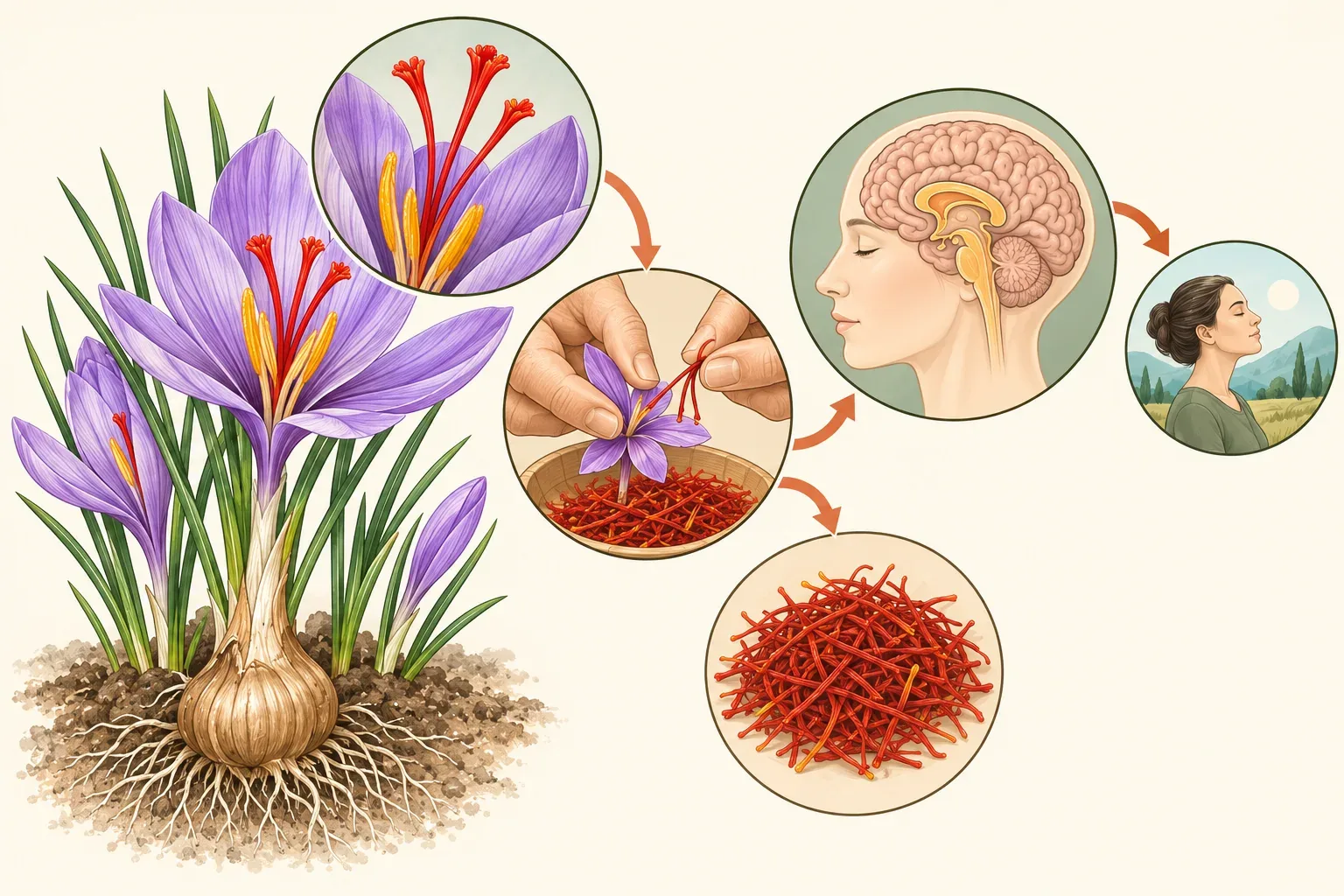
What is the historical connection?
Hosseinzadeh and Nassiri-Asl's 2013 review of saffron in Avicenna's Canon of Medicine[1] describes its historical uses for mood and sleep, among others. They draw on Book II, the part of the Canon about individual medicines, and compare those accounts with modern pharmacology.
That is an attributed interpretation of a historical medical text. Its use of modern terms such as antidepressant should not be taken to mean that Avicenna used today's diagnostic criteria. An older description of sadness, temperament or sleep can overlap with a modern symptom without defining the same disorder.
That history helps explain why researchers chose to study saffron for mood. It does not tell us whether saffron helps people with a diagnosed condition today; for that, we need trials that define who took it and what changed.
What did the placebo-controlled depression trial find?
In Akhondzadeh's 2005 study[2], 40 adult outpatients with mild to moderate major depression were assigned to a preparation from saffron stigmas—the thread-like flower parts—or placebo for six weeks. The saffron amount was 30 mg a day. Clinician-rated depression scores improved more with saffron.
This was a small, single-center trial. Its positive comparison supplies a reason for further investigation, rather than a final estimate of how much benefit to expect in routine care. Six weeks also leaves questions about lasting response, relapse and longer-term safety.
The preparation was important. A tested stigma preparation does not establish the same result from a few threads in food, an unspecified powder, a petal product or an extract with a different composition.
Do antidepressant comparisons show that saffron can replace medication?
A separate 2005 trial[3] compared saffron with fluoxetine, an antidepressant, in 40 adults over six weeks. The groups had similar symptom changes. That finding is interesting, but a small trial that does not detect a difference cannot by itself establish equal effectiveness.
A comparison intended to establish that one treatment is no worse than another needs a suitable design, enough participants and a prespecified acceptable difference. Merely reporting a nonsignificant difference leaves open whether the study could detect a meaningful one.
Adding saffron to an antidepressant asks another question. In a 2019 placebo-controlled add-on study[4], clinician ratings favored saffron while participants' own depression ratings did not clearly differ. Those findings should remain together.
Why do reviews and symptom ratings disagree?
Marx and colleagues' 2019 review[5] found encouraging average effects but also evidence of publication bias and limited regional diversity. Publication bias means the available studies may overrepresent favorable findings if negative studies are less likely to become public.
A 2026 review of 34 trials[6] reported improved self-rated depressive and anxiety symptoms without a corresponding clear clinician-rated effect. That pattern differs from the 2019 add-on trial. The studies and populations were different, so the findings do not identify one measurement as the reliable winner.
Self-ratings describe a person's experience; clinician ratings apply an external assessment. Both can be informative. When they disagree, the practical uncertainty is whether the apparent improvement is consistent across meaningful aspects of the illness. A favorable average should not conceal the outcome that failed to change.
There is also a difference between diagnosed major depression and low mood below that threshold. A study can provide useful evidence for one outcome without settling the other question.
Does newer research settle the question?
Newer trials extend the investigation but still need to be read with the scale and what they tested in mind. A 2026 placebo-controlled study of UO SAF 02[7] randomized 56 adults with low mood and subclinical to mild depressive symptoms for 56 days. Participants took one 15 mg capsule twice daily, totaling 30 mg a day, and the study reported improved mood measures.
The sponsor, Xtractiva, funded the study; several authors worked for it or its parent company, and relevant patent interests were disclosed. This small, commercially connected study concerns adults with subclinical to mild symptoms; long-term effectiveness in major depression remains open.
The useful next evidence would include independent replication in clearly defined populations, with outcomes selected in advance and enough follow-up to assess whether a benefit lasts.
Has research confirmed the traditional explanation?
The clinical evidence tests symptom changes more directly than it tests the complete explanation behind them. Proposed effects on brain signaling or inflammation are possible mechanisms to investigate.
For example, a study that finds both a mood-score change and a cortisol change has measured two outcomes. It has not necessarily shown that the cortisol change produced the mood improvement. Nor does either result establish that a historical theory of temperament correctly described the biological process.
This leaves a limited but meaningful connection: an older mood use led to a related modern hypothesis, and some controlled trials support a symptom effect from particular preparations. The mechanism, consistency and scope of that effect remain less certain.
What should you check before considering a mood supplement?
Begin with the problem you want to address. Persistent low mood deserves assessment, especially if it is disrupting sleep, work or relationships. If you already take medication, discuss an add-on with the prescriber; a study that monitored a combination does not establish that every product or combination is suitable.
Then check the product's identity against the study: plant part, named extract or formulation, standardization (the declared proportion of a measured plant compound) and amount. Short trials also cannot establish indefinite safety, and their findings should not be extended to pregnancy without appropriate evidence.
The bottom line
Saffron’s historical use for mood has a meaningful connection to modern research: some controlled trials report symptom improvements. The evidence is still uneven across preparations, populations and ways of rating symptoms, especially in terms of self-reported improvement versus clinical observations. Our main saffron guide covers the broader evidence and supplement choices.
Help us improve this article
Spotted an error or found a source we should consider? Tell us which part of this article needs another look and include a link if you have one. Please leave out personal health details and lab results; we can’t answer individual medical questions.