
What is vitamin B12?
Vitamin B12 supports nerve function, DNA production and healthy red blood cells. Animal foods, fortified foods and supplements provide it. Adults need 2.4 micrograms a day through their diet and any supplements combined.
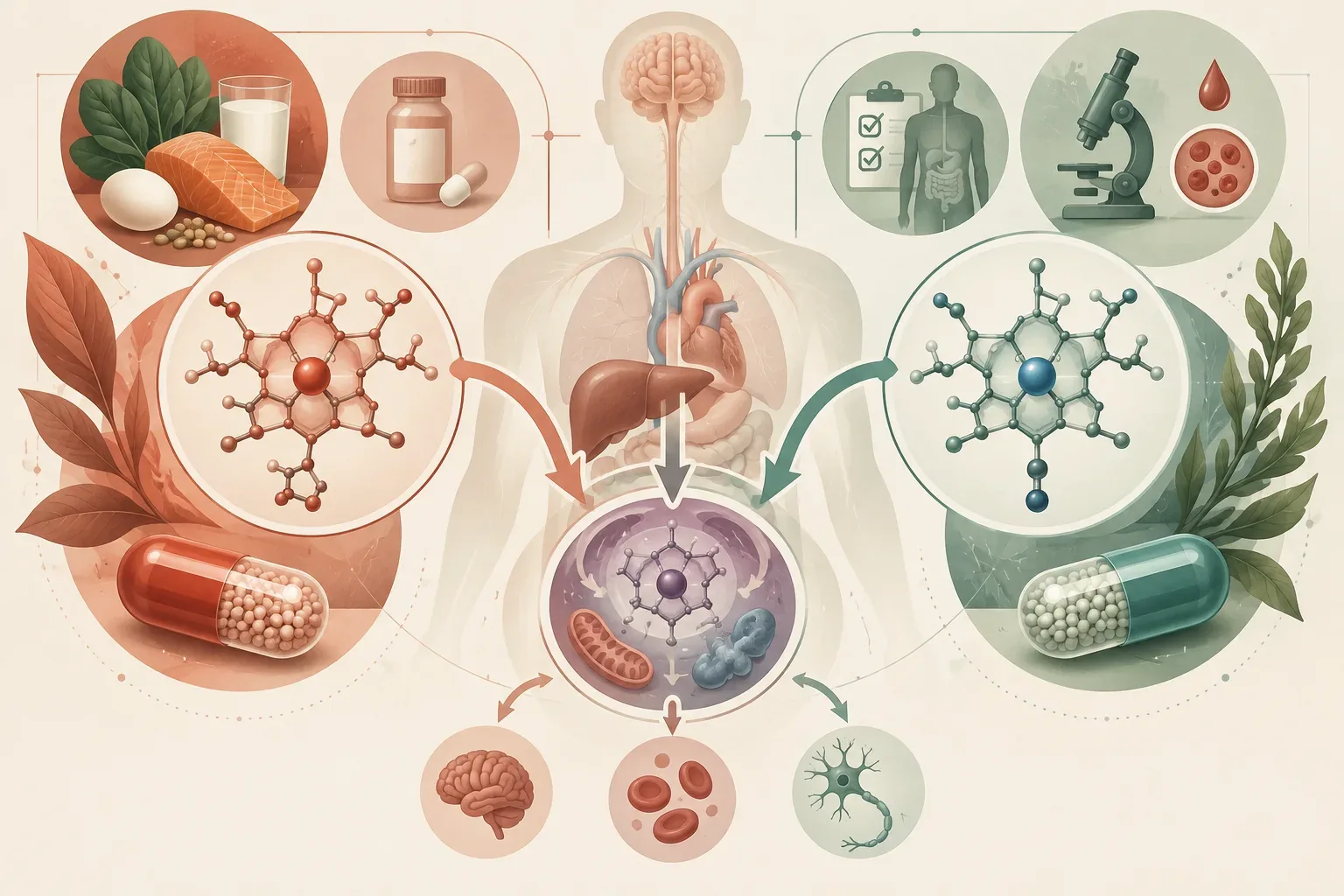
The familiar supplement names—cyanocobalamin, methylcobalamin, hydroxocobalamin and adenosylcobalamin—are forms of the same vitamin.
What does vitamin B12 do in your body?
Vitamin B12 helps two enzymes perform particular chemical conversions. One works with folate to convert homocysteine into methionine. That reaction also helps keep folate available for making DNA, which is important when bone marrow produces new blood cells.
The other B12-dependent enzyme helps process substances derived from certain fats and amino acids into material the cell can use in energy metabolism. When that reaction is impaired, methylmalonic acid, or MMA, can rise. This is why MMA sometimes helps investigate B12 status rather than serving as a general measure of energy.
B12 is also required for normal nervous-system function and the maintenance of myelin, the insulating material around nerves. Its roles in blood formation and nerves are related but distinct: nerve injury can occur without an abnormal blood count. [1]
Why do people take vitamin B12?
| Claimed benefit | Dose / form studied | Research verdict | Evidence strength |
|---|---|---|---|
| Correcting deficiency | Oral or injected replacement selected for the cause | B12 replacement addresses deficiency; route and urgency depend on symptoms and absorption. | Strong |
| Correcting marginal status in vegans or vegetarians | One trial tested 50 mcg daily or 2,000 mcg weekly in 40 participants | Both schedules addressed that specific population, rather than defining everybody's daily need. | Moderate |
| Improving diabetic nerve symptoms in long-term metformin users with B12 below 400 pmol/L (about 540 pg/mL) | Oral methylcobalamin 1,000 mcg/day for a year | A small trial improved pain and several nerve measures; tests of automatic heart and blood-pressure control and clinical examination did not improve. | Limited |
| Improving nerve function or memory in older adults with moderately low B12 but no symptoms | Oral B12 1 mg/day for a year | Blood levels improved without a nerve-function or memory benefit. | Limited |
| Preventing cardiovascular events by lowering homocysteine, a blood amino acid processed with the help of B vitamins | Trials of combined B vitamins, not B12 alone | A lower blood marker did not reliably improve the main cardiovascular outcome. | Moderate |
People eating no animal foods need a reliable fortified-food or supplement source. Some vegetarians, older adults and people taking metformin or long-term acid-suppressing medicines should also discuss whether they get enough B12 or need testing. B12 in supplements and fortified food is not bound to food protein in the same way, which can matter when releasing food-bound B12 is difficult.
Common dosage and food
The recommended daily amount from the National Academies is 2.4 mcg for adults.
Meat, fish, eggs and dairy supply B12; fortified products can provide a non-animal source if the label declares it. If you avoid animal foods, check the actual fortification and frequency rather than assuming an unfortified plant product provides B12. Your dietitian or clinician can help establish a reliable plan.
Selected values from the NIH Office of Dietary Supplements food table[1] show the stated food and preparation. Amounts are per serving.
| Food and preparation | Source | Serving | Vitamin B12 (mcg) |
|---|---|---|---|
| Beef liver, pan-fried | Meat | 3 oz (about 85 g) | 70.7 mcg |
| Clams, cooked | Shellfish | 3 oz (about 85 g) | 17 mcg |
| Nutritional yeast, fortified; check label | Fortified | about ¼ cup | 8.3–24 mcg |
| Atlantic salmon, cooked | Fish | 3 oz (about 85 g) | 2.6 mcg |
| Milk, 2% | Dairy | 1 cup | 1.3 mcg |
| Egg, cooked | Egg | 1 large | 0.5 mcg |
On a vegan diet without regularly eaten B12-fortified foods or a B12 supplement, food may supply essentially no reliable B12. The table's fortified yeast can provide several times the adult daily amount, but its B12 varies markedly by brand; check the label and how often you eat it. Unfortified plant foods are not reliable B12 sources.
Labels often contain much more than the dietary requirement. 1 mg equals 1,000 mcg. The proportion of an oral dose absorbed falls as the amount increases, which helps explain why some treatment schedules use larger numbers.
A fortified drink can make a measurable contribution: the US shelf-stable Silk Original Soymilk label lists 3 mcg B12 per 240 mL. This is one formulation, not a value for all plant milks. Added B12 is free from food protein, but ordinary fortified-food amounts should not be assumed to correct pernicious anemia or another substantial absorption problem. In pernicious anemia, immune damage prevents the stomach from making enough intrinsic factor, a protein needed to absorb ordinary amounts of B12. The amount on a carton answers an intake question; treatment still depends on the cause of deficiency. [2], [1]
What changes how much you absorb
The share absorbed depends strongly on the amount in one dose. NIH reports[1] about 50% absorption below 1–2 mcg, but roughly 2% at 500 mcg and 1.3% at 1,000 mcg. The percentage falls, yet a large tablet can still deliver more B12 in absolute micrograms. Food-bound B12 must first be released from its food protein; reduced stomach acid can impair that step even when free B12 in a fortified food or supplement remains available. These fractions do not choose a treatment route for someone with severe deficiency or malabsorption.
How can I tell if I'm low on vitamin B12?
B12 deficiency can affect blood cells and nerves, and those problems do not always develop together. Diet matters, but impaired absorption, surgery, medicines and nitrous oxide exposure can also be relevant. [1]
Low or marginal status
You may have no obvious symptoms. Because the body stores B12, recognizable deficiency can take years to develop.
Anemia-related symptoms
Tiredness, weakness, pale skin, palpitations and a sore or inflamed tongue can occur. A blood count may show large red blood cells or other low cell counts.
Neurological symptoms needing prompt assessment
Numbness or tingling in the hands and feet, changes in thinking, and new balance or walking problems can occur even without anemia.
When to seek medical assessment
Seek prompt assessment for the neurological changes above, even if a blood count shows no anemia—low hemoglobin, the oxygen-carrying blood protein. B12-related nerve injury can become permanent.
Stomach or intestinal surgery, autoimmune stomach disease, persistent symptoms and a confirmed low result need investigation of the cause.
Testing and interpretation
For more information about testing for vitamin B12, see the lab tests and preparation details near the end of this article.
Forms and routes
| Form | What the evidence allows you to say |
|---|---|
| Cyanocobalamin | Widely studied in oral replacement; a conventional B12 source |
| Methylcobalamin | Used in oral supplements and some adult replacement trials |
| Hydroxocobalamin | Has distinct injection uses; treatment route and indication matter |
| Adenosylcobalamin | A biochemical B12 form; limited evidence for marketing it as a uniquely effective oral choice |
An older study comparing four forms measured retention at small oral amounts. The highest-retained form changed with amount; it did not establish which modern high-dose tablet best corrects symptoms. The methylcobalamin versus cyanocobalamin comparison explains the adult replacement evidence in more detail.
What to look for on the label
Which amount and schedule are stated?
Read the B12 micrograms, ingredient name, serving size and whether the instructions describe daily or weekly use. A multivitamin, a B-complex and a B12-only product can contribute to the same total.
Label claims and common reading mistakes
Treating “active” as a clinical outcome
“Methyl” and “adenosyl” describe chemical forms used in the body. An “active” label is not evidence that the product improves absorption, nerve recovery or energy more than another B12 form.
Comparing Daily Value instead of purpose
A 1,000 mcg serving has an enormous Daily Value percentage. That is not itself evidence of toxicity, but neither is it evidence that everyone needs that serving. Ask whether the amount is for dietary coverage, marginal deficiency or medical replacement.
How long should I take vitamin B12 supplements for?
If you get little or no B12 from animal or fortified foods, you need a reliable continuing source even after a low level improves. The body stores roughly 1–5 mg, so classic deficiency symptoms can take several years to appear after intake becomes inadequate; that delay is not a safe waiting period. Treatment for confirmed deficiency first corrects the problem, then moves to maintenance chosen for its cause and follow-up results. Persistent malabsorption, including pernicious anemia, can require lifelong treatment; a temporary dietary gap may not. NIH's B12 review[1] does not support one taper or frequency for all of these situations.
How B12 interacts with folate
B12 and folate participate in related reactions, but folic acid alone can correct the anemia of B12 deficiency while its neurological injury continues. A normalizing blood count therefore does not establish that the B12 problem has been treated. If anemia or neurological symptoms are part of the question, assess B12 rather than using folate as a substitute.
That mechanism does not establish how often ordinary folic-acid fortification delays diagnosis. A US study counted adults who had low B12 despite blood counts showing neither anemia nor enlarged red cells. That group did not become more common after fortification; the study did not directly measure nerve injury. Other observational work found some high-folate/low-B12 associations with poorer cognition, without establishing that fortified foods caused them. B12 deficiency can itself occur without anemia, so a normal blood count deserves that caution even in someone who eats no fortified food. [3], [4], [1]
Common Myths about Vitamin B12
Does a common MTHFR variant change B12 treatment?
MTHFR is a gene that helps the body process folate[5]; a variant is an inherited difference in its DNA sequence. A common MTHFR variant does not diagnose B12 deficiency or establish that you need methylcobalamin. Symptoms, absorption and the cause of deficiency matter more to treatment. The B12 nerve-injury and MTHFR guide explains how those questions fit together.
Does a sublingual tablet bypass every absorption problem?
“Sublingual” means held under the tongue. It does not establish that the product bypasses the gut well enough to treat every cause of poor absorption. Form, route and treatment response still need to match the diagnosis.
Does a very high Daily Value mean more energy?
Not by itself. The percentage compares the serving with a small 2.4 mcg dietary reference. It does not promise an energy boost when you already get enough B12; the fatigue research remains limited.
Drawbacks and side effects
| Potential drawback | When/who it affects | Research evidence | Practical implication |
|---|---|---|---|
| Misleadingly high post-supplement blood results | Testing after oral or injected B12 | [6] | Report amount, route and timing; do not use the number alone as proof of recovery |
| Cobalt-related reactions | People with relevant sensitivity | [1] | Raise a known allergy before choosing treatment |
| Harm from an inappropriate multi-vitamin regimen | Particular disease populations and combinations | [7] | Do not assign the result to one B12 form or copy the combination |
| Acne-like skin eruption | Reported during oral treatment or after injections | [8] | Discuss a new eruption with the prescriber; do not leave confirmed deficiency untreated. |
The National Academies did not set a formal upper limit because observed B12 toxicity is low. That does not make every route, combination or medical situation equivalent, or prove benefit from escalating the amount.
B12 during pregnancy and breastfeeding
Women need 2.6 mcg/day in pregnancy and 2.8 mcg/day during breastfeeding, counting all sources. Vegan women need a reliable fortified-food or supplement plan. Check the prenatal label rather than assuming its B12 content.
Diagnosed deficiency is a different question from those dietary requirements. NICE recommends continuing necessary replacement during pregnancy and breastfeeding with clinical review, rather than stopping it because a prenatal contains a smaller amount.
The science behind B12
Metformin and B12 levels
Metformin can lower B12 over time. In a trial of 390 insulin-treated adults with type 2 diabetes[9], 850 mg metformin three times daily was compared with placebo for 4.3 years. B12 concentrations were 19% lower relative to placebo (95% CI 14–24% lower), and deficiency below 150 pmol/L (about 200 pg/mL) was 7.2 percentage points more frequent (95% CI 2.3–12.1). This establishes a reason to pay attention to B12 status during treatment; it does not test whether B12 supplementation treats neuropathy.
Studied schedules for marginal deficiency
Del Bo's trial in 40 vegans and vegetarians with marginal deficiency compared 50 mcg/day with 2,000 mcg/week. Those schedules addressed a selected population, not the dietary requirement for all healthy adults.
When oral treatment can work
Oral treatment has worked in several deficiency trials, but the cause and schedule matter. In the 1998 Kuzminski trial[10], 38 deficient adults were randomized and 33 were evaluated after folate deficiency was identified in five. Oral cyanocobalamin, 2 mg every day for four months, was compared with 1 mg injections on days 1, 3, 7, 10, 14, 21, 30, 60 and 90. Both corrected blood abnormalities; the authors also reported similar neurologic improvement. The cumulative doses differed substantially. A trial this small cannot settle the best route for severe nerve injury.
The larger OB12 trial[11] enrolled 283 adults aged 65 or older. More than 90% reached a normal serum B12 level after eight weeks of daily 1 mg tablets or injections: 1 mg on alternate days during weeks 1–2, then weekly during weeks 3–8. The oral schedule then fell to once weekly, while injections continued at 1 mg monthly. At one year, normalization was 103 of 140 with tablets and 115 of 143 with injections: a difference of −6.8 percentage points, with a 95% confidence interval from −16.6 to 2.9. That interval crossed the trial's limit for an acceptably small disadvantage, so long-term noninferiority was not established. This result concerns the weekly maintenance schedule tested.
Methylcobalamin also has adult replacement evidence. In 50 patients after Roux-en-Y gastric bypass[12], daily oral methylcobalamin, 1,000 mcg, and hydroxocobalamin injections both restored serum B12 over six months. The injection group received 2,000 mcg initially and 1,000 mcg every two months afterward. MMA and homocysteine improved without a significant between-group difference. The study measured blood markers rather than recovery from serious nerve injury, and FitForMe supplied the oral tablets.
NICE recommends lifelong intramuscular replacement for deficiency caused by autoimmune gastritis, total stomach removal or complete removal of the final part of the small intestine. For other confirmed or suspected poor absorption, it considers route clinically; when oral replacement is chosen, it specifies at least 1 mg/day. These are diagnosis-dependent treatment recommendations, not higher dietary targets.
B12 and diabetic nerve symptoms
A 2021 trial[13] studied 90 adults with diabetic neuropathy who had taken metformin for at least four years and had B12 below 400 pmol/L (about 540 pg/mL) and stable blood-sugar control (HbA1c 6.5–7.5%). Daily oral methylcobalamin, 1,000 mcg for a year, reduced the PAINDetect neuropathic-pain questionnaire score from 18.4 to 17.1; placebo scores rose from 19.3 to 20.9. The adjusted difference favored B12 (P<0.001), but this test of statistical significance does not establish that the score change was large enough to matter clinically. Several nerve-conduction and symptom measures improved, while clinical examination and tests of automatic heart and blood-pressure control did not. The small, single-center trial tested many outcomes, so its positive findings need confirmation. It supports a possible benefit in that selected group. The tablet maker supplied treatment but the authors reported no external funding.
A smaller 2026 dose-comparison trial[14] randomized 35 adults with diabetic neuropathy and B12 below 200 pg/mL (148 pmol/L) to 1,000 or 2,000 mcg of methylcobalamin daily for 16 weeks. Pain improved in both groups, without a significant difference between doses; disability scores did not change. With no placebo group, the study cannot separate treatment effects from improvement over time. Its higher-dose group also had a decline in estimated kidney function that warrants clarification in the full report.
Memory, mood and energy
Correcting a blood result does not always change symptoms. In a trial of 201 adults aged at least 75[15], participants had moderately low B12 but no anemia or neurologic or cognitive symptoms. Compared with placebo, daily 1 mg oral B12 for a year markedly raised B12 levels, yet did not improve nerve function or cognition.
A review of 16 randomized-trial reports involving 6,276 participants[16] found no overall cognitive or depression benefit from B12 alone or in B-vitamin combinations in people without overt deficiency. It includes the older-adult trial above, so these are overlapping evidence. For fatigue, the review found only one B6/B12/folic-acid combination trial: vitality improved at eight weeks, but the groups already differed significantly at the start. That limited positive finding could not be pooled or assigned to B12 alone.
Other studied uses
A small mouth-ulcer trial[17] gave 58 adults sublingual B12, 1,000 mcg daily, or placebo for six months. Ulcer duration, number and pain favored B12 late in treatment. The finding needs stronger confirmation and does not establish that sublingual dosing is better than swallowing B12.
B12 has also been tested with folic acid for fracture prevention. In the B-PROOF trial[18], 2,919 older adults with high homocysteine took 500 mcg B12 plus 400 mcg folic acid, or placebo, for two years; both groups received vitamin D. Fractures occurred in 4.2% versus 5.1% (hazard ratio 0.84, 95% CI 0.58–1.21). More participants reported a new cancer in the supplement group: 63 versus 42. That is a safety concern, though the trial was designed to assess fractures rather than cancer and cannot assign the finding to B12 alone. This combination did not establish a fracture-prevention benefit.
Lowering a blood marker is not the same as preventing disease
HOPE-2 studied 5,522 adults with vascular disease or diabetes for about five years. Daily folic acid 2.5 mg, B6 50 mg and B12 1 mg lowered homocysteine, but the primary combined cardiovascular outcome occurred in 18.8% versus 19.8% on placebo (relative risk 0.95, 95% CI 0.84–1.07). Our folate discussion explains its secondary stroke benefit and unstable-angina increase.
The DIVINe trial[19] tested a different combination in 238 people with diabetic kidney disease: folic acid 2.5 mg, B6 25 mg and B12 1 mg daily versus placebo. At 36 months, measured kidney filtration declined by 16.5 versus 10.7 mL/min/1.73 m², a difference of −5.8 (95% CI −10.6 to −1.1). The secondary combined outcome of vascular events or death was also more frequent. This small combination trial cannot assign harm to one B12 form or establish that methylcobalamin would be safer.
What you may have heard on podcasts
Gil Carvalho discussed the 2.4 mcg dietary amount and the 50 mcg/day or 2,000 mcg/week marginal-deficiency study on October 19, 2020. The trial population matters when interpreting those larger schedules. His preference for methylcobalamin with kidney problems is not established as a general rule by the multi-vitamin kidney trial.
Peter Attia discussed methylfolate and methyl B12 for lowering homocysteine on Huberman Lab on July 29, 2024, without providing a B12 microgram amount. Lowering that marker is possible, but the cardiovascular trials above show why it does not by itself establish protection from disease.
Lab tests
A total B12 result is a useful starting point, but can miss deficiency or look reassuring after supplements without the deficiency being fully treated. Nitrous oxide can also leave the measured concentration apparently normal while inactivating B12. No single test settles every case; symptoms, exposure history and, when appropriate, MMA help clarify the result. [20]; [1]
What a high B12 result can mean
A high result needs context, especially if you have not been taking B12. In an observational study of 25,017 cancer patients[21] tested before diagnosis and not receiving B12 treatment, one-year survival was 69.3% at 200–600 pmol/L, 49.6% at 601–800, and 35.8% above 800. The association concerned prognosis in selected cancer patients, not screening healthy people. Illness can change B12 handling; these data do not show that supplements caused cancer or that taking more B12 would help.
Interpreting the results
A serum B12 blood test measures B12 in the liquid part of a blood sample. The result is a concentration, reported in picograms per milliliter (pg/mL) or picomoles per liter (pmol/L). To compare them, 1 pg/mL is about 0.738 pmol/L. NIH notes that levels below roughly 200–250 pg/mL (148–185 pmol/L) are commonly considered low, while methods and laboratory ranges vary.
For an uncertain result, particularly in the 150–399 pg/mL range, methylmalonic acid, or MMA, can help. This substance can rise when cells cannot use enough B12, but kidney impairment and older age can raise it too. Homocysteine, another blood measurement, is less specific because folate and kidney function also affect it.
A blood count helps identify anemia, but a normal count does not rule out a nerve problem from B12 deficiency. Tests alone also do not identify why B12 is low. Diet, autoimmune gastritis—immune damage affecting the stomach—surgery, medicines and nitrous oxide exposure can require different plans. If you already take B12, check the test-preparation advice before arranging a blood draw.
Preparing for a test if you take supplements
Tell the clinician about oral products and the date of any injection. NICE favors obtaining diagnostic samples before treatment where practical, but urgent neurological concerns should not wait for an arbitrary pause. It does not establish an oral B12 stopping interval that restores your original baseline.
Mayo's serum B12 assay instructions[22] advise against testing within two weeks of an injection. That is advice for interpreting that assay, not a reason to delay or stop necessary replacement on your own.
Available tests
A serum vitamin B12 test is widely available. Standalone serum MMA is another option when the clinical question warrants it. Kidney function must be considered when interpreting MMA. Choose follow-up with the treating clinician rather than trying to make a post-treatment number return to a preferred range.
The bottom line
B12 supplementation has a clear purpose when intake or absorption is inadequate. The important decision is whether you need prevention or treatment, and whether symptoms or the cause of deficiency change the route and urgency.
Methylcobalamin is not established as universally better than cyanocobalamin, and a larger label amount is not your dietary requirement. Choose a usable form and schedule suited to the actual need, then assess the response appropriately. If you already get enough B12, the evidence does not make an extra high-dose product a dependable energy or cardiovascular supplement.
Help us improve this article
Spotted an error or found a source we should consider? Tell us which part of this article needs another look and include a link if you have one. Please leave out personal health details and lab results; we can’t answer individual medical questions.
More about vitamin B12 (Cobalamin)

Explore more in energy & fatigue




Food sources & dietary alternatives

References
- NIH: Vitamin B12 ↩
- Manufacturer label, checked 21 October 2026 ↩
- Qi study ↩
- Bailey study ↩
- MTHFR is a gene that helps the body process folate ↩
- NICE NG239: Diagnosis and replacement ↩
- DIVINe ↩
- Five cases described inflamed bumps and pustules appearing one week to five months after treatment began; this cannot establish frequency or a safer B12 form ↩
- trial of 390 insulin-treated adults with type 2 diabetes ↩
- Kuzminski trial ↩
- OB12 trial ↩
- 50 patients after Roux-en-Y gastric bypass ↩
- 2021 trial ↩
- 2026 dose-comparison trial ↩
- trial of 201 adults aged at least 75 ↩
- review of 16 randomized-trial reports involving 6,276 participants ↩
- small mouth-ulcer trial ↩
- B-PROOF trial ↩
- DIVINe trial ↩
- NICE explains these diagnostic limits ↩
- observational study of 25,017 cancer patients ↩
- Mayo's serum B12 assay instructions ↩
- Four-form retention study
- Del Bo: Marginal deficiency
- Kuzminski: Oral treatment
- HOPE-2
Corrections & updates
- Update
Updated the evidence discussion and practical guidance after editorial review.
- Update
Revised the article after editorial review, with clearer evidence explanations and practical guidance.