
What is vitamin B1?
Vitamin B1, also called thiamin or thiamine, is a water-soluble vitamin. Thiamin comes from foods such as pork, trout, black beans, other legumes, whole grains, and enriched or fortified breads and cereals. Hydrochloride and mononitrate are the conventional forms used in supplements and fortified foods. Benfotiamine is a synthetic derivative studied for separate disease questions.
The ordinary amount is small: 1.2 mg a day for adult men and 1.1 mg for adult women from food plus supplements.
What vitamin B1 does in your body
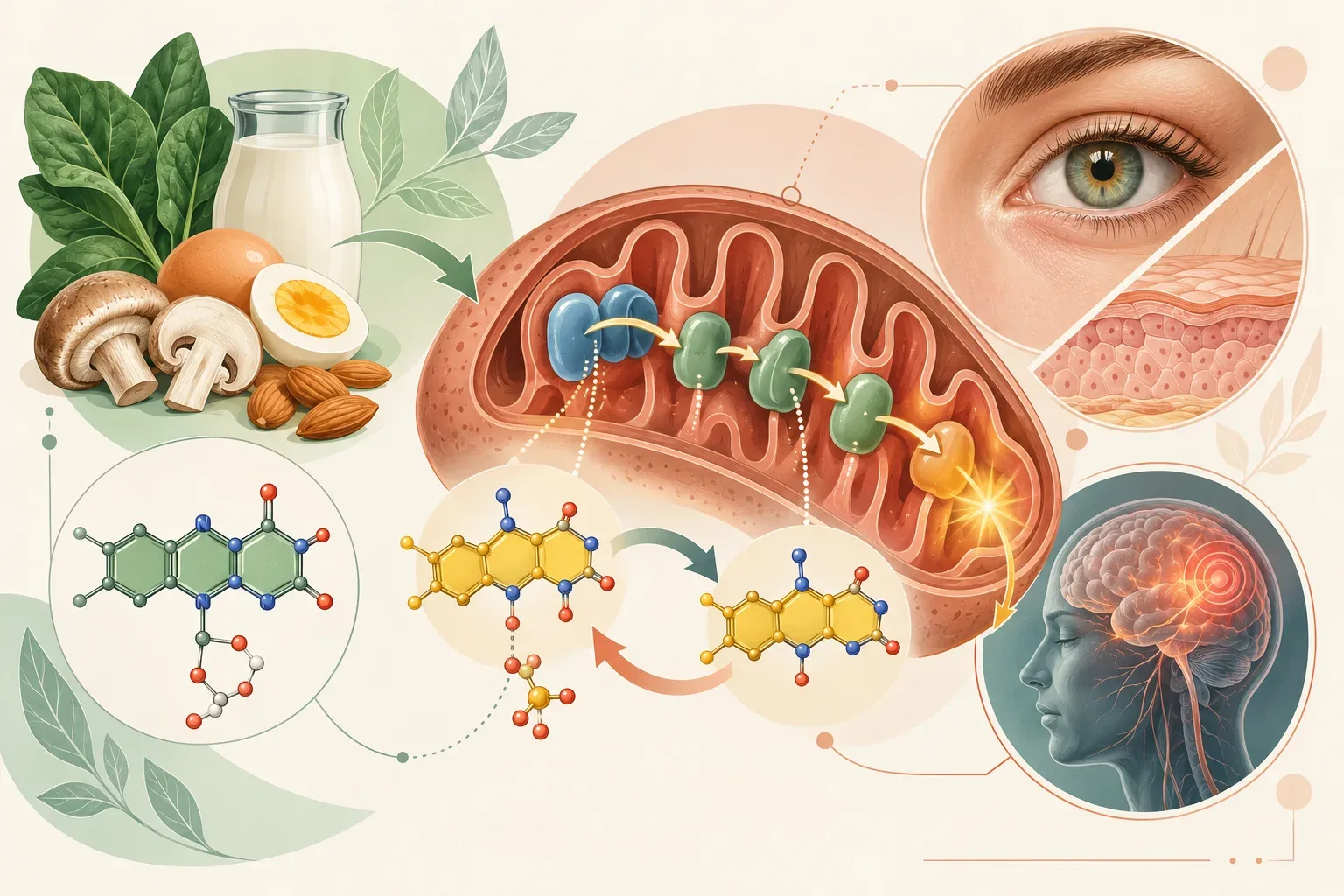
Cells convert thiamin into thiamin diphosphate (TDP), a helper molecule used by enzymes. Some of those enzymes move the breakdown products of carbohydrate into the reactions that release usable energy. Others help process fats and particular amino acids, or make the small sugar units needed for DNA and RNA.
Thiamin therefore helps the body use fuel already supplied by food; it is not fuel itself. Nerve tissue and the heart are especially vulnerable when those reactions cannot run normally. This helps explain why severe deficiency can produce neurological problems or heart-related illness, rather than simply a vague lack of energy.
Food-derived thiamin and ordinary supplement thiamin feed the same underlying system. [1]
What people take vitamin B1 for
| Claimed benefit | Dose / form studied | Research verdict | Evidence strength |
|---|---|---|---|
| Correcting thiamin deficiency | Treatment amount, route and duration depend on the cause; suspected Wernicke encephalopathy needs urgent medical treatment. | Thiamin treats deficiency; an oral capsule is not an emergency protocol. | Strong |
| Diabetic nerve symptoms | Benfotiamine 300–600 mg/day; studies ranged from six weeks to 24 months. | A short symptom signal did not translate into consistent longer-term nerve benefit. | Moderate |
| Cognition in early Alzheimer disease | Benfotiamine 300 mg twice daily for 12 months in 70 people with memory impairment with evidence of amyloid, a protein linked to Alzheimer disease, or mild Alzheimer disease. | The main cognition result was not significant; an additional dementia-severity rating favored treatment. | Limited |
| Fatigue in selected chronic illnesses | Thiamin 600–1,800 mg/day for four weeks in the inflammatory-bowel-disease trial; a later cholestatic-liver-disease trial was null. | Findings differ by disease and do not establish an energy dose for healthy adults. | Limited |
| Heart failure alongside usual treatment | Oral thiamin 200–500 mg/day in trials lasting four weeks to six months; a separate acute study used intravenous thiamin. | A small positive pilot contrasts with larger null or unfavorable comparisons; routine add-on benefit is unestablished. | Limited |
| Septic shock in hospital | Intravenous thiamin, alone or with vitamin C and hydrocortisone. | Overall trial results were null; a possible benefit among patients who started with deficiency needs confirmation. | Limited |
| Childhood nighttime bedwetting | Sulbutiamine 100 mg/day for six months, alone or with imipramine. | One trial favored sulbutiamine over imipramine, a medicine used for bedwetting; it did not test ordinary thiamin. | Preliminary |
Most people should meet their thiamin need with food and fortification rather than start a separate supplement. A modest supplement can make sense when your diet stays short of the daily amount or a clinician has identified low intake, malabsorption, or another deficiency risk.
Common dosage
For routine adequacy, use the recommended daily amount from the National Academies: 1.2 mg for adult men and 1.1 mg for adult women. That total includes food, fortified food, multivitamins, B-complex products, and standalones.
FDA uses a 1.2 mg Daily Value for adults and children age 4 and older. A 100 mg Supplement Facts line is therefore about 8,333% Daily Value and roughly 83 to 91 times the adult recommended amount.
There is no official upper limit from the National Academies, because the oral adverse-effect evidence was too sparse to set one.
What changes how much you absorb
Food preparation changes the amount available before absorption. NIH reports[1] that bread contains 20%–30% less thiamin than its raw ingredients, and pasteurization can lower the small amount in milk by up to 20%. Thiamin also dissolves into cooking water that is discarded. In the gut, nutritional amounts use an active transporter; larger pharmacologic amounts can also passively diffuse.
Morning or night, with food or without?
Time of day does not change the official dose. A meal may simply make the habit easier, and breakfast versus an empty stomach did not change absorption enough for the National Academies to adjust the daily requirement. For the daily nutritional amount, body weight and splitting intake into several times a day do not change anything.
Am I getting enough vitamin B1 from food?
Most U.S. adults can reach the daily amount through ordinary food and fortification. NIH estimates that roughly half of U.S. thiamin intake comes from foods that naturally contain it and half from enriched or fortified foods.
Selected values from the NIH Office of Dietary Supplements food table[1] show the stated food and preparation. Amounts are per serving.
| Food and preparation | Source | Serving | Thiamin (mg) |
|---|---|---|---|
| Breakfast cereal, fortified to 100% DV | Fortified | 1 labeled serving | 1.2 mg |
| Egg noodles, enriched, cooked | Egg | 1 cup | 0.5 mg |
| Pork chop, broiled | Meat | 3 oz (about 85 g) | 0.4 mg |
| Trout, cooked | Fish | 3 oz (about 85 g) | 0.4 mg |
| Black beans, boiled | Plant | ½ cup | 0.4 mg |
| Acorn squash, baked | Plant | ½ cup | 0.2 mg |
Look for a pattern that includes pork, trout, beans or other legumes, whole grains, or enriched and fortified bread and cereal. On a packaged food, use the Nutrition Facts percentage Daily Value to see what a serving contributes. Consider those foods alongside any multivitamin amount; NIH says multivitamin/mineral products commonly provide about 1.5 mg, already near or above the adult daily recommendation.
If your diet excludes several of these sources, your intake stays very low, or you have a condition that affects absorption, a food record and a clinician’s assessment are more useful than jumping from 1.2 mg to 100 mg.
Thiamin became part of grain enrichment because refining removes some of the grain's B vitamins. US enriched-flour standards still include it, so a bread label can identify a meaningful source even when no supplement is involved. This restores a selected nutrient; it does not restore the bran, fibre or original grain structure. A gluten-free or unenriched replacement should be checked on its own label rather than assumed to supply the same amount. [2], [3]
How can I tell if I'm low on vitamin B1?
Thiamin deficiency can affect nerves, muscles, the heart and the brain. Risk is higher after bariatric surgery and with prolonged vomiting, severe undernutrition, alcohol dependence, or other conditions that reduce intake or absorption. NIH also reports higher rates of low vitamin B1 levels among older adults and people with HIV/AIDS or diabetes. None of these risk factors, by itself, makes a 100 mg product or benfotiamine the right answer. [1]
Medicines can matter, too. Furosemide can increase thiamin loss in urine, and fluorouracil can interfere with how the body uses it. If you use either regularly, ask the clinician treating you whether your B1 status needs attention. NIH lists no known direct interaction in which a thiamin supplement changes how a medicine works.
Early symptoms
Loss of appetite, weight loss and muscle weakness can appear early. Changes in memory or thinking can also occur.
Established deficiency
Beriberi can cause nerve damage, with altered sensation, weakness and muscle wasting. Heart involvement can cause swelling in the legs and heart failure.
Severe deficiency requiring urgent care
New confusion, trouble walking or abnormal eye movements in someone at risk can indicate Wernicke encephalopathy. These signs do not all have to appear together. [4]
When to seek medical assessment
Get prompt medical care for those signs if thiamin deficiency is plausible. Wernicke encephalopathy is an emergency where delaying treatment can be dangerous. Clinicians use urgent thiamin treatment, often by a route that does not depend on gut absorption; hospital dosing cannot be turned into instructions for an oral supplement.
Complications after bariatric surgery and restarting food after undernutrition also deserve clinical attention.
Testing and interpretation
For more information about testing for vitamin B1, see the lab tests and preparation details near the end of this article.
Vitamin B1 forms you can buy
Thiamin hydrochloride and mononitrate are conventional sources of the same vitamin; neither has a proven clinical advantage for routine use. Benfotiamine is a separate derivative with its own milligrams and unsettled disease-specific research.
All vitamin B1 forms at a glance
| Form | Number to use | Where it fits | Buying boundary |
|---|---|---|---|
| Thiamin hydrochloride | Declared thiamin in mg | Closing an ordinary intake gap | Not shown to work better than mononitrate |
| Thiamin mononitrate | Declared thiamin in mg | Fortification or closing an ordinary intake gap | Not shown to work better than hydrochloride |
| Benfotiamine | Benfotiamine in mg | Studied in disease-specific trials; benefit remains unsettled | Do not convert it to dietary thiamin or assume better outcomes |
For benfotiamine, keep the product's milligrams attached to the exact disease study; trials used 300–900 mg a day for neuropathy or kidney questions and 600 mg a day in the cognition pilot. Do not add those milligrams to dietary thiamin or stack forms on the theory that one is water-soluble and the other is fat-soluble.
What to pay attention to on the label
The useful facts are the declared thiamin amount, the source in parentheses, and whether the product actually says benfotiamine instead.
Which number on the label is the amount
A clear conventional line might say “Thiamin 1.2 mg (as thiamin hydrochloride)” or “Thiamin 1.2 mg (as thiamin mononitrate).” In both cases, 1.2 mg is the thiamin amount.
Keep benfotiamine milligrams separate from thiamin milligrams. If a facts line says “Benfotiamine 300 mg,” treat that as 300 mg of benfotiamine unless the panel separately lists a thiamin amount.
Misleading labels
A large percentage used as the benefit
If you’re considering buying a product that says 100 mg vitamin B1, check whether the facts line identifies thiamin and its source. “High potency” accurately describes the number; it does not show that someone who already gets enough thiamin will get more energy.
A hidden form or amount
A title that says “B1” while the facts panel hides whether the ingredient is thiamin or benfotiamine prevents a valid comparison. A proprietary blend that withholds the B1 amount also cannot be compared with the 1.2 mg Daily Value.
Benfotiamine research attached to ordinary thiamin
An ad fails the form check when it uses a benfotiamine neuropathy or cognition study to support thiamin hydrochloride, mononitrate, or an ordinary B-complex. The molecules, amounts, populations, and endpoints are not interchangeable.
Hospital treatment attached to an oral wellness product
Urgent deficiency care can include injected thiamin. Those hospital doses do not tell you how to take an oral supplement or show that one prevents or treats Wernicke encephalopathy; an ad should not imply otherwise.
How long should I take vitamin B1 supplements for?
Thiamin is needed continuously. The body holds only small amounts, mainly in the liver, and NIH describes[1] a short half-life without giving a universal number of days until deficiency. If food is consistently short, a nutrition-level supplement can cover the gap for as long as it exists. Once diet reliably covers the daily amount, there is no evidence-based step-down course to finish. Treatment for a diagnosed deficiency, heavy alcohol use, or a condition that increases losses follows a separate clinician-set course; meeting the ordinary daily amount is not a substitute for that treatment.
Common Myths about Vitamin B1
Is benfotiamine simply fat-soluble B1?
Not exactly. Benfotiamine is a synthetic thiamin derivative, and laboratory work suggests the body changes it before absorption rather than absorbing it as an intact fat-soluble vitamin. The molecule-for-molecule comparison measured how much thiamin reached the bloodstream over time. It did not test whether benfotiamine relieved symptoms or improved health.
Drawbacks and side effects
| Potential drawback | When/who it affects | Research evidence | Practical implication |
|---|---|---|---|
| Uncertain long-term high-dose safety | Hundreds of milligrams taken chronically. | Small oral studies cannot establish an upper limit or exclude uncommon harms. | No official upper limit means an unknown boundary, not unlimited safety. |
| Route-specific allergic reactions | Injected thiamin in medical care. | Rare severe reactions are reported with injection; an oral event rate cannot be inferred. | Let the treating clinician choose the route; do not delay urgent treatment to try an oral capsule. |
Oral studies have generally reported mild or similar adverse events. Short trials and one 24-month study of 300 mg/day benfotiamine cannot establish rare-event risk or lifetime safety.
The 12-person high-dose absorption study was designed to measure blood exposure, not chronic harms. If a high dose seems to be causing any symptoms, stop taking it and tell a clinician about the product and amount.
Vitamin B1 during pregnancy and breastfeeding
Women need 1.4 mg of thiamin a day during pregnancy and 1.4 mg while breastfeeding, according to the National Academies amounts listed on the NIH fact sheet. The number covers total intake from food and supplements. A prenatal or multivitamin should state the thiamin amount and source clearly in milligrams. For a fortified food labeled only with percentage Daily Value, divide the percentage by 100, then multiply by the 1.2 mg Daily Value: 25% contributes 0.3 mg. Add amounts in milligrams to estimate total intake rather than assuming more is better.
Persistent vomiting during pregnancy changes the decision. It can create an urgent deficiency risk, and severe or prolonged vomiting needs medical assessment instead of a higher self-selected oral dose. After severe undernutrition, restarting food raises thiamin demand as the body processes incoming carbohydrate; that transition also needs clinical care.
The science behind thiamin and benfotiamine
The evidence is strong for nutritional adequacy and correction of true deficiency. It becomes mixed or weak when hundreds of milligrams are used for nerves, kidney markers, glucose, fatigue, or cognition in disease-specific trials.
Rice processing revealed a need before the mechanism was understood
The beriberi story shows how a useful observation can outlast its first explanation. In his 1929 Nobel lecture[5], Frederick Hopkins described work connecting polished rice with illness and the protective effect of material removed during milling. Eijkman initially interpreted the finding as neutralizing a poison; Grijns advanced the explanation that food supplied something the body needed.
Modern thiamin science[1] identifies the missing nutrient and its role in beriberi, a deficiency illness that can damage nerves and cause wasting. This discovery established the role of thiamin in preventing and treating deficiency.
Deficiency treatment and Wernicke encephalopathy
Thiamin reverses thiamin-deficiency disease, including beriberi, when the diagnosis, route, and dose fit the clinical problem. In 2022, Dingwall and colleagues compared several injected thiamin regimens in 393 at-risk and 127 symptomatic hospital patients and found no clear dose-group difference over three or five days. The trials had no placebo, substantial missing data, treatment before some baseline measurements, and under-recruitment in the symptomatic study.
Absorption is not the same as benefit
In Smithline’s study, the same 12 participants took single 100, 500, and 1,500 mg thiamin hydrochloride doses on separate occasions. Larger doses produced greater thiamin exposure in blood over the following ten hours. That contradicts the common claim that the body cannot absorb more than about 5 mg at a time, but it does not establish a benefit or long-term safety.
Another study gave the same 12 people each of two preparations: 100 mg benfotiamine and 70.2 mg thiamin mononitrate, amounts containing the same number of thiamin molecules. Benfotiamine produced greater thiamin exposure in blood over time. That is evidence of greater availability in the circulation, rather than a measurement of the exact percentage absorbed from the gut. It does not establish better delivery to a particular tissue or better symptoms, and it supplies no clinical dose-conversion rule.
Nerve and kidney trials have mixed results
The six-week BENDIP trial tested 300 or 600 mg/day benfotiamine in diabetic neuropathy. Its apparent symptom benefit appeared only after excluding participants who did not follow the protocol. When everyone assigned was included, chance could not be ruled out, and another symptom score did not differ.
Longer trials did not show a nerve benefit. In Fraser's 24-month trial, 300 mg/day raised whole-blood thiamin and TDP without improving nerve function. In the 12-month BOND trial, 600 mg/day raised all six measured thiamin-related blood values but did not improve nerve structure, conduction, sensation, automatic nerve functions such as heart-rate control, symptoms, clinical scores, or quality of life.
Kidney-marker results also conflict. A 40-person thiamin pilot at 300 mg/day reported lower urinary albumin, but a published response questioned whether the study's table supported the size of the claimed change. The finding did not establish kidney protection. In an 82-person benfotiamine trial at 900 mg/day, thiamin status improved while urinary albumin and kidney injury molecule-1, another kidney-damage marker, did not improve versus placebo.
Glucose and fatigue signals remain disease-specific
A study gave 12 people thiamin and placebo in separate periods. During six weeks of 300 mg/day thiamin hydrochloride, blood glucose measured two hours after a glucose drink fell from 9.89 to 8.78 mmol/L (about 178 to 158 mg/dL, the unit on most US reports) during the thiamin period. This change does not tell us how much more glucose changed with thiamin than with placebo, so it cannot establish a treatment benefit.
For fatigue, a trial in 40 adults with inactive inflammatory bowel disease, who received thiamin and placebo in separate four-week periods, reported benefit from 600–1,800 mg/day thiamin. A 2024 trial using separate treatment periods in primary biliary cholangitis, a disease affecting the liver’s bile ducts, used the same dose class and found no advantage over placebo on its prespecified fatigue response.
The 600 mg benfotiamine cognition pilot
Gibson’s 12-month early-treatment pilot gave benfotiamine 300 mg twice daily to 70 people with memory-predominant mild cognitive impairment plus amyloid evidence or mild Alzheimer disease. The prespecified main cognition measure did not show a statistically reliable difference. An additional measure of dementia severity favored benfotiamine.
This small, single-site pilot also reported metabolic and imaging findings that were not its main test. When researchers examine many secondary measures, the chance of finding an encouraging result that does not repeat goes up. A larger trial is needed to confirm the secondary finding with 600 mg benfotiamine.
Heart failure: small trials with inconsistent findings
A nine-person crossover pilot[6] in people with symptomatic heart failure taking diuretics reported an improvement in the heart's pumping fraction after four weeks of 300 mg/day oral thiamin compared with placebo. The estimated difference was 3.9 percentage points. A later 24-person feasibility trial[7] tested 500 mg/day thiamin mononitrate for 90 days, then crossed participants to the opposite treatment after a six-week washout. Participants were at least 60, had reduced pumping function, and remained on usual heart-failure treatment. Pumping function and the NT-proBNP heart-failure marker did not differ significantly; the overall quality-of-life score was worse during thiamin, while a narrower clinical score was not. Missing measurements and the small sample limit both positive and negative estimates.
An older furosemide study[8] began with a one-week randomized comparison of 200 mg/day intravenous thiamin, followed by oral thiamin for everyone. Its later oral phase therefore was not an oral-thiamin-versus-placebo test. Correcting deficiency remains relevant, but the trials do not establish routine high-dose oral thiamin as an effective heart-failure add-on.
A larger 69-person trial[9] tested 200 mg/day oral thiamin mononitrate for six months in ambulatory adults with reduced pumping function. It raised thiamin concentrations but did not improve exercise capacity, quality of life or NT-proBNP. After adjustment for baseline measurements, final pumping fraction was 35% with thiamin versus 38% with placebo (P=.047), an unfavorable result. Taken with the smaller trials, this does not support routine thiamin supplementation for reduced-function heart failure.
A separate acute-heart-failure trial[10] randomized 130 hospitalized patients to 100 mg intravenous thiamin hydrochloride or placebo on each of two evenings, alongside usual care; 118 had evaluable data and only one was thiamin-deficient. Breathlessness improved less with thiamin on one oxygen-supported assessment, while the other breathlessness measures, biomarkers and clinical outcomes did not differ. The authors considered the isolated unfavorable result possibly artifactual. This acute intravenous regimen adds no support for routine oral supplementation.
Intravenous thiamin in septic shock
Donnino's 88-person pilot[11] gave 200 mg intravenous thiamin twice daily for up to seven days or placebo to adults with septic shock and elevated lactate. Lactate at 24 hours, the main outcome, did not differ overall. A prespecified subgroup deficient at baseline had a lower lactate result and a possible survival signal, which remains a subgroup finding.
ACTS[12] tested intravenous 100 mg thiamin, 1,500 mg vitamin C and 50 mg hydrocortisone every six hours for four days. Among 200 treated patients, the combination did not significantly improve the change in organ-failure score over 72 hours versus placebo: adjusted difference −0.8 points, 95% confidence interval −1.7 to 0.2. This is hospital combination treatment, separate from swallowed thiamin and from treating a recognized deficiency.
VICTAS[13] likewise found no significant improvement in days alive without a breathing machine or medicines to support blood pressure with an intravenous vitamin C, thiamin and hydrocortisone combination. Its 501 participants had a median of 25 versus 26 such days over thirty days, a difference of −1 day (95% confidence interval −4 to 2). Funding ended the trial early, limiting precision.
Sulbutiamine has its own clinical research
A 2026 trial[14] randomized 450 children aged 6–18 with primary nighttime bedwetting to 100 mg/day sulbutiamine, 25 mg/day imipramine, or both for six months. The authors reported better treatment response with sulbutiamine, alone or combined with imipramine, than with imipramine alone. This preliminary study compared active treatments; it had no placebo group and did not test ordinary nutritional thiamin. Its published abstract does not settle long-term safety or whether the same result would repeat with other bedwetting treatments.
What you may have heard on podcasts
On the 2024-07-29 Huberman Lab episode about supplements and longevity, Peter Attia said thiamin had “reasonable evidence” in mild cognitive impairment. He gave no milligram and did not separate ordinary thiamin from benfotiamine in that short comment.
The study behind the claim is the 600 mg/day benfotiamine pilot, not the 1.1–1.2 mg daily nutritional amount: its main cognition measure was null and only a secondary rating favored benfotiamine. That early finding does not establish a memory benefit from ordinary thiamin or a nutrition-level supplement. The cognition question remains open.
Labs
Interpreting the results
Ordinary blood thiamin is not considered a reliable status measure by NIH. Plasma mostly reflects recent intake, while urine mostly reflects intake and excretion rather than tissue stores. [1]
For longer-term status and function, clinicians use whole-blood or red-blood-cell thiamin diphosphate (TDP), or a red-cell enzyme test called transketolase activity. No universal NIH cutoff makes every lab’s range interchangeable, and a normal result cannot rule out suspected Wernicke encephalopathy.
Before the test if you already supplement
For a planned whole-blood TDP test, Mayo Clinic Laboratories[15] requires a 12-hour fast and no vitamin supplements for those 12 hours. That includes your B1 tablet, B-complex and multivitamin. Follow the instructions for the lab actually running your sample, and check with the prescriber before interrupting treatment.
The bottom line
Most people can meet the 1.1–1.2 mg daily thiamin amount through food and enriched or fortified grains. A conventional thiamin supplement can supply a remaining dietary gap. Suspected serious deficiency needs prompt medical assessment. The benfotiamine and high-dose fatigue studies address separate treatment questions, and their results remain less certain.
Heart-failure trials include a small positive pilot and larger null or unfavorable comparisons. Hospital intravenous regimens and sulbutiamine research address distinct treatment questions, with no basis for borrowing their doses or results for ordinary oral thiamin.
Source notes
- NIH Office of Dietary Supplements: Thiamin[1]
- [16]
- [17]
- [18]
- [19]
- [20]
- [21]
- [22]
- [23]
- [24]
- [25]
- [26]
- [27]
- [28]
- [29]
- [30]
Additional outcome sources:
Help us improve this article
Spotted an error or found a source we should consider? Tell us which part of this article needs another look and include a link if you have one. Please leave out personal health details and lab results; we can’t answer individual medical questions.
Explore more in energy & fatigue



More in vitamins


References
- NIH explains thiamin's enzyme role ↩
- US enriched-flour standard ↩
- history of enrichment ↩
- Immediate assessment and treatment take priority over waiting for a vitamin test ↩
- 1929 Nobel lecture ↩
- nine-person crossover pilot ↩
- 24-person feasibility trial ↩
- older furosemide study ↩
- 69-person trial ↩
- acute-heart-failure trial ↩
- Donnino's 88-person pilot ↩
- ACTS ↩
- VICTAS ↩
- 2026 trial ↩
- Mayo Clinic Laboratories ↩
- National Academies: Dietary Reference Intakes, Thiamin chapter ↩
- FDA: Daily Value on Nutrition and Supplement Facts labels ↩
- FDA: Dietary supplement ingredient declaration guidance ↩
- Smithline 2012: high-dose oral thiamin pharmacokinetics ↩
- Schreeb 1997: equimolar benfotiamine and mononitrate pharmacokinetics ↩
- Volvert 2008: benfotiamine uptake and metabolism ↩
- Stracke 2008: BENDIP ↩
- Fraser 2012: 24-month benfotiamine nerve trial ↩
- Ziegler 2026: BOND ↩
- Alkhalaf 2010: benfotiamine and diabetic nephropathy ↩
- Rabbani 2009: thiamin and microalbuminuria pilot ↩
- Gibson 2020: benfotiamine and early Alzheimer disease ↩
- Dingwall 2022: parenteral thiamin dose trials ↩
- Aasbrenn 2024: high-dose thiamin and fatigue ↩
- Huberman Lab, 2024-07-29: Peter Attia on supplements for longevity ↩
- published correction ↩
Corrections & updates
- Update
Updated the evidence discussion and practical guidance after editorial review.
- Update
Revised the article after editorial review, with clearer evidence explanations and practical guidance.