
What is histidine?
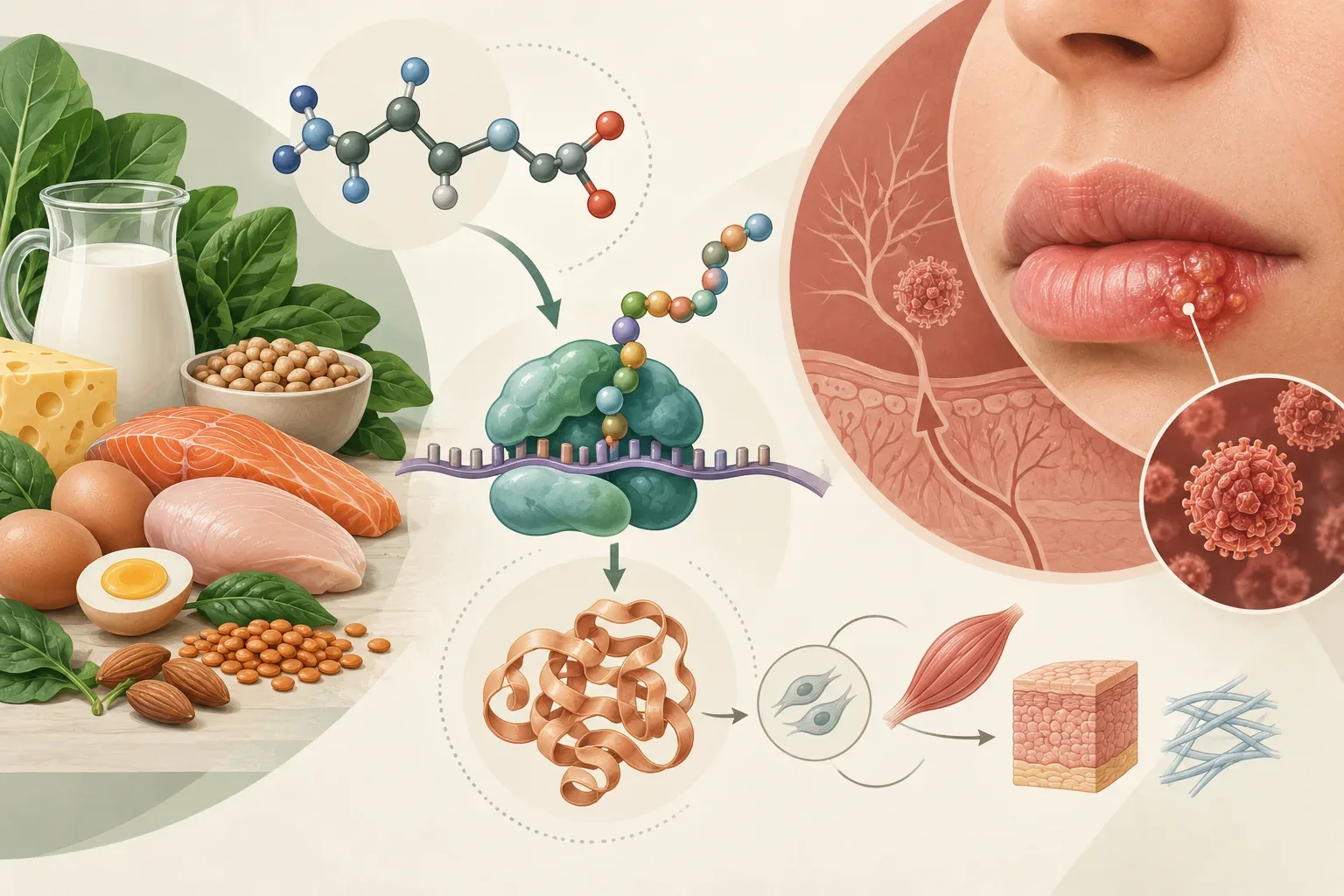
Histidine is one of the nine essential amino acids, the protein building blocks the body must get from food. It is also used to make histamine, a chemical messenger involved in alertness, allergies, and stomach acid; carnosine, which helps muscle handle acid during hard exercise; and filaggrin, a protein that helps skin retain moisture.
Meat, fish, poultry, and dairy supply histidine. Supplements are sold as L-histidine powder or capsules, sometimes labeled “as hydrochloride.” Small studies have tested histidine for glucose control, eczema, and fatigue, but they used different populations and designs. None establishes a routine treatment.
What histidine does in your body
Histidine supplies one of the building blocks needed to make proteins. Its chemical structure also lets it help proteins handle changes in acidity, which is useful in tissues where chemical conditions continually change.
The body converts some histidine into histamine. Histamine has different jobs according to location, including helping control stomach-acid secretion, signaling during immune reactions and participating in wakefulness. Histidine is therefore raw material for that messenger, not an antihistamine.
Muscle also combines histidine with beta-alanine to make carnosine, which helps buffer acidity during hard exercise. These pathways help explain histidine's nutritional role. [1]
The short version
Unit: milligrams (mg) or grams (g) of L-histidine.
Reasonable start: there is no general supplement starting amount. Most people meet the dietary requirement through protein-rich foods. The 1.65 g and 4 g research amounts were condition-specific, not routine doses.
Typical listings: 500 mg capsules or powder servings; some capsule labels allow one to four capsules a day.
Label check: identify the full daily histidine amount and distinguish histidine from the weight of a hydrochloride salt. A 500 mg serving alone does not establish the effects seen with several grams in a trial.
What people take histidine for
| Claimed benefit | Dose / form studied | Research verdict | Evidence strength |
|---|---|---|---|
| Improve metabolic markers | 4 g/day for 12 weeks; 100 women with obesity and metabolic syndrome[2], a cluster of risks such as high blood pressure, high blood sugar and a large waist | Insulin resistance—a reduced response to the blood-sugar-control hormone insulin—and body-size measures improved in one trial | Limited |
| Ease adult eczema | 4 g/day for 8 weeks; 24 adults in a crossover pilot | Scores improved, but carryover complicated the study | Limited |
| Ease childhood eczema | 0.8 g/day for 12 weeks; 49 young children under study supervision | A small pilot reported lower scores; independent confirmation is needed | Review pending |
| Reduce fatigue | 1.65 g/day for two weeks in 20 men; a later trial tested one 1.65 g dose in 100 adults | Fatigue scores and one task improved in the two-week study; the single-dose trial was negative overall | Limited |
Most people do not need a histidine supplement. The positive studies were small and condition-specific: obese women with metabolic syndrome, people with eczema, adults reporting fatigue, and people with type 2 diabetes. Histidine is therefore a research lead to discuss with a clinician, not a replacement for established treatment.
When to ask a doctor before taking histidine
- You have diabetes or take blood-sugar medicine. A small intervention included people taking stable diabetes medication, but it had no placebo group and does not establish how histidine changes treatment needs.
- You want to treat a child's eczema. A small pediatric pilot exists, but it does not establish a standard treatment dose.
- You are pregnant or breastfeeding. We found no safety data on histidine pills during these periods.
Which foods supply histidine?
These ordinary foods contain histidine as part of their protein. The amounts are calculated from the USDA FoodData Central SR Legacy records[3] for the stated edible portions and rounded to 0.01 g.
| Food and preparation | Source | Serving | Histidine (g) |
|---|---|---|---|
| [4] | Meat | 3 oz (about 85 g) | 0.82 |
| [5] | Meat | 3 oz (about 85 g) | 0.70 |
| [6] | Fish | 3 oz (about 85 g) | 0.60 |
| [7] | Plant | ½ cup (about 126 g) | 0.54 |
| [8] | Plant | 1 cup (about 198 g) | 0.50 |
| [9] | Dairy | 1 cup (about 244 g) | 0.23 |
| [10] | Plant | 1 oz (about 28 g) | 0.22 |
| [11] | Plant | 1 oz (about 28 g) | 0.15 |
| [12] | Egg | 1 large (about 50 g) | 0.15 |
A food's amino-acid content can vary by product and preparation.
How can I tell if I'm low on histidine?
There is no routine test that identifies healthy people who need a histidine supplement. The practical check is dietary protein. Adults need about 14 mg per kilogram of body weight a day from food—about 1 g for a 154 lb (70 kg) adult. If a specialist orders blood amino-acid testing, report any histidine use and follow their preparation and dose-timing instructions.
What you can buy
Histidine is sold as capsules and powder. Compare the declared histidine amount, not just the compound name on the front.
| Product | Per serving on the label | Histidine per serving |
|---|---|---|
| L-histidine capsules | 500 mg | 500 mg |
| L-histidine as hydrochloride | Check whether 500 mg refers to histidine or the entire salt | The histidine amount remains unknown if only an unspecified salt weight is given |
| Powder | 500 mg | 500 mg |
What to pay attention to on the label
Which number on the label is the amount?
Find the L-histidine line on the Supplement Facts panel and read the amount per serving. “L-histidine 500 mg (as hydrochloride)” declares 500 mg of histidine, so do not subtract the salt a second time. If the label gives only the weight of the hydrochloride compound, the conversion depends on the exact salt form and cannot be inferred safely from the front label.
Servings and daily directions
One archived label[13] defines a serving as one capsule supplying 500 mg of histidine. Its directions allow one or two capsules up to twice a day: one to four capsules, or 500–2,000 mg (0.5–2 g) daily. These are manufacturer directions, not established treatment doses.
Common Myths about Histidine
Is histidine an antihistamine?
No. Histidine is the raw material your body uses to make histamine. We found no evidence that histidine pills raise histamine enough to cause allergy-type symptoms at the amounts studied, but they are not an allergy treatment.
Drawbacks and side effects
| Potential drawback | When/who it affects | Research evidence | Practical implication |
|---|---|---|---|
| Uncertain long-term safety | Ongoing supplemental use; a rheumatoid-arthritis trial lasted 30 weeks | No clear adverse-effect pattern, but trials were too small to define a ceiling | Safety at higher daily amounts over long periods remains unknown. |
| Pediatric or diabetes-treatment uncertainty | Children with eczema or adults taking diabetes medicines | Pilot and uncontrolled findings do not establish treatment replacement or interactions | Use clinical supervision; keep prescribed treatment in place. |
Understanding these risks
The available studies do not define a safe ceiling. A rheumatoid-arthritis trial lasted 30 weeks, longer than the metabolic and eczema trials discussed here; its published abstract addresses clinical efficacy rather than establishing safety for indefinite use. There is no official upper limit. The 12-week metabolic trial reported no side effects. A 2020 review of the adult eczema pilot[14] reported nine adverse events with histidine and eight with placebo; none was judged caused by histidine. In the child pilot, two facial eczema flares were considered possibly related—two of the 50 events reported in the histidine group. These are event counts, not percentages of children harmed. The small, short studies provide limited reassurance about short-term use; they do not establish long-term safety.
The science behind histidine
Rheumatoid arthritis: no clinical advantage
A 1977 randomized, double-blind trial[15] compared oral L-histidine, 4.5 g/day, with placebo for 30 weeks in people with rheumatoid arthritis. The authors reported no advantage on the clinical measurements. Small changes in rheumatoid factor, an antibody measurement, and hematocrit, the proportion of blood made up of red cells, occurred only in the histidine group. Those laboratory changes did not translate into the clinical benefit the trial sought.
Metabolic markers improved in one controlled trial
The clearest metabolic experiment is the 2013 placebo-controlled trial[16]. One hundred women aged 33–51 with obesity and metabolic syndrome were assigned 4 g of histidine or placebo daily for 12 weeks; 92 finished. HOMA-IR, a calculation from fasting glucose and insulin used to estimate insulin resistance[17], improved more with histidine. This is a laboratory estimate of insulin responsiveness, rather than a measured reduction in diabetes complications.
Waist measurements and fat mass also improved in the histidine group relative to placebo. However, the abstract presents the numbers as how much more the histidine group improved than the placebo group, while the main results present the same numbers as how much the histidine group improved from its own starting point. That leaves uncertainty about the size of the added benefit. The trial was short and involved a particular group of women, so it does not establish that histidine reliably produces weight loss across adults.
The 2024 study[18] asked a different question: could gut bacteria help explain histidine's metabolic effects? Its registered main aim concerned histidine and its microbial breakdown products; blood-sugar measures were secondary outcomes. Twenty adults with type 2 diabetes and 19 healthy controls all took 4 g/day. After two weeks, the diabetes group had better post-meal glucose measurements and a small decrease of about 0.15 percentage points in HbA1c, a marker reflecting average blood sugar over roughly three months. Fasting glucose had not clearly improved at that point, and insulin and HOMA-IR were unchanged.
Researchers then added a week of antibiotics while histidine continued, using that disruption to examine microbial pathways and immune cells. The healthy group was a comparison for diabetes biology, not a placebo control. Consequently, the later study supplies mechanistic clues but does not independently confirm the 2013 treatment effect. Its authors disclosed several unrelated industry advisory or research relationships alongside public research support.
For someone comparing the two reports, the important distinction is the control: the first could estimate an added effect of histidine; the second followed changes while everyone took it.
Eczema: encouraging pilots, uncertain benefit size
The skin idea begins with filaggrin, a protein in the outer skin barrier that releases components of the skin's natural moisturizing system as it breaks down. That gives histidine a plausible reason to be studied in eczema, but the clinical findings come from small pilots.
The adult pilot[19] enrolled 24 people in a crossover design, using 4 g/day. During the first eight weeks, clinician-rated eczema severity fell by about a third from baseline in the histidine group, with improvement already evident at week four; placebo did not show the same pattern. The benefit carried over after participants switched treatments, preventing a clean comparison of the second period. The useful result is therefore the initial period, not two independent successes.
A 2020 report[20] also described a separate placebo-controlled pilot in 49 young children, using 0.8 g/day for 12 weeks. At 12 weeks, eczema-area/severity scores were 49% lower than the histidine group’s own starting scores; the placebo group did not show a statistically significant change from its baseline. That percentage is the change within the histidine group, not a placebo-adjusted effect size. The same report included a survey of 98 adult users describing reduced steroid-cream use; the survey cannot establish that histidine caused that reduction.
The adult and child results make eczema a substantive research lead. The different ages, amounts and outcome scales, and the small samples, leave the size and reliability of an added benefit unsettled. They do not justify substituting a supplement for a child's prescribed skin care.
Fatigue: two-week improvement, no clear single-dose benefit
In a 2015 crossover study[21], 20 men aged 45–65 who reported fatigue and poor sleep took 1.65 g of histidine daily and a cellulose placebo in separate two-week periods, with two weeks without either treatment between them. Fatigue scores improved more with histidine. Reaction time also improved on a visual-learning task, which the authors discussed as a measure of working memory. Other self-rated feelings, including tiredness and drowsiness on a separate scale, did not clearly improve. This was a small, short study, and all authors had Ajinomoto affiliations.
In 2026[22], 100 adults took a single 1.65 g dose or placebo before a mental task. The planned full-group analysis found no clear improvement in fatigue or vigor. Two secondary thinking-speed measures improved more with placebo, although repeated-test practice and the number of comparisons make those findings difficult to interpret. Favorable mood findings appeared only in an exploratory subgroup of 34 people with high baseline fatigue. Ajinomoto funded the study and employed all authors. A single dose and two weeks of daily use answer different questions.
The bottom line
Histidine is an essential nutrient, but meeting that need through protein foods is different from adding a supplement to treat eczema, fatigue or metabolic health. The benefit studies are small and specific, and the fatigue trial results are not consistent.
Help us improve this article
Spotted an error or found a source we should consider? Tell us which part of this article needs another look and include a link if you have one. Please leave out personal health details and lab results; we can’t answer individual medical questions.
Explore more in blood sugar


More in compounds


References
- National Academies: adult amino-acid requirements, Essential Guide (2006), Appendix E, pp. 463–464 ↩
- metabolic syndrome ↩
- USDA FoodData Central SR Legacy records ↩
- Chicken breast, roasted ↩
- Ground beef patty, 90% lean, cooked ↩
- Sockeye salmon, cooked ↩
- Firm tofu, calcium-set, raw ↩
- Lentils, boiled ↩
- Whole milk ↩
- Pumpkin seed kernels, dried ↩
- Almonds ↩
- Egg, hard-boiled ↩
- archived label ↩
- Gibbs: L-histidine supplementation in adults and young children with atopic dermatitis, 2020 ↩
- 1977 randomized, double-blind trial ↩
- Feng et al.: histidine and metabolic syndrome, 2013 ↩
- insulin resistance ↩
- Warmbrunn et al.: oral histidine and glucose control in people with type 2 diabetes, 2024 ↩
- Tan et al.: adult eczema crossover pilot, 2017 ↩
- 2020 report ↩
- Sasahara et al.: histidine, mental fatigue, and cognitive performance, 2015 ↩
- Shimomasuda et al.: a single dose of L-histidine and mental fatigue, 2026 ↩
- Feng et al.: histidine supplementation and insulin resistance in obese women with metabolic syndrome, 2013
- NIH Dietary Supplement Label Database: a 500 mg L-histidine capsule label
- NIH Dietary Supplement Label Database: an L-histidine label for one to two capsules twice a day
- NIH Dietary Supplement Label Database: an L-histidine hydrochloride capsule label
- NIH Dietary Supplement Label Database: an L-histidine powder label
Corrections & updates
- Update
Updated the evidence discussion and practical guidance after editorial review.