
What is inositol?
Inositol is a sugar-like compound the body makes and uses in cell signaling, including the signals that follow insulin. Fruit, beans, and grains supply additional inositol. It is sometimes sold as “vitamin B8,” but it is not a vitamin, and there is no official daily amount.
Supplements sell two main forms. Myo-inositol is the common one, sold in 500 mg capsules and 2 g powder scoops. D-chiro-inositol is a related form sold in much smaller amounts, often blended with myo-inositol.
Many people take inositol for polycystic ovary syndrome (PCOS), a hormonal condition that affects ovulation and insulin. Others take it in pregnancy, for sleep, or for mood. Trials found hormonal improvements in PCOS; pregnancy results are mixed, and sleep evidence is thin.
What inositol does in your body
Inositol forms part of phosphatidylinositol, a fat molecule in cell membranes. Cells modify these inositol-containing molecules and use their breakdown products to carry messages inside the cell after a receptor receives a signal.
One such messenger helps release calcium from stores inside the cell. Others participate in signaling systems that coordinate growth, metabolism and responses to hormones.
The body makes myo-inositol and can convert it into other forms. That signaling role gives researchers a reason to study particular inositol preparations.
What people take inositol for
| Claimed benefit | Dose / form studied | Research verdict | Evidence strength |
|---|---|---|---|
| Improve ovulation in PCOS | D-chiro-inositol 1,200 mg/day for 6–8 weeks; 44 women with PCOS and obesity | More women ovulated in one small trial | Limited |
| Prevent pregnancy complications in PCOS | Myo-inositol 2 g twice daily with folic acid until delivery; 464 pregnant women with PCOS | Large trial was negative; a broader pregnancy review was more favorable | Limited |
| Improve sleep during pregnancy | Myo-inositol 2 g/day with folic acid for 10 weeks; 60 pregnant women | Small sleep-questionnaire improvement | Limited |
| Reduce nighttime waking outside pregnancy | No established dose or course; 900 mg is a guest account, not a matching trial | Not adequately studied for this use | Insufficient |
No one needs inositol to prevent a recognized deficiency. A different question is whether it can help a condition: small trials in women with PCOS reported more ovulation or lower testosterone, while pregnancy results conflict and sleep evidence is limited to one small trial in pregnant women.
When to ask a doctor before taking inositol
- You have PCOS or are trying to conceive. Inositol should not replace standard PCOS care or fertility treatment; a clinician can decide whether it belongs alongside that care.
- You are pregnant or planning pregnancy. See the pregnancy section; results are mixed.
Inositol forms and related label types
| Form | Typical amount | Tested in people | What the evidence shows |
|---|---|---|---|
| Myo-inositol | 500 mg capsule; 2 g scoop | 2 to 4 g a day in PCOS and pregnancy | Lower testosterone in pooled PCOS trials; mixed pregnancy results |
| D-chiro-inositol | 50 mg capsule | 1,200 mg a day in one PCOS trial | More ovulation and lower testosterone in that trial |
| Myo plus D-chiro blend | 2 g plus 50 mg per scoop | Myo amount matches some trials; best ratio uncertain | A 40:1 ratio is not proven superior for everyone |
| Inositol hexanicotinate | Example label: 400 mg niacin plus 100 mg inositol | A cholesterol trial used 1,500 mg a day of the compound | The trial found no evidence that the compound became bioavailable and no cholesterol benefit; this is a niacin product |
Count myo-inositol and D-chiro-inositol separately; their milligrams are not interchangeable. Nobody has a recognized deficiency that requires an inositol supplement. If PCOS is the reason you are considering it, discuss the condition and form with your clinician. Skip products sold as “flush-free niacin” when you want inositol, and skip products that market inositol as “vitamin B8.”
Amounts used in labels, trials, and commentary
There is no recognized recommended daily amount or official upper limit for inositol. The benefit table compares condition-specific trials. These label directions, broader review and podcast account do not set a personal dose.
| Source | Amount a day | Who and how long | What it shows, and what it does not |
|---|---|---|---|
| Example labels | 500 mg myo-inositol capsule once a day, or 2 g scoops twice a day | Two different product directions | One label gives far less than the 4 g used in some PCOS and pregnancy trials; the other totals 4 g |
| Pregnancy review, myo | Varied by trial | 12 trials, 4,765 women without preexisting diabetes | Reported a 44 percent relative reduction in gestational-diabetes risk; the evidence summary did not provide the starting event rates |
Trials of myo-inositol often split the dose into morning and evening; D-chiro was given once a day. Myo-inositol and D-chiro-inositol amounts are not interchangeable: do not add them together or swap one for the other milligram for milligram, because each trial tested one form.
What to pay attention to on the label
Which number on the label is the amount?
Find the per-serving amount of each form separately. Then multiply each amount by the number of daily servings. One powder lists 2,000 mg of myo-inositol and 50 mg of D-chiro-inositol per scoop, taken twice a day: 4 g of myo-inositol and 100 mg of D-chiro a day. One capsule product lists 500 mg of myo-inositol per capsule.
Misleading labels
Niacin sold under the inositol name
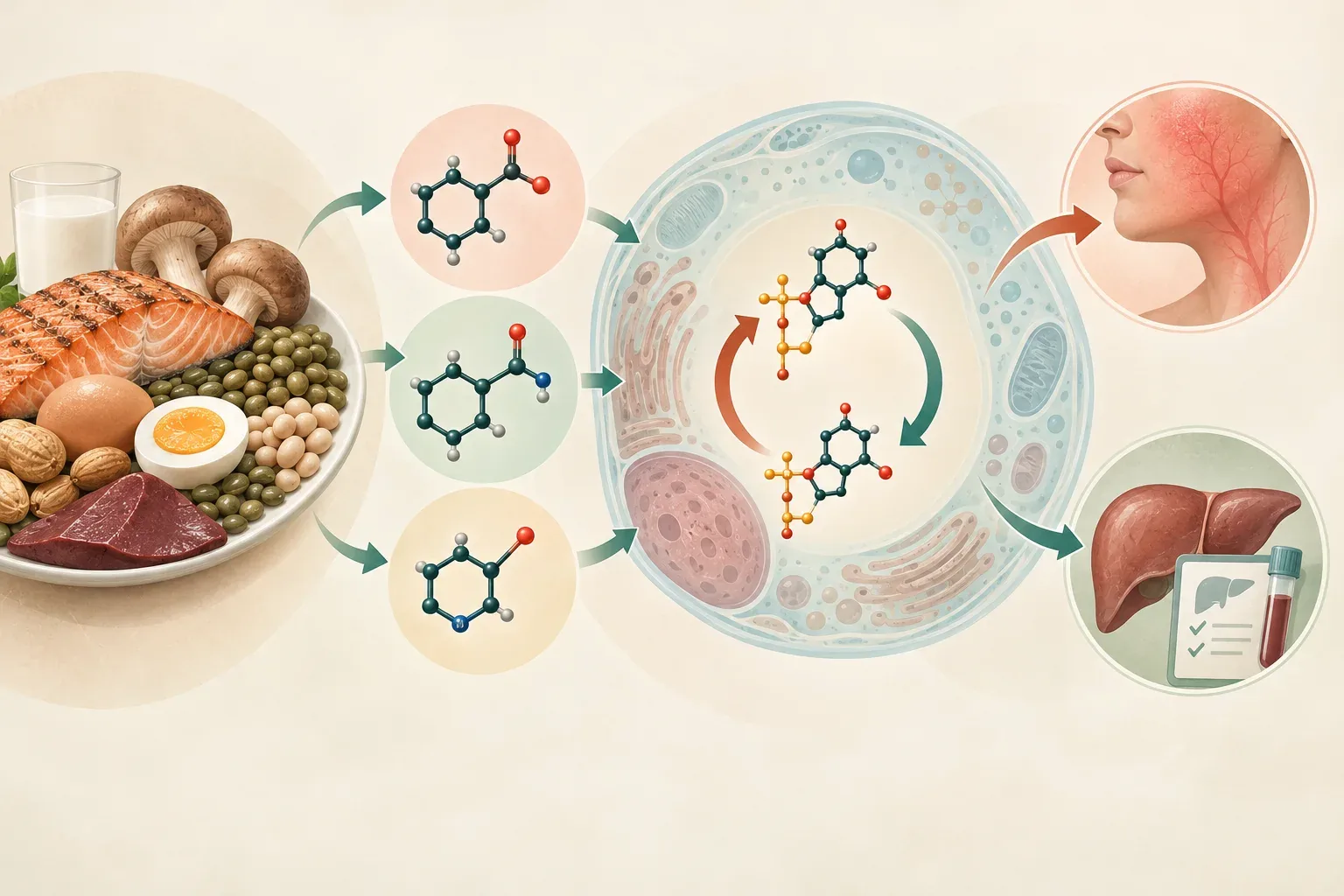
"Flush-free niacin" is inositol hexanicotinate, niacin molecules attached to inositol. One capsule lists 400 mg of niacin and 100 mg of inositol. It is a niacin product with a different release and absorption question, not a way to buy an inositol dose. See our vitamin B3 forms guide.
Confusing servings and items per serving
Some manufacturers put 180 capsules on the front, and the back says 3 capsules per serving and 60 servings. The amount on the Supplement Facts panel is for the whole 3-capsule serving.
"Supports ovarian function" or "hormonal balance"
These claims may point to PCOS trials of myo- or D-chiro-inositol. Check which form and outcome the trial actually tested; a change in a hormone measurement does not automatically mean better fertility or symptom relief.
"40:1 ratio"
This names a myo-to-D-chiro mix. One small trial compared seven ratios, but it does not establish a best blend for everyone.
"Restful sleep" and "vitamin B8"
The sleep claim draws on a small pregnancy trial or individual podcast experience, not trials of nighttime waking in the general population. "Vitamin B8" is a marketing name; inositol is not an essential vitamin.
Why is inositol used as a filler in some supplements?
Inositol is a crystalline powder that dissolves in water: the USP monograph[1] reports one gram dissolving in six milliliters. It can therefore add bulk to a powder or help make a mix palatable and easy to dissolve. It has also been studied as an inactive formulation ingredient in pharmaceutical products, where its physical properties affected stability. If inositol appears only under "Other Ingredients" without an amount, do not count it toward a myo-inositol dose.
Practical questions
What is the difference between myo-inositol and D-chiro-inositol?
They have the same chemical formula but their atoms are arranged differently; chemists call such forms isomers. Trials tested them separately: D-chiro at 1,200 mg in the 1999 ovulation trial, and myo at 2 to 4 g in later trials. The cited evidence includes no direct equal-amount comparison.
Does inositol help PCOS?
It may improve some hormone measures. In 1999, 1,200 mg a day of D-chiro-inositol for 6 to 8 weeks led to ovulation in 19 of 22 women versus 6 of 22 on placebo and lowered several metabolic measures. A 2026 review combined 9 trials and found lower testosterone and more sex-hormone-binding globulin, a protein that binds testosterone. The clearest pattern appeared in normal-weight women; the heavier groups did not show a clear change. Because that weight comparison was a secondary analysis across different studies, it cannot prove that weight caused the difference or overturn the separate 1999 D-chiro result in women with obesity. The two forms have not been compared directly, and this page excludes a frequently cited 2007 myo-inositol trial retracted for copied text.
Does inositol help sleep?
The evidence is thin. One trial in 60 pregnant women found that 2 g of myo-inositol a day for 10 weeks slightly improved scores on a sleep questionnaire. We found no trial of inositol for waking in the night, and none at 900 mg.
Drawbacks and side effects
| Potential drawback | When/who it affects | Research evidence | Practical implication |
|---|---|---|---|
| Uncertain high-dose and long-term safety | Amounts beyond the studied regimens | Common side effects were not adequately detailed; no official upper limit | Long-term safety remains uncertain. |
| Treatment decisions needing supervision | PCOS, fertility, pregnancy or diabetes medicines | Trials do not establish a self-adjustment rule for medicines or fertility care | Discuss the exact form and purpose with the clinician; myo and D-chiro are not interchangeable. |
| Nausea, gas or diarrhea | Reported with high-dose myo-inositol, around 12 g/day | [2] | Do not use the research amount as a target or a personal no-effect threshold. |
Understanding these risks
There is no official upper limit or evidence-based threshold for “too much” inositol. Taking 2–4 g/day in a study does not establish that amount as a safe ceiling. The large pregnancy trial and the gestational-diabetes review reported no differences in complications such as preterm birth or low newborn blood sugar.
A review of myo-inositol safety[2] reports mild nausea, gas and diarrhea at high amounts around 12 g a day. That is well above the 2–4 g used in many PCOS studies. These findings concern myo-inositol and do not establish identical tolerability for every inositol form.
Inositol during pregnancy and breastfeeding
Myo-inositol has been tested in pregnancy, with mixed results. A 2026 review of 12 trials in 4,765 women without preexisting diabetes, taking myo-inositol before or during pregnancy, reported a 44 percent relative reduction in gestational-diabetes risk; the evidence summary did not give the starting event rates. It found no differences in other complications or newborn problems. But a 2025 trial at 13 Dutch hospitals gave 464 pregnant women with PCOS either 2 g of myo-inositol twice a day with folic acid or folic acid alone until delivery. At least one of gestational diabetes, preeclampsia, or preterm birth occurred in 25.0 percent versus 26.8 percent, no meaningful difference. Taking inositol in pregnancy is a decision to make with your prenatal care team. The trials cited on this page did not include breastfeeding use.
The science behind inositol
The evidence comes from women with PCOS and from pregnancy; there is little in other groups.
Why the PCOS evidence remains uncertain
The positive 1999 trial tested D-chiro-inositol in only 44 women with PCOS and obesity: 19 of 22 women ovulated, compared with 6 of 22 on placebo. The 2026 review combined 9 trials and 440 women but mixed inositol forms and found large differences between studies. Together they show a signal, not a settled best form, amount, or patient group.
The 2023 international PCOS guideline[3] says inositol may be considered based on preferences, with possible metabolic-measure improvements but limited clinical benefit for ovulation, excess hair growth, or weight. For women with PCOS seeking pregnancy, its infertility recommendations[4] treat inositol as experimental because effects on ovulation, pregnancy, and live birth remain uncertain. That is a more useful boundary than calling all PCOS outcomes either proven or disproven.
Does the 40:1 ratio have evidence?
A 2019 open-label randomized trial[5] assigned 56 women with PCOS to seven ratios, with only eight women per group, for three months. The authors favored 40:1 on ovulation-related measures. There was no placebo group, and the study did not establish a live-birth benefit. The 2023 international guideline[6] still found insufficient quality evidence to recommend a specific type, dose, or combination. A trial exists; a reliably superior ratio remains unproven.
Why the pregnancy evidence conflicts
The favorable 2026 review combined 12 trials in women without preexisting diabetes, while the large 2025 null trial enrolled pregnant women with PCOS and measured a three-part complication outcome. Different populations and outcomes may explain part of the conflict, but they do not identify which result will replicate.
Why the sleep result does not generalize
The only cited sleep trial enrolled 60 pregnant women, used 2 g a day, and measured overall sleep quality. It cannot establish an effect at 900 mg, for waking during the night, or outside pregnancy.
What is still open
Whether myo or D-chiro works better, whether the gestational diabetes benefit holds in women with PCOS, and whether inositol helps sleep outside pregnancy have not been settled.
What you may have heard on podcasts
Andrew Huberman (Huberman Lab, 22 February 2023, repeating advice from his 9 January 2023 episode) said he takes 900 mg of myo-inositol before bed and falls back asleep much more easily when he wakes in the night. He takes it with magnesium threonate, apigenin, and theanine, and described it as his own experience.
We found no trial of inositol at 900 mg or for night waking. The one sleep trial used 2 g a day in pregnant women and measured overall sleep quality. Because he takes four supplements together, his experience cannot show which one helps.
The bottom line
Inositol has some encouraging findings in PCOS, but the form, population and outcome make a large difference. Pregnancy results conflict, and a small sleep study in pregnant women does not establish a general remedy for nighttime waking.
We would not choose a bottle from the word “inositol” alone or assume that a popular ratio settles the evidence. Check which form and amount the relevant study actually used. For fertility or pregnancy, discuss the exact form and purpose with the clinician handling your care.
Help us improve this article
Spotted an error or found a source we should consider? Tell us which part of this article needs another look and include a link if you have one. Please leave out personal health details and lab results; we can’t answer individual medical questions.
Explore more in blood sugar



Nutrient connections worth understanding
 Disputed pairing
Vitamin B3 (Niacin): Forms, Daily Amount, Flushing, and What the Trials Found
Connection details
Context: inositol hexanicotinate sold as inositol
Inositol hexanicotinate is a B3 ester, not the myo-inositol hub.
Source for this connection
More in compounds



References
- USP monograph ↩
- Mild digestive effects in the safety review ↩
- 2023 international PCOS guideline ↩
- infertility recommendations ↩
- 2019 open-label randomized trial ↩
- 2023 international guideline ↩
- Pharmacodynamics and pharmacokinetics of inositols in health and disease
- Nestler et al.: D-chiro-inositol in polycystic ovary syndrome, 1999
- Unfer et al.: myo-inositol in PCOS, systematic review, 2012
- Tienforti et al.: inositol and androgens in PCOS, meta-analysis, 2026
- van der Wel et al.: myo-inositol to prevent pregnancy complications in PCOS, randomized trial, 2025
- Poyatos-León et al.: myo-inositol and gestational diabetes prevention, meta-analysis, 2026
- Mashayekh-Amiri et al.: myo-inositol and sleep quality in pregnancy, 2022
- Keenan: extended-release niacin versus inositol hexanicotinate, 2013
- Office of Dietary Supplements: Niacin, health professional fact sheet
- Retraction note: Gerli et al. 2007 myo-inositol PCOS trial, 2023
- Huberman Lab: Andy Galpin on nutrition and supplementation, 22 February 2023
- NIH Dietary Supplement Label Database: a myo plus D-chiro powder label
- NIH Dietary Supplement Label Database: a myo-inositol capsule label
- NIH Dietary Supplement Label Database: a myo-inositol 4-capsule label
- NIH Dietary Supplement Label Database: a myo, D-chiro, and choline blend label
- NIH Dietary Supplement Label Database: an inositol hexanicotinate label