
What is citrulline?
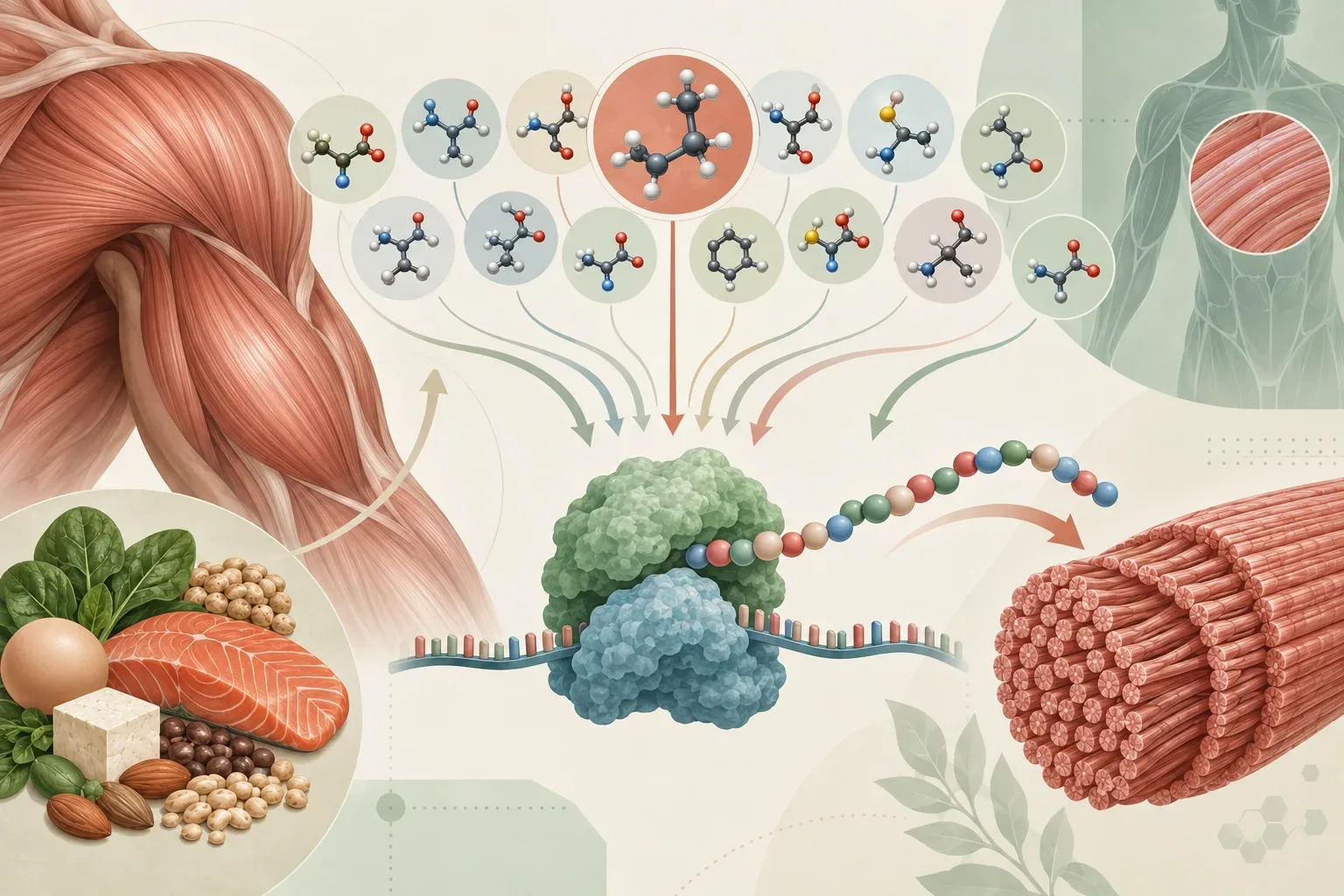
Citrulline is an amino acid your body makes on its own. Watermelon is the best-known food source.
Supplements come in two forms: L-citrulline, which is citrulline alone, and citrulline malate, which is citrulline bound to malic acid, the acid in apples. They are not equal gram for gram: the malate form includes the weight of both ingredients.
Your kidneys turn most citrulline into arginine, which the body uses to make nitric oxide and relax blood vessels. People take citrulline before workouts for more repetitions and a bigger "pump," the full, tight feeling in a working muscle, and some take it for blood pressure or erections. The workout effect in trials is small, and most of the blood-pressure and erection trials were also small and short.
What citrulline does in your body
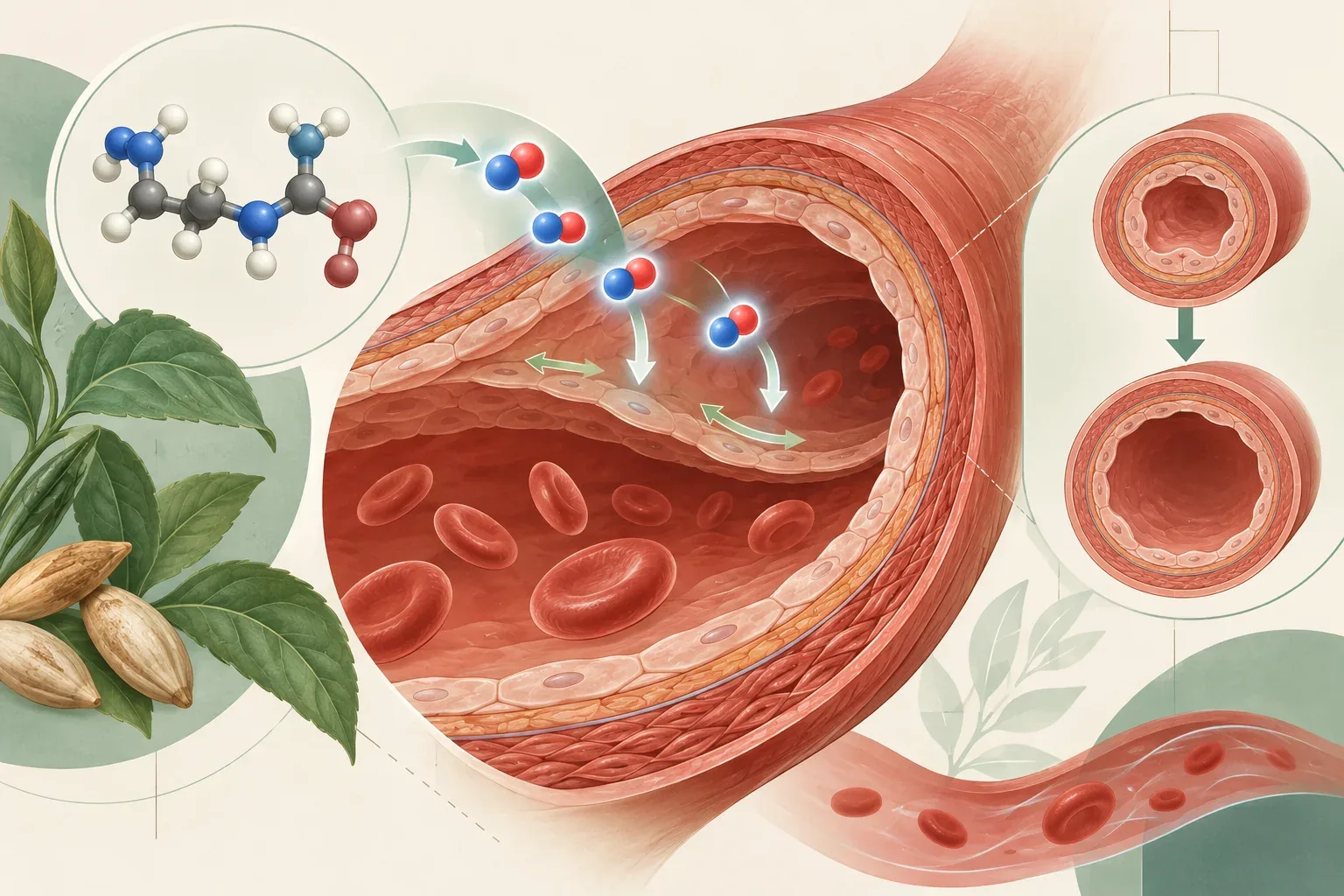
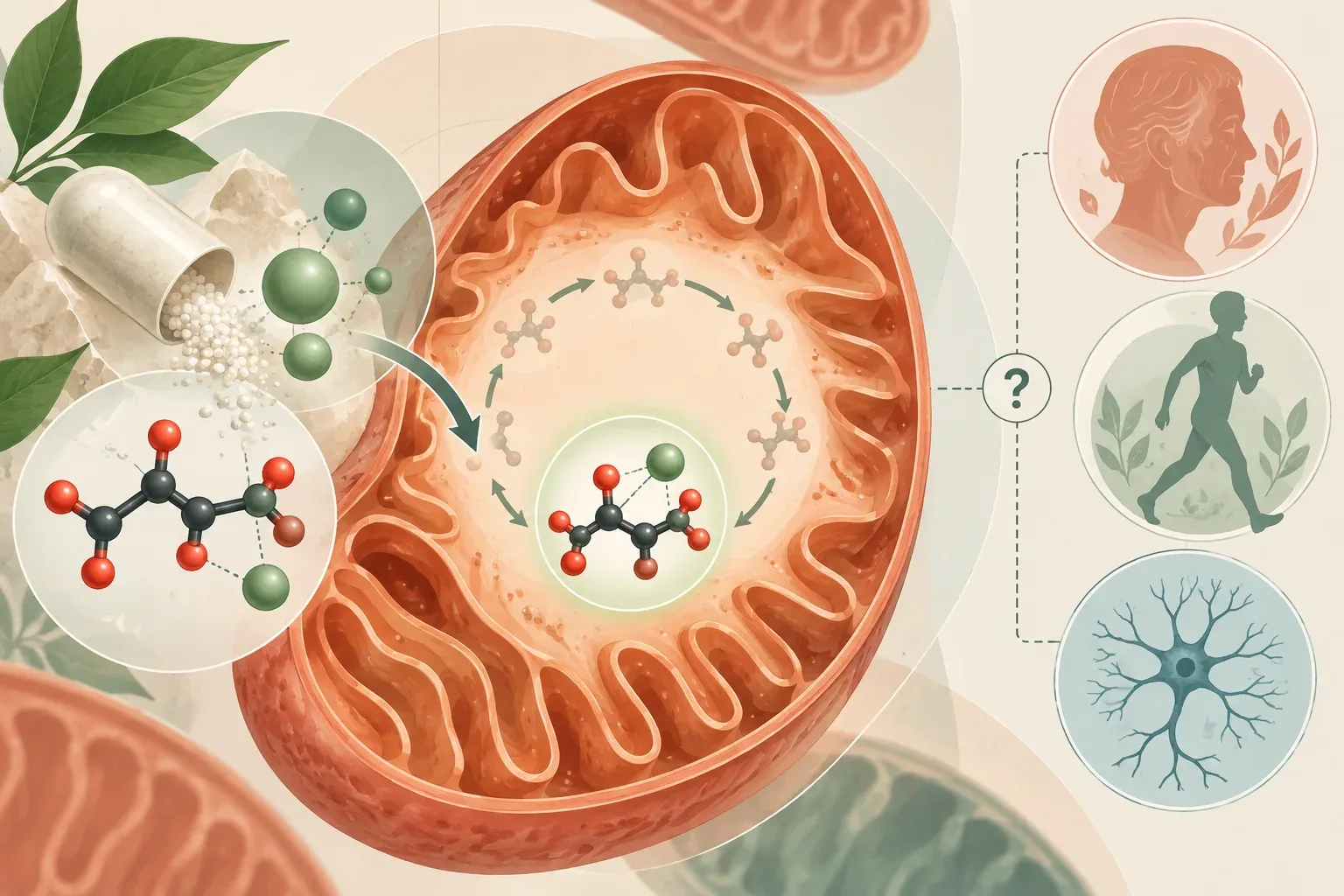
Citrulline links several amino-acid pathways. The intestine produces it, and the kidneys can convert circulating citrulline into arginine. Arginine can then be used to make nitric oxide, the signal that helps relax blood vessels.
Citrulline also participates in the liver's urea cycle, which converts nitrogen waste into urea for excretion. That normal role should be kept separate from the claim that taking it clears exercise fatigue.
Oral citrulline can raise circulating arginine because its handling differs from swallowing arginine itself. [1]
The short version
Compare the citrulline amount. A citrulline malate label counts the malic acid too, so its grams are not citrulline grams.
Before using a supplement: most people do not need it. Ask a doctor if you take blood-pressure, nitrate, or erection medicines, have kidney disease, or are pregnant or breastfeeding.
Typical listings: L-citrulline powder at 1.5 to 3 g per scoop, citrulline malate powder at 2 to 5 g per scoop, and 750 mg capsules taken four at a time for 3 g.
Skip: products whose title says "L-citrulline" while the facts panel lists citrulline malate, proprietary blends that hide the citrulline grams.
What people take citrulline for
| Claimed benefit | Dose / form studied | Research verdict | Evidence strength |
|---|---|---|---|
| More repetitions during lifting | 8 g citrulline malate (about 4.5 g citrulline) about 1 hour before a single session; male lifters | Small possible benefit, with mixed later trials | Limited |
| Training-related muscular endurance | 8 g/day plain product or 12 g/day malate product for 6 weeks; 33 trained men completed | Upper-body repetition gains favored both forms; strength gains did not | Limited |
| Lower blood pressure | 3–9 g/day L-citrulline for 1–17 weeks; mostly healthy adults in small trials | Systolic pressure fell modestly; results varied | Limited |
| Mild erection problems | 1.5 g/day L-citrulline for 1 month; 24 men after a placebo month | Hardness improved in one small study | Limited |
Most people do not need citrulline: your body makes it, and healthy adults are not known to run low. Lifters seeking a few more repetitions in high-repetition sets may consider a time-limited trial, but an analysis combining 12 studies found only a small benefit and almost none in workout power.
Two other groups try it. Small trials in mostly healthy adults found that 3 to 9 g a day lowered the top blood-pressure number by about 4 mm Hg on average. One small trial in men with mild erection problems used 1.5 g a day for a month.
When to ask a doctor before taking citrulline
- You take blood-pressure pills, nitrates for chest pain, or erection drugs such as sildenafil. Citrulline lowered blood pressure a little in trials. A small study tested citrulline with resveratrol during continued erection-drug use, but it cannot establish general safety with these medicines. Check the combination with your prescriber.
- You have kidney disease. Your kidneys turn citrulline into arginine, and we found no trial in people with kidney disease.
- You get frequent cold sores. Citrulline raises blood arginine, which gives a biological reason for Andy Galpin's caution about high doses. No human trial has tested whether taking citrulline changes outbreak frequency.
Which foods contain citrulline?
A food-composition report summarized in a human study[2] lists citrulline in these produce samples. Values are per 100 g of the reported food. These are composition estimates, not a guarantee for every piece of fruit.
| Food | Source | Citrulline (mg per 100 g) |
|---|---|---|
| Watermelon | Plant | 180 |
| Loofah gourd | Plant | 57 |
| Melon | Plant | 50 |
| Bitter gourd | Plant | 16 |
| Cucumber | Plant | 9.6 |
The NIH fact sheet[1] gives a separate estimate of about 365 mg per cup of diced seedless watermelon. That is higher than the amount calculated from this table: 180 mg per 100 g gives about 274 mg in a 152 g cup. The food-portion example below uses the table's concentration consistently.
How can I tell if I'm low on citrulline?
Routine care has no citrulline test used to decide whether a healthy adult should take a supplement. Specialists use blood amino acid tests for rare inherited disorders affecting how the body clears nitrogen, not to guide workout supplementation.
What you can buy
Citrulline comes as L-citrulline powder or capsules and as citrulline malate powder, with different ways of declaring the amount.
| Listing | Per serving on the label | Citrulline per serving |
|---|---|---|
| L-citrulline powder | 1.5 to 3 g | 1.5 to 3 g |
| L-citrulline capsules | 3 g (four 750 mg capsules) | 3 g |
| Citrulline malate powder | 2 to 5 g | Depends on the actual citrulline-to-malate composition |
| Pre-workout or amino drink with citrulline malate | Varies; one branched-chain amino acid drink lists 4 g | Cannot be calculated from combined grams alone |
Use the table to compare products by actual citrulline rather than scoop count. Plain L-citrulline states that amount directly; citrulline malate also includes malic acid.
What to pay attention to on the label
The form and its actual citrulline grams matter more than the total powder weight or the ratio claimed on the front.
Which number on the label is the amount?
Look for the line that names the ingredient and its grams on the Supplement Facts panel. If it says L-citrulline, that number is citrulline. The NIH fact sheet describes a preparation containing about 57% citrulline by weight; 8 g of that preparation supplies about 4.5 g of citrulline. A label marked 2:1 claims two parts citrulline to one part malic acid by weight, but tested products often fell short of that ratio.
Misleading labels
"L-citrulline" on the front, citrulline malate on the back
One capsule product's title says "L-Citrulline 1500 mg," but its facts panel lists 1,500 mg of L-citrulline DL-malate per three capsules. The panel does not establish that all 1,500 mg is citrulline. The title gives the combined compound’s weight the appearance of a citrulline amount, inflating the apparent strength when compared with plain citrulline.
A 2:1 ratio that tests lower
At a true 2:1 by weight, an 8 g scoop would hold about 5.3 g of citrulline. When researchers tested powders sold as 2:1, many came in closer to 1.6:1 (about 4.9 g in 8 g), and some at 1.1:1 (about 4.2 g in 8 g).
Citrulline in a proprietary blend
If you're considering buying a product that says "citrulline complex" or "proprietary blend," look for the citrulline grams. One tablet label lists a "micro-peptide citrulline complex" with no citrulline amount at all, so there is no way to know how much you'd actually be getting.
Confusing servings and items per serving
A capsule label may say 750 mg on the front, but the serving on the back is four capsules for 3 g. A 180-capsule jar at that serving lasts 45 days.
Manufacturer claims and the studies they may be based on
"Boosts nitric oxide" and "bigger pump" claims probably rest on studies that measured blood arginine or nitric oxide markers, not muscle or performance. "More reps" and "less soreness" claims may be based on the 2010 bench-press trial, which used 8 g of citrulline malate in men in a single session. "Supports healthy blood pressure" claims may rest on the small blood-pressure trials, which used 3 to 9 g a day of L-citrulline.
Common Myths about Citrulline
Does citrulline work like creatine?
No. Creatine has years of trials and a sports-nutrition position statement behind a daily 3 to 5 g dose that builds up in muscle over weeks. Citrulline has been tested both before individual sessions and daily during training, with small or inconsistent effects.
Is citrulline better than arginine?
For raising blood arginine, yes: more citrulline survives the gut, and the kidneys turn most of it into arginine. Higher blood arginine has not been shown to mean better performance, though, and the blood-arginine comparison does not establish which supplement improves a workout more.
Can watermelon give you the same dose?
Matching a multi-gram supplement amount takes a large portion. Using the food table's 180 mg per 100 g and Purdue Extension's 152 g per diced cup[3], a cup supplies about 274 mg. On that basis, 4.5 g of citrulline would take roughly 16½ cups, or 2.5 kg (5½ lb) of edible flesh.
The USDA buying guide[4] estimates that 61% of a whole watermelon's weight becomes ready-to-eat diced fruit. That would mean buying about 4.1 kg (9 lb) of whole watermelon. These estimates use the table's food concentration and an average preparation yield; they are not an exact citrulline measurement for every melon.
Does citrulline work as well as erection drugs?
No. The authors of the one small trial said it was less effective than prescription erection drugs. Half the men improved from mild problems to normal hardness on 1.5 g a day, compared with about 1 in 12 on placebo.
Drawbacks and side effects
| Potential drawback | When/who it affects | Research evidence | Practical implication |
|---|---|---|---|
| Stomach discomfort | 8 g citrulline malate in a single-session lifting trial | Six of 41 participants reported discomfort | A studied amount can still upset the stomach. |
| Potential added blood-pressure lowering | Blood-pressure drugs, nitrates or erection medicines | Trials found modest pressure changes; combinations are not adequately tested | Ask a pharmacist before combining; kidney disease also needs clinical advice. |
Understanding these risks
The most common side effect is an upset stomach: in the 8 g trial, 6 of 41 lifters, about 1 in 7, reported stomach discomfort. There is no recognized recommended daily amount or official upper limit for citrulline. The NIH fact sheet notes no adverse effects in short studies of up to 6 g a day for 4 weeks, and says longer daily use has not been studied well enough to call safe. Because citrulline lowers blood pressure a little, taking it with blood-pressure or erection drugs could add to their effect. The small citrulline–resveratrol pilot described below does not settle interaction safety.
The science behind citrulline
The strongest signal is a small increase in high-repetition lifting; endurance, blood-pressure, and erection findings are less settled or rest on small studies.
Workouts
The trials point to a small boost in high-repetition lifting sets and no clear boost in power or endurance. In the best-known trial, published in 2010, 41 healthy male weightlifters took 8 g of citrulline malate or a placebo an hour before a chest workout, then switched. They completed more later-set bench-press repetitions and reported about 40% less soreness over the next two days. It was a single session in men only.
In 2019, researchers combined 12 studies of 198 healthy men and women who took at least 3 g of citrulline or citrulline malate, mostly citrulline malate, before high-intensity tests. They found a small average benefit. Each study alone was too small or uncertain to show a clear effect; combining them produced a more precise estimate, not a larger effect in any one study. A 2021 critical review called the 8 g citrulline malate results unclear and mixed and noted that later trials of high-volume lifting found no effect.
Plain citrulline did not help endurance in a 2006 trial. Seventeen young men and women took 3 g before testing or 9 g over 24 hours and lasted about seven seconds less on the treadmill than with placebo (888 versus 895 seconds). A trial of 12 g of citrulline malate before hard cycling also found no effect, while a trial of 2.4 g of L-citrulline a day for a week found faster 4 km cycling times. A 2018 review by a sports nutrition society placed citrulline in its limited-or-mixed evidence group and said it is unclear whether citrulline, malate, or both do the work.
Plain citrulline and a cycling blend give different answers
In a single-dose trial[5], eighteen resistance-trained adults took 8 g plain L-citrulline or placebo one hour before testing. Each participant tried both treatments on separate visits. Citrulline did not increase bench-press repetitions, force in a stationary pulling test or the measured muscle-oxygen response. This single-dose result is distinct from citrulline-malate trials and from taking plain citrulline for several weeks.
A different study[6] tested thirty trained male cyclists after seven days of a daily blend containing 8 g branched-chain amino acids (BCAAs), 6 g L-citrulline and 300 mg alpha-GPC, a choline-containing compound. The same cyclists tried both the blend and 15 g maltodextrin placebo in separate treatment periods. Peak power was higher during a 20 km time trial, but finishing time and average power did not clearly improve. In a separate high-intensity test, time to fatigue was about 19 minutes 49 seconds versus 14 minutes 33 seconds. The blend therefore had some favorable results, without a faster time-trial finish; none identifies citrulline as the responsible ingredient.
Daily use during six weeks of training
A 2025 trial[7] moves beyond a single workout. Thirty-three resistance-trained men completed six weeks of training four times weekly while taking 8 g/day of plain citrulline product, 12 g/day of citrulline malate product or placebo. Manufacturer certificates put the actual citrulline amounts at 7.96 and 8.4 g, respectively—close, though not identical.
For total repetitions across bench press and incline press, the improvement exceeded placebo by about 5.6 repetitions with plain citrulline and 4.5 with malate. The estimated average benefits were uncertain: the reported statistical ranges were 2.9–8.2 and 0.5–8.4 extra repetitions respectively, rather than ranges of individual participants’ gains. Those totals cover several sets, not an extra five repetitions on every set. Maximum-strength gains did not differ clearly between groups, nor was there a clear advantage of one citrulline form over the other.
This small study supports an improvement in repetitions across those upper-body exercises under its training conditions. It does not settle whether malate adds value: failure to detect a difference in small groups is not proof the forms are equivalent. Whether the repetition benefit persists beyond six weeks also remains uncertain. One author owned the training gym; another disclosed consulting for supplement manufacturers unrelated to the products used.
Running in the heat
A different 2025 trial[8] tested 6 g/day of plain citrulline for seven days in 13 trained runners, who tried citrulline and placebo in separate periods. They completed a 50-minute run in heat before a 3 km time trial, arriving at that test mildly dehydrated. Citrulline raised circulating arginine but did not clearly improve running performance, body-temperature control or the measured gut-injury response.
The exercise picture is therefore specific: some lifting protocols yield a few more repetitions; a higher blood arginine level has not reliably translated into faster endurance performance. Training history, the type of task and the preparation matter more than the generic claim that a product boosts nitric oxide.
Blood pressure
Small trials found a modest drop in blood pressure. A 2019 analysis combined eight trials of 3 to 9 g of L-citrulline a day for 1 to 17 weeks, each with 12 to 34 people, mostly healthy adults. Systolic pressure, the top number, fell by about 4.1 mm Hg; the change in the bottom number was unclear, and results varied widely.
A 2025 analysis of 15 trials and 415 middle-aged and older adults found the top number fell about 4.0 mm Hg and the bottom number about 2.5 mm Hg. It combined citrulline pills with watermelon, so it cannot isolate the effect of pills.
Erections
One small trial tested citrulline alone. In a 2011 study, 24 men around 56 years old with mild erection problems took a placebo for a month and then 1.5 g of L-citrulline a day for a month. Hardness improved to normal in 12 of 24 on citrulline and 2 of 24 on placebo. Participants did not know which treatment they received, but researchers did; the placebo month always came first, and the full sequence lasted two months.
Citrulline with resveratrol alongside erection medicines
A small preliminary study in 2018[9] tested 800 mg/day L-citrulline plus 300 mg/day transresveratrol. Each man received both the combination and placebo in separate one-month periods. The men had erectile dysfunction despite taking a PDE5 inhibitor, such as sildenafil, as needed, and continued that medicine. Twenty enrolled; thirteen completed. There was no break between treatment periods to let any lingering effects of the first treatment wear off. That makes the effects of the two periods harder to separate. The authors reported no funding or conflicts of interest.
The combined supplement improved the overall Sexual Health Inventory for Men questionnaire score compared with placebo. Erection-hardness and sexual-symptom scores did not show a clear benefit. No adverse events were reported among completers, but this small, short trial cannot establish general interaction safety. It tested a mixture added to medication, so the improvement cannot be assigned to citrulline alone.
Malnourished older adults
In the CIPROAGE trial[10], 24 malnourished rehabilitation patients aged 80–92 received 10 g/day oral citrulline or a comparison mixture of six other amino acids supplying the same nitrogen amount for three weeks. Citrulline did not improve the primary measure of whole-body protein synthesis—the rate of making new proteins throughout the body—or protein synthesis in the liver compared with that mixture. Overall body-composition comparisons also showed no clear benefit.
Women receiving citrulline gained lean mass and lost fat compared with their own starting measurements. That subgroup observation is less conclusive than a clear advantage over the comparison group and does not overturn the overall result.
Exercise in older women
A six-week pilot[11] randomized 20 active women aged 60–75 to 3 g/day citrulline malate or placebo; both groups exercised three times weekly. The citrulline group improved on a sit-to-stand test. However, the published abstract does not clearly identify that improvement as a between-group effect. Walking distance and a combined physical-performance score did not differ significantly between groups, and quality-of-life comparisons were also null. This remains preliminary evidence for adding citrulline malate to exercise.
What you may have heard on podcasts
On Huberman Lab on 22 February 2023, exercise scientist Andy Galpin called the citrulline and arginine route an option for people who train at night and avoid caffeine. In his opinion, though, beetroot has the more consistent effect, mainly for moderate to longer endurance. His cold-sore caution is an arginine-pathway hypothesis: citrulline raises arginine, and cell-culture experiments[12] found herpes simplex virus needed arginine to replicate. Those experiments do not tell us whether a citrulline supplement causes more outbreaks in people; that has not been tested.
The bottom line
Citrulline has some support for a small improvement in high-repetition lifting, but the results are mixed. It is much less convincing as a general endurance supplement, and the blood-pressure and erection findings do not establish a routine treatment.
If you want to compare products, start with the amount of citrulline itself. A scoop of citrulline malate includes the malate portion, so the larger scoop number can be misleading. Once that is clear, the practical question is whether a small, uncertain training benefit is worth another supplement in your routine.
Help us improve this article
Spotted an error or found a source we should consider? Tell us which part of this article needs another look and include a link if you have one. Please leave out personal health details and lab results; we can’t answer individual medical questions.
Explore more in exercise & muscle

More in compounds



References
- Office of Dietary Supplements: Dietary supplements for exercise and athletic performance, health professional fact sheet ↩
- food-composition report summarized in a human study ↩
- Purdue Extension's 152 g per diced cup ↩
- USDA buying guide ↩
- single-dose trial ↩
- different study ↩
- Six-week comparison of L-citrulline, citrulline malate and placebo, 2025 ↩
- Cable et al.: citrulline and running in heat while hypohydrated, 2025 ↩
- small preliminary study in 2018 ↩
- CIPROAGE trial ↩
- six-week pilot ↩
- cell-culture experiments ↩
- Pérez-Guisado and Jakeman: citrulline malate and bench-press performance, 2010
- Hickner et al.: L-citrulline and treadmill exercise, 2006
- Kerksick et al.: International Society of Sports Nutrition exercise and sports nutrition review, 2018
- Trexler et al.: citrulline and high-intensity strength and power, meta-analysis, 2019
- Gough et al.: critical review of citrulline malate and exercise, 2021
- Barkhidarian et al.: L-citrulline and blood pressure, meta-analysis, 2019
- Luo et al.: L-citrulline, watermelon, and blood pressure in middle-aged and older adults, meta-analysis, 2025
- Cormio et al.: oral L-citrulline and erection hardness, 2011
- Huberman Lab: Andy Galpin on nutrition and supplementation, 22 February 2023
- NIH Dietary Supplement Label Database: an L-citrulline powder label
- NIH Dietary Supplement Label Database: a citrulline malate 2:1 powder label
- NIH Dietary Supplement Label Database: a capsule label titled L-citrulline that lists citrulline malate
- NIH Dietary Supplement Label Database: a citrulline complex blend label
- NIH Dietary Supplement Label Database: a 750 mg L-citrulline capsule label
Corrections & updates
- Update
Updated the evidence discussion and practical guidance after editorial review.