
What is arginine?
Arginine is an amino acid your body makes on its own, mainly in the kidneys from another amino acid, citrulline. Because the body makes it, arginine is not one of the nine essential amino acids that must come from food.
Food still supplies a lot: a typical diet gives 4 to 5 g a day, mostly from meat, poultry, fish, dairy, and nuts. Supplements sell L-arginine as 500 to 1,000 mg capsules and tablets, and as arginine alpha-ketoglutarate (AAKG) powder, often in "nitric oxide" pre-workouts sold for a bigger "pump," the full, tight feeling in a working muscle.
Your body also uses arginine to make nitric oxide, which relaxes blood vessels, and to make creatine and other molecules. People take it for workouts, blood pressure, and erections. The workout claims have little support, the blood-pressure and erection effects are modest, and one trial in people who had just had a heart attack was stopped after more deaths in the group that was receiving arginine.
What arginine does in your body
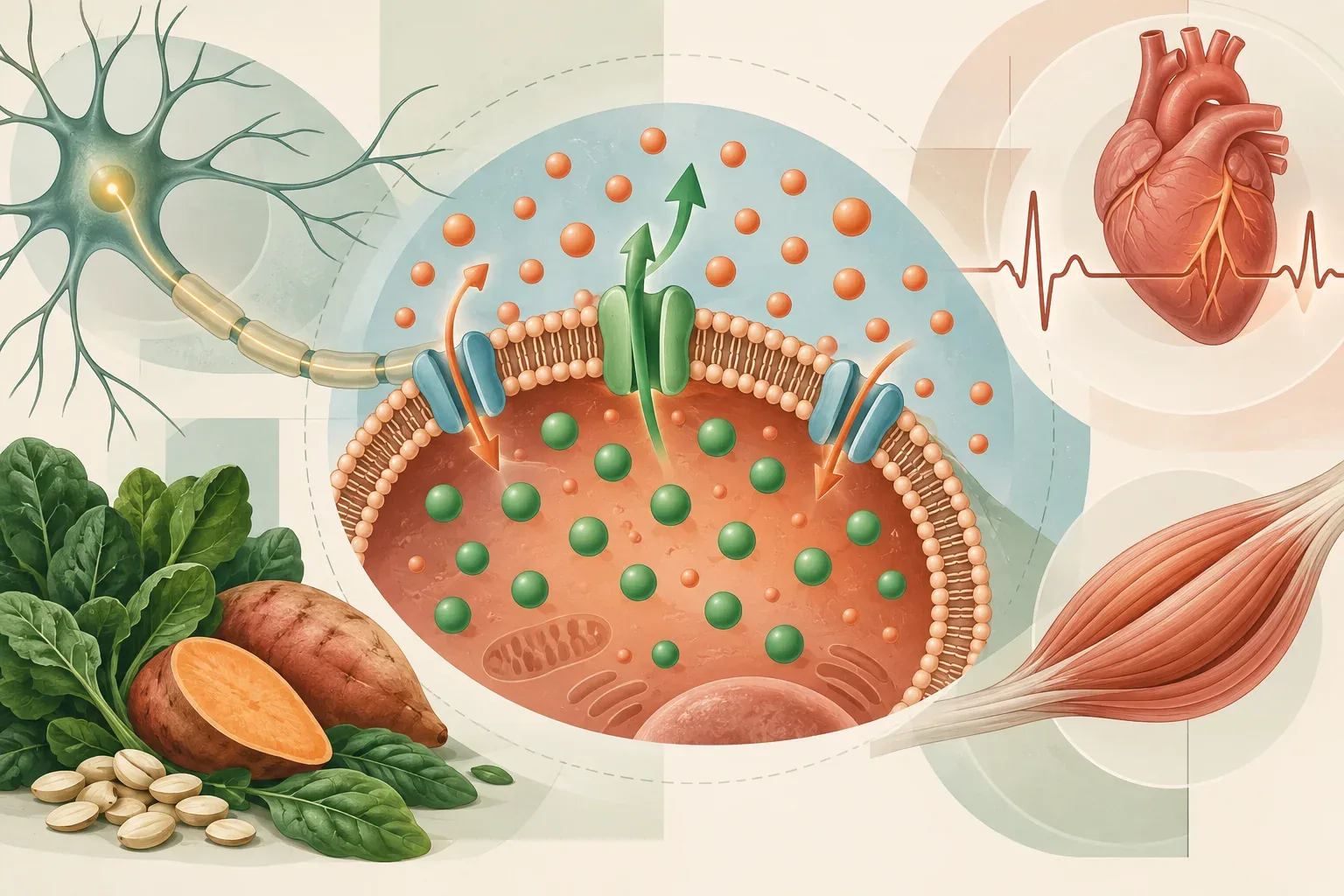
Arginine is used to build proteins, but it also supplies material for several other pathways. One enzyme converts it into nitric oxide, a short-lived signal that helps the muscle around blood vessels relax. That can change vessel diameter and blood flow.
Arginine also participates in the liver's urea cycle, which packages nitrogen waste as urea for removal through the kidneys. Other reactions use it to make creatine. These jobs happen in different tissues, with enzymes controlling how much material goes through each route.
Swallowed arginine is partly processed in the gut and liver before it reaches general circulation.
The short version
Unit: grams (g) or milligrams (mg) of L-arginine. On an AAKG product, total AAKG weight includes alpha-ketoglutarate; use the separately stated arginine amount.
Reasonable start: most people do not need it. Discuss a medical use with your doctor. There is no recognized recommended daily amount or official upper limit; study amounts depend on the question tested.
Typical listings: 500, 700, or 1,000 mg capsules and tablets, and AAKG powders of 2.5 to 4.2 g per scoop.
Skip: do not use arginine after a heart attack unless your heart doctor approves. Skip arginine-only “pump” products marketed for performance. For AAKG, compare products by their arginine content rather than total AAKG weight.
What people take arginine for
| Claimed benefit | Dose / form studied | Research verdict | Evidence strength |
|---|---|---|---|
| Lower blood pressure | 4–24 g/day oral L-arginine in short adult trials; courses varied | Readings fell modestly; fewer heart attacks or strokes were not shown | Limited |
| Mild to moderate erection problems | 1.5–5 g/day in older trials of plain arginine or mixtures; separate trial in men with blood-flow-related erection problems used 6 g/day for 90 days | Symptom scores improved; plain arginine has its own positive trial, while prescription drugs performed better in older comparisons | Limited |
| Workout performance | 2–20 g/day, generally 4–8 weeks in small studies, mostly young men | Little support for better strength, performance or recovery | Limited |
| Heart recovery after a first heart attack | Target 3 g three times daily for 6 months alongside usual care | No improvement demonstrated; six deaths versus none in one trial | Moderate |
Arginine has a more credible case for selected erection problems than for a workout pump. Men with mild to moderate erection problems and people with mildly high blood pressure may reasonably discuss it with a doctor because analyses combining several trials found modest improvements in both cases. Prescription erection drugs worked better, and no trial has shown that the small blood-pressure change prevents heart attacks or strokes.
When to ask a doctor before taking arginine
- You have had a heart attack or have heart disease. In a trial of people who had just had a first heart attack, 6 of those taking arginine died and none on placebo, and the trial was stopped; we found no trial showing it is safe in other heart disease.
- You take blood-pressure pills or nitrates for chest pain. Arginine can lower blood pressure. Some trials added it to prescribed treatment, but those studies do not establish the safety of every combination; review your particular medicines with the prescriber.
- You take an erection drug such as sildenafil. Trials have combined these drugs with arginine and found a larger effect than either alone. Both can lower blood pressure, so let your doctor decide whether to combine them.
- You are pregnant or breastfeeding. Supplemental use for a medical purpose needs the treating clinician; adult erection and exercise trials do not guide pregnancy care.
- You get frequent cold sores. On Huberman Lab on 22 February 2023, exercise scientist Andy Galpin, discussing citrulline and beetroot, cautioned that the arginine pathway, the body's route from arginine to nitric oxide, may make them worse, especially at high doses. We found no trial that tested this.
Which foods supply arginine?
These ordinary foods contain arginine as part of their protein. The amounts are calculated from the USDA FoodData Central SR Legacy records[1] for the stated edible portions and rounded to 0.01 g.
| Food and preparation | Source | Serving | Arginine (g) |
|---|---|---|---|
| [2] | Plant | ½ cup (about 126 g) | 1.72 |
| [3] | Meat | 3 oz (about 85 g) | 1.59 |
| [4] | Plant | 1 oz (about 28 g) | 1.50 |
| [5] | Fish | 3 oz (about 85 g) | 1.46 |
| [6] | Meat | 3 oz (about 85 g) | 1.39 |
| [7] | Plant | 1 cup (about 198 g) | 1.38 |
| [8] | Plant | 1 oz (about 28 g) | 0.69 |
| [9] | Egg | 1 large (about 50 g) | 0.38 |
| [10] | Dairy | 1 cup (about 244 g) | 0.22 |
Food values are estimates; amino-acid content varies by product and preparation.
How can I tell if I'm low on arginine?
Routine care has no test used to decide whether a healthy adult should take arginine. Usual blood panels do not measure it, your body makes it, and an ordinary protein diet adds 4 to 5 g a day.
Before the test if you already supplement
If a specialist orders blood amino-acid testing, report arginine use and follow the test-specific preparation instructions, especially for prescribed treatment.
What you can buy
Arginine is sold as capsules, tablets, and powder. An AAKG serving combines arginine and alpha-ketoglutarate, so the total weight is not its arginine amount.
| Listing | Per serving on the label | Arginine per serving |
|---|---|---|
| One-capsule or one-tablet servings | 500, 700, or 1,000 mg of L-arginine | Same amount shown on the L-arginine line in Supplement Facts |
| Two-capsule servings | 1 g per two 500 mg capsules | 1 g |
| AAKG powder | 2.5 to 4.2 g of AAKG on the checked labels | One 2.5 g label states 1.761 g arginine; the 4.2 g total alone does not establish its arginine amount |
| Arginine and citrulline caplets | 500 mg of each | 500 mg arginine, plus 500 mg citrulline that the body partly turns into arginine |
What to pay attention to on the label
Which number on the label is the amount?
Find the L-arginine line on the Supplement Facts panel and its milligrams per serving. On an AAKG product, use a separately declared arginine amount. If the label supplies only total AAKG weight, that number alone does not tell you how much arginine it contains.
Misleading labels
AAKG grams that are not arginine grams
One AAKG powder lists 2,500 mg of AAKG per serving and, underneath, 1,761 mg of L-arginine and 739 mg of alpha-ketoglutarate. Presenting only the larger AAKG figure in an arginine comparison makes the product appear to contain more arginine than it does.
"Nitric oxide" and "pump" claims
If you're considering buying a product that says it boosts nitric oxide for a bigger pump, know that the NIH fact sheet found arginine usually did not raise nitric oxide or blood flow in trained athletes, and had little to no effect on performance at 2 to 20 g a day.
Confusing servings and items per serving
A label may say 500 mg on the front, but the serving is two capsules for 1 g, taken twice a day. Another suggests one 500 mg capsule two to six times a day, which ranges from 1 to 3 g.
Manufacturer claims and the studies they may be based on
"Supports healthy blood pressure" claims may rest on the pooled blood-pressure trials, which used 4 to 24 g a day, far more than one capsule. "Supports male sexual health" claims may rest on the erection trials, many of which combined arginine with Pycnogenol, a pine-bark extract. "Supports growth hormone" claims probably rest on short studies with conflicting results.
Drawbacks and side effects
| Potential drawback | When/who it affects | Research evidence | Practical implication |
|---|---|---|---|
| Serious harm after a heart attack | Recent first heart attack; 9 g/day trial target | Six deaths on arginine versus none on placebo; enrollment stopped | Avoid self-treatment after a heart attack; involve the cardiologist. |
| Diarrhea, nausea or lower blood pressure | Higher amounts, including 9–30 g/day; blood-pressure or erection medicines | NIH reports gut effects and pressure changes; combination risk is not quantified | Review medicines and do not treat short-term tolerance as long-term safety. |
Reported side effects in short studies
At 9 to 30 g a day, the NIH fact sheet lists diarrhea, nausea, and a slightly lower blood pressure, and says the safety of high doses beyond three months is not known. In the erection trials, side effects were more common on arginine than placebo, about 8% versus 2%, and none were severe.
The warning after a heart attack
After a heart attack, 9 g a day was linked to more deaths in one trial. The same 9 g sits at the top of the range the NIH sheet calls generally safe for days or weeks, but that trial gave it for six months to people with damaged hearts, longer and in sicker people than the safety data cover.
The science behind arginine
The evidence separates small changes in readings from outcomes that matter more, and the heart-attack trial is the reason not to treat those changes as a general benefit.
Blood pressure
Some short trials found modestly lower blood-pressure readings with arginine. A 2011 analysis of 11 double-blind trials in 387 people taking 4 to 24 g a day found systolic pressure, the top number, was about 5.4 mm Hg lower than with placebo and diastolic pressure, the bottom number, was about 2.7 mm Hg lower. The trials were short and did not show fewer heart attacks or strokes.
A 2022 review[11] also reported lower readings, but it combined different clinical settings and preparations, including an AAKG study and a trial that began with intravenous treatment. Its tables showed reductions in trials lasting more than 24 days, while its prose said longer courses were ineffective. The mixed preparations and conflicting duration findings make its result difficult to use for choosing an oral product or duration. The review overlaps the earlier evidence; its participants should not be counted as a separate confirmation.
After a heart attack
In the VINTAGE MI trial, published in 2006, 153 people who had just had a first heart attack were assigned to arginine, aiming for 3 g three times a day, or a placebo for a planned six months on top of their usual treatment. Arginine did not show a significant improvement in artery stiffness or how well the heart pumped. Enrollment was stopped because of excess deaths in the arginine group. Across six-month follow-up, six people assigned arginine died and none assigned placebo did; one arginine-group death occurred after study treatment had stopped. The authors said arginine should not be recommended after a heart attack. The number of deaths was small. The paper described the circumstances, but did not establish that arginine caused them.
Erections
Erection studies give arginine a more specific use than a general promise to improve circulation. They also test three different treatments: arginine alone, blends containing arginine, and arginine added to a prescription drug.
The 2019 review[12] combined ten trials and 540 men with mild to moderate erectile dysfunction. Improvement was more likely with arginine-containing supplements than with placebo or no treatment, but the pooled result included other ingredients, including pine-bark extract. Sexual desire did not improve. Better erectile function and greater libido are different outcomes.
The 2021 comparison[13] pooled four trials involving 373 men. Drugs in the sildenafil family worked better than arginine alone; adding arginine to a drug improved sexual-function scores more than either treatment alone. That is a supervised combination-treatment question, especially when other medicines also lower blood pressure.
What happened with arginine alone?
A 2022 Italian trial[14] specifically tested oral L-arginine, 6 g/day for 90 days, in men whose erection problems were linked to impaired penile blood flow. Of 98 randomized men, 95 completed treatment. A six-question erectile-function score improved more with arginine than placebo. The result supports a symptom benefit in this selected population.
The ultrasound result was more selective: penile blood flow improved in the subgroup with mild–moderate vascular impairment, while the severe-impairment subgroup had no clear flow benefit. This gives the symptom result a useful boundary: improvement on a questionnaire did not mean every degree of vascular disease improved. The authors declared no research funding; one disclosed consultancy payments from Damor outside the study.
Plain arginine therefore has evidence of its own. A positive blend study is still evidence for that blend, and neither line of research establishes that a low-dose sexual-health mixture is equivalent to prescription treatment.
Preeclampsia: prevention and treatment trials
Preeclampsia is a pregnancy complication involving high blood pressure and possible organ injury. A placebo-controlled prevention trial[15] assigned 100 women at high risk to L-arginine or placebo starting at 20 weeks of pregnancy. Preeclampsia occurred in 3 of 49 women assessed in the arginine group and 11 of 47 in the placebo group. This is an encouraging result, but the accessible abstract does not specify the dose; it cannot guide choosing a retail regimen.
A separate treatment trial[16] studied women who already had preeclampsia. Eighty-three were assigned oral L-arginine, 3 g/day, or placebo in addition to standard treatment; 61 completed the study. The authors reported better fetal-growth and circulation measurements, longer pregnancy duration and higher newborn Apgar scores[17] with arginine. These scores assess breathing, heart rate, muscle tone, reflexes and skin color shortly after birth. The small study and the 22 women who did not finish limit confidence in the result.
Workouts and hormones
The NIH exercise fact sheet calls the research limited and conflicting and finds little scientific support for better strength, performance, or recovery. Most trials were small, enrolled men aged 18 to 25, and lasted four to eight weeks. A review of 54 studies also found little or no benefit for strength, endurance or recovery. Growth-hormone results conflict, and a 2023 analysis of nine studies found no change in IGF-1, a hormone made in response to growth hormone.
Some later reviews reported positive exercise findings. A 2021 review[18] found a small increase in maximum oxygen uptake—the most oxygen the body uses during intense exercise—including a subgroup of five studies it classified as plain L-arginine. Its overall analysis also included AAKG, arginine aspartate and multi-ingredient products, so the overall figure is not a result for one plain-arginine preparation. The small studies and differing protocols leave the practical performance benefit uncertain.
A positive 2020 performance review[19] also drew a 2025 methodological critique[20]. The comment raised concerns about how study variability, repeated measurements and some comparisons were handled. The authors’ reply[21] acknowledged issues but did not provide a corrected arginine estimate. The original combined results therefore cannot securely settle the performance claim or establish a dosing plan.
The bottom line
Arginine has modest findings for blood pressure and some erection problems, but little convincing support for the workout gains that often sell it.
The heart-attack trial is a more consequential finding than a small change in a blood-pressure reading: more deaths occurred in the arginine group, without the hoped-for functional benefit. We would not use arginine to manage recovery after a heart attack. If your reason for considering it is medical, review that reason and your medicines before choosing a form or dose.
Help us improve this article
Spotted an error or found a source we should consider? Tell us which part of this article needs another look and include a link if you have one. Please leave out personal health details and lab results; we can’t answer individual medical questions.
Explore more in heart & blood pressure

More in compounds



References
- USDA FoodData Central SR Legacy records ↩
- Firm tofu, calcium-set, raw ↩
- Chicken breast, roasted ↩
- Pumpkin seed kernels, dried ↩
- Sockeye salmon, cooked ↩
- Ground beef patty, 90% lean, cooked ↩
- Lentils, boiled ↩
- Almonds ↩
- Egg, hard-boiled ↩
- Whole milk ↩
- 2022 review ↩
- 2019 review ↩
- 2021 comparison ↩
- Menafra et al.: isolated L-arginine for vasculogenic erectile dysfunction, 2022 ↩
- placebo-controlled prevention trial ↩
- separate treatment trial ↩
- Apgar scores ↩
- 2021 review ↩
- 2020 performance review ↩
- 2025 methodological critique ↩
- authors’ reply ↩
- Office of Dietary Supplements: Dietary supplements for exercise and athletic performance, health professional fact sheet
- National Academies: Dietary Reference Intakes for energy, carbohydrate, fiber, fat, fatty acids, cholesterol, protein, and amino acids, 2005
- Dong et al.: oral L-arginine and blood pressure, meta-analysis, 2011
- Schulman et al.: L-arginine after acute myocardial infarction (VINTAGE MI), 2006
- Rhim et al.: arginine supplements and erectile dysfunction, meta-analysis, 2019
- Xu et al.: L-arginine and PDE5 inhibitors for erectile dysfunction, meta-analysis, 2021
- Nejati et al.: arginine supplementation and IGF-1, meta-analysis, 2023
- Huberman Lab: Andy Galpin on nutrition and supplementation, 22 February 2023
- NIH Dietary Supplement Label Database: a 700 mg L-arginine capsule label
- NIH Dietary Supplement Label Database: a two-capsule L-arginine label
- NIH Dietary Supplement Label Database: a 1,000 mg L-arginine tablet label
- NIH Dietary Supplement Label Database: an AAKG powder label listing arginine
- NIH Dietary Supplement Label Database: an AAKG powder label
Corrections & updates
- Update
Updated the evidence discussion and practical guidance after editorial review.