
What are essential amino acids?
EAA stands for essential amino acids: nine protein building blocks the body must get from food. They are histidine, isoleucine, leucine, lysine, methionine, phenylalanine, threonine, tryptophan, and valine. Muscle needs all nine; leucine can start the building signal, but the other eight supply the material.
An EAA supplement provides the nine as free amino acids rather than as intact protein. Meat, fish, dairy, eggs, and soy already contain all nine, and a varied plant-protein diet can provide them too. The practical question is therefore not whether EAAs matter. It is whether a powder adds anything when protein intake is already adequate.
What essential amino acids do in your body
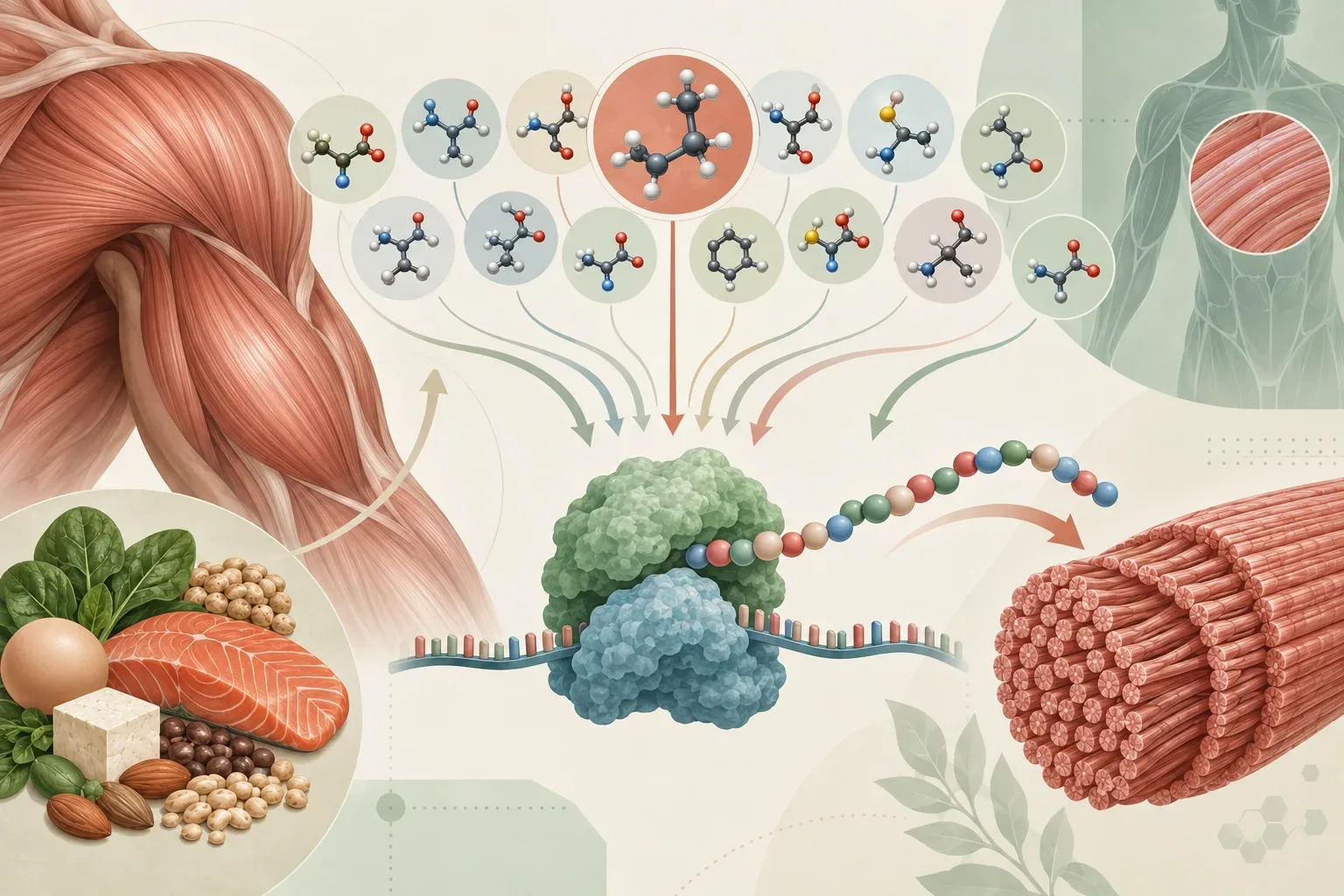
The body uses amino acids to assemble proteins in a particular sequence. Some of those proteins become muscle fibers; others serve as enzymes, transporters or parts of other tissues. The nine essential amino acids must come from food because the body cannot manufacture enough of them to meet its needs.
Making a new protein requires all of its building blocks. Leucine helps activate a cellular system that signals protein building, but that signal cannot supply missing amino acids. BCAAs, or branched-chain amino acids, are leucine, isoleucine and valine. A leucine-only or BCAA product supplies only part of the full set of essential amino acids.
Digestion releases these amino acids from food protein, while free-form supplements supply them without that initial protein breakdown. Faster availability is a delivery difference, not automatic proof of more lasting muscle growth. [1]
The nine amino acids at a glance
They all help build proteins, but they also enter different pathways. The descriptions below explain what each does in the body; the supplement studies later in this article address different questions.
| Amino acid | A short description of its role |
|---|---|
| Histidine | Helps build proteins and is a starting material for histamine, a messenger involved in immune and stomach functions. |
| Isoleucine | One of the three BCAAs. It becomes part of proteins and can also be used for energy. |
| Leucine | A BCAA that both becomes part of proteins and helps turn on a muscle protein-building signal. |
| Lysine | Supplies a building block for proteins, including collagen; the body cannot make it from other amino acids. |
| Methionine | Supplies sulfur for the body and can be used to make cysteine, another amino acid. |
| Phenylalanine | Can be converted to tyrosine, which the body uses to make several chemical messengers. |
| Threonine | Helps build proteins, including the mucins that form part of the intestinal mucus barrier. Animal feeding research[2] shows that a severe threonine shortage reduces mucin synthesis. |
| Tryptophan | Supplies material for serotonin and, through further steps, melatonin and niacin. |
| Valine | The third BCAA. Like isoleucine, it becomes part of proteins and can be used for energy. |
What people take EAAs for
| Claimed benefit | Dose / form studied | Research verdict | Evidence strength |
|---|---|---|---|
| Improve walking capacity in older adults with low physical function | 15 g/day finished EAA-containing formula for 12 weeks, compared with a whey preparation | Walking distance improved more with the formula; lean mass did not. The formula and reporting discrepancies remain unresolved | Review pending |
| Reduce infections during hospital rehabilitation | 8 g/day amino-acid mixture for the first hospital month; 80 older patients | Fewer patients developed infections in one trial using a defined mixture | Review pending |
| Gain lean mass in older women | 15 g/day of a mixture listing eight EAAs for 3 months; 14 older women | Total lean mass rose within the supplement group; strength did not improve | Review pending |
| Preserve muscle during bed rest | Amino-acid mixture plus 30 g carbohydrate three times daily for 28 days; EAA dose differs between text and table | Leg mass was better preserved; both groups lost strength | Limited |
| Build more muscle than adequate complete protein | No established EAA-supplement dose or course for this advantage | Short laboratory signals do not establish extra long-term gains | Review pending |
“Review pending” means we have not finished assessing that evidence; it does not mean the paper awaits publication or scientific peer review. The result column states what the studies reviewed here show and their main limits.
Most people do not need an EAA supplement. Adequate complete protein from food already supplies the same nine amino acids, and no trial here shows that an EAA supplement builds more muscle than adequate food or protein powder.
EAAs have been studied in unusually narrow situations, including 14 older women, 12 older adults with impaired blood-sugar control, and participants confined to bed. Those studies may inform a clinician-led nutrition plan when eating enough protein is difficult, but they do not establish a routine gym supplement.
When to ask a doctor before taking EAAs
- You have maple syrup urine disease or another inherited amino acid disorder. These are treated by limiting specific amino acids that EAA products contain.
- You have been told to limit protein, for example because of kidney or liver disease. EAA powders are concentrated protein building blocks and must be counted in that plan.
Common dosage
There is no standard dose, recommended daily amount, or official upper limit for an EAA supplement. The National Academies[3] set requirements for protein and for each essential amino acid across the whole diet, not for a nine-amino powder. Those figures can still help you read a label: multiply an amino acid's daily amount per kilogram by your body weight, then compare that result with the individual amount of that amino acid in the product and in your food. For example, the adult leucine reference of 42 mg/kg/day works out to about 2.94 g/day at 70 kg (about 154 lb). A 9 g EAA serving is not 9 g leucine; the label must show how much of its 9 g is leucine. Food and protein powder count toward that dietary reference too, so 2.94 g is not a target for leucine from an EAA product alone.
Which foods provide all nine essential amino acids?
Protein foods supply essential amino acids together. The last column adds the nine values reported for each identified food; it is a composition comparison, not a score for protein quality or the amount your body absorbs.
| Food and preparation | Source | Serving | Nine essential amino acids, added (g) |
|---|---|---|---|
| [4] | Meat | 3 oz (about 85 g) | 10.94 |
| [5] | Fish | 3 oz (about 85 g) | 9.97 |
| [6] | Meat | 3 oz (about 85 g) | 8.47 |
| [7] | Plant | ½ cup (about 126 g) | 8.18 |
| [8] | Plant | 1 cup (about 198 g) | 6.54 |
| [9] | Dairy | 1 cup (about 244 g) | 3.53 |
| [10] | Plant | 1 oz (about 28 g) | 3.14 |
| [11] | Egg | 1 large (about 50 g) | 2.77 |
| [12] | Plant | 1 oz (about 28 g) | 1.76 |
Vegan foods can supply all nine essential amino acids. If total protein intake is low or most of it comes from grains with few beans or soy foods, some amino acids, especially lysine, may be low on that diet. [13]
The proportions inside the protein differ
The table below uses four of the exact USDA foods and serving sizes above. Each percentage is that amino acid's share of the sum of the nine essential amino acids in that food. The percentages in each food column add to about 100%, allowing for rounding.
| Essential amino acid | Chicken breast | Firm tofu | Lentils | Almonds |
|---|---|---|---|---|
| Histidine | 7.5% | 6.6% | 7.7% | 8.6% |
| Isoleucine | 12.7% | 13.1% | 11.8% | 11.9% |
| Leucine | 18.1% | 21.4% | 19.8% | 23.4% |
| Lysine | 20.5% | 13.6% | 19.1% | 9.0% |
| Methionine | 6.7% | 3.3% | 2.3% | 2.5% |
| Phenylalanine | 9.6% | 12.9% | 13.5% | 18.0% |
| Threonine | 10.2% | 12.1% | 9.8% | 9.6% |
| Tryptophan | 2.8% | 3.6% | 2.5% | 3.4% |
| Valine | 12.0% | 13.4% | 13.6% | 13.6% |
For example, lysine is about one fifth of chicken's nine-amino-acid total but less than one tenth of almonds'. The percentages alone can still mislead: the stated chicken serving has about 2.24 g lysine, while the ounce of almonds has about 0.16 g. Tofu's leucine share is higher than chicken's, yet its methionine share is lower. All four foods contain all nine, but equal servings do not provide the same amounts or balance. A food record can show your protein sources and approximate total protein intake. That total alone cannot establish whether you get enough of each essential amino acid.
How can I tell if I'm low on essential amino acids?
No routine blood result has been shown to identify healthy people who benefit from an EAA supplement. Start with a food record. The adult recommended daily amount for protein is 0.8 g per kilogram of body weight: about 56 g for a 154 lb (70 kg) adult or 73 g at 200 lb (91 kg). That is a general dietary reference.
Resistance-training research has examined higher total protein intakes, but it does not establish a precise target for every person or a need for an EAA supplement. The research section below explains those findings.
Before the test if you already supplement
If a specialist orders blood amino-acid testing, tell them about any EAA blend you take and follow their preparation instructions.
What you can buy
EAAs come as flavored powders, capsules, and tablets. The label examples below show how much the formats vary.
| Listing | Per serving on the label | Notes |
|---|---|---|
| Powder | 6 to 10 g total powder per scoop | Includes flavors and other ingredients as well as EAAs |
| Capsules | About 0.5 to 1 g of EAAs per serving | Labels suggest one to three servings a day |
| Tablets | Up to 5 g per five tablets | Some list a blend with no amounts |
| "Multi-amino" tablets | Collagen-based | Not a complete set of the nine |
What to pay attention to on the label
Which number on the label is the amount?
Find all nine amino acids on the Supplement Facts panel and add their amounts. That total—not the scoop weight or a front-label “amino” number—is the comparable EAA amount. A 10 g scoop can contain much less than 10 g of the nine after flavors, electrolytes, filler powder and other amino acids are counted.
Misleading labels
"Essential aminos" led by an ingredient that isn't essential
One 10 g “essential aminos” scoop lists 3,000 mg of citrulline as its largest ingredient. Another includes 500 mg of glutamine. Neither ingredient is one of the nine, so neither amount belongs in the EAA total. Their presence is a warning to count carefully; reject the product if all nine amounts are not disclosed or cannot be totaled.
Per-amino-acid amounts versus the capsule total
One “essential aminos complex” capsule lists 75 mg of each of the nine amino acids. Adding those lines gives 675 mg of EAAs per capsule, or 1.35 g in two capsules. The per-ingredient number and the capsule total describe different amounts; neither establishes an effective dose.
"Multi-amino" tablets made from collagen
Some “multi-amino” tablets use 1,500 mg of collagen per tablet as the source. Because collagen lacks tryptophan and is low in several other essential amino acids, it is not a complete nine-EAA product and cannot be treated as a substitute.
Blends that hide the amounts
One tablet product lists a 5,000 mg blend per five tablets without giving each amino-acid amount; one powder does the same inside a 10 g scoop. If the nine cannot be totaled, the label cannot be matched to the evidence.
Confusing servings and items per serving
A capsule label may suggest one capsule one to three times a day, so the daily amount is up to three times the serving on the panel. A tablet product's serving may be five tablets, so one tablet is a fifth of the listed amount.
Manufacturer claims and the studies they may be based on
“Clinically shown to build muscle” can refer to a short-term laboratory signal rather than muscle or strength gained over months. An EAA product supplies all nine essential building blocks, while BCAAs supply only three. That is an ingredient advantage; it does not by itself establish better muscle or strength gains.
Drawbacks and side effects
| Potential drawback | When/who it affects | Research evidence | Practical implication |
|---|---|---|---|
| Excess amino acids for a prescribed diet | Kidney/liver disease with a protein limit or an inherited amino-acid disorder | The ingredients count toward the prescribed restriction | Have a clinician or dietitian check the formula and total intake. |
| Unknown high-dose or long-term safety | About 50 g/day of an amino-acid mixture was tested for four weeks in 13 bed-rest participants | Small short trials cannot define a safe ceiling | Do not extrapolate that research protocol to routine long-term use. |
Understanding these risks
The small, short trials cannot define a safe ceiling. There is no official upper limit for an EAA blend or for most individual essential amino acids. The roughly 50 g of amino-acid mixture a day used during bed rest was a four-week research protocol, not evidence that this amount is generally safe. EAA powders also count toward any prescribed protein limit.
The walking trial discussed below has unresolved safety reporting. Its registry[14] lists three deaths in the whey group and none in the EAA group over about four months, yet lists zero serious adverse events in either group. It does not explain the deaths' timing, causes or relationship to treatment. These entries cannot establish that whey caused harm or that the EAA formula improved survival.
The science behind EAAs
Muscle building in the lab
A full set of nine can support the muscle-building response longer than leucine or BCAAs alone. A 2023 International Society of Sports Nutrition paper interprets short studies that track labeled amino acids through newly built muscle protein as showing a response from about 1.5–3 g with a plateau around 15–18 g. Those experiments follow protein building over hours, not changes in muscle or strength over months, and several authors hold EAA-formula patents.
The society also sets amino-acid daily targets that differ from the National Academies' dietary requirements—for example, 49 versus 42 mg of leucine per kilogram of body weight.
Free amino acids versus milk protein
In a 2022 comparison[15], researchers matched a free-amino-acid mixture to the amino-acid profile of 30 g of milk protein. Essential amino acids made up 44.7% of that mixture, so it was not an EAA-only product. The free amino acids entered the blood faster. The overall rate of muscle-protein building over six hours did not clearly differ between groups, although more amino acids from the free mixture appeared in newly built muscle protein. Long-term muscle and strength were not tested.
Total protein during resistance training
A review of 49 trials[16] estimated that fat-free-mass gains leveled off around 1.6 g/kg/day of total protein—about 112 g/day at 70 kg (about 154 lb). The data did not locate a clear cutoff: the estimate ranged from 1.03 to 2.20 g/kg/day and did not pass the usual statistical test. A later strength review[17] estimated no further strength gain above about 1.5 g/kg/day. Together, these models suggest diminishing returns, rather than a precise intake that works for everyone. Neither review establishes a dependable extra gain from routinely exceeding roughly 2 g/kg/day. A correction to the first review[18] disclosed one author's Dymatize advisory-board role; several authors of the later review worked for a food company.
Bed rest
In a 2004 study[19], 13 men spent 28 days in bed. Seven received an amino-acid mixture with 30 g of carbohydrate three times a day between meals; six received a diet soft drink. The paper describes 16.5 g of EAAs per serving, but its ingredient table includes glycine and gives a conflicting 15 g EAA total. The exact EAA dose is therefore unclear.
Lean leg mass was maintained on average in the supplement group, with a 0.2 kg increase, while the control group's fell 0.4 kg. The load they could lift on the leg-extension test fell in both groups, by about 9 kg with the supplement and 18 kg in the control group; strength loss was significantly greater in controls. The mixture helped reduce strength loss during complete inactivity but did not prevent it. It also supplied 558 extra calories a day, so the trial cannot separate the amino acids' contribution from the added energy.
Older adults
In a 2009 trial[20], 14 women around age 68 took an amino-acid mixture or lactose placebo for three months. The reported 15 g daily dose contained eight listed essential amino acids, with no tryptophan. Total lean mass rose from 43.5 to 45.2 kg in the supplement group, compared with 40.7 to 41.0 kg in controls. The increase within the supplement group passed the study's statistical test; strength did not improve. There were seven women per group.
An accompanying editorial[21] called the lean-mass result promising but questioned how much represented muscle. Total lean mass includes water and other tissues, and the scan could not distinguish those contributions. The trial therefore leaves both the amount of actual muscle gain and its practical benefit uncertain.
A 2008 study gave 12 older adults with impaired blood-sugar control 11 g of EAAs plus arginine twice a day for 16 weeks. Lean mass rose 1.1 kg at week 12, but the smaller 0.6 kg change at week 16 was not statistically significant; leg strength rose about 22%. With no control group and arginine in the product, the study cannot show what EAAs alone caused. Separately, two authors hold EAA-formula patents, which matters when weighing the result.
Walking capacity with an EAA-containing formula
A 2021 trial by Azhar and colleagues[22] adds a different outcome: how far older people with low physical function could walk in six minutes. Participants were 66–86 years old and had cardiac disease. The randomized, blinded comparison tested an EAA-containing preparation against whey for 12 weeks. The EAA group improved its walking distance by about 35 metres, and the improvement was greater than with whey. Lean mass did not increase. A separate education group was also followed, but it was not part of the randomized supplement comparison.
The formula matters. The paper describes a 15 g daily serving of finished powder: a 12 g mixture containing EAAs, citrulline and carnitine, plus 3 g of flavoring. The comparison contained 13.5 g of whey isolate and 1.5 g of flavoring. This was a direct comparison with a protein preparation, but it cannot identify an effect of EAAs alone.
The public protocol[23] and registry describe a different plan: 9 g twice daily, with an ingredient list that includes glutamine, vitamins and caffeine but does not list citrulline. The protocol also describes a whey concentrate/isolate blend. The available documents do not resolve which formulation and amount were actually delivered. The posted June 2018 plan called for analyses accounting for starting values, sex and lean mass, with stricter significance thresholds for specified follow-up comparisons. The published walking analyses describe one-sided tests, which test for a difference in a specified direction. The reasons for the differences between these analysis descriptions and any amendments remain unresolved.
A 2024 paper[24] examined gut bacteria and clinical measurements from the same trial. Its analysis included 45 people from the same supplement trial who provided stool samples before and after treatment. The registry records 63 people starting and 60 completing, whereas the later papers call 60 randomized; those stages have not been fully reconciled. This follow-up and a 2023 analysis of blood proteins[25] come from the same trial, so they are not independent confirmations. Reported dietary protein intake averaged about 0.85–0.87 g/kg/day across the groups; the study was not a test in athletes already eating a high-protein diet.
The trial received public and institutional support, and Amino Company supplied the products. The 2021 paper disclosed formula patents held by two authors and one author's company equity. The 2024 paper declared no conflicts. The walking result is encouraging for older people with low physical function. The formulation and reporting discrepancies need resolution, alongside independent replication.
Infections during hospital rehabilitation
A 2011 trial by Aquilani and colleagues[26] randomly assigned 80 older rehabilitation patients to an amino-acid mixture or a calorie-matched maltodextrin placebo. During the first hospital month, infections affected 21 of 40 patients receiving the mixture, compared with 33 of 40 receiving placebo. All 80 completed the trial. Nurses checked patients daily, and physicians diagnosed infections using clinical criteria for starting antibiotics.
The preparation supplied 4 g of amino acids twice daily, with nurses assisting patients during intake. It contained all nine essential amino acids plus cysteine and tyrosine, so the daily 8 g was the total mixture. This was a positive result from one rehabilitation centre, using a specific formula in older patients recovering from illness. The paper declares no conflicts of interest but does not specify financial funding or product-supply arrangements.
COPD: a short-term protein-balance experiment
COPD, or chronic obstructive pulmonary disease[27], damages the lungs or airways, restricting airflow and making breathing difficult.
A feeding study in which each participant received both mixtures on separate days[28] compared two free-amino-acid mixtures in 23 people with moderate to very severe COPD and 19 healthy older adults. One mixture contained only essential amino acids, with leucine making up 40%; the other contained essential and nonessential amino acids in the pattern found in whey protein. Neither was ordinary whey protein.
Researchers estimated how much protein the body made minus how much it broke down: the net protein gain across the whole body. The EAA mixture produced a larger net gain during the feeding experiment. But dividing that gain by the grams of essential amino acids consumed gave a different comparison: the mixture patterned after whey produced more gain per gram of EAAs. A larger overall response therefore did not mean a larger response for each gram supplied, and the high leucine proportion did not explain an advantage. This was a short-term measure of protein building and breakdown, not a test of lasting muscle gain, breathing improvement or walking ability.
Do the longer studies show an advantage over protein?
The International Society of Sports Nutrition emphasizes the laboratory muscle-building signal. The small longer trials suggest possible value during bed rest and in some older adults. The Azhar trial found a walking-capacity advantage over whey for a particular formula containing other ingredients. NIH guidance likewise treats complete protein as the default source of EAAs. What remains open is whether a retail EAA product improves muscle or strength beyond an equivalent amount from food or protein powder, or a combination of the two.
What you may have heard on podcasts
On Huberman Lab in February 2023, exercise scientist Andy Galpin described EAA and BCAA supplements as unimportant when total protein is adequate; when it is not, he preferred EAAs to BCAAs but expected at most a small benefit. On FoundMyFitness in July 2023, muscle researcher Chris McGlory said better amino-acid intake may soften, but cannot prevent, the muscle loss caused by immobilization.
The bottom line
An EAA supplement supplies all nine essential amino acids, which complete protein foods and protein powders also provide. The studies reviewed here do not establish extra lasting muscle or strength gains from adding an EAA product when protein intake is already adequate.
Small studies suggest possible value during bed rest or in older adults with particular nutrition and physical-function problems. The walking trial favored a formula containing other ingredients over whey, but its formulation and reporting discrepancies remain unresolved. Those findings do not identify a general starting dose or a routine gym supplement.
If low appetite or illness makes eating enough protein difficult, a clinician or dietitian can help assess the gap. For anyone comparing products, the detailed label examples above show how to identify the actual amounts of all nine; that tells you what the product contains, not whether it will add a benefit.
Editor's note: For a daily shake, we prefer whey protein as the base with a smaller addition of collagen-pattern beef isolate or collagen peptides over an EAA or BCAA product. Our whey-and-beef mix article explains the amino-acid comparison and why a different profile alone does not prove a better training outcome.
Help us improve this article
Spotted an error or found a source we should consider? Tell us which part of this article needs another look and include a link if you have one. Please leave out personal health details and lab results; we can’t answer individual medical questions.
Explore more in exercise & muscle



Food sources & dietary alternatives
More in compounds




References
- ISSN position statement: essential amino acid supplementation ↩
- Faure et al.: threonine restriction and intestinal mucin synthesis in rats, 2005 ↩
- National Academies ↩
- Chicken breast, roasted ↩
- Sockeye salmon, cooked ↩
- Ground beef patty, 90% lean, cooked ↩
- Firm tofu, calcium-set, raw ↩
- Lentils, boiled ↩
- Whole milk ↩
- Pumpkin seed kernels, dried ↩
- Egg, hard-boiled ↩
- Almonds ↩
- Review of protein and amino acids in vegetarian diets ↩
- Azhar trial registry: NCT03424265, including results and safety reporting ↩
- Weijzen et al.: free amino acids versus milk protein and muscle-protein synthesis, 2022 ↩
- Morton et al.: protein supplementation and resistance-training gains, meta-analysis, 2018 ↩
- Tagawa et al.: total protein intake and strength with resistance training, dose-response meta-analysis, 2022 ↩
- Morton et al.: 2020 disclosure correction ↩
- Paddon-Jones et al.: essential amino acid and carbohydrate supplementation during 28 days of bed rest, 2004 ↩
- Dillon et al.: amino acid supplementation in older women, 2009 ↩
- accompanying editorial ↩
- Azhar et al.: EAA-containing formula, whey and walking capacity, 2021 ↩
- Azhar trial protocol and statistical plan, version 6, June 2018 ↩
- Azhar et al.: gut microbiota and function, analysis of the same trial, 2024 ↩
- Azhar et al.: blood proteins, analysis of the same trial, 2023 ↩
- Aquilani et al.: EAA supplementation and infections in older rehabilitation patients, 2011 ↩
- COPD, or chronic obstructive pulmonary disease ↩
- feeding study in which each participant received both mixtures on separate days ↩
- National Academies: Dietary Reference Intakes for energy, carbohydrate, fiber, fat, fatty acids, cholesterol, protein, and amino acids, 2005
- Office of Dietary Supplements: Dietary supplements for exercise and athletic performance, health professional fact sheet
- Jäger et al.: International Society of Sports Nutrition position stand on protein and exercise, 2017
- International Society of Sports Nutrition position stand on essential amino acids, 2023
- Børsheim et al.: amino acid supplementation and muscle in elderly people, 2008
- Huberman Lab: Andy Galpin on nutrition and supplementation, 22 February 2023
- FoundMyFitness: Chris McGlory on omega-3 and muscle, 3 July 2023
- NIH Dietary Supplement Label Database: an "essential aminos" powder led by citrulline
- NIH Dietary Supplement Label Database: a vegan "essential aminos" powder with glutamine
- NIH Dietary Supplement Label Database: a 75 mg-per-amino capsule label
- NIH Dietary Supplement Label Database: a collagen-based "multi-amino" tablet
- NIH Dietary Supplement Label Database: a 10 g EAA powder with a proprietary blend
- NIH Dietary Supplement Label Database: an essential amino acid capsule label
Corrections & updates
- Update
Updated the evidence discussion and practical guidance after editorial review.
- Update
Updated the evidence discussion and practical guidance after editorial review.
- Update
Revised the article after editorial review, with clearer evidence explanations and practical guidance.