
What is methionine?
Methionine is one of the nine essential amino acids, meaning the body has to get it from food. It contains sulfur and helps supply another sulfur-containing amino acid, cysteine. Dietary requirements therefore count methionine and cysteine together.
Meat, fish, eggs, dairy products, and other protein-rich foods normally cover the combined methionine-and-cysteine requirement. Supplements usually provide 500 mg of L-methionine per capsule, sometimes with vitamin B6. Labels promote liver, hair, nail, and “methylation” support, but we found no controlled trial showing a benefit from methionine pills in healthy people.
What methionine does in your body
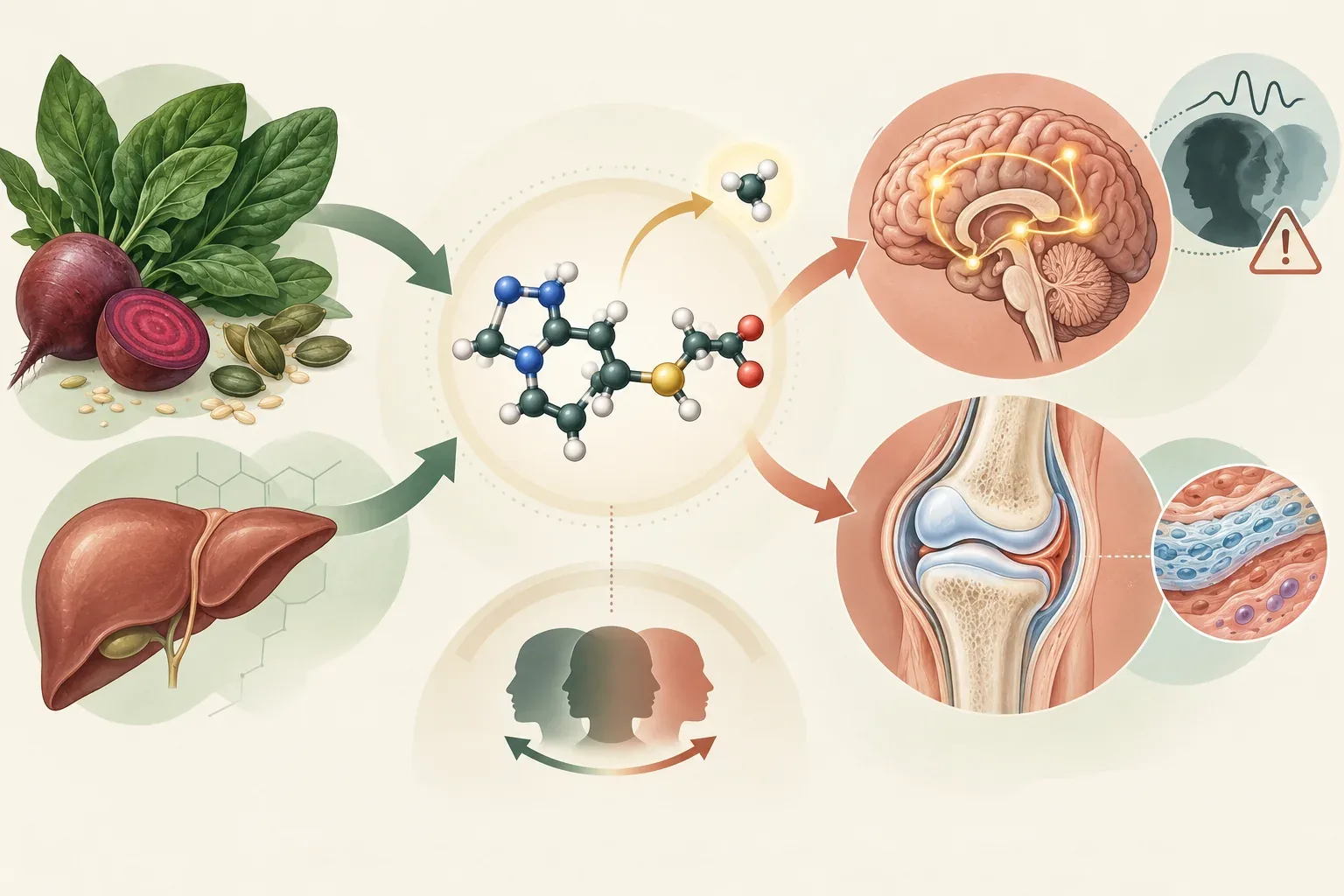
Methionine is used to build proteins and to make SAMe, a molecule that donates small chemical units called methyl groups. Cells use those transfers in the processing of DNA, proteins and other molecules.
After donating a methyl group, the pathway produces homocysteine. The body can recycle it into methionine through routes involving folate and B12 or betaine. Another route, supported by B6, directs material toward cysteine.
This links methionine supply to both recycling and the production of other sulfur-containing compounds. The pathways have to work together; adding more methionine does not guarantee that downstream processing increases to match. [1]
The short version
Unit: milligrams (mg) of L-methionine.
Reasonable start: there is no evidence-based supplement starting amount for healthy people. Protein-rich foods normally cover the combined methionine-and-cysteine requirement.
Typical listings: 500 mg capsules, and 1,000 mg per two capsules with vitamin B6. These are retail serving amounts, not daily requirements.
Skip: liver, hair, nail, or methylation claims supported only by methionine's role in the body, and any self-treatment of an acetaminophen overdose.
What people take methionine for
| Claimed benefit | Dose / form studied | Research verdict | Evidence strength |
|---|---|---|---|
| Support liver health | No established supplemental dose or treatment duration | A role in metabolism does not establish a liver-treatment benefit | Insufficient |
| Improve hair or nails | No established supplemental dose or treatment duration | No adequate controlled benefit evidence in the research reviewed here | Insufficient |
| Improve methylation | No established supplemental dose; dietary requirements include cysteine | More is not known to help; high amounts can raise homocysteine | Insufficient |
Oral methionine has a history as an antidote for acetaminophen (paracetamol) overdose in some settings. That is emergency medicine, not a supplement use. Current overdose assessment is time-sensitive, and acetylcysteine is the main antidote used in clinical care.
When to ask a doctor before taking methionine
- You have schizophrenia. Methionine can worsen symptoms.
- You have high homocysteine, kidney disease, or heart or blood-vessel disease. Elevated homocysteine is associated with cardiovascular risk and can also reflect B-vitamin deficiency, kidney problems or other causes. A higher result alone does not diagnose heart disease. Methionine supplements can raise this marker and complicate its interpretation. [2]
- You may have taken too much acetaminophen. Contact emergency services or a poison center now; do not wait for symptoms or treat it yourself with methionine.
Food requirements and retail directions
| Amount | What it represents | What it does not establish |
|---|---|---|
| 19 milligrams per kilogram (mg/kg) a day from food | National Academies adult requirement for methionine plus cysteine; about 1.3 g total at 70 kg | A methionine-pill target |
| 500 mg one to three times a day | Common retail directions for isolated L-methionine | A tested health benefit |
Labels sometimes say to take methionine between meals, but no trial established a best time of day.
Which foods supply methionine?
One gram (g) equals 1,000 milligrams (mg).
These ordinary foods contain methionine as part of their protein. The amounts are calculated from the USDA FoodData Central SR Legacy records[3] for the stated edible portions and rounded to 0.01 g.
| Food and preparation | Source | Serving | Methionine (g) |
|---|---|---|---|
| [4] | Meat | 3 oz (about 85 g) | 0.73 |
| [5] | Fish | 3 oz (about 85 g) | 0.73 |
| [6] | Meat | 3 oz (about 85 g) | 0.55 |
| [7] | Plant | ½ cup (about 126 g) | 0.27 |
| [8] | Dairy | 1 cup (about 244 g) | 0.20 |
| [9] | Egg | 1 large (about 50 g) | 0.20 |
| [10] | Plant | 1 oz (about 28 g) | 0.17 |
| [11] | Plant | 1 cup (about 198 g) | 0.15 |
| [12] | Plant | 1 oz (about 28 g) | 0.04 |
On a vegan diet centered on legumes, individual servings may provide less methionine than the fish or meat servings shown here: a cup of lentils has about 0.15 g and a half cup of tofu about 0.27 g. Dietary requirements are assessed for methionine together with cysteine, and grains, seeds, soy and other foods contribute across the day. [13]
How can I tell if I'm low on methionine?
There is no routine test used to decide whether a healthy adult needs a methionine supplement. The practical check is the whole protein pattern: record a few typical days and look for regular servings of eggs, dairy products, fish, meat, beans, soy, or mixed plant proteins. A restricted diet, poor appetite, or illness is a reason for a clinician or dietitian to review overall protein intake and nutrition.
See Labs for what homocysteine can and cannot tell you.
What to pay attention to on the label
Find the L-methionine line on the Supplement Facts panel and check how many capsules make one serving. Labels also differ in whether they include vitamin B6.
| Product | Amount per labeled serving | Amount per capsule |
|---|---|---|
| Single-ingredient capsule | 500 mg methionine per one capsule | 500 mg methionine |
| Two-capsule serving with B6 | 1,000 mg methionine plus 20 mg vitamin B6 | 500 mg methionine plus 10 mg B6 |
The two-capsule example divides both ingredients by two. A combined serving still needs to be distinguished from the total taken over a day.
Common Myths about Methionine
Does more methionine mean better methylation?
Not necessarily. Extra methionine feeds the pathway and can raise homocysteine. Folate, vitamin B12, vitamin B6, and betaine participate in processing homocysteine, but adding those nutrients does not turn a high methionine intake into a proven health strategy.
Is methionine a liver supplement?
The human evidence reviewed here does not establish that benefit from methionine supplements in healthy people. Historical use as an acetaminophen-overdose antidote is a time-sensitive medical treatment and cannot be carried over to a daily “liver support” claim.
Drawbacks and side effects
| Potential drawback | When/who it affects | Research evidence | Practical implication |
|---|---|---|---|
| Raised homocysteine; temporary blood-vessel dysfunction at large loading doses | Homocysteine rose with 1.5 g/day for four weeks as well as with larger research loads | Repeated-dose and loading studies measure different exposures | The concern is not confined to a single very large dose |
| Worsened psychiatric symptoms | People with schizophrenia | The human safety review describes symptom worsening in this population | Discuss use with the treating clinician |
| Uncertain long-term safety | Regular supplemental use, especially pregnancy or breastfeeding | No official upper limit or adequate long-term safety basis | Long-term supplemental safety remains uncertain |
What high-dose studies found
There is no official upper limit. A 2006 human-safety review[1] found no adverse effects in nutritional and metabolic studies using amounts around the requirement. A single 0.1 g/kg research loading dose raises homocysteine and temporarily impairs blood-vessel relaxation. For a 70 kg (154 lb) adult, that is 7 g or 7,000 mg—the amount in fourteen 500 mg capsules.
In one small graded-dose study[14], six healthy men added 25, 50 and 75 mg/kg/day of methionine to their usual diet for one week at each amount. Homocysteine rose significantly at the highest amount; the lower amounts did not show a statistically clear rise. These were supplemental methionine amounts, not multiples of the combined methionine-and-cysteine dietary requirement.
The review describes B vitamins and vitamin C modifying some laboratory responses, but that does not establish a regimen that prevents clinical harm from high methionine intake.
Homocysteine also rose with 1.5 g/day
A placebo-controlled crossover trial[15] studied eight women with chronic urinary tract infections and twelve healthy women. They took 500 mg L-methionine three times daily for four weeks. Compared with their placebo periods, average homocysteine rose from 9.4 to 11.2 micromoles/L in the patients and from 8.9 to 11.0 in the healthy women, despite adequate vitamin status.
This was a blood-marker change at a repeated daily amount, not just a response to a large one-off load. The trial did not establish that these changes caused heart attacks or strokes.
When too much is dangerous
The review describes infant growth concerns with excess methionine. In a cluster of ten infants receiving high-methionine formula, estimated intakes were 125–507 mg/kg/day, compared with usual estimates of 62–97 mg/kg/day. These are infant methionine-intake comparisons.
It also describes a death after a suspected research-dose error. Blood concentrations suggested roughly ten times the intended loading dose, but the amount actually given was not directly verified. The review separately reports worsened psychiatric symptoms in people with schizophrenia given large amounts.
The science behind methionine
Urine acidity and kidney-stone chemistry
A controlled-diet study[16] gave twelve healthy volunteers a single 1.5 g dose of L-methionine. Researchers compared urine collected that day with the preceding day on the same standardized diet. Urine became more acidic, and calculated supersaturation for brushite and struvite—two types of crystals that form kidney stones—fell; urinary calcium did not clearly change. Supersaturation measures how favorable the urine is for those crystals to form.
The study measured urine chemistry over one day, not actual stone recurrence or treatment of a urinary infection. It suggests a possible application for particular stone types, but whether taking methionine prevents those stones remains unestablished by this study.
Methionine restriction asks the opposite question
Interest in methionine and aging often comes from experiments that lower dietary methionine, especially animal studies. Those cannot be used to support adding a methionine capsule.
A 16-week human trial[17] studied a specially formulated low-methionine diet in adults with obesity and metabolic syndrome. The comparison group received supplemental methionine to restore intake. The restricted group showed a greater shift toward burning fat and a greater improvement in a liver-fat imaging measure. Weight and insulin-sensitivity improvements occurred in both groups without a clear extra advantage from restriction.
This was a controlled dietary intervention, not a trial of choosing ordinary protein foods freely or adding an amino acid for longevity. It did not measure longer life, and its metabolic results do not establish that a well-nourished person should deliberately restrict an essential amino acid. The finding does explain why a claim about “methionine and longevity” must state which direction the intervention went.
Methionine is not SAMe
The body uses methionine to make S-adenosylmethionine, usually called SAMe. That biochemical relationship does not make their supplements interchangeable. A trial giving SAMe tests a particular downstream molecule; it does not show that extra methionine produces the same exposure or benefit. Mood or joint claims supported by SAMe studies need to stay attached to SAMe, while methionine has its own requirement, metabolism and high-exposure risks.
Acetaminophen overdose
Oral methionine has been used in the United Kingdom to prevent liver injury after acetaminophen overdose. In a 1981 report of 132 treated cases[18], severe liver injury occurred in 7 of the 96 people treated within ten hours, compared with 47% of those treated later. This was a case series, not a randomized comparison proving methionine equivalent to acetylcysteine; poisoning severity and treatment timing also matter. The history concerns an urgent antidote intervention, not daily protection from alcohol, medicines or an unhealthy diet. Modern triage depends on the amount and timing of exposure and can require urgent testing and acetylcysteine. Anyone who may have overdosed should contact emergency services or a poison center rather than use a supplement.
Where the sources disagree
Supplement labels turn methionine's normal roles into liver, hair, nail, and methylation claims. The human evidence found for this page establishes a food requirement and shows that homocysteine can rise with repeated 1.5 g/day supplementation as well as larger exposures, but it does not show a benefit from a methionine pill in healthy people. Whether any well-nourished group benefits remains open.
Labs
A clinician may order homocysteine, vitamin B12 and folate tests when investigating an elevated homocysteine result. Kidney function, medicines, smoking, thyroid status, age and inherited disorders may also matter. Homocysteine is not a test for methionine deficiency; the clinician should decide which measurements are useful and how to interpret them.
Before the test if you already supplement
If homocysteine is being checked, MedlinePlus says an 8–12-hour fast may be needed[2]. Its instructions do not set a methionine-stop interval. Tell the clinician about methionine and B-vitamin products and ask when to take the next dose.
The bottom line
Methionine is a necessary part of dietary protein, but extra methionine has no established role as a routine liver, hair or “methylation” supplement.
High supplemental amounts can raise homocysteine. We would meet the nutritional need through an adequate diet rather than treat a 500 mg capsule as an obvious addition. A specific medical use needs its own reason and supervision.
Help us improve this article
Spotted an error or found a source we should consider? Tell us which part of this article needs another look and include a link if you have one. Please leave out personal health details and lab results; we can’t answer individual medical questions.
Explore more in liver
More in compounds

References
- Garlick: toxicity of methionine in humans, 2006 ↩
- MedlinePlus: homocysteine test ↩
- USDA FoodData Central SR Legacy records ↩
- Chicken breast, roasted ↩
- Sockeye salmon, cooked ↩
- Ground beef patty, 90% lean, cooked ↩
- Firm tofu, calcium-set, raw ↩
- Whole milk ↩
- Egg, hard-boiled ↩
- Pumpkin seed kernels, dried ↩
- Lentils, boiled ↩
- Almonds ↩
- Review of protein and amino acids in vegetarian diets ↩
- small graded-dose study ↩
- placebo-controlled crossover trial ↩
- controlled-diet study ↩
- Plaisance et al.: dietary methionine restriction in metabolic syndrome, 2011 ↩
- Vale et al.: oral methionine in 132 acetaminophen-poisoning cases, 1981 ↩
- National Academies: adult amino-acid requirements, Essential Guide (2006), Appendix E, pp. 463–464
- Wright and Crowe: oral methionine for low-dose paracetamol overdose, BMJ letter, 1998
- Alsalim and Fadel: oral methionine versus intravenous N-acetylcysteine after paracetamol overdose, 2003
- NIH Office of Dietary Supplements: folate and homocysteine
- Dart et al.: out-of-hospital acetaminophen-exposure triage guideline, 2025
- The Diary of a CEO: Darren Candow on creatine, 15 June 2026
- NIH Dietary Supplement Label Database: a 500 mg L-methionine capsule label
- NIH Dietary Supplement Label Database: a twice-daily L-methionine label
- NIH Dietary Supplement Label Database: an L-methionine label for one to three capsules a day
- NIH Dietary Supplement Label Database: an L-methionine and vitamin B6 label
Corrections & updates
- Update
Updated the evidence discussion and practical guidance after editorial review.