
What is choline?
Choline is an essential nutrient. Eggs, liver, soybeans, meat, fish, beans, vegetables, grains, nuts, and seeds can all contribute.
Food tables report total choline. Supplements may instead list choline itself, choline bitartrate, phosphatidylcholine, lecithin, alpha-GPC, or citicoline. Those numbers do not all describe the same thing. The usual daily reference is total choline from food and supplements: 425 mg for adult women and 550 mg for adult men.
People use choline products to fill a food gap, especially during pregnancy or lactation, and they use alpha-GPC or citicoline for focus or memory. Adequacy, pregnancy research, and form-specific cognition studies are separate questions.
The short version
- Unit: Count milligrams of choline. A food-table value or a Supplement Facts line that says “Choline 250 mg” is already a choline amount.
- Reasonable starting point: Estimate food first against the amount for your sex and life stage. Use a supplement only for the remaining gap, with a clearly declared choline amount.
- Skip: Skip a lecithin product with no usable choline declaration, any product that presents the weight of a choline compound (such as 1,000 mg choline bitartrate) as milligrams of choline, and promises of brain repair or better child development from a routine supplement; the clinical findings below do not establish those broad benefits.
| Form you may see | What the number on the label usually means | Arithmetic that is defensible |
|---|---|---|
| Food total choline | Milligrams of total choline across several compounds | Use the food-table number as listed |
| Choline bitartrate | Either declared choline or salt weight, depending on the facts line | The pure dry salt, with no water bound into its crystal, is about 41.1% choline |
| Phosphatidylcholine or lecithin | Material or mixture weight unless choline is declared separately | Use a product-specific choline declaration; no universal percentage works |
| Alpha-GPC | Usually milligrams of the compound | Pure compound is about 40.5% choline by molecular weight |
| Citicoline | Usually milligrams of the compound or salt | The basic compound before sodium or water is added is about 21.3% choline by chemical mass |
What choline does in your body
Choline supplies material for phosphatidylcholine and sphingomyelin, two types of fat molecule in cell membranes. These membranes separate cells from their surroundings and organize structures inside them. Phosphatidylcholine also helps the liver package fats for transport into the blood, which helps explain the connection between severe choline shortage and fat accumulating in the liver.
The body also uses choline to make acetylcholine. This chemical messenger carries signals involved in muscle contraction and nervous-system functions. A third route converts choline into betaine, which donates small chemical units called methyl groups in metabolism.
Your liver makes some choline-containing compounds, but diet still has to supply enough.
What people take choline for
| Claimed benefit | Dose / form studied | Research verdict | Evidence strength |
|---|---|---|---|
| Child development during pregnancy | 480 versus 930 mg/day total choline in the third trimester; a separate trial used phosphatidylcholine supplying 750 mg/day choline from week 18 to 90 days after birth. | Small attention findings and a larger null trial leave the benefit uncertain. | Limited |
| Memory in older adults | Citicoline 500 mg/day for 12 weeks in adults aged 50–85 with age-associated memory impairment; compound weight. | The main memory test was null; some secondary tests improved. | Limited |
| Thinking in Alzheimer disease | Alpha-GPC 1,200 mg/day for 180 days in mild-to-moderate Alzheimer disease; compound weight, specialist treatment context. | One trial found better clinical scores; this does not establish healthy-adult focus benefits. | Limited |
| Recovery after acute ischemic stroke | Citicoline 1,000 mg every twelve hours, first intravenous then oral, for six weeks. | A large trial found no improvement in combined recovery at ninety days. | Large trial negative |
Choline supplementation makes the most sense when a diet shows a real gap that you cannot close comfortably with food. Pregnant or lactating women, people who avoid eggs and several animal foods, and people on very restricted diets have a reason to check if they're getting enough. Long-term intravenous feeding, malabsorption, or liver disease calls for clinical nutrition advice.
An intake below the official adequate intake is not automatically a diagnosed deficiency. An adequate intake is the National Academies' best estimate when evidence is too thin to set a more certain daily requirement. Because the Academies could not determine an average requirement for choline, population shortfalls cannot be turned into a percentage of people who are clinically deficient.
When to ask a doctor before taking
Large amounts of choline can lower blood pressure, so ask before using them if your blood pressure is already low. Trimethylaminuria is a disorder in which the body does not properly process trimethylamine, an odor-producing substance that can be made from choline; extra choline can worsen the fishy odor. Kidney or liver disease can also raise susceptibility to adverse effects because blood choline may rise more after supplements. The National Academies review[1] identifies these concerns; [2]
If you are considering alpha-GPC while receiving care for heart or stroke risk, discuss the uncertain stroke association described below with that clinician. It is a signal from prescription-use records, not proof that ordinary dietary choline is harmful. Pregnancy complications or treatment for dementia or brain injury also call for advice from the treating clinician: the mixed, condition-specific trials below do not establish a self-directed treatment course.
The NIH choline fact sheet lists no known clinically relevant medication interactions.
Common dosage
As of 2026, the National Academies' adequate intakes are 550 mg a day for adult men, 425 mg for adult women, 450 mg during pregnancy, and 550 mg during lactation. For choline, those estimates came from small studies of the amount that prevented liver injury in people fed low-choline diets. These totals include food and supplements.
For ordinary adequacy, count food first and use the intake for your sex or life stage. The larger amounts in treatment studies address particular conditions and are not daily-nutrition targets.
The official upper limit from the National Academies is 3,500 mg a day of total choline for adults. For pregnant and lactating women ages 14–18, it is 3,000 mg; for ages 19–50, it is 3,500 mg. The limit is a ceiling, not a goal.
There is no official morning, evening, empty-stomach, cycling, or split-dose rule for meeting the daily amount. Count the total over the day. If a product causes stomach upset, its directions and your clinician can guide how you take it.
Am I getting enough choline from food?
You may be able to reach the daily amount with food, but the answer depends on the whole day rather than one “high-choline” item. The NIH table lists about 356 mg in 3 ounces of pan-fried beef liver, 147 mg in one large hard-boiled egg, 107 mg in one-half cup roasted soybeans, 72 mg in 3 ounces of roasted chicken breast, and 71 mg in 3 ounces of cooked Atlantic cod.
Selected values from the NIH Office of Dietary Supplements food table[3] show the stated food and preparation. Amounts are per serving.
| Food and preparation | Source | Serving | Total choline (mg) |
|---|---|---|---|
| Beef liver, pan-fried | Meat | 3 oz (about 85 g) | 356 mg |
| Egg, hard-boiled | Egg | 1 large | 147 mg |
| Beef top round, braised | Meat | 3 oz (about 85 g) | 117 mg |
| Soybeans, roasted | Plant | ½ cup | 107 mg |
| Atlantic cod, cooked | Fish | 3 oz (about 85 g) | 71 mg |
| Red potato, baked with skin | Plant | 1 large | 57 mg |
Those numbers are already total choline. Do not apply a phosphatidylcholine or salt conversion to them. On a vegan diet, you may get less choline from food if you rarely eat soybeans, beans, potatoes and other contributing plants. The half cup of roasted soybeans plus large potato shown here adds up to 164 mg, still below the adult adequate intakes of 425 mg for women and 550 mg for men; other food across the day counts too. Compare a short food record with the amount for your sex or life stage. Falling below an adequate intake does not by itself diagnose deficiency.
How can I tell if I'm low on choline?
A low dietary intake does not necessarily produce noticeable choline-deficiency symptoms. The body makes some choline, and individual requirements vary.
What established deficiency can do
Choline deficiency can cause liver damage, fat accumulation in the liver and muscle damage. These may be found during clinical evaluation rather than through a distinctive sensation you can recognize. [4]
Why a severity checklist would be misleading
There is no established minor, moderate and severe symptom scale for dietary choline deficiency. Fatigue or a memory complaint is not a specific choline-deficiency sign. A food record helps assess intake; suspected liver or muscle injury needs evaluation of its possible causes.
What testing can and cannot show
There is no routine standalone blood test that can diagnose a dietary choline gap. Choline in blood can stay fairly steady because your body makes some and tissues can release it as their phospholipids break down and rebuild. Blood phosphatidylcholine also varies with the particles that carry fats through the bloodstream, so one result has no validated consumer cutoff that tells you to buy a supplement. [3]
Start with a three- to seven-day food record, then compare your estimated intake with the adequate intake for your sex and life stage. If liver or muscle injury is a concern, a clinician may use a standard liver enzyme test, the muscle enzyme creatine phosphokinase test, clinical history, and sometimes liver imaging as part of a broader evaluation.
Before the test if you already supplement
If a clinician orders liver or muscle-enzyme tests, report your choline product and dose. There is no established choline-stop interval for these injury markers. Follow the ordered test’s preparation instructions; [5]
Choline forms you can buy
Products use several choline forms, but no form has proved universally best or won on long-term clinical outcomes. Food is the best-supported first choice for reaching the adequate intake. If a food gap remains, look for a label that lets you count actual choline. Alpha-GPC and citicoline have been studied mainly in selected patient groups; the results do not establish a general healthy-adult focus benefit.
Choline bitartrate
Bitartrate is useful when Supplement Facts declares the nutrient amount clearly; count that declared choline as shown in the label section. If only salt weight appears, the theoretical fraction explained there is usable only when the exact material is identified. Bitartrate has no proven cognition or pregnancy advantage over other forms.
Phosphatidylcholine and lecithin
Phosphatidylcholine is a dietary phospholipid family, while commercial lecithin is a mixture that can contain phosphatidylcholine and other phospholipids. If you want this lipid-derived source, the useful distinction is whether the label gives a product-specific choline amount; “lipid-derived” alone does not show a benefit. The research-material percentages in the label section do not transfer to an unrelated product.
Alpha-GPC
Alpha-GPC is a defined phosphocholine compound usually sold for focus or exercise. Its theoretical choline fraction is useful for label arithmetic, but it does not establish how much verified choline a finished product supplies or whether the product improves a clinical outcome. One Alzheimer trial found better clinical scores, while prescription-use records raised an unresolved stroke concern. These findings do not establish alpha-GPC as a better choice for ordinary nutrition or healthy-adult focus.
Citicoline
Citicoline, also called CDP-choline, is a defined compound that contains a choline portion. Sodium and water bound into the material change the calculation, so the label needs to identify the material before the theoretical fraction in the label section is useful. Memory findings are mixed, and large brain-injury and stroke trials found no recovery benefit. Citicoline was not included in the direct equal-choline form comparison.
Can you take two choline products the same day?
First add the declared choline from food and every product, then check whether a second product would fill any remaining dietary gap. The 3,500 mg adult upper limit applies to total choline from all sources. When a label gives only alpha-GPC, citicoline, bitartrate, or phosphatidylcholine weight, keep that theoretical calculation separate from verified choline. Tracking only front-panel compound numbers can hide the real total.
What to pay attention to on the label
The deciding number is the separately declared amount of choline, when the facts panel provides one. Form names help identify the source, but they do not replace that nutrient amount.
The label Daily Value is a one-size reference of 550 mg for adults and children age 4 and older. It does not replace the sex- and life-stage adequate intakes, such as 425 mg for adult women or 450 mg during pregnancy.
Which number on the label is the amount
If Supplement Facts says:
Choline 250 mg (as choline bitartrate)
count 250 mg choline. If a product instead says only “choline bitartrate 1,000 mg,” that 1,000 mg is the weight of the salt. Pure anhydrous chemistry would contain about 411 mg of the choline portion, but that theoretical calculation does not confirm how much is in the finished product.
The same boundary applies when alpha-GPC or citicoline is sold for focus or memory. 300 mg alpha-GPC is about 122 mg of its choline portion, and 600 mg is about 243 mg. 500 mg free-base citicoline is about 107 mg, while 2,000 mg is about 427 mg. Citicoline sold as a salt or with water bound into its crystal has a different total molecular weight. If the label does not identify the exact material, do not use the free-base calculation.
Phosphatidylcholine and lecithin need product-specific information. One research egg-phosphatidylcholine material was about 13.7% choline, and another trial preparation was documented as about 15%.
Misleading labels
A compound total presented as choline
A front-panel “1,000 mg choline bitartrate” claim can look larger than the 550 mg label Daily Value while providing about 411 mg choline by pure-salt arithmetic.
A declared nutrient amount converted twice
“Choline 250 mg (as bitartrate)” already gives the nutrient amount. Multiplying it by 41.1% again would incorrectly reduce 250 mg to about 103 mg.
A variable mixture treated as a fixed percentage
A percentage measured in one research preparation does not establish the choline in another lecithin bottle. Lecithin contains varying amounts of different phospholipids, and even phosphatidylcholine molecules can carry different fatty acids. Use the product's separately declared choline amount rather than multiplying its mixture weight by a fixed percentage.
Study compound weight is not the choline amount
The 500 mg citicoline memory study used 500 mg of the whole compound, not 500 mg of choline. The free-base calculation above yields about 107 mg of its choline portion. Reaching the same total choline intake with bitartrate would not reproduce the tested citicoline treatment or its memory findings.
Manufacturer claims and the studies they may be based on
A pregnancy-development claim may be based on research comparing 480 with 930 mg of total daily choline. A memory claim on citicoline may be based on a branded 500 mg compound used in older adults with age-associated memory impairment. An alpha-GPC cognition claim may trace to 1,200 mg a day in diagnosed Alzheimer disease. Those examples do not show that another product matches the studied preparation, population, or outcome, and they do not establish ordinary dietary adequacy.
How long should I take choline supplements for?
For an ordinary dietary gap, first count choline from food and use a supplement only for the amount still missing. This is an ongoing intake question, not a short loading course. Pregnancy and breastfeeding change the daily target; the need does not disappear because a bottle has been finished. NIH's choline review[3] describes how intake and individual requirements vary, but it does not provide a reliable time for body stores to drain or a standard supplement taper. If diet later covers the relevant intake, the extra product may no longer be needed. A study of a larger choline compound for a particular outcome has its own dose and follow-up period; it should not become a maintenance dose for everyone.
How choline interacts with other nutrients
Vitamin B12 and folate
Choline, vitamin B12, and folate help move methyl groups through related metabolic pathways. That shared job does not create a mandatory supplement stack or show that high-dose B12 or folate must accompany choline, alpha-GPC, or citicoline. Assess each nutrient from its own intake, deficiency risks, and clinical evidence.
Common Myths about Choline
Does more choline mean better focus?
Not shown. Choline is required to make acetylcholine, but a required biochemical pathway does not show that extra alpha-GPC or citicoline improves focus in an already adequate healthy adult. The adequate intakes were set from the amount that prevents liver injury in people fed low-choline diets, not from any test of focus.
Does TMAO prove eggs are harmful?
Not settled. Gut microbes can turn some choline-containing material into trimethylamine, which the liver converts to trimethylamine N-oxide, or TMAO. That pathway is real. Whether ordinary egg intake causes cardiovascular events through TMAO is still disputed.
Are alpha-GPC and citicoline interchangeable?
No. They are different compounds with different choline fractions. The milligrams on their labels cannot be compared directly, and neither has been shown to be the universal best form for adequacy, focus, or memory.
Drawbacks and side effects
| Potential drawback | When/who it affects | Research evidence | Practical implication |
|---|---|---|---|
| Fishy odor, digestive upset and low blood pressure | High total choline intake, especially gram doses. | NIH and the National Academies describe these effects; the adult total-intake limit is 3,500 mg/day. | Count choline from all sources; stop and seek advice if significant symptoms develop. |
| Uncertain cardiovascular implications | TMAO production and prescription alpha-GPC exposure. | Cohort associations do not establish causation; genetic evidence complicates the TMAO interpretation. | Do not infer that eggs cause heart disease or that a different choline form removes the uncertainty. |
Too much choline can cause fishy body odor, vomiting, sweating or salivation, diarrhea and other digestive effects, and low blood pressure.
Fishy body odor, vomiting, persistent diarrhea, heavy sweating or salivation, or light-headedness are reasons to stop the product and contact a clinician before restarting it. Seek urgent medical care if symptoms are severe or you feel faint.
The limit came from sparse evidence. A seven-person Alzheimer pilot used 4 g a day and then 7.5 g a day of choline; nausea, diarrhea, and a small blood-pressure decrease appeared at 7.5 g. The National Academies divided that adverse-effect level by two and rounded the calculated 3.75 g down to 3.5 g.
Choline during pregnancy and breastfeeding
Women need 450 mg a day during pregnancy and 550 mg a day during lactation as adequate intakes. To set the pregnancy amount, the National Academies estimated how much choline would be added to the fetus and other tissue during pregnancy. The lactation amount adds estimated choline transferred into milk.
This matters because many pregnant women consume less than 450 mg, and many prenatal products contain little or no choline. Count food plus the choline specifically declared on a prenatal facts panel.
Research has not established a retail form or a universal intake above 450 mg for pregnancy. Women considering a higher amount can take that unresolved question to their prenatal clinician.
The science behind choline
The studies cover pregnancy development, form-specific cognition and stroke recovery, TMAO and cardiovascular risk, and short-term form handling. Their milligrams, populations, and outcomes cannot be pooled into one “choline works” verdict.
The pregnancy studies include small positive results and a larger null trial
Caudill's controlled-feeding study assigned 26 women to 480 or 930 mg a day of total choline in the third trimester; 24 infants contributed follow-up data. A statistical model planned before the analysis estimated that infants in the 930 mg group looked toward an image 33.8 milliseconds faster. The simple group averages differed by 22.6 milliseconds in the same direction. Tests of anticipating where an image would appear and remembering visual locations did not differ. The sample was too small to replace the 450 mg pregnancy amount.
Bahnfleth later assessed 20 children from that cohort at age seven. The study's unitless sustained-attention score favored the 930 mg group, but the difference has no familiar everyday interpretation. The higher-intake group also maintained correct detection of one type of brief visual signal better, while other attention measures, false alarms, missed signals, and off-task behavior did not differ. This was a small follow-up of the same prenatal experiment, not an independent population trial.
Cheatham's separate placebo-controlled trial assigned 140 pregnant women to a phosphatidylcholine preparation delivering 750 mg a day of choline or corn oil from week 18 through 90 days after birth; 99 infants were assessed. It found no significant group difference in short-term visuospatial memory, long-term episodic memory, language, or global development at 10 or 12 months. The positive and null studies used different forms, background diets, timing, comparators, and tests. The remaining question is whether a higher total intake produces a meaningful, repeatable child outcome.
TMAO association and genetic evidence point in different directions
Tang gave 40 healthy adults two hard-boiled eggs plus labeled phosphatidylcholine and showed that gut microbes helped generate TMAO. A linked cohort followed 4,007 high-risk patients undergoing coronary angiography. Over three years, 513 participants had a major event, and higher fasting TMAO was associated with greater event risk. The cohort did not assign eggs or choline, and participants who had events also had lower kidney filtration on average.
Jia's analysis used inherited genetic differences as stand-ins to examine which direction cause and effect might run. Genetically predicted TMAO was not associated with coronary artery disease, heart attack, or stroke after the researchers adjusted for testing several relationships. By contrast, genetic liability to diabetes and chronic kidney disease was associated with higher TMAO. The analysis depends on strong, valid genetic stand-ins.
Tang supports production and association; Jia makes simple causation and reverse direction less certain. Neither study is a randomized egg-versus-no-egg cardiovascular event trial.
Alpha-GPC and citicoline results belong to narrow populations
A 261-person placebo-controlled trial reported better scores on tests used to track thinking and clinical symptoms with 1,200 mg a day of alpha-GPC for 180 days in adults with mild-to-moderate Alzheimer disease. It did not test healthy focus or a 300 mg pre-workout amount. A separate Korean study of national health-insurance records associated prescription alpha-GPC with more strokes over ten years. That large observational signal cannot prove alpha-GPC caused the strokes or estimate risk in younger supplement users.
For citicoline, a sponsor-designed 12-week study in 100 adults ages 50–85 with age-associated memory impairment used 500 mg a day. Its main planned memory test, called Spatial Span, did not improve significantly, although some secondary memory tests favored citicoline after statistical correction.
COBRIT then tested 2,000 mg a day for 90 days in 1,213 traumatic-brain-injury patients. The share meeting the study's definition of a favorable functional outcome after brain injury was 35.4% with citicoline and 35.6% with placebo, and the global result showed no benefit. These studies do not answer one shared healthy-adult focus question.
The direct form comparison was an acute metabolism study in six men
Böckmann compared single doses designed to provide 550 mg choline equivalent: 740 mg choline chloride, 1,336 mg bitartrate, 1,358 mg alpha-GPC, and 4,018 mg egg phosphatidylcholine. In six healthy men, cumulative blood exposure—the area traced by choline levels over six hours—did not differ significantly, although egg phosphatidylcholine reached its peak later. The water-soluble forms raised TMAO acutely while egg phosphatidylcholine did not during those test days.
Citicoline after an acute ischemic stroke
ICTUS[6] randomized 2,298 adults with moderate-to-severe acute ischemic stroke to citicoline or placebo within 24 hours of symptom onset. Treatment was 1,000 mg every twelve hours intravenously for three days, then by mouth, for six weeks altogether, alongside stroke care. The main outcome combined neurological recovery, disability and ability to perform daily activities at ninety days.
Recovery did not differ significantly: odds ratio 1.03 (95% confidence interval 0.86–1.25). The trial stopped for futility, meaning the planned interim assessment made the hoped-for benefit unlikely. Manufacturer Ferrer funded it. This is a large negative treatment result for a specific citicoline regimen, distinct from memory studies and from the observational alpha-GPC stroke association.
What you may have heard on podcasts
Podcast claims range from a food target to using alpha-GPC for focus or training, while the official amounts and clinical trials answer narrower questions.
Andrew Huberman said in a 2025 Essentials release that most people should strive for 500–1,000 mg a day from food, especially egg yolks, and linked acetylcholine with focus. The lower end overlaps the adult adequate intakes, which were set to prevent liver injury, not to improve focus. His food target also cannot be translated into 500–1,000 mg of alpha-GPC or citicoline.
Rhonda Patrick discussed the 480-versus-930 mg pregnancy study in a July 2025 interview and described the children as smarter. The trial measured infant processing speed, and the small age-seven follow-up measured sustained attention; neither was a general intelligence test. Her roughly six-eggs-plus-supplement intake was her personal routine.
In a February 2023 conversation, Huberman described occasional 300–600 mg alpha-GPC before hard training and sometimes 300 mg before mental work; Andy Galpin replied that human exercise evidence was sparse. In a July 2024 Peter Attia discussion, Huberman described occasional 600–900 mg alpha-GPC with espresso and mentioned garlic as a possible way to reduce TMAO. These were Huberman's personal-use reports from those two conversations.
The bottom line
Choline is an essential nutrient, but meeting that need and taking a specialized choline compound for memory are different decisions. Pregnancy studies are mixed, and cognitive results vary by compound and population.
Start with total dietary choline, then identify what a supplement actually contains. Choline itself, phosphatidylcholine, citicoline and alpha-GPC do not share a single milligram scale or an interchangeable evidence base. A more expensive brain-health form is not automatically a better way to fill an ordinary nutritional gap.
Citicoline also failed to improve recovery in the large acute-stroke trial. Its initial intravenous treatment and subsequent oral course answer a different question from daily nutrition or healthy memory.
Source notes
- National Academies choline review[7] — adequate-intake and upper-limit basis
- NIH choline fact sheet[3] — daily amounts, food values, safety, and medication-interaction summary
- Caudill 2018[8] and Bahnfleth 2022[9] — 480-versus-930 mg pregnancy study and age-seven follow-up
- Cheatham 2012[10] — placebo-controlled phosphatidylcholine pregnancy trial
- Böckmann 2022[11] — six-man acute equal-choline crossover
- Alpha-GPC Alzheimer trial[12] and alpha-GPC stroke cohort[13]
- Citicoline memory trial[14] and COBRIT[15]
- Tang 2013[16] and Jia 2019[17] — TMAO association and bidirectional genetic analysis
Additional outcome sources:
Help us improve this article
Spotted an error or found a source we should consider? Tell us which part of this article needs another look and include a link if you have one. Please leave out personal health details and lab results; we can’t answer individual medical questions.
Explore more in focus & memory





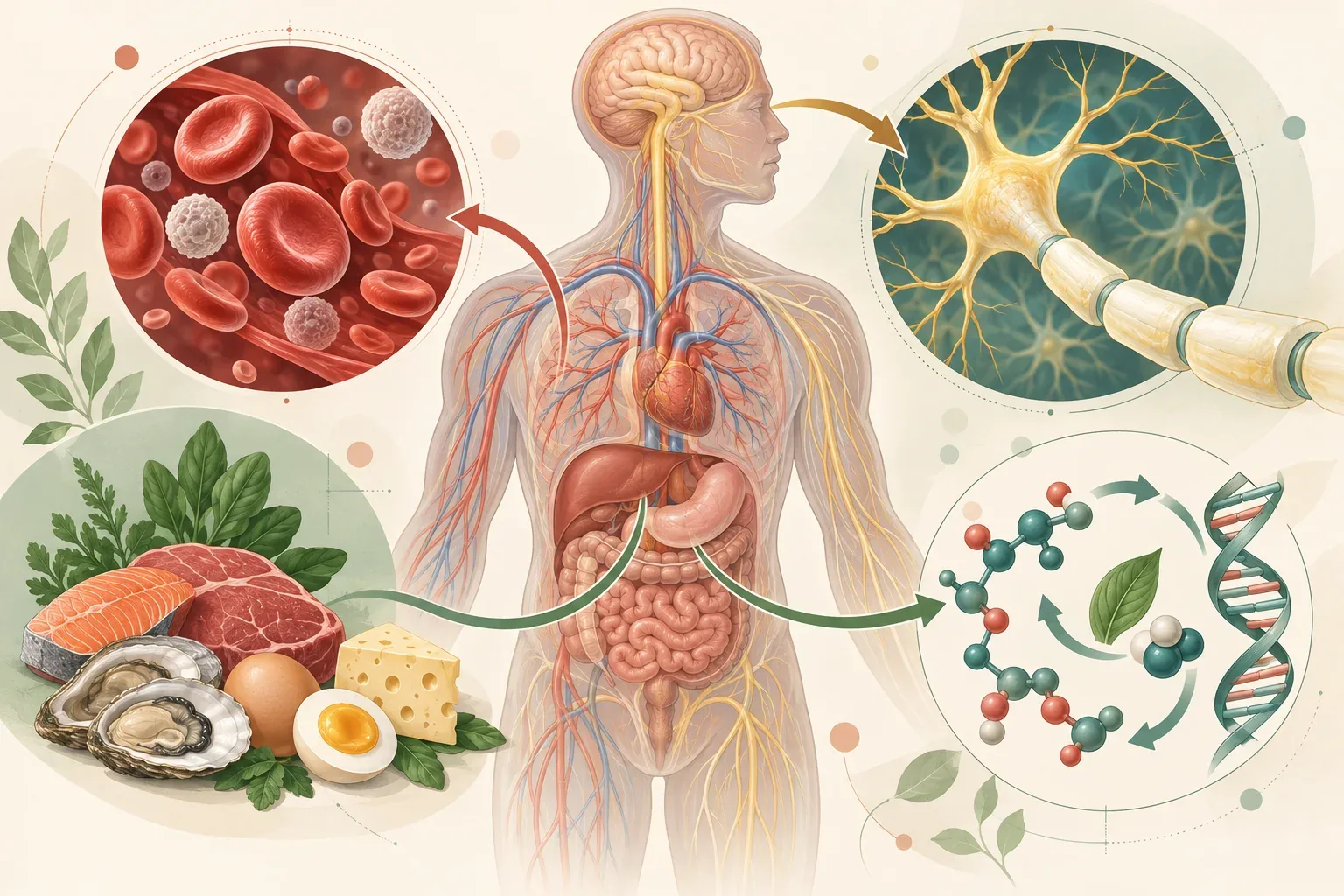
Food sources & dietary alternatives

Nutrient connections worth understanding
 Disputed pairing
Vitamin B12 (Cobalamin): Daily Needs, Deficiency Signs and Treatment Choices
Connection details
Context: megadose B12 with grams of choline
Choline and B12 share methyl metabolism, but that physiology does not justify milligram B12 with gram-dose choline compounds.
Source for this connection
 Disputed pairing
Vitamin B9 (Folate and Folic Acid): Benefits, Forms, and Dosage
Connection details
Context: megadose folate with grams of choline
Choline and folate share methyl metabolism, but that physiology does not justify megadosing either nutrient.
Source for this connection
References
- National Academies review ↩
- MedlinePlus explains trimethylaminuria ↩
- NIH Office of Dietary Supplements food table ↩
- NIH describes these consequences ↩
- liver testing may require fasting and clinician-directed medicine changes ↩
- ICTUS ↩
- National Academies choline review ↩
- Caudill 2018 ↩
- Bahnfleth 2022 ↩
- Cheatham 2012 ↩
- Böckmann 2022 ↩
- Alpha-GPC Alzheimer trial ↩
- alpha-GPC stroke cohort ↩
- Citicoline memory trial ↩
- COBRIT ↩
- Tang 2013 ↩
- Jia 2019 ↩
Corrections & updates
- Update
Updated the evidence discussion and practical guidance after editorial review.
- Update
Revised the article after editorial review, with clearer evidence explanations and practical guidance.