
How much choline do you actually need from your diet?
As of 2026, the National Academies uses an adequate intake of 425 mg daily for adult women and 550 mg daily for adult men. An adequate intake is a reference used when the evidence is insufficient to set a recommended allowance. For adult women, the adequate intake is 450 mg daily during pregnancy and 550 mg during breastfeeding.
The first step is to estimate how much your food actually provides. The NIH table lists roughly 147 mg choline in one large hard-boiled egg, illustrating why removing a daily egg can matter even though eggs are not the only source.
Which animal foods supply choline without eggs?
If you eat meat, fish or dairy, eggs are only one option. The NIH choline food table[1] gives these amounts for specific cooked foods and serving sizes:
| Food | Serving | Choline |
|---|---|---|
| Beef liver, pan-fried | 3 oz (85 g) | 356 mg |
| Lean beef top round, braised | 3 oz (85 g) | 117 mg |
| Chicken breast, roasted | 3 oz (85 g) | 72 mg |
| Atlantic cod, cooked | 3 oz (85 g) | 71 mg |
| 1% milk | 1 cup | 43 mg |
| Nonfat vanilla yogurt | 1 cup | 38 mg |
| Canned white tuna, drained | 3 oz (85 g) | 25 mg |
Liver supplies much more per serving than the other examples; milk and yogurt make smaller contributions that can add up across a day. These are food-content estimates, not a claim that any one serving completes a whole diet.
Can soy replace the missing contribution?
Soy can improve the total, but the example below shows why one replacement does not necessarily reach the reference. It adds 150 g of cooked mature soybeans and removes 150 g of cooked rice from an egg-free plant-based day.
| Food | Before: daily amount | After: daily amount |
|---|---|---|
| [2] | 70 g (2.5 oz) | 70 g (2.5 oz) |
| [3] | 300 g (10.6 oz) | 150 g (5.3 oz) |
| [4] | 150 g (5.3 oz) | 150 g (5.3 oz) |
| [5] | 150 g (5.3 oz) | 150 g (5.3 oz) |
| [6] | 100 g (3.5 oz) | 100 g (3.5 oz) |
| [7] | 250 g (8.8 oz) | 250 g (8.8 oz) |
| [8] | 120 g (4.2 oz) | 120 g (4.2 oz) |
| [9] | 180 g (6.3 oz) | 180 g (6.3 oz) |
| [10] | 30 g (1.1 oz) | 30 g (1.1 oz) |
| [11] | 40 g (1.4 oz) | 40 g (1.4 oz) |
| [12] | 0 g | 150 g (5.3 oz) |
Ounce equivalents are approximate weights; calculations use the gram amounts.
Table note: Weights refer to edible portions in the preparations shown; oats are dry. Cooking and drinking water are excluded from the nutrient estimate.
The calculated changes are:
| Daily total | Before | After | Change (%) |
|---|---|---|---|
| Energy (kcal) | 1,861.5 | 1,935.0 | +3.9% |
| Choline (mg) | 244.5 | 302.0 | +23.5% |
These estimates use the USDA's 2018 food-composition records and compare only the nutrients shown; other nutrient needs may remain unmet. They do not measure absorption or nutrient levels in your body.
Choline rises from 244.5 to 302.0 mg. The day with added soybeans is still about 123 mg below the women's adequate intake and 248 mg below the men's. Those are gaps between this example and planning references, not diagnoses of deficiency.
More choline-containing foods could raise intake further. If you eat animal foods, meat, fish and dairy provide additional options; if you do not, the quantities of soybeans, beans and other plant foods become more important.
When does a choline supplement have a useful job?
First count the foods you actually eat over several typical days, including the animal or plant options above. If that pattern still falls short of the relevant adequate intake and changing meals is impractical, a supplement can provide a measured amount. In the soybean example only, adding 125 mg of choline to the 302 mg food estimate gives 427 mg, just above the 425 mg reference for adult women. Adding 250 mg gives 552 mg, just above the 550 mg reference for adult men. Your own food total will be different, and the adequate intake is a planning reference rather than a treatment target.
Choline bitartrate and phosphatidylcholine contain choline plus other material. A front-label amount of the compound is not necessarily the amount of choline. Prefer a clear Supplement Facts declaration of choline per full serving, and count any choline already supplied by a multivitamin. [1]
How much is too much?
The official upper limit from the National Academies is 3,500 mg daily from all sources for adults. High intakes can cause a fishy body odor, vomiting, sweating, salivation and low blood pressure.
If you have a medical reason to suspect a problem, interpretation needs more than comparing a meal estimate with the adequate intake.
The bottom line
Skipping eggs does not automatically mean you need a choline supplement. Beef, chicken, fish and dairy can contribute if you eat them; soy, beans and other plant foods can also help, though the all-plant example here remained below both adult reference amounts even after adding soybeans. Add up your usual meals first. If a gap remains, a supplement with a clearly declared choline amount can fill it without assuming that a larger front-label compound weight or a “brain support” claim is useful.
Help us improve this article
Spotted an error or found a source we should consider? Tell us which part of this article needs another look and include a link if you have one. Please leave out personal health details and lab results; we can’t answer individual medical questions.
Keep exploring
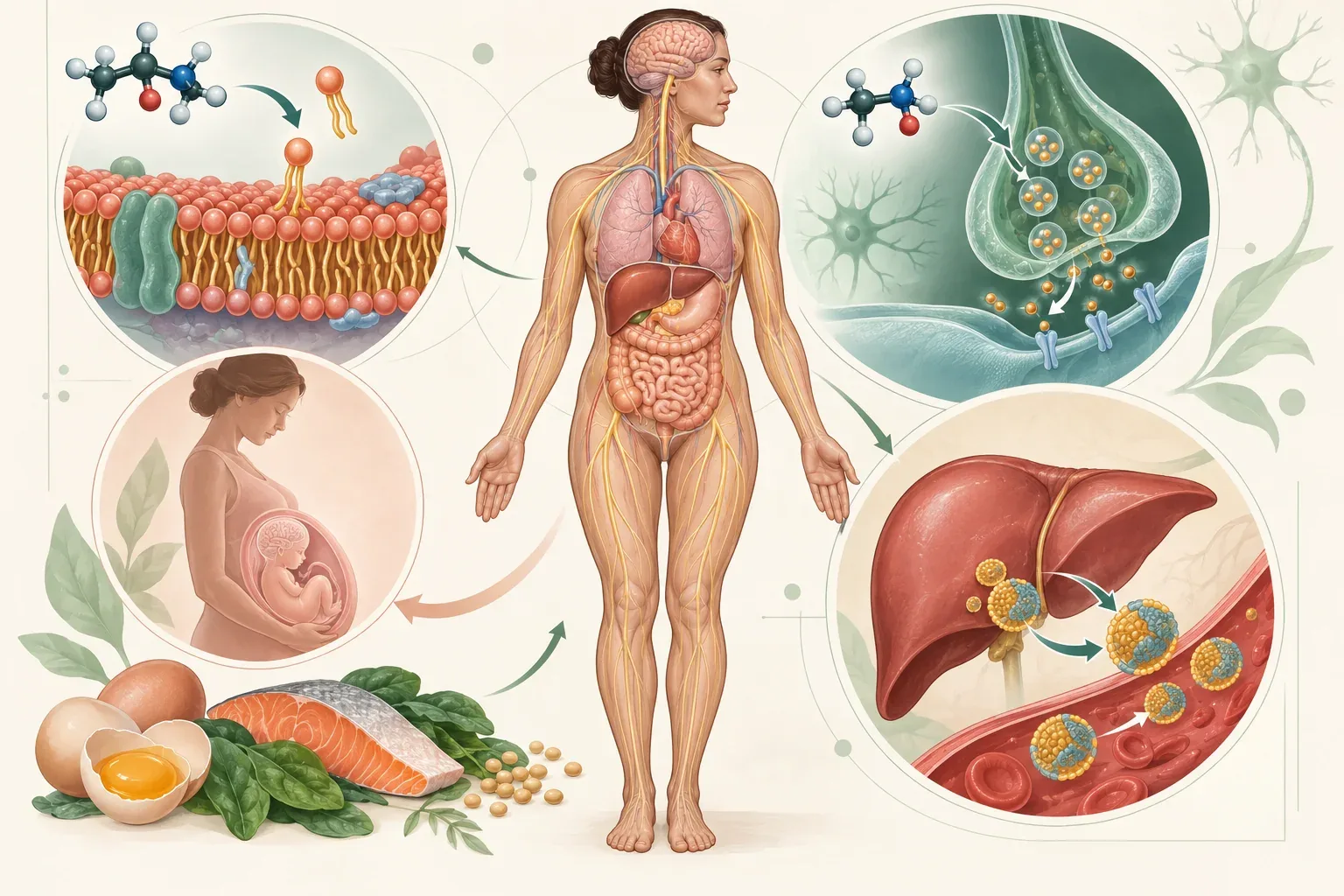
Nutrient connections worth understanding
 Disputed pairing
Vitamin B9 (Folate and Folic Acid): Benefits, Forms, and Dosage
Connection details
Context: megadose folate with grams of choline
Choline and folate share methyl metabolism, but that physiology does not justify megadosing either nutrient.
Source for this connection
 Disputed pairing
Vitamin B12 (Cobalamin): Daily Needs, Deficiency Signs and Treatment Choices
Connection details
Context: megadose B12 with grams of choline
Choline and B12 share methyl metabolism, but that physiology does not justify milligram B12 with gram-dose choline compounds.
Source for this connection