
What is folate?
Folate is vitamin B9. Your body uses it to copy DNA and make new cells, which is why it matters most in tissues that renew quickly, such as red blood cells, and during the first weeks of pregnancy. It also helps recycle homocysteine, an amino acid in the blood, back into a usable form.
You get folate from beans, leafy greens, asparagus, avocado, citrus and liver. In the United States, enriched flour, bread, rice, pasta and many breakfast cereals also contain added folic acid, the stable manufactured form. Supplements use folic acid or methylfolate (also sold as 5-MTHF or L-methylfolate), the form that circulates in your blood. A fourth form, folinic acid, is mostly a prescription medicine.
For adults, the recommended daily amount from the National Academies is 400 micrograms of dietary folate equivalents (mcg DFE) from food and supplements combined. The most common supplement amount is 400 mcg of folic acid, which appears on a label as about 667 mcg DFE. People take folate to fill a gap in their diet, to correct a diagnosed deficiency, and, for women who could become pregnant, to lower the risk of serious birth defects of the brain and spine.
What does folate do in your body?
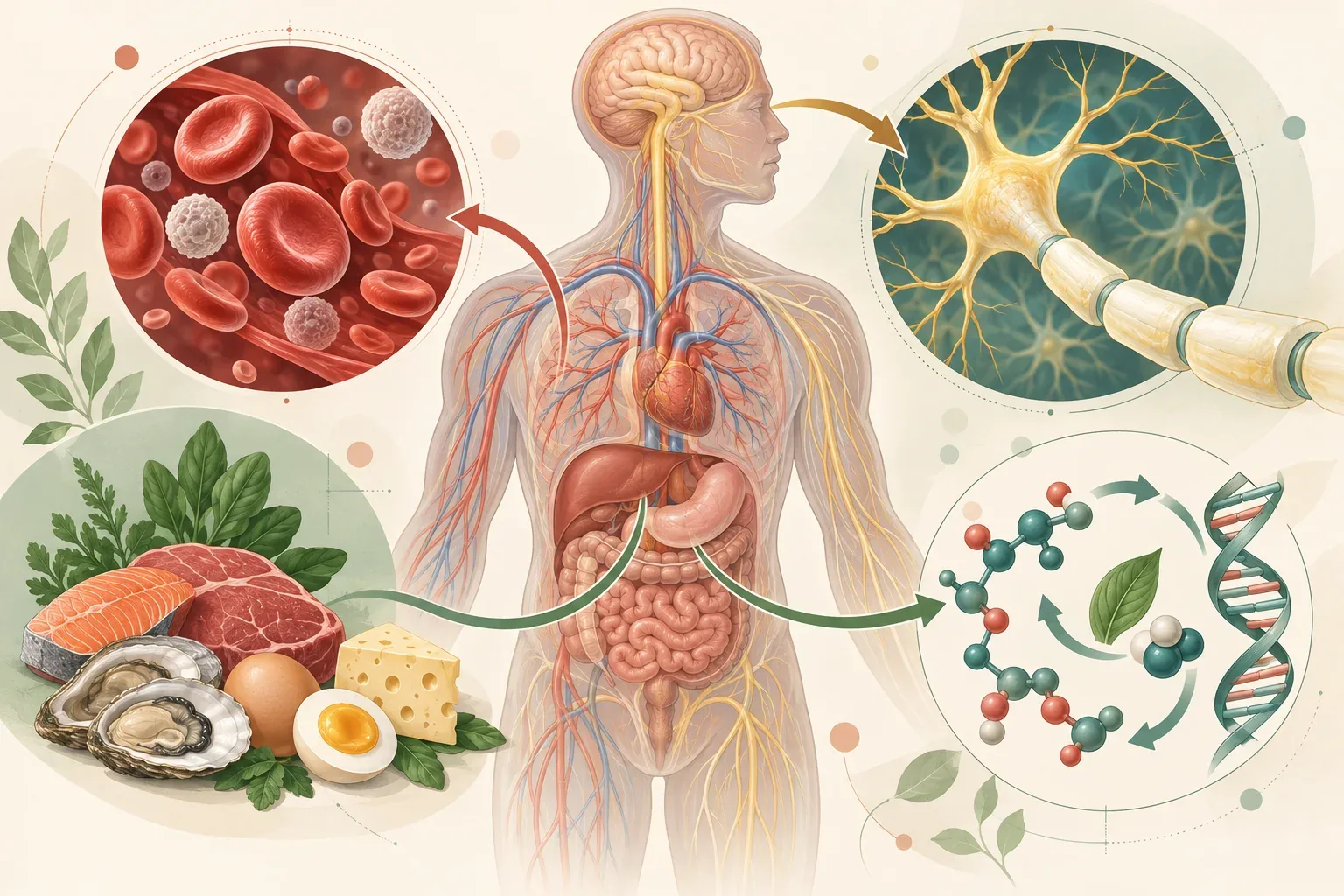
Folate carries small carbon units between reactions. Cells use those units to make the building blocks of DNA and to process amino acids. DNA must be copied whenever a cell divides, so tissues that continually make new cells have an ongoing need for folate. Developing tissues during pregnancy are another important example.
In bone marrow, this matters when new red blood cells are produced. A shortage can disrupt normal cell division and lead to unusually large, poorly functioning cells. Folate also works with vitamin B12 in the conversion of homocysteine back to methionine, an amino acid used in proteins and other reactions.
This explains the relationship between folate, blood formation and development. Folate can improve the anemia caused by B12 deficiency without treating the associated nerve injury. A better blood count therefore cannot settle whether a separate B12-related nerve problem remains. [1]
Why do people take folate?
| Claimed benefit | Dose / form studied | Research verdict | Evidence strength |
|---|---|---|---|
| Preventing a first neural-tube defect, a birth defect of the brain or spine | Folic acid from before conception into early pregnancy; one key trial used a multivitamin with 800 mcg folic acid | Fewer affected pregnancies in trials; current US guidance is built on folic acid specifically. | Strong |
| Preventing a repeat neural-tube defect after an affected pregnancy | 4 mg/day folic acid under a doctor's direction | Recurrence fell from 3.5% to 1.0% in a high-risk group. | Strong |
| Correcting anemia caused by folate deficiency | Folic acid prescribed after vitamin B12 deficiency is ruled out or treated | Standard treatment for a confirmed deficiency; it says nothing about extra folate when levels are normal. | Strong |
| Keeping blood folate up in pregnancy with methylfolate instead of folic acid | 625 mcg/day 5-MTHF versus 600 mcg/day folic acid for 16 weeks, starting at 8–21 weeks of pregnancy | Blood folate was similar and unmetabolized folic acid was lower; birth defects were not measured. | Moderate |
| Preventing heart attack and stroke by lowering homocysteine | 2.5 mg/day folic acid with vitamins B6 and B12 for five years | Homocysteine fell; the main heart outcome did not. | Moderate |
| Preventing a first stroke in adults with hypertension in a low-fortification setting | 800 mcg/day folic acid added to enalapril for a median 4.5 years | First stroke fell from 3.4% to 2.7% in one Chinese trial. | Limited, but promising |
| Protecting memory or preventing dementia in older adults | 400–2,500 mcg/day folic acid, usually with B12 and B6, for months to several years; one trial used 800 mcg/day folic acid alone for three years in adults with high homocysteine | Large reviews found little or no effect on memory or thinking; one trial in people with high homocysteine found small gains. | Review pending |
| Treating depression alongside an antidepressant | 15 mg/day L-methylfolate added to a common type of antidepressant (SSRI) in adults whose depression had not responded | One trial was positive and an earlier one was not; the manufacturer funded both. | Review pending |
Most adults can get enough folate from food and enriched grains, so a supplement is worth considering when your diet falls short of 400 mcg DFE, when a doctor finds a deficiency after a blood test, or when you could become pregnant.
When to ask a doctor before taking folate
Talk to your doctor first if any of these apply to you:
- You take methotrexate, trimethoprim, sulfasalazine, pyrimethamine or a seizure medicine. Folate is sometimes prescribed alongside these drugs on purpose, but the amount and timing can affect how well they work, so the prescriber decides.
- You are being treated for cancer.
- You had a previous pregnancy affected by a neural-tube defect. You need a higher dose prescribed by your doctor.
- You have a condition that limits absorption, such as celiac disease, or you have had bariatric surgery.
Common dosage
Adults need 400 mcg DFE a day from food and supplements combined. The amount is the same for men and women and is not set by body weight.
The official upper limit for adults is 1,000 mcg a day of folic acid from supplements and fortified foods. Two details make this number easy to misread. It is counted in micrograms of folic acid, not DFE. And it does not count the folate that occurs naturally in food, so a large spinach salad does not move you toward it.
Children need less, and their upper limits are lower too. The National Academies set these amounts by age; they are the same for boys and girls.
| Age | Recommended daily amount (from all sources) | Upper limit (folic acid from supplements and fortified foods) |
|---|---|---|
| Birth to 6 months | 65 mcg DFE* | Not set; breast milk, formula and food only |
| 7–12 months | 80 mcg DFE* | Not set; breast milk, formula and food only |
| 1–3 years | 150 mcg DFE | 300 mcg folic acid |
| 4–8 years | 200 mcg DFE | 400 mcg folic acid |
| 9–13 years | 300 mcg DFE | 600 mcg folic acid |
| 14–18 years | 400 mcg DFE | 800 mcg folic acid |
| 19 and older | 400 mcg DFE | 1,000 mcg folic acid |
*For infants this is an adequate intake, based on what healthy breastfed babies take in, because there was not enough evidence to set a recommended amount.
The children's limits matter because an adult tablet is easy to share. A 400 mcg folic acid tablet is already above the limit for a child aged 1 to 3 and at the limit for a child aged 4 to 8, before any fortified cereal is counted. Children's multivitamins list folate the same way adult ones do, so the folic acid number in parentheses is the one to compare with the table.
You can take folic acid with or without food. The DFE conversion accounts for differences in absorption: taken with a meal, each microgram of folic acid counts as about 1.7 mcg DFE, and taken on an empty stomach it counts as 2 mcg DFE. The printed label stays the same whichever way you take it. A 400 mcg tablet therefore supplies about 667 mcg DFE with food or 800 mcg DFE without it. No time of day has been shown to matter, and there is no set course length; the limit is per day.
What changes how much you absorb
Natural food folate and added folic acid are not interchangeable microgram for microgram. NIH's DFE basis[1] estimates about 50% bioavailability for naturally occurring food folate and at least 85% for folic acid taken with food; supplemental folic acid on an empty stomach is estimated to be nearly fully bioavailable. These are reference assumptions across diets, not a promise for a particular serving. Cooking and discarded water can also reduce the folate present in food before it is eaten. That loss is separate from the fraction absorbed in the gut.
Am I getting enough from food?
A varied diet can reach 400 mcg DFE, and in the United States enriched bread, pasta, rice and many cereals add folic acid to everyday meals. Whether you get there depends on how often you eat beans, greens and those grains.
Selected values from the NIH Office of Dietary Supplements food table[1] show the stated food and preparation. Amounts are per serving.
| Food and preparation | Source | Serving | Folate (mcg DFE) |
|---|---|---|---|
| Beef liver, braised | Meat | 3 oz (about 85 g) | 215 mcg DFE |
| Spinach, boiled | Plant | ½ cup | 131 mcg DFE |
| Black-eyed peas, boiled | Plant | ½ cup | 105 mcg DFE |
| Breakfast cereal, fortified to 25% DV | Fortified | 1 labeled serving | 100 mcg DFE |
| Asparagus, boiled | Plant | 4 spears | 89 mcg DFE |
| Avocado, raw | Plant | ½ cup | 59 mcg DFE |
DFE accounts for the higher availability of folic acid in fortified food. Keep the DFE unit when adding foods; do not convert a fortified row a second time.
Cooking changes these numbers. Folate leaks into cooking water, and in one study boiling kept about half the folate in spinach and broccoli, while steaming kept most of it. Steaming or eating some greens raw holds on to more.
Food folate is a good base for everyone. Before pregnancy, it does not replace the daily 400 mcg of folic acid, because the amount you get from food varies from day to day and the prevention evidence is for folic acid.
Fortification aims to reach women before a pregnancy is recognized, rather than relying entirely on later supplement use. US surveillance found fewer births affected by defects of the developing brain or spine after enriched-grain folic-acid requirements began in 1998. That population finding supports prevention. Country rules also differ: the UK's requirement for specified non-wholemeal wheat flour starts on 13 December 2026, still forthcoming when this section was checked on 21 October. [2], [3]
How can I tell if I'm low on folate?
Folate deficiency can affect blood-cell production and the lining of the mouth. Low intake, heavy drinking, poor absorption, some medicines and increased needs during pregnancy can contribute.
Symptoms as deficiency becomes established
Megaloblastic anemia means the body produces abnormally large red blood cells. It can cause tiredness, weakness, poor concentration, irritability, headaches, palpitations and shortness of breath. A sore tongue or shallow sores inside the mouth can also occur. [1]
Why symptoms do not define the severity
There is no dependable minor, moderate and severe symptom ladder. B12 deficiency can cause the same anemia. Numbness, tingling or trouble walking make checking B12 especially important, rather than treating the anemia with folate alone.
When to seek medical assessment
Talk to your doctor if you have anemia, numbness or tingling, balance problems, memory changes, or a blood test showing large red blood cells. Folate can correct the anemia from vitamin B12 deficiency while nerve damage from the missing B12 continues, so B12 needs checking first.
Testing and interpretation
For more information about testing for vitamin B9, see the lab tests and preparation details near the end of this article.
Folate forms you can buy
Folate is sold under several names because it comes in several chemical forms. They are all vitamin B9. What changes is how the body handles each one, how the label counts it, and which purpose it has evidence for.
Folic acid
Folic acid is the stable form used in enriched grains, most multivitamins and most prenatals. Your body converts it into the forms it uses. It is the form with direct evidence for preventing neural-tube defects, the form in the CDC and Task Force recommendations, and usually the least expensive option. Choose it if you could become pregnant, or if you want a simple, well-documented way to close a gap in your diet. A typical listing: "Folate 667 mcg DFE (400 mcg folic acid)."
Methylfolate (5-MTHF, L-methylfolate)
Methylfolate is the form already circulating in your blood, sold as calcium or glucosamine salts, sometimes under trademarked names. It raises blood folate without the conversion step that folic acid needs, and in pregnancy trials it left less unmetabolized folic acid in the blood. Some people prefer it for those reasons. Its limit is that it has not been tested for preventing neural-tube defects, so it fits a general folate need better than the before-pregnancy job. A typical listing: "Folate 400 mcg DFE (as 5-MTHF glucosamine salt)." Look for the weight of the methylfolate itself, which some labels leave out.
Outside pregnancy, results depend on the dose. In one 24-week trial in 104 women, about 100 mcg of either form raised blood folate equally. In another, 416 mcg of methylfolate raised red blood cell folate faster than 400 mcg of folic acid. Eprova, the methylfolate maker, supplied the ingredient for both trials, and one author of the first worked for the company.
Folinic acid (leucovorin)
Folinic acid is a medicine more than a supplement. Doctors use it to protect healthy cells during high-dose methotrexate and in some chemotherapy regimens. The label conversions for folic acid and methylfolate do not apply, and there is no everyday supplement amount. Use it if a doctor prescribes it, not as an upgrade for daily use.
The methylfolate versus folic acid guide compares the two main supplement forms in more detail.
Food folate and "whole-food" products
Natural food folate counts toward your daily amount one for one. Some supplements advertise "folate from whole foods" or a vegetable powder. Unless the label gives a measured folate amount in mcg DFE, you cannot tell how much you are getting, and food folate has not been tested as a substitute for the folic acid recommendation before pregnancy.
What to look for on the label
The number to find is the one in parentheses after "folate." Most US labels list folate in mcg DFE first, then the actual form and its weight in parentheses. The first number tells you how the amount counts toward your daily total. The parenthetical number tells you what was actually put in the product.
Which number on the label is the amount?
DFE stands for dietary folate equivalents. The National Academies created the unit because the body absorbs folic acid better than natural food folate. One microgram of food folate counts as 1 mcg DFE. One microgram of folic acid taken with food counts as about 1.7 mcg DFE. So a label's DFE figure is usually larger than the folic acid in it.
Here is how one listing in the NIH Dietary Supplement Label Database works out. The label says "Folate 667 mcg DFE (400 mcg folic acid)." The ingredient is 400 mcg of folic acid. Multiply by 1.7 (or divide by 0.6) and you get about 667 mcg DFE. Both numbers describe the same tablet.
You will see four different numbers on folate labels. They do not convert into each other one to one.
| What the label lists | What that number is | Example |
|---|---|---|
| mcg DFE | How much the product counts toward your daily total | 667 mcg DFE |
| mcg folic acid | The weight of folic acid; this is the number that counts toward the pregnancy recommendation and the upper limit | 400 mcg folic acid |
| mcg 5-MTHF or methylfolate | The weight of methylfolate, often as a calcium or glucosamine salt | 588 mcg 5-MTHF |
| mg L-methylfolate | A prescription-strength amount, in milligrams rather than micrograms | 15 mg L-methylfolate |
The Daily Value for folate is 400 mcg DFE, so "100% DV" means 400 mcg DFE. The percentage is not a grade. A product at 100% DV may contain only 240 mcg of folic acid, and one at 250% DV may contain 600 mcg of folic acid, more than half the upper limit before you count any fortified food.
Misleading labels
"100% Daily Value" that is 240 mcg of folic acid
A multivitamin label that says "400 mcg DFE (240 mcg folic acid)" meets the adult Daily Value. It does not supply 400 mcg of folic acid, which is the amount the CDC recommends for women who could become pregnant. If that is why you are buying, the parenthetical number needs to say at least 400 mcg folic acid.
A large DFE number on a methylfolate product
No official conversion exists for methylfolate. The FDA lets a manufacturer count each microgram of methylfolate as up to 1.7 mcg DFE, but sets no minimum. A label that says "1,000 mcg DFE (588 mcg 5-MTHF)" contains 588 mcg of methylfolate. Some methylfolate labels give only the DFE figure and leave out the weight of the ingredient, which makes it impossible to compare products directly.
"Active folate" in a product sold for pregnancy
Words such as "active," "methylated" or "MTHFR-friendly" describe the chemistry of the ingredient. If a prenatal contains only methylfolate and claims to help prevent birth defects, it is borrowing evidence from trials of folic acid. Check whether the parenthetical list includes folic acid and how much.
Milligram-dose L-methylfolate
A label that says "L-methylfolate 15 mg" is a prescription-strength amount, 15,000 mcg of methylfolate rather than a routine nutritional amount. One such listing gives it as 25 mg DFE. These products were developed for depression treatment under a doctor's care. They are not a stronger version of a daily vitamin. "L-methylfolate calcium" on the same kind of label names the salt; it is not a calcium dose.
Manufacturer claims and the studies they may be based on
"Prevents birth defects" claims are probably based on folic acid trials and the CDC recommendation, which apply to folic acid. "Better absorbed" or "raises folate more" claims for methylfolate may be based on blood-test studies, some of which found a larger rise and some an equal one, depending on the dose. "Less unmetabolized folic acid" claims may be based on later-pregnancy trials that did find lower levels, without showing any health difference for mother or baby. "Supports mood" claims on methylfolate may be based on prescription-dose depression trials that used 7.5 to 15 mg alongside an antidepressant.
How long should I take folate or folic acid supplements for?
There is no single duration for folate supplementation. If it fills a dietary gap, continue while that gap persists and reassess when your diet or circumstances change. For a diagnosed deficiency, the clinician should check its cause and your B12 status, then decide when to change or end treatment based on reassessment. Folic acid used to reduce neural-tube-defect risk must be in place before conception and during early pregnancy; it is not a course to start only after a positive test. NIH's folate review[1] describes these different uses.
How folate interacts with other nutrients
Vitamin B12
Folate and vitamin B12 work in the same recycling step: B12 is needed to turn methylfolate back into a form your cells can use to make DNA. That is why a shortage of either one causes the same type of anemia. It is also why folate alone can be risky when B12 is low. Folate can fix the anemia so the blood count looks better, and the B12 deficiency goes unnoticed while it damages nerves. If you are low in one, your doctor will usually check both.
TMG
TMG (trimethylglycine, also called betaine) recycles homocysteine through a separate route that does not use folate. It is a parallel path, so it does not replace folate. If homocysteine is the reason you are reading, folate and B12 status come first.
Common Myths about Folate
Do I need methylfolate if I have an MTHFR gene variant?
No. Common MTHFR variants can make your blood folate run lower and your homocysteine higher, but you can still use folic acid. The CDC recommends 400 mcg folic acid daily for women who could become pregnant[4], including those with a common MTHFR variant. Methylfolate skips the step the MTHFR enzyme performs. That shortcut is real chemistry, but no trial has shown it leads to healthier pregnancies or better health in people with the variant.
A trial in 932 northern Chinese women[5], where grains were not fortified, compared 100, 400 or 4,000 mcg of folic acid daily with 4,000 mcg weekly. Women with two copies of the C677T variant—the TT group—had lower folate and higher homocysteine. Their pattern of response across doses did not clearly differ from the other genetic groups, although 100 mcg daily and the weekly schedule did not lower their high homocysteine. This was a blood-marker study, not a comparison of folic acid with methylfolate or a test of pregnancy outcomes.
Is folic acid harmful because it is synthetic?
Not at the recommended amount. When you take folic acid, some can show up in your blood unchanged, called unmetabolized folic acid. The CDC and NIH say no harm has been confirmed from that at 400 mcg a day. Folic acid is also the form behind the birth-defect prevention evidence and grain fortification. The real cautions come from high amounts, especially when vitamin B12 is low, rather than from the form being manufactured.
Does lowering homocysteine with folate protect your heart?
Not in the large trials. Folic acid with B6 and B12 reliably lowers homocysteine, but a five-year trial in people with heart disease or diabetes found no drop in heart attacks, strokes and heart deaths combined. A lower number on the test did not translate into fewer events.
Drawbacks and side effects
At ordinary amounts, folate rarely causes side effects. The concerns come from high folic acid intake and from using folate to treat a problem whose cause has not been found.
| Potential drawback | When/who it affects | Research evidence | Practical implication |
|---|---|---|---|
| Hiding vitamin B12 deficiency | People with low B12 who take high folic acid | [6] | Get B12 checked before treating anemia or nerve symptoms with folate |
| Unmetabolized folic acid in the blood | Anyone taking folic acid, more so at higher amounts | [7] | An open question rather than a demonstrated problem |
| Possible effects on existing colon growths or cancer | Adults with a history of colorectal adenomas; long-term high intake | One trial found warning signals; a larger pooled analysis found no overall cancer increase over about five years | Unsettled; keep total folic acid within the limit unless a doctor directs otherwise |
| Interference with some medicines | People taking methotrexate, seizure medicines and similar drugs | [1] | Let the prescriber choose the amount and timing |
| Upset stomach | People taking a multivitamin or prenatal | Usually caused by other ingredients; folic acid at vitamin amounts is generally well tolerated | Look at the whole formula before blaming the folate |
The official upper limit is 1,000 mcg of folic acid a day for adults. To stay under it, add up the folic acid from every source: fortified breakfast cereal, enriched bread and pasta, a multivitamin, a prenatal, a B-complex and any standalone tablet. Compare the folic acid micrograms, not the DFE totals. Food folate does not count.
Higher doses do exist in medicine. Doctors prescribe several milligrams of folic acid for confirmed deficiency, for women who have had a pregnancy affected by a neural-tube defect, and alongside some drugs. Those are supervised treatment amounts, chosen after B12 has been checked.
Folate before and during pregnancy
Women who could become pregnant should get 400 mcg of folic acid every day, starting at least one month before conception. That is the CDC recommendation. The U.S. Preventive Services Task Force recommends a daily supplement with 400 to 800 mcg of folic acid for the same group. Both are recommendations for folic acid specifically, because folic acid is the form that was tested in the prevention trials. The 400 mcg figure was also included in the National Academies' 1998 report, on top of a varied diet.
Timing matters because the neural tube, which becomes the brain and spinal cord, closes within the first weeks of pregnancy, often before a woman knows she is pregnant. Starting folic acid after a positive test can miss that window.
The pregnancy daily amount is a separate number with a separate purpose. Pregnant women need 600 mcg DFE a day from all sources, and women who are breastfeeding need 500 mcg DFE. Those numbers cover the body's general need for folate. A prenatal with 400 mcg folic acid supplies about 667 mcg DFE, and one with 800 mcg supplies about 1,333 mcg DFE, so either already covers the 600 mcg DFE pregnancy amount before any food is counted. For pregnant or breastfeeding girls aged 14 to 18, the upper limit is 800 mcg of folic acid a day rather than 1,000, so an 800 mcg prenatal leaves no room for fortified foods or another supplement.
If you are considering buying a prenatal that says "folate," read the parentheses. "Folate 1,000 mcg DFE (600 mcg folic acid)" meets the prevention amount. A prenatal that lists only methylfolate has not been tested for preventing neural-tube defects. Some prenatals contain both forms; in that case, count only the folic acid toward the 400 to 800 mcg.
Women who have had a pregnancy affected by a neural-tube defect are in a different situation. A doctor will usually prescribe a much higher dose of folic acid before the next pregnancy, and that plan replaces the everyday amount.
The science behind folate
Folic acid's clearest preventive role is reducing neural-tube defects when taken before conception and in early pregnancy. Other outcomes depend more on the population: one large trial reduced first strokes in adults with hypertension and low background folate, while heart-attack and general memory-prevention results have mostly been negative. Smaller trials in selected groups leave worthwhile questions open.
Preventing neural-tube defects
The UK Medical Research Council trial enrolled 1,817 women who had already had an affected pregnancy. Those given 4 mg of folic acid a day before conception had a recurrence in 6 of 593 pregnancies (1.0%), compared with 21 of 602 (3.5%) without folic acid. Among pregnancies with a known outcome, the absolute difference was about 2.5 percentage points; the relative risk was 0.28 (95% CI 0.12–0.71). It is a high dose in a high-risk group, so it supports a doctor-directed plan after an affected pregnancy rather than 4 mg for everyone.
A Hungarian trial tested first-time prevention in women planning a pregnancy. The group taking a daily multivitamin with 800 mcg folic acid, from at least a month before conception, had no neural-tube defects among 2,104 pregnancies with known outcomes; the group taking trace minerals had six among 2,052. Because the supplement contained many vitamins, the trial cannot separate folic acid from everything else in it. Hoffmann-La Roche supplied the products.
A Cochrane review pooled five trials with 6,708 births and found neural-tube defects were about a third as common with folic acid, alone or with other nutrients. How many cases that prevents depends on the starting risk, and most of the evidence comes from recurrence trials. A 2023 evidence update for the Task Force found no new research overturning the benefit and no statistically significant harm at usual pregnancy amounts, though the new studies were observational.
Population evidence supports folic-acid fortification as well. CDC surveillance[2] estimated roughly 1,326 fewer U.S. births affected by anencephaly or spina bifida each year after mandatory grain fortification (95% CI 1,122–1,531). This compares population rates before and after fortification; it is not a randomized estimate of what an individual prenatal will do.
Methylfolate versus folic acid in pregnancy
A 2024 Canadian pilot trial gave 60 healthy pregnant women either 625 mcg of methylfolate or 600 mcg of folic acid a day for 16 weeks, starting at 8 to 21 weeks of pregnancy. Blood folate ended up similar in both groups. Unmetabolized folic acid was slightly higher in the folic acid group, by 0.6 nmol/L, and the authors said they did not know whether that mattered. Natural Factors and Merck donated the supplements; the authors declared no conflicts.
A 2026 US trial compared a prenatal with 588 mcg methylfolate against one with 800 mcg folic acid in 80 women randomized at 12 to 16 weeks. Total folate was similar. Unmetabolized folic acid was lower with methylfolate. The two prenatals differed in total DFE and other ingredients. Ritual, which makes the methylfolate prenatal, funded the trial, and four authors were Ritual employees.
A 2026 Indonesian trial[8] gave 110 women either 600 mcg folic acid or 1,100 mcg of a methylfolate salt, matched molecule for molecule, for 12 weeks starting at 9 to 14 weeks. Red-blood-cell folate rose similarly. A higher plasma methylfolate result was no longer statistically significant after adjustment for the starting level. Simex Pharmaceutical Indonesia, which makes the methylfolate product, funded it.
One 2025 review pooled two Chinese-language trials of 402 women with a history of pregnancy problems and reported fewer adverse outcomes with methylfolate. One of those trials was unblinded, the doses were not matched, the authors rated the study quality as limited, and neither trial measured neural-tube defects.
A separate 2015 trial in recurrent miscarriage[9] began before conception. It randomized 220 women to 1 mg/day of either form, but only 135 became pregnant during follow-up. Methylfolate raised blood folate more; miscarriage did not differ significantly. Concurrent treatment and substantial exclusions limit interpretation. This was a pregnancy-maintenance trial, not a neural-tube-defect prevention trial.
The blood-marker trials starting at eight weeks or later began after the neural tube had closed. The preconception miscarriage trial asked a different pregnancy-outcome question. None tested whether methylfolate prevents neural-tube defects as reliably as folic acid.
Homocysteine and the heart
The HOPE-2 trial gave 5,522 adults aged 55 and older who had heart disease or diabetes either 2.5 mg folic acid with 50 mg vitamin B6 and 1 mg vitamin B12, or a placebo, for about five years. Homocysteine fell. The main outcome, heart deaths, heart attacks and strokes combined, occurred in 18.8% on vitamins and 19.8% on placebo, a difference that could be chance. Strokes alone were less common (4.0% versus 5.3%), while hospital stays for unstable angina—new or worsening chest pain from inadequate blood flow to the heart—were more common; both were secondary findings. A Cochrane review of 15 trials with 71,422 people found no reduction in heart attacks or deaths from B vitamins and a small reduction in stroke. Many trials used B-vitamin combinations; the review also included folic-acid-specific evidence, so results need to be read by regimen.
First-stroke prevention in a specific setting
The China Stroke Primary Prevention Trial[10] enrolled 20,702 adults with hypertension but no previous stroke or heart attack. Both groups took 10 mg/day enalapril; one also took 800 mcg/day folic acid. Over a median 4.5 years, first strokes occurred in 282 of 10,348 on folic acid and 355 of 10,354 controls: 2.7% versus 3.4%, hazard ratio 0.79 (95% CI 0.68–0.93).
That is a credible, but setting-specific benefit: roughly seven fewer first strokes per 1,000 treated over the trial. The study stopped early and took place with little background folate fortification. Public and private funders supported it, and sponsor Shenzhen AUSA participated in design. The evidence is limited, but promising for first-stroke prevention alongside blood-pressure treatment in this population; transfer to adequately fortified populations remains uncertain.
Mostly null memory findings, with small gains in a selected group
High homocysteine and low folate are both linked with poorer memory and a higher risk of dementia in observational studies, which is why researchers tested whether folate could slow decline. In most trials, folate lowered homocysteine without changing how people's thinking held up.
- Older adults with normal memory: a 2018 Cochrane review of 14 trials with 27,882 people, mostly in their 60s and 70s, found B vitamins (folic acid, B12, B6 or combinations) probably had little or no effect on overall thinking for up to five years, and may have none at five to ten years. Few trials counted new cases of dementia.
- Mild cognitive impairment: a second 2018 Cochrane review of five trials with 879 people found little or no effect on memory, planning, processing speed or quality of life after six months to two years. None of the trials counted who went on to develop dementia.
- Pooled long-term trials: an analysis of 11 trials with about 22,000 people found no slowing of cognitive aging, and its results ruled out any slowing larger than about one month per year of treatment. People who started with higher homocysteine or lower folate did no better.
- Alzheimer's disease: a US trial gave 409 people with mild-to-moderate Alzheimer's disease 5 mg folic acid with 25 mg B6 and 1 mg B12 a day, or a placebo, for 18 months. Decline was the same in both groups, and depression-related side effects were more common on the vitamins. The National Institute on Aging funded it, and Roche donated the vitamins.
The Dutch FACIT trial points the other way. It gave 818 adults aged 50 to 70, who had high homocysteine and normal B12, either 800 mcg of folic acid alone or a placebo for three years. The Netherlands did not fortify grains at the time. Memory and processing speed declined slightly less in the folic acid group. The differences were small; thinking was a secondary outcome of a trial about artery health, and dementia was not measured. A Dutch public research grant, Wageningen University and a Wageningen food-research alliance that includes food companies funded it.
The contrast is therefore between mostly negative broad prevention trials and some positive results in selected populations. These findings should not be folded into a claim that extra folate protects everyone's memory. The overall assessment still depends on the population and the outcome measured.
Cancer findings conflict; long-term effects remain uncertain
A US trial gave 1 mg of folic acid a day or a placebo to 1,021 adults who had recently had a colorectal adenoma, a growth that can become cancer. Folic acid did not prevent new adenomas: 44.1% had one at the first follow-up, versus 42.4% on placebo. At the second follow-up, advanced adenomas were more common with folic acid (11.6% versus 6.9%), and so were multiple adenomas and some other cancers. Those were secondary findings in a group that already had adenomas, and US grain fortification started during the trial.
A larger analysis pooled 13 trials and nearly 50,000 people taking folic acid, mostly with other B vitamins, for about five years. Cancer occurred in 7.7% of the folic acid groups and 7.3% of the control groups, a difference that could be chance, and no specific cancer site stood out. The two results point in different directions. Five years is too short to rule out slower effects, and the pooled trials had limited power for individual cancers, so the long-term question is still open.
Prostate cancer deserves a separate look. A secondary analysis of the adenoma trial[11] followed 643 men for a median seven years. There were 34 prostate cancers; with 1 mg/day folic acid versus placebo, the age-adjusted hazard ratio was 2.63 (95% CI 1.23–5.65). The estimated ten-year risk was 9.7% versus 3.3%. This was a small secondary outcome, not the trial's main question. The larger pooled analysis, which included this trial, did not confirm a statistically significant prostate-cancer increase (rate ratio 1.15, 99% CI 0.94–1.41). The overlapping results leave uncertainty rather than establishing that folic acid generally causes prostate cancer.
The later B-PROOF combination trial also reported more cancers with folic acid plus B12; its fracture and safety findings add to this picture. That trial was not designed primarily to assess cancer.
Methylfolate added to an antidepressant: one positive trial, one null
Two trials tested L-methylfolate in adults whose depression had not improved on a selective serotonin reuptake inhibitor (SSRI), a common type of antidepressant. Participants continued the antidepressant while taking methylfolate or placebo. The first, using 7.5 mg and then 15 mg, did not beat placebo. In the second, 32.3% responded on 15 mg a day versus 14.6% on placebo. Pamlab, which sold the product, funded the trials and helped design them, and several authors had financial ties to the company. This concerns treatment-sized methylfolate alongside an SSRI under medical supervision.
A small hearing benefit in adults with high homocysteine
In a Dutch hearing trial[12], 728 older adults with high homocysteine and adequate B12 received 800 mcg/day folic acid or placebo for three years. Low-frequency hearing thresholds worsened by 1.0 dB with folic acid and 1.7 dB with placebo: a small difference of −0.7 dB (95% CI −1.2 to −0.1). High-frequency hearing did not benefit. The study took place before grain fortification and selected people with high homocysteine, so it offers a narrow early finding rather than an established hearing-loss treatment.
Folic acid with zinc did not improve live births
A U.S. trial in 2,370 couples seeking infertility treatment[13] tested 5 mg/day folic acid plus 30 mg/day zinc in the male partner for six months. Live births were 404 of 1,185 with supplements and 416 of 1,185 with placebo, a difference of −0.9 percentage points (95% CI −4.7 to 2.8). Most semen measures did not improve, while digestive symptoms and sperm DNA fragmentation, breaks in sperm’s genetic material, were higher. Semen was available for 69% at six months, whereas live-birth follow-up covered all couples. This combination did not improve the outcome that mattered most to the couples.
B vitamins did not clearly prevent fractures
B-PROOF[14] tested 400 mcg folic acid plus 500 mcg B12 daily for two years in 2,919 older adults with high homocysteine; both arms also received vitamin D. Fractures occurred in 4.2% versus 5.1% (hazard ratio 0.84, 95% CI 0.58–1.21). An apparent benefit in an older, adherent subgroup was exploratory, and more cancers were reported with the combination. The overall result did not establish fracture prevention.
What you may have heard on podcasts
None of the guests below gave a folate dose in micrograms, so their comments do not change the amounts on this page.
On the Huberman Lab podcast in July 2024, Peter Attia said he takes methylfolate with methyl-B12 to lower homocysteine.
On The Proof in October 2025, David Katz pointed to folic acid fortification of grains as an example of strong public-health evidence for a supplement.
Lab tests
For anemia or nerve symptoms, folate and B12 are usually tested together.
Interpreting the results
Serum folate is the usual first test. It reflects what you have eaten and taken over the past few days, so a supplement or a folate-rich meal can raise it quickly. Red blood cell folate reflects the past few months, but results vary between laboratory methods. Homocysteine rises when folate is low, but it also rises with low B12 or B6, kidney disease and some genetic variants, so a high result does not identify the cause.
The NIH fact sheet gives these reference points. Use the range your own laboratory reports when it differs.
| Test | Reference point and interpretation | Same value in the other unit | What it cannot show |
|---|---|---|---|
| Serum folate | Above 3 ng/mL indicates adequate folate status | About 6.8 nmol/L | Long-term status; it can look normal after a few days of supplements |
| Red blood cell folate | Above 140 ng/mL indicates adequate folate status | About 317 nmol/L | A precise value across laboratories, because methods differ |
| Homocysteine | Above 16 µmol/L is the most common "high" cutoff (12–14 is also used) | — | Which vitamin is low, or whether kidney function is the cause |
Methylmalonic acid (MMA) answers a different question. It often rises in B12 deficiency and is usually normal in isolated folate deficiency. It can help clarify a borderline B12 result, but reduced kidney function can also raise MMA[15]. Interpretation needs kidney function and the clinical findings, particularly before treating anemia with folate.
Preparing for a test if you take supplements
For serum folate, Mayo Clinic Laboratories requires an 8-hour fast[16], but lists no separate multi-day hold on folate supplements. Ask whether to take that morning's folic acid, methylfolate or prenatal after the blood draw. If your folate was prescribed, including during pregnancy, agree on any change with the prescriber.
Skipping one tablet does not bring the level back to where it was before you started supplements. Tell the clinician the amount you take, when you last took it, and whether the test is looking for a deficiency or following treatment. A fasting rule for serum folate does not apply to red blood cell folate, so follow the collecting lab's instructions for the test you book.
Where to get tested
- Serum folate: shows recent folate status.
- Combined vitamin B12 and folate: checks both vitamins from one blood draw when anemia or nerve symptoms make B12 relevant; it does not include MMA.
- Walk-In Lab Methylmalonic Acid, Serum: MMA on its own, for when a B12 result is borderline.
What to do with the result
A low serum folate result with anemia needs a doctor to confirm the cause and check B12 before treatment starts. A normal serum result after a few days of supplements says little about the months before. If homocysteine is high, the next step is checking folate, B12 and kidney function rather than adding more folate.
The bottom line
Folate is essential, and folic acid has a particularly clear role before and during early pregnancy: reducing the risk of neural tube defects. That is a stronger reason to choose it than a general claim about methylation or an “active” form. Methylfolate can improve folate status, but that does not give it the same pregnancy-prevention evidence.
For a supplement, read both the DFE amount and the amount of the named ingredient. More is not automatically better, and treating anemia needs attention to vitamin B12 as well. The right choice depends on the reason for taking it.
Help us improve this article
Spotted an error or found a source we should consider? Tell us which part of this article needs another look and include a link if you have one. Please leave out personal health details and lab results; we can’t answer individual medical questions.
More about vitamin B9 (Folate)
Explore more in heart & blood pressure

Nutrient connections worth understanding
 Disputed pairing
TMG (Betaine): What It Does to Homocysteine and Cholesterol, and Who Needs It
Connection details
Context: TMG as a folate replacement
TMG is a parallel remethylation path (BHMT), not a folate replacement.
Source for this connection
 Absorption & use · Lab interpretation
Vitamin B12 (Cobalamin): Daily Needs, Deficiency Signs and Treatment Choices
Connection details
Context: physiologic amounts
Folate and B12 share the remethylation pathway, but that physiology does not justify megadosing either nutrient.
Source for this connectionContext: folic acid or high folate with untreated B12 deficiency
Folate can correct the anemia picture while neurologic injury from B12 deficiency continues.
Source for this connection
References
- NIH: Folate fact sheet for health professionals ↩
- CDC surveillance ↩
- UK guidance ↩
- CDC: MTHFR gene variants and folic acid ↩
- Crider 2011: MTHFR genotype and folic acid dose ↩
- National Academies 1998: Dietary Reference Intakes, folate chapter ↩
- CDC: Folic acid safety ↩
- 2026 Indonesian trial ↩
- 2015 trial in recurrent miscarriage ↩
- China Stroke Primary Prevention Trial ↩
- secondary analysis of the adenoma trial ↩
- Dutch hearing trial ↩
- U.S. trial in 2,370 couples seeking infertility treatment ↩
- B-PROOF ↩
- reduced kidney function can also raise MMA ↩
- Mayo Clinic Laboratories: serum folate ↩
- CDC: Folic acid clinical overview
- U.S. Preventive Services Task Force 2023 recommendation
- Task Force 2023 evidence report
- Medical Research Council Vitamin Study (1991)
- Czeizel and Dudas: first-occurrence trial (1992)
- Cochrane 2015: periconceptional folate and birth defects
- Cochrane 2024: methylfolate versus folic acid in pregnancy
- Deng 2026: methylfolate prenatal trial
- Ernawati 2026: equimolar methylfolate trial
- Venn 2002: low-dose methylfolate versus folic acid
- Lamers 2006: methylfolate and red blood cell folate
- Xie 2025: active folate meta-analysis
- PREFACE trial registration
- HOPE-2 (2006)
- Cochrane 2017: homocysteine-lowering and cardiovascular events
- Cole 2007: folic acid and colorectal adenomas
- Vollset 2013: folic acid and cancer incidence
- Cochrane 2018: vitamins and minerals for cognition in healthy adults
- Cochrane 2018: vitamins and minerals in mild cognitive impairment
- Clarke 2014: B vitamins and cognitive aging, 11 trials
- Aisen 2008: high-dose B vitamins in Alzheimer's disease
- Durga 2007: FACIT trial, folic acid and cognition
- Papakostas 2012: L-methylfolate in SSRI-resistant depression
- Food folate cooking retention study
Corrections & updates
- Update
Updated the evidence discussion and practical guidance after editorial review.
- Update
Revised the article after editorial review, with clearer evidence explanations and practical guidance.