
What are methylfolate and folic acid?
Methylfolate, also called 5-MTHF or L-methylfolate, is the main form of folate in blood. Folic acid is a stable, manufactured form of folate that the body converts before use.
For women who could become pregnant, folic acid has the prevention evidence. It is the only form of folate shown in trials to prevent neural-tube defects, birth defects of the brain and spine that form in the first weeks of pregnancy. The Centers for Disease Control and Prevention recommends 400 mcg of folic acid a day, and the US Preventive Services Task Force recommends 400 to 800 mcg. A product with 400 mcg of folic acid meets both recommendations.
If pregnancy is not part of the decision, either form can raise blood folate. Methylfolate, also sold as 5-MTHF or L-methylfolate, sometimes raises it more, but that has not established a better health outcome.
For daily amounts, food sources, pregnancy guidance, and the other forms, see our folate guide.
Methylfolate and folic acid at a glance
| Methylfolate (5-MTHF) | Folic acid | |
|---|---|---|
| What it is | The main form of folate in blood; ready to use without conversion | A stable, man-made form; the body converts it before use |
| Raises blood folate | Yes; equal or larger rises in trials | Yes |
| Evidence for preventing neural-tube defects | Not established | Shown in trials |
| Leaves unmetabolized folic acid in blood | No | Sometimes; health meaning unknown |
| Label number (DFE, a unit adjusted for absorption) | The maker chooses a conversion up to 1.7 mcg DFE per mcg, so check whether the form amount is also shown | 1 mcg with food is listed as 1.67 mcg DFE |
| Cost and marketing | Usually costs more; "active," "methylated," "MTHFR support" | Cheaper; sometimes called "synthetic" |
Pregnancy evidence breaks the tie
For women who could become pregnant, folic acid is the only form backed by prevention trials.
A 1991 trial in women who had already had an affected pregnancy found that 4 mg of folic acid a day reduced recurrence by 72 percent. A 1992 Hungarian trial of a multivitamin containing 800 mcg of folic acid found six defects in the comparison group and none in the vitamin group. A Cochrane review pooling five trials found about a 69 percent lower risk with folic acid.
No methylfolate trial has shown the same prevention outcome. The three recent pregnancy biomarker comparisons enrolled women at eight weeks or later, after the neural tube had closed, and measured blood markers rather than birth defects.
A 2025 review points the other way but does not settle the question. Its report of fewer miscarriages and birth defects with methylfolate came from two small Chinese-language trials that compared 400 mcg of methylfolate with 800 mcg of folic acid; one of the trials was not blinded, so women and researchers knew which form they received. The authors called the evidence limited and asked for better trials. A pooled report of birth defects does not establish that methylfolate prevents neural-tube defects specifically; it does not replace the direct prevention evidence for folic acid.
A direct 2015 form comparison[1] enrolled 220 women with at least three previous miscarriages, starting 1 mg/day of either form at least eight weeks before conception. Among the 135 who became pregnant, ongoing pregnancy at 20 weeks occurred in 36 of 69 taking methylfolate and 27 of 66 taking folic acid; the authors found no significant difference. Higher folate levels with methylfolate therefore did not establish a better pregnancy outcome. Some women were excluded after the groups were assigned, which can weaken the comparison. Other treatments could also have affected pregnancy outcomes, making it harder to isolate the folate form’s contribution. Too few women shared each genetic variant to draw dependable conclusions about variants.
Blood markers do not establish a universal winner
Most form comparisons measure folate in blood rather than health outcomes, including the pregnancy studies below.
Blood folate
At about 100 mcg a day, a 2002 trial found that both forms raised blood folate about equally. At about 400 mcg, a 2006 trial found a larger rise in red-blood-cell folate, a longer-term measure, with methylfolate. In a 2026 trial of 110 pregnant women[2], daily doses of 1,100 mcg methylfolate glucosamine salt and 600 mcg folic acid raised red-blood-cell folate similarly over 12 weeks. The different weights supplied the same number of folate molecules: the salt includes an attached partner that adds weight. Methylfolate initially appeared to raise folate more in the liquid part of blood, but that difference was no longer statistically clear after accounting for starting levels. The biomarker evidence therefore does not support a universal winner.
Common MTHFR variants do not rule out folic acid
MTHFR is a gene involved in folate processing, and many people carry a common variant. Products often use that fact to argue that you need methylfolate. In a large trial, people with the variant had lower blood folate but still responded to folic acid. The CDC says common MTHFR variants are not a reason to avoid folic acid or change the 400 mcg recommendation.
Unmetabolized folic acid
When folic acid enters the body faster than it is converted, some can remain unchanged in blood. Methylfolate does not add this unmetabolized folic acid. Women taking methylfolate had lower levels in the 2024 and 2026 pregnancy trials, but those trials did not show that the lower level improved health for the woman or baby. Harm has not been confirmed at the recommended 400 mcg of folic acid a day.
Read the label
- DFE is a label conversion, not the form amount. DFE means dietary folate equivalents and adjusts for differences in absorption. A capsule containing 400 mcg of folic acid is listed as 667 mcg DFE when taken with food.
- Methylfolate labels can hide the form amount. The maker may use a conversion factor up to 1.7. One product says "400 mcg" on the front and lists only 400 mcg DFE on the Supplement Facts label. Without the maker's factor, you cannot tell the exact micrograms of methylfolate.
- For pregnancy, count the folic acid. Look for "as folic acid" and the micrograms in parentheses. A prenatal with only methylfolate does not carry the prevention evidence.
- Do not treat milligrams like micrograms. A 15 mg L-methylfolate capsule contains 15,000 mcg of methylfolate. That dose comes from depression-treatment research, not routine nutrition.
- The upper limit applies to folic acid. The official upper limit from the National Academies is 1,000 mcg a day of folic acid from supplements and fortified foods. Count the folic acid amount, not DFE. The United States has not set a separate limit for methylfolate; that does not make any amount safe. Clinician-supervised treatment doses are handled separately.
Include the foods as well as the bottle in that form comparison. An enriched-grain product may already supply folic acid even if your supplement uses methylfolate. Switching the capsule does not remove that food contribution. Count the declared folic-acid amount separately from total DFE when reviewing overlap. [3], [4]
Who should let a doctor choose?
Let a doctor choose the form and amount when your pregnancy history, symptoms, or medicines make this more than a routine nutrition decision.
- Women who have had a pregnancy affected by a neural-tube defect. The recurrence trial used 4 mg of folic acid a day, ten times the standard 400 mcg amount. A doctor should choose and prescribe the dose for a future pregnancy.
- People with possible or confirmed B12 deficiency, anemia with large red blood cells, numbness, or balance problems. Folic acid can correct the anemia of B12 deficiency while nerve damage continues; get B12 checked before taking either form.
- People taking methotrexate, trimethoprim, pyrimethamine, sulfasalazine, or an antiseizure medicine. Folate can change how these drugs work, and the form and timing depend on the drug.
- Anyone considering milligram-dose L-methylfolate for mood. That is a treatment decision, not a supplement swap.
The bottom line
For women who could become pregnant, choose a product that clearly lists 400 to 800 mcg of folic acid: it has the evidence for preventing neural-tube defects. A mix of folic acid and methylfolate can fit if the folic acid amount is clear.
If pregnancy is not part of the decision, either form can raise blood folate. For methylfolate, choose a label that shows the form's actual micrograms rather than DFE alone. “Active” does not establish better health outcomes, and a common MTHFR variant does not by itself require the more expensive form. Treatment doses need a clinical reason and plan.
Help us improve this article
Spotted an error or found a source we should consider? Tell us which part of this article needs another look and include a link if you have one. Please leave out personal health details and lab results; we can’t answer individual medical questions.
More about vitamin B9 (Folate)
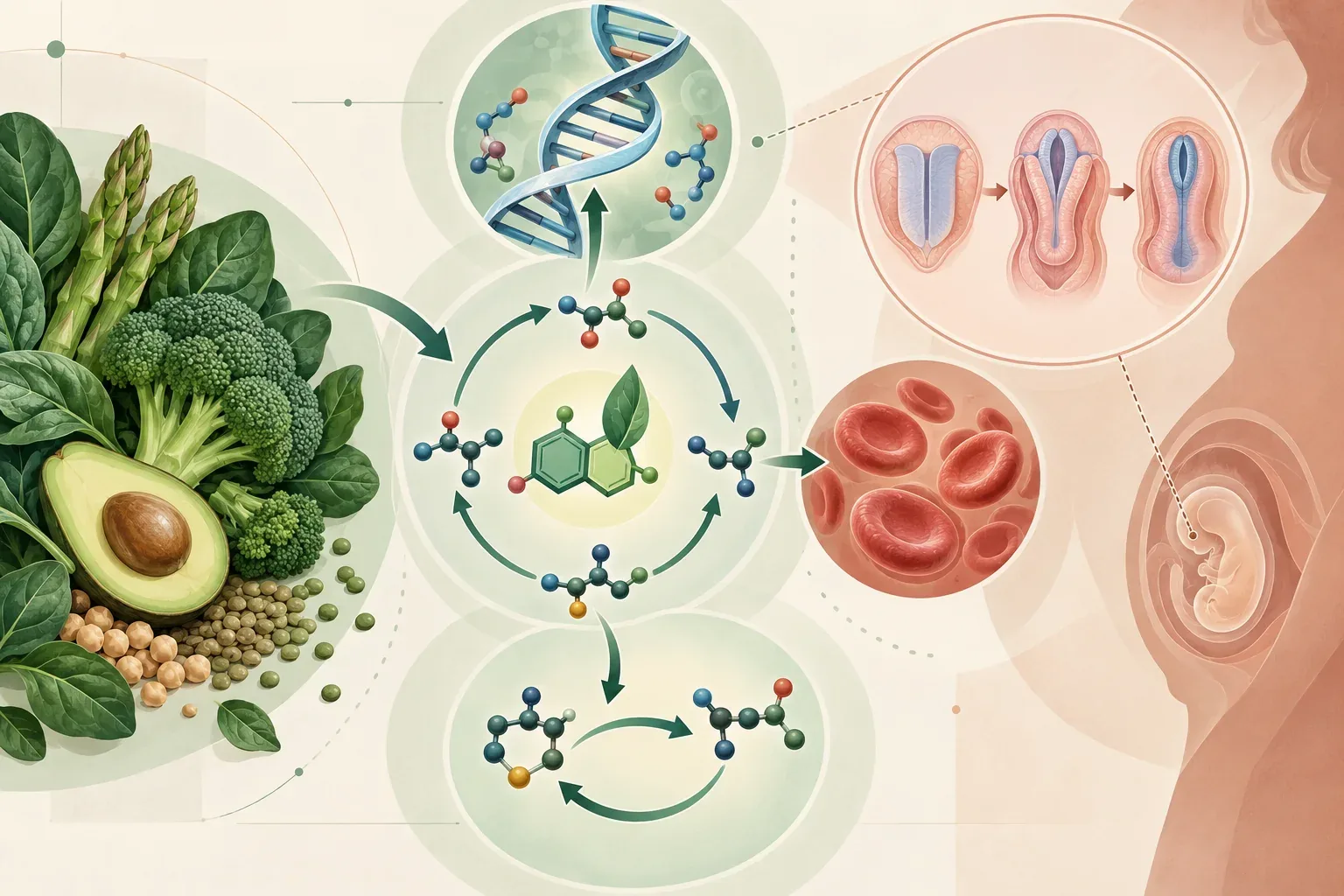
Nutrient connections worth understanding
 Disputed pairing
TMG (Betaine): What It Does to Homocysteine and Cholesterol, and Who Needs It
Connection details
Context: TMG as a folate replacement
TMG is a parallel remethylation path (BHMT), not a folate replacement.
Source for this connection
 Absorption & use · Lab interpretation
Vitamin B12 (Cobalamin): Daily Needs, Deficiency Signs and Treatment Choices
Connection details
Context: physiologic amounts
Folate and B12 share the remethylation pathway, but that physiology does not justify megadosing either nutrient.
Source for this connectionContext: folic acid or high folate with untreated B12 deficiency
Folate can correct the anemia picture while neurologic injury from B12 deficiency continues.
Source for this connection
More in vitamins



References
- 2015 form comparison ↩
- 2026 trial of 110 pregnant women ↩
- FDA folate label guidance ↩
- CDC population evidence ↩
- Office of Dietary Supplements: Folate, health professional fact sheet
- CDC: folic acid clinical overview
- CDC: MTHFR gene variants and folic acid
- MRC Vitamin Study Research Group: prevention of neural tube defects, 1991
- Czeizel and Dudás: first occurrence of neural-tube defects with a multivitamin, 1992
- De-Regil et al.: periconceptional folic acid, Cochrane review
- Viswanathan et al.: folic acid to prevent neural tube defects, USPSTF evidence review, 2023
- Venn et al.: 5-MTHF vs folic acid at low dose, 2002
- Lamers et al.: red-blood-cell folate with 5-MTHF vs folic acid, 2006
- Crider et al.: MTHFR genotype and response to folic acid, 2011
- Pregnancy trial of 5-MTHF vs folic acid from 8 weeks, 2024
- Draicchio et al.: 5-MTHF prenatal and unmetabolized folic acid, 2026
- Ernawati et al.: equal-dose 5-MTHF vs folic acid in pregnancy, 2026
- Xie et al.: active folate vs folic acid in women of childbearing age, meta-analysis, 2025
- Samaniego-Vaesken et al.: folic acid or 5-MTHF and neural tube defect prevention, review, 2024
- ClinicalTrials.gov: PREFACE preconception trial (NCT06641245)
- NIH Dietary Supplement Label Database: a 400 mcg folic acid label
- NIH Dietary Supplement Label Database: a 5-MTHF label listing DFE only
- NIH Dietary Supplement Label Database: a 15 mg L-methylfolate label
Corrections & updates
- Update
Updated the evidence discussion and practical guidance after editorial review.
- Update
Revised the article after editorial review, with clearer evidence explanations and practical guidance.