
What is vitamin K?
Vitamin K helps activate proteins used in blood clotting and bone biology. The family includes K1, found especially in leafy vegetables, and K2, which includes MK-4 and MK-7. Those names matter: studies of one form at a particular amount do not establish the same benefit for every vitamin K bottle.
For an adult choosing a supplement, start with food intake, the named form and the units.
What does vitamin K do in your body?
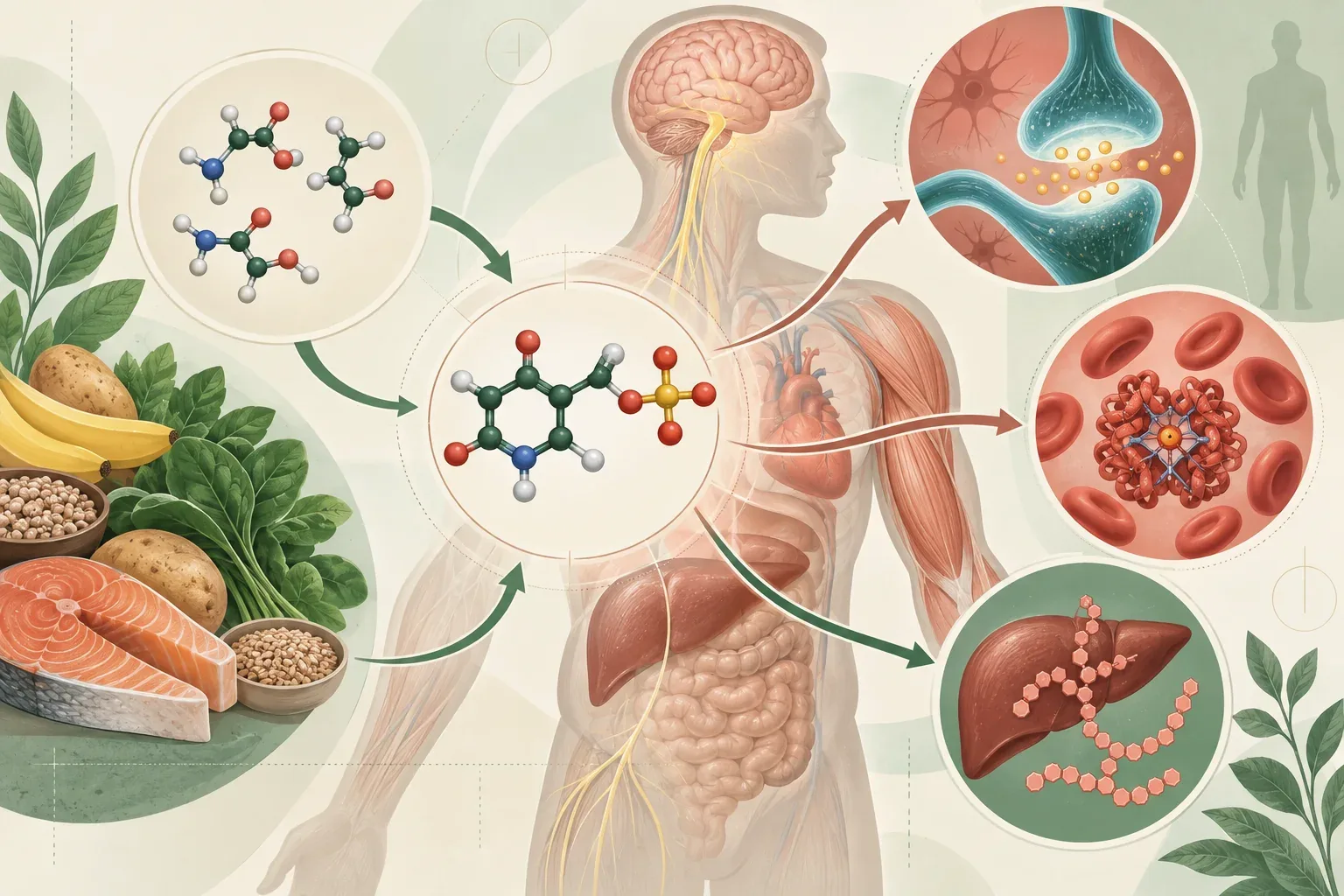
Vitamin K helps an enzyme modify certain proteins after the body makes them. The modification lets those proteins bind calcium, which is necessary for their particular jobs. The body recycles vitamin K through a chemical cycle so it can be used again.
In the liver, vitamin-K-dependent proteins include several involved in blood clotting. Some help form a clot and others help regulate the process. Warfarin works by interfering with vitamin K recycling, which explains why changes in vitamin K intake can alter its effect.
Other vitamin-K-dependent proteins include osteocalcin in bone and matrix Gla protein in blood vessels and other tissues. Their biology gives researchers a reason to test effects on bone and calcification. It does not, by itself, establish that adding MK-7 or MK-4 prevents fractures or heart attacks. [1]
Why do people take vitamin K?
| Outcome | Studied use or amount | What the evidence shows | Evidence strength |
|---|---|---|---|
| Correcting deficiency-related bleeding | Clinician-directed vitamin K; amount and route depend on the cause and age | An established medical use, distinct from optional adult K2 supplementation. | Strong |
| Preventing fractures with MK-4 | 45 mg/day for two years in a Japanese osteoporosis study | A positive small trial and a qualified older review do not establish a benefit for ordinary MK-7 capsules. | Limited |
| Improving bone density | K1 1 mg/day or MK-4 45 mg/day for one year, with calcium and vitamin D in all groups | Neither improved bone density versus placebo in the US trial. | Moderate |
| Improving arterial stiffness | MenaQ7 MK-7 180 mcg/day for three years in postmenopausal women | Some stiffness measures improved; the trial did not establish fewer heart attacks or strokes. | Limited |
| Nighttime leg cramps in older adults | MK-7 180 mcg/day for eight weeks. | Authors report fewer cramps; retraction and replacement leave the size and statistical certainty unresolved. | Preliminary |
| Slowing aortic-valve calcification | MK-7 720 mcg plus vitamin D 25 mcg/day for two years. | The combination did not significantly slow valve calcification. | Limited; combination-specific |
| Stabilizing anticoagulation under clinic supervision | Low-dose vitamin K, including 150 mcg/day for six months in unstable warfarin control. | One selected-patient trial improved INR control; a broader dose-finding trial found small, uncertain gains. | Limited; selected patients |
Who should consider a supplement?
Someone whose diet supplies little vitamin K may need to improve food intake or discuss a supplement. Deficiency is uncommon in otherwise healthy adults, but impaired fat absorption and certain medicines can change the situation. Unexplained bleeding requires medical assessment.
If you take warfarin or another vitamin K antagonist, keep vitamin K intake consistent and discuss changes with the anticoagulation clinic. This includes food, multivitamins, separate K products and switching from K1 to a longer-lasting MK-7 product. Do not stop eating vegetables to avoid vitamin K.
Some other blood thinners act directly on clotting proteins rather than blocking vitamin K. If you take one, a new supplement still needs review by the treating team; a vitamin K pill is not a self-treatment for bleeding on these medicines.
Common dosage, food and timing
The NIH fact sheet[1] lists National Academies adequate intakes of 120 mcg/day for adult men and 90 mcg/day for adult women. These were based on intake in healthy people because there was not enough evidence to calculate a recommended dietary allowance covering nearly everyone's needs. The amounts concern total dietary intake, rather than an extra pill on top of food, and were based on K1 intake data. There is no separate official MK-7 or MK-4 requirement.
Leafy vegetables can make substantial contributions. K1 is found in spinach, kale and broccoli while natto (fermented soybeans) supplies MK-7. Natto also contains the enzyme nattokinase, a separate substance from vitamin K2, as its composition research describes[2]. Cheese and some animal foods contribute other K forms, with amounts varying by food and production. Use the NIH food table[1] to compare the portions you eat with the total-intake amount. Count the food's listed vitamin K; you do not need to estimate how many of those micrograms you absorb.
Selected values from the NIH Office of Dietary Supplements food table[1] show the stated food and preparation. Amounts are per serving.
| Food and preparation | Source | Serving | Vitamin K (mcg) |
|---|---|---|---|
| Natto, fermented soybeans (MK-7) | Plant | 3 oz (about 85 g) | 850 mcg |
| Collard greens, frozen, boiled (K1) | Plant | ½ cup | 530 mcg |
| Spinach, raw (K1) | Plant | 1 cup | 145 mcg |
| Broccoli, boiled (K1) | Plant | ½ cup | 110 mcg |
| Chicken breast, rotisserie (MK-4) | Meat | 3 oz (about 85 g) | 13 mcg |
| Cheddar cheese (MK-4) | Dairy | 1½ oz (about 43 g) | 4 mcg |
The K1 and MK-4/MK-7 labels identify different food forms. Most entries in the NIH table measure K1; a food total does not translate into a measured absorbed amount. If you take warfarin, keep your usual intake pattern consistent.
Vitamin K is fat-soluble. Eating vegetables or taking a supplement with a meal containing fat supports absorption. NIH’s review[1] does not give one absorption percentage that applies to all greens, oils, MK-4 and MK-7.
MK-7 products commonly use 90–180 mcg per serving. That describes a supplement range, not an established heart-attack prevention dose. A 180 mcg study should not be mistaken for an official daily requirement or proof that everyone needs that amount.
How can I tell if I'm low on vitamin K?
Vitamin K deficiency becomes clinically important when the blood cannot clot normally. Obvious deficiency is rare in adults and is more plausible with malabsorption or medicines that interfere with vitamin K. [1]
Low intake without obvious bleeding
There is no dependable minor-versus-moderate symptom checklist. Absence of bleeding does not tell you whether every vitamin-K-dependent process is fully supplied.
Severe deficiency and bleeding
Bleeding and hemorrhage are the classic signs of severe deficiency. Significant or unexplained bleeding needs prompt assessment, particularly if you take an anticoagulant. Newborns are a distinct high-risk group because their vitamin K supply and clotting-factor levels are low; this is why newborn prevention is handled separately from adult supplement choices.
Testing and interpretation
For more information about testing for vitamin K, see the lab tests and preparation details near the end of this article.
MK-7 vs MK-4: how to choose a vitamin K form
K1, MK-7 and MK-4 all belong to the vitamin K family. MK-7 is found in natto, while MK-4 occurs in animal foods and can also be made by the body from K1. For a microgram K2 supplement, MK-7 has clearer evidence for raising circulating levels. That is a narrower advantage than proving better bone or heart outcomes.
| Label name | What it identifies | What matters when choosing |
|---|---|---|
| K1, phylloquinone or phytonadione | The main dietary form, especially in leafy vegetables | Amount in mcg and total intake; K1 is not MK-4 |
| K2 as MK-7 / menaquinone-7 | A longer-lasting K2 form, commonly sold at 90–180 mcg | Better blood-level evidence at microgram amounts; bone and artery results remain mixed |
| K2 as MK-4 / menaquinone-4 / menatetrenone | A K2 form sold in both mcg and mg amounts | The positive fracture studies used 45 mg/day, far above ordinary microgram products |
What longer-lasting means
In a small 2012 comparison in healthy Japanese women[3], a single 420 mcg dose of MK-7 peaked in blood after about six hours and remained measurable for two days. The test did not detect MK-4 after the same mass dose. With 60 mcg daily for a week, MK-7 levels increased while MK-4 levels did not. Sato, the lead author, worked for J-OIL MILLS; the other authors declared no competing interests.
That study measured blood, rather than delivery to bones or arteries. Undetectable MK-4 does not mean the study proved it had no tissue effect. A separate MK-7-versus-K1 study[4] estimated an MK-7 half-life of about three days—the time for its circulating amount to fall by half. That is different from saying it was still detectable two days after a dose.
Micrograms and milligrams are different choices
1 mg equals 1,000 mcg. The 45 mg/day MK-4 regimen used as an osteoporosis drug in Japan therefore supplies 45,000 mcg. A 5 mg MK-4 label[5] supplies one-ninth of that amount; a 500 mcg label[6] supplies one-ninetieth. Neither reproduces the fracture-trial regimen, and there is no established conversion that makes a microgram MK-7 dose its equivalent.
The MK-7 bone and artery studies discussed below used 180–375 mcg/day, while common products supply 90–120 mcg. When those study findings are used to promote a lower-serving product, the difference in daily amount is part of assessing the claim.
“Vitamin K2” alone does not identify the form. Some products combine K1, MK-7 and MK-4; read each ingredient and amount if it's stated on the label. There is no official vitamin K conversion to international units. The adult Daily Value on US labels is 120 mcg, so a woman's 90 mcg adequate intake need not equal 100% Daily Value.
Menadione, or K3, is a different synthetic compound and is no longer used in dietary supplements following liver-cell toxicity concerns.
How long should I take vitamin K supplements for?
Vitamin K adequacy depends on continuing intake, especially from food; taking a bottle until it is empty is not a way to permanently fill a store. If diet meets the relevant intake, extra K has no established routine course or taper. A documented deficiency or fat-malabsorption problem requires cause-specific treatment. For a person taking warfarin, the priority is consistent vitamin K intake and medicine management, not starting, stopping or cycling a K supplement independently. NIH's review[1] does not give one depletion rate or post-treatment supplement frequency that fits these situations.
Common Myths about Vitamin K
Does taking vitamin D mean I must add K2?
Vitamin D and vitamin K participate in related bone biology. That mechanism does not establish that everyone taking D needs a K2 pill. K2 also does not cancel excessive vitamin D or high blood calcium. Read the amounts of each vitamin separately rather than treating the combination as protection from an excessive dose.
Does no upper limit mean any amount is safe?
The National Academies did not establish a vitamin K upper limit from the available evidence. That does not remove the interaction with warfarin or prove that every high-dose regimen has been adequately studied.
Drawbacks and side effects
| Concern | When it matters | Evidence or limit | Practical response |
|---|---|---|---|
| Changed warfarin effect | Starting, stopping or changing vitamin K intake | [1] | Arrange the change and monitoring with the anticoagulation clinic |
| Assuming microgram MK-7 cannot affect treatment | A longer-lasting K2 product, even at an ordinary supplement amount | [4] | Do not use 50 mcg as a personal safe threshold |
| Unnecessary high-dose use | Copying a milligram dose from a study | There is no official upper limit, but a universal high-dose benefit is unproven | Identify the clinical reason and exact form before copying a regimen |
Orlistat and bile-acid-binding medicines can interfere with fat-soluble vitamin absorption. Long antibiotic courses combined with poor intake can also matter. A pharmacist can check the specific product and medicines rather than applying one spacing rule to everything.
Vitamin K during pregnancy and breastfeeding
For women aged 19 or older, the adequate intake during pregnancy and breastfeeding is 90 mcg/day. For pregnant or breastfeeding teenagers aged 14–18, it is 75 mcg/day. Those are total-intake amounts, not a special high-dose K2 pregnancy recommendation.
Vitamin K given to a newborn to prevent deficiency bleeding is separate medical care. Maternal MK-7 drops are not a substitute for the newborn vitamin K intervention.
What the science shows
Bone studies do not all answer the same question
Shiraki's Japanese study randomized 241 women with osteoporosis to 45 mg/day MK-4 or no treatment for two years and reported fewer clinical fractures. It was open-label: participants and clinicians knew the treatment, and the comparison was untreated rather than a matching placebo.
An older fracture review pooled mostly milligram MK-4 studies. A 2018 editorial caution identified problematic or retracted reports and directed readers to the analysis excluding them. That restricted analysis still favored treatment for spinal fractures and for fractures outside the spine, but the separate hip-fracture estimate was inconclusive. Small, selected trials and their methodological problems limit the conclusion. Their results cannot be attached to a 100 mcg MK-7 bottle.
Binkley's US trial compared 1 mg K1, 45 mg MK-4 and placebo for one year in 381 postmenopausal women; all groups received calcium and vitamin D. Bone-protein activation changed, but bone density did not improve with either vitamin K form. Bone density is not a fracture count, and the different populations and background treatments also matter.
MK-7 bone trials disagree
A three-year Dutch trial[7] gave 244 healthy postmenopausal women 180 mcg MK-7 daily. Bone loss was slower at the femoral neck, part of the hip, but not across the total hip. The manufacturer of the study ingredient funded the trial.
A three-year Danish trial[8] tested 375 mcg MK-7 daily in 142 women with low bone density. Both groups also received calcium and vitamin D. Bone density, detailed bone structure and blood measurements of bone breakdown and building did not differ from placebo, despite a change in vitamin-K-dependent osteocalcin, a bone protein.
These studies do not establish a dependable fracture-prevention benefit from an ordinary K2 capsule. The comparisons discussed here also do not establish a head-to-head health-outcome winner between MK-7 and MK-4.
Artery markers are not heart attacks
Knapen's manufacturer-funded trial used 180 mcg/day MenaQ7 MK-7 for three years in 244 healthy postmenopausal women. Some measures of arterial stiffness improved, along with a vitamin-K-dependent protein marker. That supports a result for those measurements in that setting, rather than a claim of fewer cardiovascular events.
Other imaging research is less reassuring. A six-month trial of 360 mcg/day MK-7 in 68 people with diabetes and cardiovascular disease lowered the protein marker but did not reduce calcium deposits measured by computed tomography, or CT scanning. A second imaging method, assessing ongoing mineral deposition, tended to show more activity rather than less, although the difference remained uncertain and could have arisen by chance. Marker improvement and artery improvement therefore cannot be treated as the same outcome.
A 2026 coronary-artery trial[9] randomized 180 people with coronary artery disease to 360 mcg MK-7 daily or placebo for two years. A higher CT calcium score means more calcium deposits in the coronary arteries. Median scores rose from 135 to 184 with MK-7, compared with 145 to 214 with placebo. Both groups' scores increased, but the adjusted comparison supported slower progression with MK-7 (P=.02). Whether that imaging difference improves plaque stability or prevents heart attacks remains uncertain. An author disclosed Gnosis by Lesaffre grants and shares in Coagulation Profile for work outside this study. That disclosure does not identify this trial’s funding or product supplier, so its commercial support remains unclear. This is not evidence that an ordinary K2 capsule prevents heart attacks.
A corrected trial of nighttime leg cramps
A Chinese placebo-controlled trial[10] tested 180 mcg/day of oral MK-7 for eight weeks in adults aged 65 or older with recurrent nighttime leg cramps. Its corrected report describes 210 people randomized and 199 included in the main analysis after 11 withdrew before treatment. The MK-7 group reported fewer weekly cramps than placebo.
The paper was retracted and replaced in 2025[11] to clarify withdrawals and add analyses and protocol changes after publication. The authors retained a favorable conclusion. However, their uncertainty calculation uses variation in eight weekly group averages, rather than differences between individual participants. The same participants supplied each week’s reports; whether this method captures the uncertainty in the treatment effect across people remains unresolved. The added analyses and reliance on self-reported cramps also limit interpretation; confirmation must address these concerns as well as whether relief lasts. People taking vitamin K antagonists were excluded.
Aortic-valve calcium and coronary calcium are different outcomes
AVADEC[12] randomized 365 older men with substantial calcium deposits on the aortic valve to 720 mcg MK-7 plus 25 mcg vitamin D daily or placebo for two years. The combination did not significantly slow valve-calcification progression or improve the measured valve-function outcomes, despite changing a vitamin-K-dependent protein marker.
A coronary analysis from the same research programme[13] examined 304 men without a history of heart disease caused by reduced blood supply to the heart muscle. Overall coronary-calcium progression also did not differ significantly. Findings favoring supplementation among men with higher starting calcium scores and in a small comparison of heart attacks, artery procedures and deaths were exploratory: they suggest questions for another trial, rather than establishing protection. This was a K2-plus-D regimen; its overall null findings and subgroup signals should not be presented as separate, independent trials proving K2 protects the heart.
Why an anticoagulation clinic might deliberately prescribe K1
Consistent intake can sometimes be achieved with a small prescribed supplement. In 70 warfarin-treated patients with unstable anticoagulation[14], 150 mcg oral vitamin K daily for six months improved time in the target INR range more than placebo: the improvement from the preceding six months was 28 versus 15 percentage points. INR measures the anticoagulant effect, not vitamin K sufficiency.
A 400-person dose-finding trial[15] in people starting vitamin K antagonists tested 100, 150 or 200 mcg K1/day for six to twelve months. The average gains over placebo were small, and the statistical uncertainty range included no improvement at all. Patients were not selected for unstable control. These results leave a possible role in selected unstable patients, with anticoagulant doses and INR managed together by the clinic. They do not change the advice to arrange any vitamin K change with that clinic.
What you may have heard on podcasts
Joel Gould, speaking on Health Theory on September 24, 2020, advocated daily K2 and mentioned natto and cheese. He also advised against combining calcium with vitamin D. That is his position; the bone trials above sometimes supplied both nutrients. Those studies do not establish his advice as a general rule.
Lab tests
NIH explains the assessment limits[1]
Interpreting the results
A blood K1 concentration test exists, but recent intake affects it, and it does not measure all K2 forms or establish an optimal vitamin K status.
Prothrombin time, a test of how long blood takes to clot, can help assess a clinically important problem. Its standardized result, INR, is also used to monitor warfarin. A prolonged result can help identify a clinically important clotting problem, but a normal result does not tell you whether K2 is helping bones or arteries. Test preparation while taking vitamin K is covered below.
Preparing for a test if you take supplements
For INR monitoring, maintain the vitamin K intake agreed with your anticoagulation clinic. Report changes in food, supplements and medicines.
A K1 test may have fasting instructions. Follow the ordered laboratory's directions and disclose supplementation. A fasting requirement does not establish a multi-day vitamin K washout or turn a K1 result into a measure of MK-7 status.
A clinician can arrange clotting tests or a K1 measurement when indicated. Neither a routine consumer vitamin panel nor a single K1 value supplies a validated target for increasing K2 indefinitely.
The bottom line
Vitamin K is essential, but an extra K2 supplement has a less settled case for being in your supplement cabinet.
Start with food intake and the reason for considering a supplement, then read the named form and units. If you want a microgram K2 supplement, MK-7 has the clearer blood-level evidence; its bone and artery results are mixed. Milligram-dose MK-4 treatment belongs in an osteoporosis care plan. If you take warfarin, discuss any vitamin K change with your doctor before starting supplementation as an off-the-shelf microgram amount can still affect treatment.
The retracted-and-replaced short cramp trial reports a possible use, but its effect size and statistical certainty remain unresolved. The valve-calcification trial was negative. A clinician sometimes uses K1 to stabilize anticoagulation, which requires coordinated INR and drug-dose management.
Source notes
Additional outcome sources:
Help us improve this article
Spotted an error or found a source we should consider? Tell us which part of this article needs another look and include a link if you have one. Please leave out personal health details and lab results; we can’t answer individual medical questions.
Explore more in bone health

More in vitamins

References
- NIH describes these protein roles ↩
- its composition research describes ↩
- small 2012 comparison in healthy Japanese women ↩
- MK-7-versus-K1 study ↩
- 5 mg MK-4 label ↩
- 500 mcg label ↩
- three-year Dutch trial ↩
- three-year Danish trial ↩
- 2026 coronary-artery trial ↩
- Chinese placebo-controlled trial ↩
- retracted and replaced in 2025 ↩
- AVADEC ↩
- coronary analysis from the same research programme ↩
- 70 warfarin-treated patients with unstable anticoagulation ↩
- 400-person dose-finding trial ↩
- Shiraki: MK-4 osteoporosis trial ↩
- Cockayne: Fracture review and sensitivity analysis ↩
- 2018 editorial caution ↩
- Binkley: K1, MK-4 and bone density ↩
- Knapen: MK-7 and arterial stiffness ↩
- Zwakenberg: MK-7 and vascular calcification ↩
- NIH Dietary Supplement Label Database: a 100 mcg MK-7 label ↩
- NIH Dietary Supplement Label Database: an MK-7 product with K1 and MK-4 ↩
Corrections & updates
- Update
Updated the evidence discussion and practical guidance after editorial review.
- Update
Revised the article after editorial review, with clearer evidence explanations and practical guidance.