
What is sodium?
Sodium is an essential mineral, and it is the main mineral in the fluid outside your cells. It holds water in your bloodstream, which is why eating more of it raises blood pressure in many people, and your nerves and muscles need it to work. Your kidneys keep the level in your blood inside a narrow range by sending the extra into your urine.
Most sodium comes from salt, which is sodium chloride, and most of that salt is already in food before you pick up a salt shaker. More than 70 percent of the sodium Americans eat comes from packaged and prepared food. Bread, cheese, cured meat, soups, pizza, and sandwiches carry the big amounts.
Salt is about 39 percent sodium, so a gram of salt holds about 400 mg of sodium and a teaspoon holds about 2,300 mg. The National Academies’ 2019 report set an adequate intake — the amount judged enough for healthy people — of 1,500 mg of sodium from age 14, and the same report says to reduce sodium if you eat more than 2,300 mg a day. Americans average about 3,400 mg.
People look for sodium supplements to replace what they sweat out in long workouts or heat, or because a low-carb diet or a podcast said they need more. Most people already eat more than both official recommendation numbers, and lowering sodium lowers blood pressure. Heavy sweaters and people whose doctor has a medical reason for more are exceptions to that general pattern.
What sodium does in your body
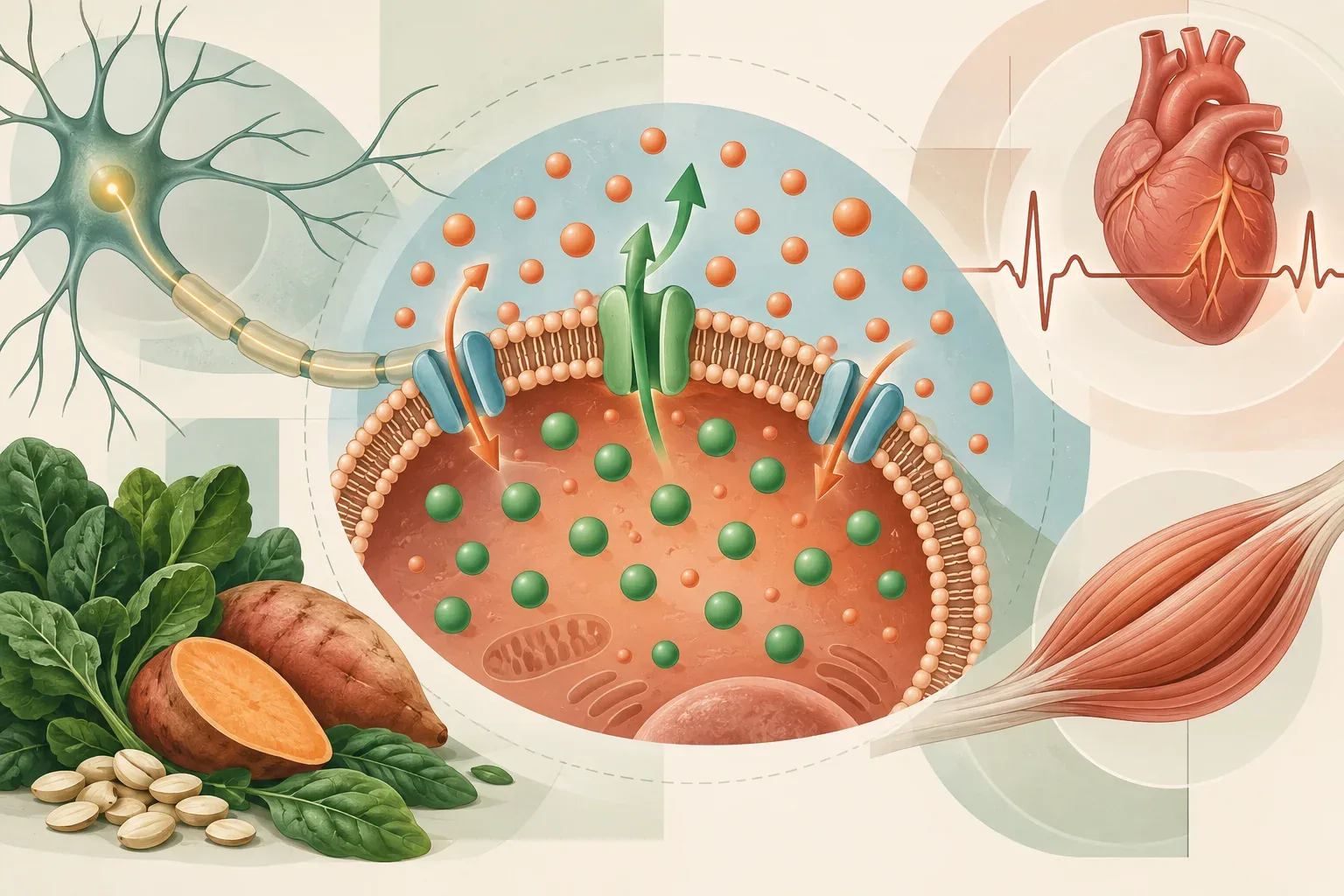
Sodium is the main positively charged mineral in the fluid outside cells. It helps maintain fluid balance and, together with potassium and other charged particles, creates the electrical changes needed for nerve signals and muscle contraction.
In the intestine, transport proteins carry sodium and glucose into cells together[1], linking sodium movement to nutrient absorption. Its movement and concentration are linked to water balance, which is one reason replacing heavy sweat losses involves both fluid and electrolytes. The kidneys and hormones regulate how much sodium and water are retained.
These jobs explain why sodium is necessary, but they do not make a low blood-sodium result a simple measure of dietary shortage. Blood concentration depends on the relationship between sodium and water[2], not just the number of grams of salt eaten. [3]
The short version
Unit: milligrams of sodium. A label that lists grams of salt needs one conversion: 1 g of salt is about 400 mg of sodium.
Ordinary decision: most people should not start a sodium supplement because they already eat more than 2,300 mg. For prolonged heavy sweating, use the product label to identify its sodium amount; replacement depends on duration, fluid intake, heat, and individual sweat loss rather than a universal “one serving.”
| Product | Common supplement dosage | What that number means |
|---|---|---|
| Iodized table salt | About 2,300 mg per teaspoon | Milligrams of sodium in the salt |
| Electrolyte drink mix | A few hundred mg up to about 1,000 mg per serving | Milligrams of sodium per serving |
| Salt tablet | Listed per tablet | Milligrams of sodium, or grams of salt to convert |
Skip: salt tablets if you have high blood pressure, a product that lists grams of salt as if they were milligrams of sodium, and sea salt sold as a mineral supplement.
What people take sodium for
| Claimed benefit | Dose / form studied | Research verdict | Evidence strength |
|---|---|---|---|
| Replacing substantial sweat losses | No universal replacement dose; amount and duration depend on sweat loss, fluid intake, heat and exercise. | [4] | Moderate |
| Treating low blood sodium | Clinician-selected treatment based on the cause; no general salt-tablet dose or duration. | A low blood result can reflect excess water and is not a diagnosis of low dietary salt. | Strong |
| Lower blood pressure by changing sodium intake | About 3,450, 2,300 and 1,150 mg/day total sodium for 30 days each in DASH-Sodium. | Reducing intake lowered blood pressure; adding sodium was not beneficial in this trial. | Strong |
Most people should not take a sodium supplement. The average American eats about 3,400 mg of sodium a day, well above the 1,500 mg adequate intake and above the 2,300 mg line where the National Academies say to cut back. For most readers, the useful change is less packaged food, not more salt.
Added sodium is a reasonable question if you lose a lot of it. Long, heavy sweating in heat or endurance training is the common case, and the sodium usually goes into the drink you replace fluid with. The other case is medical: your doctor has found low blood sodium or a condition that makes you lose salt, such as ongoing diarrhea or vomiting, and has told you how much to add.
When to ask a doctor before taking sodium
Ask first if you have high blood pressure, heart failure, kidney disease, or liver cirrhosis. Those conditions make the body hold fluid, and extra salt adds to the load. Heart failure, kidney disease, and cirrhosis can also lower blood sodium by holding extra water, which is a reason to see your doctor rather than to take salt.
You should also ask a doctor if you take a water pill (diuretic), which can push blood sodium down or, by drying you out, up. Some medicines, including certain over-the-counter pain relievers and antidepressants, can lower blood sodium; your pharmacist can tell you whether yours is one. With any of these, the question is whether you should change your sodium at all, and your doctor answers, usually after a blood test and a blood pressure reading.
If you are thinking of switching to a potassium salt substitute to cut sodium, ask first if you have kidney disease or take an angiotensin-converting enzyme (ACE) inhibitor, an angiotensin receptor blocker, or a potassium-sparing diuretic. Those can push potassium too high.
Common dosage
As of 2026, sodium has no Recommended Dietary Allowance, the technical target used when requirements can be calculated. The National Academies instead set an adequate intake of 1,500 mg of sodium a day from age 14, for men and women alike. It is the lowest intake the committee could support from trials without signs of too little; it did not go lower because the evidence below 1,500 mg is limited.
| Age | Daily amount |
|---|---|
| Birth to 6 months | 110 mg |
| 7–12 months | 370 mg |
| 1–3 years | 800 mg |
| 4–8 years | 1,000 mg |
| 9–13 years | 1,200 mg |
| 14 and older | 1,500 mg |
The same report replaced the old sodium upper limit with a chronic-disease line: from age 14, reduce sodium if you eat more than 2,300 mg a day. There is no official upper limit in the 2019 model. For children, the report says to reduce sodium if intake is above 1,200 mg at ages 1 to 3, 1,500 mg at 4 to 8, and 1,800 mg at 9 to 13. The 2,300 mg number also sits on food labels as the Daily Value.
The daily amount is not set by body weight, and there is no official time of day. Sodium from food arrives with your meals. If you sweat heavily, the sodium in an electrolyte mix belongs in the fluid you drink during and after the sweating, not in a morning pill on a desk day.
Am I getting enough sodium from food?
Almost certainly, and usually more than enough, though this really depends on your diet. Americans average about 3,400 mg a day, against a daily amount of 1,500 mg. About 40 percent of that sodium comes from a short list of foods: deli-meat sandwiches, pizza, burritos and tacos, soups, savory snacks such as chips and crackers, poultry, pasta dishes, burgers, and egg dishes. Bread adds up because you eat it several times a day, and foods such as cereals and pastries carry sodium without tasting salty. Baking soda, MSG, and preservatives such as sodium nitrite and sodium benzoate count toward the sodium intake count too.
These examples from the USDA Standard Reference Legacy sodium list[5] show how processed foods can add up. They are 2018 database entries, not promises about a product sold today; compare the Nutrition Facts panel of what you buy.
| Food and preparation | Source | Serving | Sodium (mg) |
|---|---|---|---|
| Black bean soup, canned, condensed | Prepared | 1 cup | 2,493 mg |
| Frozen cheese pizza, baked (database brand example) | Prepared | ¼ pizza | 1,274 mg |
| Cured ham, heated | Meat | 3 oz (about 85 g) | 1,181 mg |
| Baked beans with pork, canned | Prepared | 1 cup | 1,047 mg |
| Chicken broth or bouillon, dry | Seasoning | 1 cube | 955 mg |
The examples compare sodium content, not how much sodium a person needs to add. Condensed soup may be diluted before eating, and brands and preparation can change every number.
If you cook most of your food from fresh ingredients, eat little packaged food, and sweat a lot, your intake may be closer to the daily amount, and that is when the sweat question matters.
How can I tell if I'm low on sodium?
Low blood sodium, or hyponatremia, is primarily a water-balance problem, not a direct reading of how much salt you eat. Symptoms depend partly on how quickly the concentration falls.
Mild or absent symptoms
A low result can produce few or no obvious symptoms, especially when it develops slowly.
Moderately severe symptoms
Nausea, headache and confusion can occur. Confusion needs urgent assessment even if a laboratory labels the sodium reduction moderate.
Severe symptoms
Vomiting, seizures, reduced consciousness or collapse can signal an emergency. Endocrine emergency guidance distinguishes symptom severity from the blood-number categories[6]: a person can be very unwell without the lowest result. Treatment depends on the cause and may involve water balance, medicines or illness, so these symptoms should not be managed by adding salt tablets yourself.
Testing and interpretation
For more information about testing for sodium, see the lab tests and preparation details near the end of this article.
Sodium products you can buy
The sodium in table salt, specialty salts, salt tablets, and electrolyte mixes is the same nutrient, but the products can contain very different amounts and other minerals. Potassium salt substitutes replace some sodium chloride with potassium chloride and need their own medicine and kidney check.
Iodized table salt
Iodized table salt is the cheapest sodium source and the one that also carries iodine, about 78 mcg per ¼ teaspoon. A teaspoon holds about 2,300 mg of sodium. For almost everyone, this is the sodium product already in the kitchen, and the question is how little of it you need, not whether to add more.
Sea salt, kosher salt, and pink salt
Specialty salts are still sodium chloride. Their sodium per serving is on the Nutrition Facts line, and that is the number to compare with table salt. Many carry no iodine. Pick one for taste or texture, not as a mineral supplement.
Electrolyte drink mixes and salt tablets
These are the products for long, heavy sweating. The label on an electrolyte mix says sodium per serving, along with potassium and sometimes magnesium, and the ordinary range runs from a few hundred milligrams to about 1,000 mg. A label that says 1,000 mg of sodium also says about 43 percent of the Daily Value. Salt tablets deliver sodium without the fluid, so the label and your drinking both matter. Neither is a desk-day supplement, and neither is for someone with high blood pressure.
Potassium salt substitutes
A potassium salt substitute replaces part of the sodium chloride with potassium chloride, so you get less sodium and more potassium per shake. This lower-sodium, potassium-containing substitute has trial evidence for fewer strokes. It carries about 440 to 2,800 mg of potassium per teaspoon, depending on how much of the salt is potassium chloride, and the Nutrition Facts line lists potassium per serving. Ask your doctor first if you have kidney disease or take an ACE inhibitor, an angiotensin receptor blocker, or a potassium-sparing diuretic.
For most people, the practical choice is iodized salt used sparingly and fewer packaged foods. Electrolyte mixes fit prolonged heavy sweating; potassium substitutes fit sodium reduction only when kidneys and medicines allow them; high blood pressure, heart failure, or kidney disease rules out self-directed salt tablets.
What to pay attention to on the label
The number that counts is milligrams of sodium per serving, and on a salt package or an electrolyte mix you may need to convert grams of salt first.
Which number on the label is the amount?
On a food or electrolyte label, look for Sodium in milligrams and the percent Daily Value next to it. The Daily Value for sodium is 2,300 mg, and the FDA’s advice is to stay under it. Five percent or less per serving is low and 20 percent or more is high. Check how many servings you actually eat; the number is per serving.
Misleading labels
Grams of salt read as milligrams of sodium
Salt is about 39 percent sodium. If you're considering buying a product that says 1 g of salt per tablet, that is about 400 mg of sodium, not 1,000 mg. Going the other way, 2,300 mg of sodium is about 5.8 g of salt, or about a teaspoon.
Confusing servings and items per serving
Some manufacturers put 180 capsules on the front, and the back says 3 capsules per serving and 60 servings. The sodium on the facts line is for all three.
“No salt added” read as sodium-free
On a food label, “no-salt-added” or “unsalted” means no salt was added during processing; the food can still contain sodium. “Low sodium” means 140 mg or less per serving, “very low sodium” 35 mg or less, and “salt-free” or “sodium-free” less than 5 mg. “Reduced sodium” means at least 25 percent less than the regular product, which can still be a lot.
Sea salt sold as a mineral supplement
Sea salt, pink salt, and other specialty salts are still almost all sodium chloride. At kitchen amounts, the magnesium and potassium in them are traces. Many do not carry iodine: noniodized sea salt has 0 mcg per ¼ teaspoon, while iodized table salt has about 78 mcg, about half of an adult’s 150 mcg daily iodine amount.
An electrolyte stick sold as a day’s sodium
Some sticks list about 300 mg of sodium and are sold as if one stick covers what you need. That is a fifth of the 1,500 mg daily amount: one serving, not a day.
Manufacturer claims and the studies they may be based on
A “hydration” or “electrolyte replacement” line may borrow sports advice about replacing sweat losses during long exercise. A “full-spectrum minerals” line on specialty salt may borrow the fact that the salt contains traces of other minerals, but those traces are too small to matter at the amounts you eat. A “heart-healthy” line on a lower-sodium product may borrow from the trials in which less sodium lowered blood pressure; that benefit comes from eating less sodium overall, not from the salt brand.
How long should I take sodium supplements for?
Most readers already get enough sodium from food, as the National Academies' intake review[7] shows. Replacement is a specific response to a measured loss or a clinician's plan, not a course for building permanent stores. Sweat loss varies with heat, duration and the individual; low blood sodium also depends on water balance and can have causes that require more than salt. There is therefore no general store-drain interval or dose taper for a sodium supplement. Use the reason for the loss, ongoing diet and any clinical follow-up to decide when extra sodium is no longer needed. The routine daily intake advice elsewhere in this article is not a replacement protocol.
Common Myths about Sodium
Is sea salt healthier than table salt?
Not meaningfully. Sea salt and table salt are both almost entirely sodium chloride, and a teaspoon of either carries about the same sodium. The real difference is iodine: iodized table salt carries it, and many sea salts do not. If you use sea salt and eat little dairy or seafood, you may be dropping a main iodine source.
Is 2,300 mg a toxic limit?
No. The 2,300 mg number is where the National Academies say to start cutting back to lower the risk of high blood pressure and heart disease. It is not a dose where harm suddenly begins, and eating 2,000 mg is not automatically safe for someone whose blood pressure is high. In the DASH-Sodium feeding trial, reducing sodium from about 2,300 to 1,150 mg a day lowered blood pressure further over 30 days.
Does everyone on a low-carb diet need grams of extra salt?
No. Some people who eat very low-carb, drink a lot of coffee, and train hard lose more sodium and feel better with more in their fluids. That does not make extra salt right for a person with high blood pressure who sits most of the day. Blood pressure and sweat loss are important inputs, alongside kidney, heart, and liver disease, medicines, fluid intake, and any history of abnormal blood sodium.
Drawbacks and side effects
| Potential drawback | When/who it affects | Research evidence | Practical implication |
|---|---|---|---|
| Raised blood pressure and fluid burden | Chronic excess, especially with hypertension, heart, kidney or liver disease. | Feeding trials show higher blood pressure with higher sodium intake. | Count total food sodium and follow the clinician’s sodium plan. |
| Severe high blood sodium | Usually water deficit; inappropriate salt loading can add risk. | Severe hypernatremia can cause confusion, seizures or coma. | A blood sodium problem needs assessment of fluid balance and cause, not self-adjusted salt tablets. |
What chronic excess intake can do
Too much sodium over time raises blood pressure, and high blood pressure raises the risk of stroke, heart attack, heart failure, kidney disease, and vision loss. In the feeding trials, each step down in sodium lowered blood pressure, most in people who already had high blood pressure.
There is no official upper limit in the National Academies’ 2019 model. The blood-pressure evidence that once set the upper limit now sets the 2,300 mg reduction line. The real limiter is your blood pressure and your heart and kidneys.
When too much is dangerous
A high result, called hypernatremia, usually comes from too little water rather than too much salt. It can bring thirst, very little urine, confusion, muscle twitching, and, in severe cases, seizures or coma. Salt tablets added to an ordinary diet stack on top of a number most people already exceed. People with high blood pressure, heart failure, or kidney disease are at greater risk and should not wait for symptoms before following their clinician’s sodium plan.
The science behind sodium
The research answers two questions. Feeding trials show that eating less sodium lowers blood pressure, step by step, most in people who already have high blood pressure. A large salt-substitute trial shows fewer strokes and deaths when kitchen salt is partly replaced with potassium salt. What the trials have not settled is whether pushing far below 2,300 mg lowers heart attacks and strokes further, and an observational study points the other way.
Less sodium, lower blood pressure
In the DASH-Sodium feeding trial, 412 adults with blood pressure above 120/80 ate either a typical American diet or the DASH diet, rich in fruit, vegetables, and low-fat dairy, at three sodium levels for 30 days each. At about 2,100 calories, the levels were 150, 100, and 50 mmol a day, or about 3,450 mg, 2,300 mg, and 1,150 mg of sodium (1 mmol of sodium is about 23 mg). In that trial:
- Going from the high to the middle level lowered systolic pressure (the top number) by 2.1 mm Hg on the typical diet and 1.3 on DASH.
- Going from the middle to the low level lowered it another 4.6 on the typical diet and 1.7 on DASH.
- DASH at the lowest sodium was 11.5 mm Hg lower than the typical diet at the highest sodium in people with high blood pressure, and 7.1 lower in people without.
Those were blood-pressure results over 30-day periods, not heart attacks or strokes.
Salt substitutes and stroke
The 2021 Salt Substitute and Stroke Study randomized 600 villages in rural China, with 20,995 people who had had a stroke or were 60 or older with high blood pressure. Half the villages replaced regular salt with a substitute of about 75 percent sodium chloride and 25 percent potassium chloride. Over about 4.7 years, in that group:
- Strokes were about 29 for every 1,000 people followed for a year on the substitute and 34 on regular salt.
- Deaths were about 39 and 45.
- Serious high-potassium events were about the same in both groups.
People on potassium-sparing drugs or with serious kidney disease were excluded, and a salt company donated the substitute in the third and fourth years of the study. A company that supplies the product could benefit from a good result, which is worth knowing when you weigh it. A 2018 federal review found that cutting sodium lowered blood pressure and that part of a salt substitute’s effect comes from the sodium it removes.
Where the 2,300 mg line is still argued
A 2011 analysis of 28,880 adults who already had heart disease or high-risk diabetes estimated each person’s sodium from a single morning urine sample and followed them for heart attacks, strokes, heart failure, and death. Events were higher at both low and high estimated intakes, and lowest in the group eating about 4,000 to 5,999 mg a day. That study measured events, which the feeding trials did not, but it could not show cause: a single urine sample is a rough estimate of intake, and people who are sicker may eat less. The National Academies weighed this kind of evidence in 2019 and kept the 2,300 mg reduction line, while saying the chronic-disease evidence below 2,300 mg is weaker than the blood-pressure evidence. What is still open is whether going far below 2,300 mg lowers events further.
What you may have heard on podcasts
The podcast numbers for sodium disagree with the National Academies’ 2,300 mg line and with each other, because they answer different questions: a daily total, a single packet, and a workout drink.
On 14 March 2022, Andrew Huberman walked through the 2011 urine-sodium study and said 4 to 5 g (4,000 to 5,000 mg) of sodium a day looked associated with even fewer events than intakes near the 2,300 mg line. In the same episode he relayed James DiNicolantonio’s The Salt Fix band of 8 to 12 g of salt a day, which he put at 3.2 to 4.8 g (3,200 to 4,800 mg) of sodium, and said to find your own number using blood pressure. That daily band sits above the 2,300 mg reduction line.
In a 22 February 2023 conversation, Andy Galpin discussed adding sodium to fluid during training, said a gram of sodium in a drink is not outrageous for someone who trains, eats low-carb, and drinks caffeine, and warned that drinking too much plain water can cause low blood sodium. The discussion supplied no complete per-liter, per-hour, or per-workout rule.
Labs
The test is blood sodium, which shows whether your water and sodium balance is in range today; it will not show how much salt you eat. A standard electrolyte panel includes sodium and potassium; a comprehensive metabolic panel also includes kidney and liver markers.
Interpreting the results
A serum sodium test measures the concentration in your blood, not dietary salt intake. Low values can occur with vomiting, diarrhea, diuretics, heart, kidney or liver disease, certain medicines, or excess water intake. The cause determines treatment.
Before the test if you already supplement
There is no standard salt-tablet stop interval in MedlinePlus’s sodium-test preparation guidance[8]. Have the ordering clinician set any changes to sodium supplements, medicines and fasting. Do not interrupt prescribed salt tablets or deliberately load salt or water to prepare for the test.
Blood sodium measures water and sodium balance, not how much salt you usually eat. For a 24-hour urine collection, ask whether the aim is to assess your usual intake, including tablets, or a clinician-directed change. Follow that plan for the full collection; skipping a morning tablet is not a way to recreate an untreated baseline. [8]
Home blood pressure readings show blood pressure over time and can help assess its response to an agreed dietary change; they do not identify sodium’s contribution on their own. A complete 24-hour urine sodium collection helps estimate intake during that period, and repeated collections may be needed to estimate usual intake. The National Academies explain why a single spot urine sample is unreliable for an individual’s long-term intake[9].
The bottom line
Most people do not need extra sodium as a routine wellness supplement. Replacing substantial sweat losses can be appropriate, but the useful amount depends on the exercise, conditions, fluids and individual losses rather than one packet for everyone.
Compare sodium milligrams, not the larger weight of salt, and count what food already supplies. A low blood-sodium result also is not simply evidence that you ate too little salt; the cause changes the treatment. For ordinary long-term intake, the blood-pressure evidence gives a clearer reason to avoid excess than to add it without a specific purpose.
Help us improve this article
Spotted an error or found a source we should consider? Tell us which part of this article needs another look and include a link if you have one. Please leave out personal health details and lab results; we can’t answer individual medical questions.
Explore more in electrolytes & hydration
More in minerals


References
- transport proteins carry sodium and glucose into cells together ↩
- MedlinePlus: Low blood sodium ↩
- MedlinePlus: sodium in the diet ↩
- National Athletic Trainers’ Association: fluid replacement for physically active people ↩
- USDA Standard Reference Legacy sodium list ↩
- Endocrine emergency guidance distinguishes symptom severity from the blood-number categories ↩
- National Academies: Dietary Reference Intakes for Sodium and Potassium, 2019 ↩
- MedlinePlus: Sodium blood test ↩
- National Academies explain why a single spot urine sample is unreliable for an individual’s long-term intake ↩
- National Academies: sodium and potassium Dietary Reference Intakes, 2019 release
- FDA: Sodium in Your Diet
- NIH Office of Dietary Supplements: Iodine — Health Professional Fact Sheet
- Sacks et al.: DASH-Sodium feeding trial
- Appel et al.: the DASH feeding trial
- Neal et al.: Salt Substitute and Stroke Study
- O’Donnell et al.: urinary sodium and cardiovascular events
- Agency for Healthcare Research and Quality: sodium and potassium intake review, 2018
Corrections & updates
- Update
Revised the article after editorial review, with clearer evidence explanations and practical guidance.