
What are omega-3s?
Omega-3s are a family of fats. Plant foods such as walnuts and flaxseed supply alpha-linolenic acid, or ALA. Fish and algae supply the longer-chain fats usually listed as EPA and DHA on supplement labels.
People take these oils for heart health, mood, memory and pregnancy nutrition. The evidence differs across those uses: a result in someone already being treated for depression answers a different question from preventing depression in a generally well older adult. The amount of EPA relative to DHA also matters when comparing a product with a study.
For an oil supplement, the useful comparison is EPA milligrams plus DHA milligrams per serving. A capsule containing 1,000 mg of fish oil may provide only 180 mg EPA and 120 mg DHA: 300 mg combined, rather than a gram of those two fats.
What do omega-3s do in your body?
Omega-3 fats become part of the membranes surrounding cells. DHA (docosahexaenoic acid) is especially prominent in the retina and brain, while EPA (eicosapentaenoic acid) and DHA also supply material for signaling molecules involved in the body's responses to injury and inflammation.
ALA (alpha-linolenic acid), the plant omega-3, is an essential fatty acid. The body can convert some ALA into EPA and then DHA, but conversion is limited and variable. That is why a gram of flaxseed oil and a gram of an EPA/DHA product cannot be assumed to provide the same exposure. Conversion to DHA is particularly restricted. Human metabolism studies[1] also suggest greater conversion in women than in men. There is no dependable personal conversion factor for turning ALA grams into EPA and DHA milligrams. Limited conversion alone does not establish an EPA-and-DHA deficiency in someone eating a vegan diet. Algae oil can supply DHA and, in some products, EPA directly; check which fats and amounts it supplies.
Changing the fats available to tissues can change membrane composition and signaling. At the larger amounts used in prescription treatment, EPA/DHA preparations can also lower triglycerides. Whether a particular product prevents a cardiovascular event is a further clinical question, which the trials must answer. [2]
Why do people take omega-3?
| Claimed benefit | Dose / form studied | Research verdict | Evidence strength |
|---|---|---|---|
| Lowering high triglycerides, a type of blood fat | Prescription preparations, commonly 4 g/day under medical care | Blood-fat lowering is established; prevention of heart attacks and strokes depends on the drug and trial. | Strong |
| Preventing cardiovascular events in adults without prior disease | VITAL: 460 mg EPA plus 380 mg DHA daily | The main combined cardiovascular outcome was not significantly reduced. | Moderate |
| Preventing cardiovascular problems in selected high-risk patients taking statins, cholesterol-lowering medicines | REDUCE-IT: 4 g/day prescription icosapent ethyl | Benefit versus mineral oil does not transfer to ordinary mixed fish oil. | Strong |
| Treating major depression in adults | EPA alone or EPA-rich mixtures, with or without antidepressants; usually weeks rather than years | Some trials improve symptom scores; larger trials finding no benefit and uncertain chances of recovery keep the answer unsettled. | Review pending |
| Improving age-related memory complaints | MIDAS: 900 mg DHA/day for 24 weeks | A small improvement on selected memory tests; everyday benefit and dementia prevention remain unproven. | Limited |
| Reducing preterm birth | Pregnancy trials use DHA or DHA plus EPA; ADORE compared 1,000 with 200 mg DHA/day | A large trial finding no overall benefit and a dose comparison suggest starting status may matter; benefit is not assured. | Review pending |
Table note: Review pending means the editorial evidence rating is unfinished. The research findings are summarized here, but these two topics have not yet received a completed rating.
If you rarely eat fatty fish, or don't eat fish at all, a supplement can supply EPA and DHA that your diet lacks. If high triglycerides or cardiovascular disease is the reason, the decision is about your medical treatment, rather than simply choosing the biggest fish-oil number.
When to ask a doctor before taking an oil
Discuss using gram amounts of EPA plus DHA if you have atrial fibrillation or a bleeding problem, take blood thinners or already use a prescription omega-3. Atrial fibrillation is an irregular heart rhythm that appeared more often in several higher-dose trials. Do not add an over-the-counter oil to a prescription regimen without reviewing the total.
If depression is your reason for considering omega-3, discuss it with the clinician managing your treatment. The studies include both add-on treatment and oil used alone; they do not supply a safe reason to stop an effective antidepressant.
Fish allergy and the source ingredients also matter. Algae oil offers a non-fish source, but you still need to check the complete product label.
Common dosage and timing
The National Academies' adequate intake applies to ALA: 1.6 g/day for adult men and 1.1 g/day for adult women. It does not set an EPA-and-DHA requirement. One gram equals 1,000 mg.
That leaves two separate decisions: whether to fill a dietary gap and whether a specified prescription preparation is indicated. If you rarely eat fish, first consider adding suitable seafood or compare the EPA-and-DHA amounts in a supplement with a dietitian or clinician; there is no single official capsule amount to substitute for the ALA requirement. The 4 g/day drug trials do not establish a self-directed daily fish-oil amount for everyone.
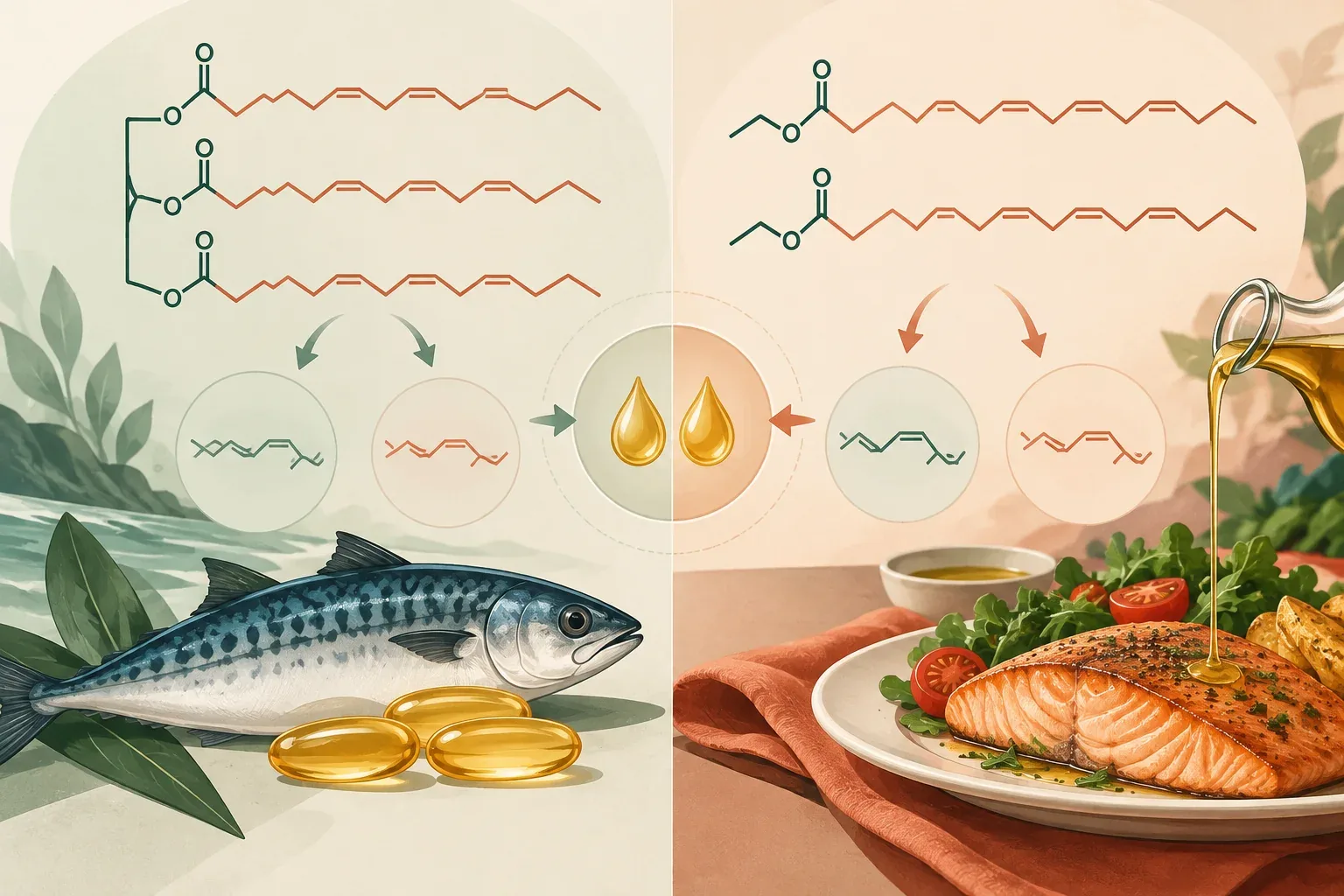
Triglycerides and ethyl esters are different chemical forms used to carry EPA and DHA in oils. Here, triglyceride describes the oil form; a blood triglyceride result measures a blood fat. Take ethyl-ester oils with a meal because their absorption depends more on meal fat.
What changes how much you absorb
The oil form and the meal can alter EPA/DHA uptake. NIH's review[2] finds that somewhat more EPA and DHA is absorbed from triglyceride, re-esterified triglyceride and free-fatty-acid forms than from ethyl esters, while all forms raise blood EPA and DHA. Study conditions and meal fat change the size of the difference, so there is no honest single percentage to attach to every capsule. Oxidation during storage is a different issue: it can change the oil before swallowing and is not a gut-absorption percentage. Use the label's actual EPA plus DHA amount first. An oil that produces a higher blood level in a short study has not thereby proved a cardiovascular advantage.
Which foods supply omega-3s?
ALA from plants and EPA plus DHA from seafood are different entries, so compare them by name as well as grams. The NIH food table[2] gives these examples for the stated servings.
| Food and preparation | Source | Serving | Omega-3 amount |
|---|---|---|---|
| Flaxseed oil | Plant | 1 tbsp | 7.26 g ALA |
| Chia seeds | Plant | 1 oz (about 28 g) | 5.06 g ALA |
| English walnuts | Plant | 1 oz (about 28 g) | 2.57 g ALA |
| Atlantic salmon, farmed, cooked | Fish | 3 oz (about 85 g) | 0.59 g EPA + 1.24 g DHA |
| Atlantic herring, cooked | Fish | 3 oz (about 85 g) | 0.77 g EPA + 0.94 g DHA |
| Sardines, canned in tomato sauce | Fish | 3 oz (about 85 g) | 0.45 g EPA + 0.74 g DHA |
The plant rows show ALA and the fish rows show EPA and DHA; the amounts are not interchangeable gram for gram. The adult adequate intake is for ALA, while no separate official EPA-and-DHA requirement has been set. Food composition varies, especially by fish species and production.
The American Heart Association advises[3] eating two servings of fish, particularly fatty fish, weekly. Whether a supplement adds something useful depends on what you eat regularly; the table can help you compare an ordinary portion with a product's stated EPA and DHA.
How can I tell if I'm low on omega-3?
Dietary history can show whether you eat little oily fish. Blood fatty-acid tests can describe exposure, but there is no universally established EPA-and-DHA deficiency cutoff that tells every adult to take a capsule.
An omega-3 index measures EPA plus DHA as a percentage of red-blood-cell fatty acids and reflects intake over roughly the previous four months. Plasma and serum results can vary substantially after a meal; whole-blood tests also measure a different mixture from the red-cell index. An omega-3/omega-6 blood panel is not automatically the same measurement as a red-cell omega-3 index. [2]
Preparing for a test if you take supplements
Tell the lab which oil and amount you use and follow the preparation instructions for your particular test. OmegaQuant says a same-day dose does not appreciably change its red-blood-cell index, but those instructions do not apply to plasma or whole-blood testing: recent intake can affect these samples differently.
Choosing among oils
| Oil or preparation | Why someone might choose it | Label check |
|---|---|---|
| Triglyceride fish oil | A fish-derived EPA-and-DHA source | EPA, DHA and serving size |
| Ethyl-ester oil | A concentrated formulation | EPA and DHA, plus meal instructions; prescription identity if applicable |
| Algae oil | A non-fish source, often richer in DHA than EPA | Which fats are actually supplied and in what amounts |
| Krill oil | Another marine source | EPA and DHA rather than total krill weight |
Krill's different fat structure does not show that it improves health more at equal EPA-and-DHA amounts. “Pharmaceutical grade” also does not substitute for named ingredients, measured amounts or a trial of the product. Compare the declared EPA, DHA, source and full serving when choosing a product.
What to look for on the label
Which numbers should I add?
Find EPA and DHA separately and add them for the full serving. Two capsules each providing 180 mg EPA and 120 mg DHA supply 600 mg combined. The front-of-package fish-oil weight includes other fats.
Keep the two amounts visible after adding them. A product with 900 mg DHA and little EPA has a different composition from one with 900 mg EPA and little DHA. Both can advertise the same combined amount, but the depression and memory studies below used different mixtures. “High strength” does not tell you which fat makes up that strength.
Misleading labels
Oil weight presented as the active amount
“1,000 mg fish oil” is incomplete information for comparing EPA and DHA. If those amounts are missing, the oil weight cannot fill the gap.
A drug result used to advertise a supplement
REDUCE-IT[4] used 4 g a day of icosapent ethyl, a prescription EPA preparation, in selected high-risk patients already taking statins. A mixed EPA-and-DHA supplement is a different preparation, even if its label lists the same total amount.
REDUCE-IT found fewer major cardiovascular events than its mineral-oil comparison group. The EPA-only formulation, patient group and comparison treatment matter alongside the amount. STRENGTH[5], which tested 4 g/day of a different EPA-and-DHA preparation, did not reduce its main cardiovascular outcome. A heart-health claim based on a prescription trial therefore needs more support than the presence of omega-3 on a supplement label.
A large serving hidden behind a small capsule count
Read the serving size before comparing prices or amounts. A front-label claim may describe four capsules rather than one.
Cod liver oil treated as ordinary fish oil
Cod liver oil can also supply vitamins A and D. Increasing the oil amount increases those vitamins too; see how to count them.
How long should I take omega-3 supplements for?
If fish or other sources do not supply the EPA and DHA amount you have chosen for your dietary goal, an oil is an ongoing substitute for that missing intake, not a short course that permanently fills a tank. EPA and DHA enter blood and cell membranes, but their rise and decline depend on the measure and the starting diet; no single washout interval tells you when to stop. A prescription-strength product for high triglycerides is a distinct, monitored treatment. Your clinician can choose follow-up blood-fat tests and interpret them alongside the prescription and overall cardiovascular risk. Those tests assess treatment of high triglycerides, a different question from measuring omega-3 intake. NIH's review[2] does not provide a universal step-down schedule. If food later covers the goal, reassess the added oil.
Vitamins A and D in omega-3 products
Count the vitamins in cod liver oil separately, including their amounts in any multivitamin or other supplement you take. For vitamin A, check whether the ingredient is preformed vitamin A, such as retinol or a retinyl ester, rather than beta-carotene; preformed vitamin A is especially important to review in pregnancy. Add its declared amount to your other sources. For vitamin D, 1 microgram equals 40 international units, so 25 micrograms equals 1,000 international units. Check for either vitamin in other supplements too.
Drawbacks and side effects
| Potential drawback | When/who it affects | Research evidence | Practical implication |
|---|---|---|---|
| Burping or digestive discomfort | Ordinary supplementation | [2] | Consider serving size and meal instructions |
| Atrial fibrillation | More evident in higher-dose cardiovascular trials | [6] | Review gram-level use if rhythm risk matters |
| Bleeding | Especially relevant to high-dose purified EPA and concurrent medicines | [7] | Review the specific preparation and medicines rather than treating all oils alike |
The National Academies have not set a formal maximum daily intake unlikely to cause harm. That gap does not erase the increased occurrence of irregular heartbeat found in later drug trials.
The NIH fact sheet[2] also lists unpleasant taste, bad breath, heartburn, nausea, diarrhea, headache and changes in sweat odor. These usually mild effects are separate from the heart-rhythm and bleeding questions at higher exposures.
Omega-3 during pregnancy and breastfeeding
During pregnancy, the decision includes your usual seafood intake, the DHA already in your prenatal, and your risk of preterm birth. The National Academies' adequate intake remains 1.4 g/day ALA during pregnancy and 1.3 g/day during breastfeeding. Those plant-fat amounts are separate from DHA.
For food, FDA advice for pregnant and breastfeeding women[8] is 8–12 ounces a week of a variety of lower-mercury fish. Salmon, sardines and other suitable choices can supply DHA and EPA alongside protein and other nutrients. A woman avoiding fish can obtain DHA from algae oil; the label still needs to show the actual DHA amount.
A 2024 international clinical practice guideline[9] takes a more specific approach to preventing preterm birth. It recommends at least 250 mg/day DHA plus EPA from food or supplements for women of childbearing age, with an additional 100–200 mg/day DHA during pregnancy. For women with low intake or low DHA blood levels, it recommends approximately 600–1,000 mg/day of DHA plus EPA, or DHA alone, preferably starting in the second trimester by about 20 weeks and continuing to about 37 weeks, or earlier delivery. This is a clinical guideline from the named participating organizations, rather than a new US dietary requirement.
That targeted supplementation belongs in a maternity-care discussion that accounts for your diet and existing prenatal. The guideline allows an intake questionnaire to identify low supply; it also notes that blood methods and cutoffs need further standardization. The pregnancy trials below explain why the starting level matters.
The cod liver oil label checks above are especially relevant during pregnancy because it can supply preformed vitamin A.
The science behind omega-3
VITAL did not reduce its main cardiovascular outcome
VITAL[10] randomized 25,871 adults without previous cardiovascular disease or cancer to a daily capsule containing 460 mg EPA and 380 mg DHA or placebo. Over a median 5.3 years, its main cardiovascular outcome—heart attack, stroke or cardiovascular death—occurred in 386 versus 419 participants. There was no statistically clear reduction.
Heart attacks considered separately were less frequent—an estimated 28% relative reduction, with an uncertainty range of 10%–41%—while strokes and cardiovascular deaths were not. This secondary finding differs from the main combined outcome. Invasive cancer occurred in 820 versus 797 participants, also without a clear difference, and neither cancer mortality nor all-cause mortality was reduced. NIH funded the trial, which used donated study products.
Why the 4-gram trials disagree
REDUCE-IT[11] tested 4 g/day of prescription icosapent ethyl in 8,179 statin-treated patients with elevated triglycerides and either established cardiovascular disease or diabetes with other risk factors. Over a median 4.9 years, its combined outcome of cardiovascular death, heart attack, stroke, coronary revascularization or unstable angina occurred in 17.2% with the drug and 22.0% with mineral oil: an absolute difference of 4.8 percentage points. Amarin funded the trial. Whether mineral oil worsened the comparison group's risk markers remains part of interpreting the result.
STRENGTH[12] tested 4 g/day of mixed EPA-and-DHA carboxylic acids against corn oil in 13,078 high-risk adults taking statins. This preparation supplies the fats in their free-fatty-acid form. The corresponding cardiovascular outcome occurred in 12.0% versus 12.2%, without a clear difference. The trial stopped early because continuing was unlikely to demonstrate benefit. AstraZeneca funded it.
Both trials recorded more atrial fibrillation. Their drugs and comparison oils differed, so the results do not isolate whether EPA alone explains REDUCE-IT's benefit. They also do not establish that an ordinary mixed supplement reproduces the prescription result.
Lower triglycerides are a separate treatment outcome
The American Heart Association's 2019 advisory[13] describes prescription omega-3 at 4 g/day as an effective option for high triglycerides. In very high triglycerides, at least 500 mg/dL, EPA-and-DHA drugs lowered triglycerides by 30% or more but could raise LDL cholesterol. EPA-only drugs did not raise LDL in that setting. At moderately elevated triglycerides, both types lowered triglycerides without that same LDL pattern.
That is clinical drug guidance for treating a measured blood-lipid abnormality, alongside assessment of its causes and other treatment. The advisory preceded STRENGTH, which subsequently showed why lowering triglycerides cannot by itself establish fewer cardiovascular events.
Atrial fibrillation and bleeding: the absolute risks matter
In REDUCE-IT, hospitalization for atrial fibrillation or flutter occurred in 3.1% versus 2.1% over the trial's follow-up. Serious bleeding occurred in 2.7% versus 2.1%, but that particular comparison did not reach conventional statistical significance.
A 2021 meta-analysis[14] pooled seven cardiovascular-outcome trials involving 81,210 people, with an average follow-up of about five years. It found increased atrial-fibrillation risk overall: an estimated 25% relative increase, with an uncertainty range of 7%–46%. The estimate was larger in trials testing more than 1 g/day, although the lower-dose group also showed a smaller increase in the main analysis. With fuller atrial-fibrillation follow-up from ASCEND, the lower-dose estimate became uncertain: an estimated 8% relative increase, with an uncertainty range from 1% lower to 17% higher risk, using an analysis that allowed effects to vary between studies. That sensitivity to follow-up and analysis method prevents treating 1 g/day as a firm safety boundary. Trial populations and how atrial fibrillation was detected differed; these are not one person's predicted absolute risks.
A 2024 bleeding meta-analysis[15] pooled 11 trials and 120,643 participants. Overall bleeding was not clearly increased: the estimate ranged from 9% lower to 31% higher rates. A prespecified high-dose purified-EPA analysis did find an increase, about 0.6 percentage points in absolute terms. This reconciles two apparently contradictory statements: bleeding was not increased across the whole pool, but a particular high-dose prescription category carried a small additional risk. These pooled analyses include the major trials already discussed, rather than representing new independent patient groups.
Blood pressure: a small average reduction
A 2022 review of 71 randomized trials[16] included 4,973 adults receiving EPA, DHA or both through supplements or food. Trials lasted at least four weeks and excluded people whose hypertension was being treated with blood-pressure medicines. Its dose-response model estimated that 2–3 g/day lowered systolic pressure by about 2.6 mm Hg versus control. At 2 g/day the uncertainty range was 1.7–3.6 mm Hg lower; diastolic pressure was about 1.6 mm Hg lower. These are pooled model estimates, not a trial proving one universally optimal dose.
Larger effects appeared in people starting with high blood pressure. Conversely, three years of 1 g/day in DO-HEALTH[17], among generally healthy adults aged 70 or older, did not clearly improve its blood-pressure outcomes. Dose and population matter, and the higher-dose safety findings also belong in any treatment decision.
Eye health: dry-eye treatment and macular degeneration differ
In DREAM[18], 535 adults with moderate-to-severe dry eye were assigned 3 g/day of fish-derived EPA and DHA or olive-oil placebo for a year. Symptoms improved in both groups. The between-group advantage was only 1.9 points on a 100-point symptom scale, with an uncertainty range from 5.0 points better to 1.1 points worse. Tear production, tear stability and eye-surface staining also showed no clear benefit. This substantial trial does not support promising reliable relief from a general fish-oil capsule.
Other dry-eye analyses have been more favorable. A 2023 review[19] pooled trials lasting one to 12 months, with varied EPA/DHA doses and causes of dry eye, and found an average symptom improvement. The analysis combined different symptom scales, so its estimate cannot be read as a fixed change on the 100-point scale used by DREAM. Results differed greatly between studies, and the pool included DREAM. A 2026 review of 27 trials[20] again found overall improvements but different results by cause: long-chain omega-3 did not clearly help dry eye linked to the eyelid glands that supply oil to tears, or dry eye without a specified cause, while some screen-use and contact-lens groups improved. The newer review also described limited favorable evidence for dry eye associated with rosacea, an inflammatory skin condition, or Sjögren’s disease, an autoimmune cause of dryness, but no clinically meaningful benefit after LASIK surgery. Short-chain omega-3 and mixed short-/long-chain preparations did not show clear benefits. These pooled findings do not yet identify a dependable dose and treatment length for each cause of dry eye.
Macular degeneration is a different condition. AREDS2[21] studied 4,203 adults at high risk of progression to advanced disease. Adding 650 mg EPA plus 350 mg DHA daily to the background AREDS vitamin-and-mineral regimen for a median five years did not clearly reduce progression; the estimate ranged from 18% lower to 16% higher rates. The result concerns omega-3 added to that regimen, not whether the established AREDS formulation itself works.
Autoimmune disease prevention
The initial VITAL autoimmune report[22] found 130 confirmed new autoimmune diseases with 460 mg EPA plus 380 mg DHA daily versus 148 with placebo over 5.3 years. The estimated rate during follow-up ranged from 33% lower to 8% higher, leaving the benefit uncertain.
A 2024 follow-up[23] confirmed additional cases and followed willing survivors for two years after assigned supplementation ended. Across approximately seven years, cases numbered 234 versus 280, an estimated 17% lower rate during follow-up, with an uncertainty range of 1%–30%. The updated randomized-period estimate alone was still uncertain, ranging from 29% lower to 6% higher rates. The later signal is encouraging, but it combines the treatment period with follow-up after treatment stopped. It does not establish treatment of rheumatoid arthritis, thyroid disease or another already-diagnosed autoimmune condition.
Muscle, strength and physical function
Omega-3 muscle studies range from laboratory measurements to training and immobilization. These outcomes should not be combined into a single muscle-building claim.
In a small immobilization trial[24], 20 healthy young women took 5 g/day omega-3 or sunflower oil, beginning four weeks before one leg was immobilized for two weeks and continuing through two weeks of recovery. Muscle volume fell by 8% versus 14% during immobilization, a statistically significant difference. This is a preliminary finding about temporary disuse in young women, not a general prescription for older adults or surgery recovery.
A 2023 resistance-training trial[25] used 3.85 g/day EPA plus DHA or placebo for ten weeks in young, recreationally trained adults. Twenty-one of 28 participants completed the study. The omega-3 group gained about 5 kg more on the maximum bench press, with an uncertainty range of 0.07–9.93 kg. Absolute squat strength and lean-body-mass gains did not clearly differ. The small sample, withdrawals and mixture of positive and null outcomes leave the effect on general muscle gain unsettled.
In contrast, three years of 1 g/day in DO-HEALTH did not clearly improve physical performance in generally healthy older adults. The encouraging small-trial results do not replace that larger, longer clinical picture.
ADHD symptoms in children
A 2023 Cochrane review[26] included 37 trials of polyunsaturated fatty acids in children and adolescents with ADHD. Most tested omega-3, sometimes combined with omega-6 or added to treatment provided in both groups; supplementation lasted two weeks to six months. On parent-rated total symptoms, 16 trials involving 1,166 children showed little or no difference. Combining the different symptom scales produced a very small average effect, with uncertainty spanning improvement and worsening. Inattention and hyperactivity ratings also did not clearly improve.
A smaller set of three trials found more children classified as improved, but that result had low certainty. It does not outweigh the larger, more certain symptom-score result. The mix of preparations also means this review does not establish a specific EPA/DHA dose as an ADHD treatment.
Possible depression benefit remains uncertain
There is a possible antidepressant effect, but it is less settled than many fish-oil claims suggest. Trials differ in whether people are already taking medication, how severe their depression is, and which oil they receive. Adding omega-3 to an antidepressant and using it as the only treatment are separate decisions. A symptom score describes how severe symptoms are. A treatment response means a substantial improvement in symptoms; remission means symptoms have fallen below the study's threshold for depression. An average score improvement does not necessarily mean more people achieve response or remission.
An early Peet and Horrobin trial[27] enrolled 70 people who remained depressed despite antidepressant treatment. They continued that medication and received placebo or 1, 2 or 4 g/day of an EPA preparation for 12 weeks. The 1 g group improved more on depression scales; 9 of 17 reached a 50% reduction on the Hamilton scale, compared with 5 of 17 in the placebo analysis. The higher amounts did not produce a clear, increasing benefit. This was a small add-on study, not a demonstration that escalating the dose improves the response.
A larger Lespérance trial[28] was less encouraging. It randomized 432 adults with a major depressive episode to 1,050 mg EPA plus 150 mg DHA daily or placebo for eight weeks; about 40% were taking an antidepressant. The overall difference on its main self-rated symptom scale was 1.32 points, with an uncertainty range from 0.20 points worse to 2.84 points better, which included no benefit. A planned subgroup without an accompanying anxiety disorder did better. That subgroup result helps explain the continuing interest, but the overall trial did not meet its main statistical test.
The 2021 Cochrane review[29] pooled 33 placebo comparisons with 1,848 participants for depression symptom scores. The average advantage was equivalent to about 2.5 points on the 17-item Hamilton depression scale, with an uncertainty range of about 1–4 points. The review used 3 points as a threshold for a clinically important difference. Its estimate therefore spanned both a small effect and a potentially meaningful one. Remission and response rates were not clearly improved, and the reviewers judged the symptom evidence very uncertain because of small studies, inconsistency and possible bias.
That average is not the final word. A 2024 pilot report[30] found lower symptom scores with 2.1 g EPA plus 1.1 g DHA daily than with soybean-oil placebo over 12 weeks in 60 adults receiving no other depression treatment. It did not find statistically clear differences in remission or response. Nine participants discontinued, including one in each group because of high suicide risk. Although published in 2024, the trial was conducted in 2004–2005. It adds a positive symptom result, while leaving the larger question of reliable recovery open.
If you are considering omega-3 for depression, the evidence is most useful as part of a treatment discussion: what preparation was tested, whether it was added to medication, and whether the improvement was large enough to matter. These studies do not establish that fish oil can replace standard depression care.
No established EPA advantage over DHA for mood
EPA-rich oils attract attention because several positive depression studies used them. But an EPA-rich label does not guarantee a benefit, and the distinction is not simply “EPA for mood, DHA for memory.”
A direct comparison published by Mischoulon and colleagues[31] randomized 196 adults with major depression to an EPA-rich oil, a DHA-rich oil or placebo for eight weeks, without antidepressants. The methods give about 1,060 mg EPA plus 274 mg DHA for the EPA-rich daily serving, and 900 mg DHA plus 180 mg EPA for the DHA-rich serving. These were enriched mixtures, not pure EPA against pure DHA.
Among the 177 participants with at least one follow-up assessment, symptom scores improved in all three groups. Neither oil outperformed placebo, and response and remission rates were similar. The trial was NIH-funded, with oils and placebos donated by Nordic Naturals. It does not settle whether EPA works better as an add-on in a selected patient group, but it argues against treating an EPA-to-DHA ratio as an established antidepressant prescription.
DHA modestly improved a memory test; everyday benefit remains uncertain
In MIDAS[32], 485 adults aged 55 or older with age-related cognitive complaints received 900 mg DHA daily or placebo for 24 weeks. They had relatively preserved overall cognitive screening scores, but performed below younger-adult norms on a memory test. DHA reduced errors on the primary visual learning and memory task by about 1.6 errors more than placebo; the uncertainty range was approximately 0.1–3.1 fewer errors. Some verbal-memory results improved too, while working memory and executive-function tests did not.
That is a specific, modest test result over six months. It leaves unanswered how much improvement someone would notice in daily life and whether it persists.
Pregnancy trials: why starting status matters
A reason to examine DHA during pregnancy is the possibility of reducing preterm birth. Preterm birth means delivery before 37 completed weeks; early preterm birth is before 34 weeks. These are different outcomes with different baseline risks.
The ORIP trial[33] tested a broad supplementation approach. It randomized 5,544 pregnancies in 5,517 Australian women to 900 mg/day of total omega-3 or a vegetable-oil control, beginning before 20 weeks and stopping at 34 weeks or delivery. Among 5,486 pregnancies in the primary analysis, early preterm birth occurred in 61 of 2,734 pregnancies (2.2%) with omega-3 and 55 of 2,752 (2.0%) with control. There was no clear overall reduction; the adjusted estimate ranged from 21% lower to 63% higher risk.
An exploratory ORIP analysis[34] then separated women by their starting omega-3 blood levels. It found a lower early-preterm rate with supplementation among women with low levels, and a higher rate among women with high levels. This analysis used whole-blood fatty acids in singleton pregnancies and tested several possible markers. It raised a useful targeting question; it did not establish a universal cutoff to use with every commercial test.
ADORE[35] tested dose more directly in the United States. It randomized 1,100 women with singleton pregnancies at 12–20 weeks to 1,000 or 200 mg/day of algal DHA. There was no zero-DHA placebo group. Among the 1,032 pregnancies with observed birth outcomes, early preterm birth occurred in 9 of 540 women (1.7%) at the higher dose and 12 of 492 (2.4%) at the lower dose.
The study used Bayesian analysis, which expresses the probability that one dose performs better under its model. That probability was 81% in the primary model, compared with 91% in an alternative model; the overall result was suggestive rather than decisive. Among women who began with low DHA status, observed rates were 2.0% versus 4.1%, with stronger support for the higher dose. Women starting with higher DHA status had low rates at either dose. The starting-status analysis was added while the trial was under way, after the ORIP findings became available. NIH funded ADORE and DSM donated the capsules; relevant author ties were declared.
Taken together, the findings support paying attention to low intake and starting status, while showing why the same higher dose need not help every pregnancy. The practical guideline above reflects that targeted approach. ADORE's red-cell DHA-only measurement and ORIP's whole-blood total omega-3 measurement also differ from the familiar red-cell EPA-plus-DHA omega-3 index.
What you may have heard on podcasts
Bill Harris discussed roughly 1,500 mg/day of triglyceride-form EPA plus DHA on The Proof on May 31, 2022, in relation to a model of raising the omega-3 index. Individual responses varied, and his OmegaQuant testing-business ties are relevant.
Gil Carvalho described a personal 800–900 mg combined EPA-and-DHA routine on Nutrition Made Simple on August 10, 2026, and said he stayed below a gram because of rhythm concerns.
The bottom line
Settle your reason for taking omega-3 before choosing the oil or form. Count EPA and DHA separately.
Prescription omega-3 treatment has a defined place in high triglycerides, with cardiovascular-event results depending on the preparation and patient group. Depression treatment remains promising but inconsistent. A modest memory-test improvement is different from preventing dementia.
During pregnancy, low intake or low DHA status can change the discussion about supplementation. Include your diet and prenatal in that discussion, because the trials do not show that more DHA is better for every woman.
Across all these uses, the actual preparation, starting situation and outcome matter more than the front-label fish-oil weight.
Help us improve this article
Spotted an error or found a source we should consider? Tell us which part of this article needs another look and include a link if you have one. Please leave out personal health details and lab results; we can’t answer individual medical questions.
Keep exploring

Explore more in heart & blood pressure



References
- Burdge and Calder: conversion of ALA to longer-chain omega-3s ↩
- NIH: Omega-3 fatty acids ↩
- American Heart Association advises ↩
- REDUCE-IT ↩
- STRENGTH ↩
- Atrial-fibrillation trial analysis ↩
- Bleeding trial analysis ↩
- FDA: Advice about eating fish ↩
- Cetin: 2024 international pregnancy guideline ↩
- VITAL ↩
- REDUCE-IT ↩
- STRENGTH ↩
- American Heart Association's 2019 advisory ↩
- 2021 meta-analysis ↩
- 2024 bleeding meta-analysis ↩
- 2022 review of 71 randomized trials ↩
- DO-HEALTH ↩
- DREAM ↩
- 2023 review ↩
- 2026 review of 27 trials ↩
- AREDS2 ↩
- VITAL autoimmune report ↩
- 2024 follow-up ↩
- small immobilization trial ↩
- 2023 resistance-training trial ↩
- 2023 Cochrane review ↩
- Peet and Horrobin: EPA added to antidepressant treatment ↩
- Lespérance: EPA-rich oil for a major depressive episode ↩
- Cochrane: Omega-3 fatty acids for depression in adults ↩
- Wu: Depression monotherapy pilot ↩
- Mischoulon: EPA-rich versus DHA-rich oils for depression ↩
- MIDAS: DHA and age-related cognitive decline ↩
- ORIP: Prenatal supplementation and preterm delivery ↩
- Simmonds: Starting omega-3 status in ORIP ↩
- ADORE: Higher versus lower DHA during pregnancy ↩
- American Heart Association: Supplementation advisory
- VITAL
- Absorption comparison
- OmegaQuant: Preparation questions
Corrections & updates
- Update
Updated the evidence discussion and practical guidance after editorial review.
- Update
Revised the article after editorial review, with clearer evidence explanations and practical guidance.