
What are triglyceride and ethyl ester fish oils?
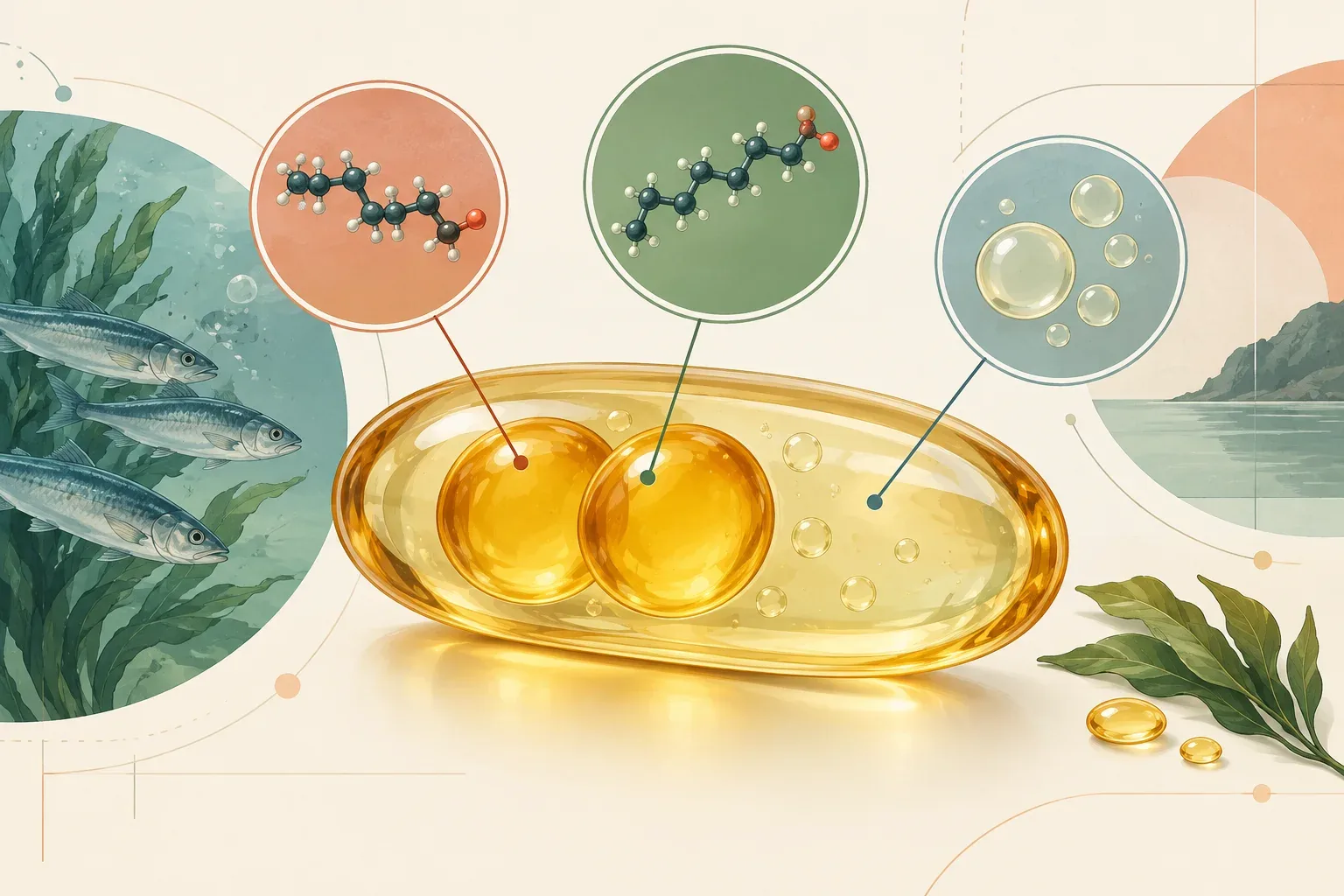
Both carry EPA and DHA, the two omega-3 fats in fish oil. They differ in what the fats are attached to.
- Triglyceride is the natural form of fat in fish: three fatty acids attached to glycerol, a small molecule that holds them together. Re-esterified triglyceride (rTG) is concentrated oil that has been converted back to this form.
- Ethyl ester fish oil has the fatty acids taken off glycerol and attached to ethanol during refining, which lets makers concentrate the oil. Prescription fish oils use this form.
For how much EPA and DHA to take, the heart trials, and krill and algae oils, see our omega-3 guide.
Both forms raise blood levels of EPA and DHA, the two main omega-3 fats in fish oil. Triglyceride fish oil raised those levels somewhat more than ethyl ester in trials that gave equal EPA and DHA amounts. Ethyl ester was used in two major heart trials, but that does not show the form was responsible: the VITAL trial did not clearly reduce major heart events, and REDUCE-IT tested a prescription EPA-only drug unlike store fish oil. The bigger practical differences are how much EPA and DHA a capsule contains and whether ethyl ester is taken with a meal.
Triglyceride and ethyl ester at a glance
| Triglyceride (natural or re-esterified) | Ethyl ester | |
|---|---|---|
| What it is | The form fats take in fish; "re-esterified" is ethyl ester converted back to it | Omega-3 fats bonded to ethanol during refining, which allows more concentrated oils |
| Blood omega-3 rise at equal EPA+DHA amounts | Higher in most trials | Lower in most trials; mixed in one 7-week trial |
| Needs a meal | Absorbs better with fat, but less dependent on it | Absorbs much better with a fatty meal |
| Major heart-outcome evidence | No direct heart-outcome comparison in the studies discussed here | Used in VITAL and REDUCE-IT, but neither showed ethyl ester was superior because of its form |
| Storage | Broke down more slowly through reactions with oxygen in one lab test | Broke down faster through reactions with oxygen in the same test |
How do the forms differ?
Absorption
At equal amounts of EPA and DHA, triglyceride usually comes out ahead on blood levels.
In 2010, 72 adults took about 3.3 g of EPA and DHA a day for 2 weeks. The researchers set the blood-level response to natural fish oil at 100: re-esterified triglyceride scored 124 on that relative scale and ethyl ester scored 73. These are not percentages of the swallowed dose absorbed or percentage changes from baseline. Labels that promise "up to 70 percent better absorption" match the comparison of 124 with 73, which is about 1.7. Natural triglyceride came out about 1.4 times ethyl ester (100 divided by 73; our calculation). This was a 2-week blood test at a dose several times a typical capsule.
In 2011, 150 adults with high blood lipids who were taking statins were randomized to 1.68 g of EPA and DHA a day as re-esterified triglyceride or ethyl ester, or corn-oil placebo, for 6 months. Capsules were taken with food, morning and evening. Among the 129 participants included in the final analysis, the omega-3 index—the share of EPA and DHA in red blood cells—rose from 7.00% to 13.25% with re-esterified triglyceride and from 7.42% to 12.24% with ethyl ester. The six-month comparison clearly favored re-esterified triglyceride on this blood measure. It was an additional study outcome rather than the main one, and 21 randomized participants were excluded from the final analysis. It measures incorporation into blood cells over time, not the fraction of one dose absorbed. Dr. Loges & Co. supplied the supplements free of charge.
In 2011, 12 men took a single 1.68 g dose of EPA and DHA. Triglyceride was higher, but the difference could have been chance.
In 1993, 31 men took about 3.5 g of EPA and DHA a day for 7 weeks. The blood-level comparison differed depending on which blood component the researchers measured, so it did not give one consistent absorption winner. The forms had similar effects on cholesterol, blood triglycerides (a blood-fat measurement), and the activity of platelets, the blood cells involved in clotting.
Food
Ethyl ester depends heavily on dietary fat. In a 1988 study, absorption of EPA and DHA from ethyl ester roughly tripled, to about 60 percent, with a meal containing 44 g of fat instead of a low-fat meal. With triglyceride, EPA absorption rose from 69 to 90 percent, while DHA absorption did not improve. On the low-fat meal, EPA from ethyl ester was absorbed about a third as well as EPA from triglyceride; the fatty meal narrowed the gap, but triglyceride remained ahead for EPA. The study did not test an empty stomach.
For someone who regularly takes fish oil with little dietary fat, the absorption evidence favors triglyceride.
Heart outcomes
VITAL, a large trial in healthy adults, used a 1 g ethyl-ester capsule a day with 840 mg of EPA and DHA; the difference in major heart events could not be distinguished from chance. REDUCE-IT used icosapent ethyl, 4 g a day of a prescription EPA-only ethyl ester, in people already on statins; it found fewer heart events, at a dose and drug unlike store fish oil. Neither trial compared triglyceride oil directly with ethyl ester at an equal EPA/DHA amount. The head-to-head trials discussed above measured blood levels or other intermediate outcomes; they do not establish which form prevents more heart attacks or strokes.
Oxidation
In a 2015 lab test of store-bought oils kept at temperatures from 5 to 60 °C (41 to 140 °F), ethyl-ester oils oxidized faster than triglyceride oils at every temperature. Oxidized oil smells and tastes fishy or sharp. The test compared different products, not the same oil in two forms, and it did not measure effects in people.
Read the label
- Add the EPA and DHA lines. That sum is the dose, not the fish oil weight on the front. One triglyceride label lists 1,326 mg of fish oil with 729 mg EPA and 275 mg DHA per softgel, about 1,004 mg together. Use separately declared EPA and DHA amounts; "total omega-3" can include other omega-3 fats.
- Look for the form. Triglyceride products usually say "triglyceride" or "rTG" (re-esterified triglyceride). Ethyl-ester products may list "ethyl esters" next to the omega-3 line. Some labels leave the form unspecified.
- Treat “up to 70 percent better absorption” as a blood-level claim. That figure matches the 2-week trial above. It does not mean you get 70 percent more benefit.
- "Take with a meal." Ethyl-ester labels often say this; follow it.
Who should check with a doctor?
- People taking a blood thinner, or with a bleeding disorder or atrial fibrillation (an irregular heartbeat). Ask before starting either form, especially at gram doses (1 g is 1,000 mg). In REDUCE-IT and STRENGTH, two trials of 4 g a day of prescription omega-3, atrial fibrillation was more common than with placebo, and REDUCE-IT recorded serious bleeding in 2.7% versus 2.1%; that bleeding comparison was not statistically conclusive (P=0.06).
- People taking prescription omega-3. Do not add a store-bought oil without asking; the prescription already supplies a measured dose.
- People with a fish allergy. Both forms come from fish.
Either form can cause unpleasant taste, bad breath, heartburn, nausea or diarrhea[1]. The absorption comparisons do not establish that one form reliably prevents these ordinary side effects.
A 2024 analysis of 11 randomized trials[2] did not find a clear overall increase in bleeding with omega-3. Its high-dose purified-EPA subgroup did show a small absolute increase, about 0.6 percentage points. The prescription drug, dose and reason for treatment matter more to interpreting that result than the word “ethyl ester” alone.
The bottom line
Compare EPA plus DHA per full serving, the capsule count needed to supply it and the meal instructions before paying more for a form name. Both forms raise blood omega-3 levels; triglyceride generally produces the higher rise at equal amounts, especially with low-fat meals. We have not selected specific products for recommendation.
Help us improve this article
Spotted an error or found a source we should consider? Tell us which part of this article needs another look and include a link if you have one. Please leave out personal health details and lab results; we can’t answer individual medical questions.
Keep exploring

Explore more in heart & blood pressure




References
- Office of Dietary Supplements: Omega-3 fatty acids, health professional fact sheet ↩
- 2024 analysis of 11 randomized trials ↩
- Dyerberg et al.: bioavailability of marine omega-3 formulations, 2010
- Neubronner et al.: omega-3 index with triglyceride vs ethyl ester over 6 months, 2011
- Schuchardt et al.: single-dose comparison of triglyceride, ethyl ester, and krill oil, 2011
- Hansen et al.: ethyl ester vs triglyceride fish oil over 7 weeks, 1993
- Lawson and Hughes: ethyl ester and triglyceride absorption with a high-fat meal, 1988
- Manson et al.: VITAL, marine omega-3 and prevention of heart disease and cancer, 2019
- Bhatt et al.: REDUCE-IT, icosapent ethyl in statin-treated patients, 2019
- Nicholls et al.: STRENGTH, high-dose omega-3 vs corn oil, 2020
- Gencer et al.: omega-3 dose and atrial fibrillation across seven trials, 2021
- Sullivan Ritter et al.: oxidation rates of triglyceride and ethyl ester fish oils, 2015
- NIH Dietary Supplement Label Database: a triglyceride fish oil label
- NIH Dietary Supplement Label Database: an ethyl ester fish oil label
Corrections & updates
- Update
Updated the evidence discussion and practical guidance after editorial review.
- Update
Revised the article after editorial review, with clearer evidence explanations and practical guidance.