
What is creatine?
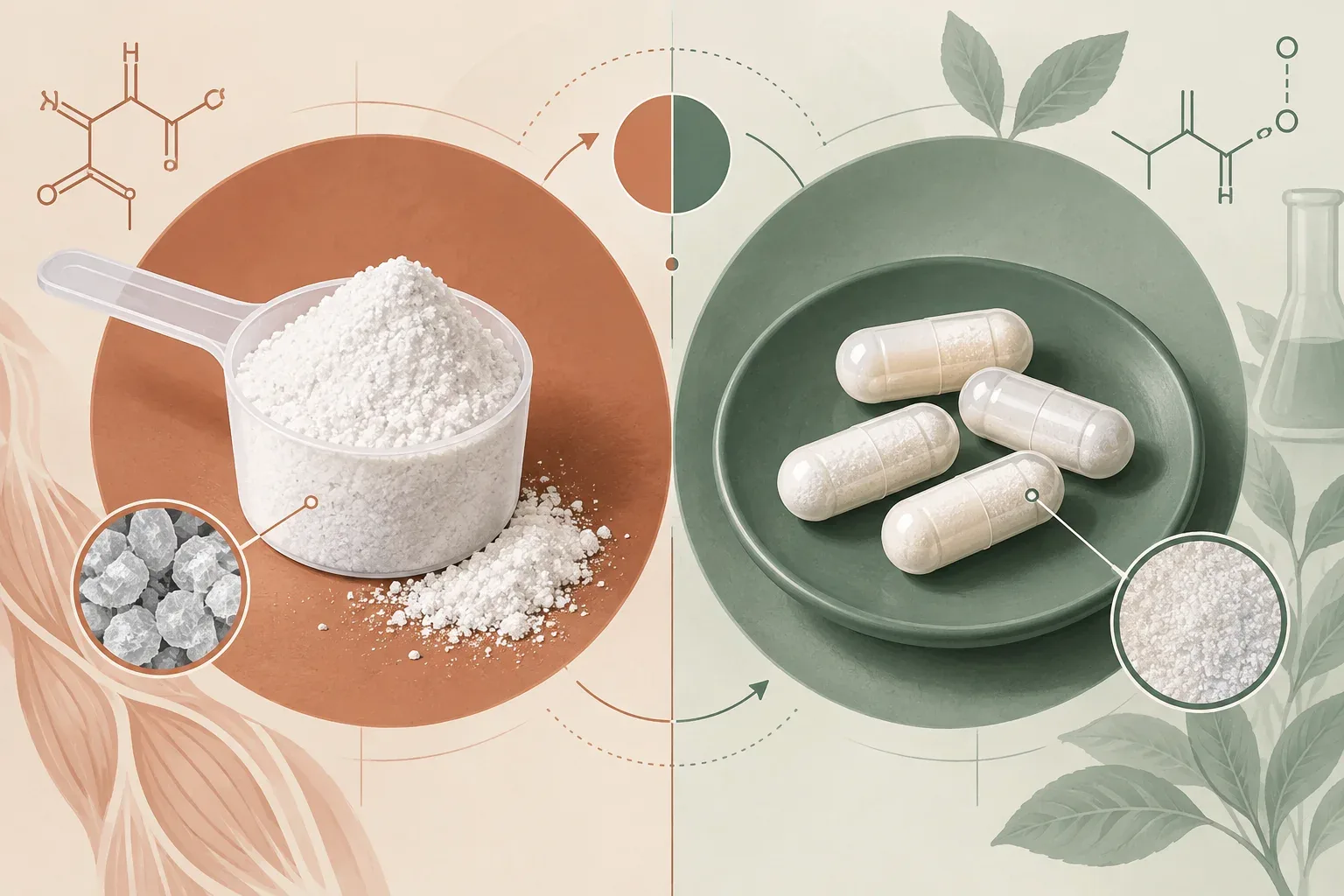
Creatine helps cells replenish energy, particularly during short, demanding muscular efforts. Your body makes it, and meat and fish supply some through food. Supplements are usually creatine monohydrate powder, although capsules, hydrochloride and gummies are also sold.
For healthy adults considering it alongside training, the widely studied maintenance range is 3–5 grams of creatine monohydrate a day. Regular intake builds and maintains muscle creatine stores, but an occasional missed dose does not immediately empty them. Monohydrate remains the best-studied form.
What does creatine do in your body?
Cells use ATP, a molecule that supplies energy for work such as muscle contraction and nerve signaling. They attach a phosphate group to some creatine, forming phosphocreatine. When a muscle uses ATP during a short, hard effort, phosphocreatine can donate that phosphate to help regenerate ATP quickly. It acts as a rapidly available reserve while other energy-producing pathways catch up.
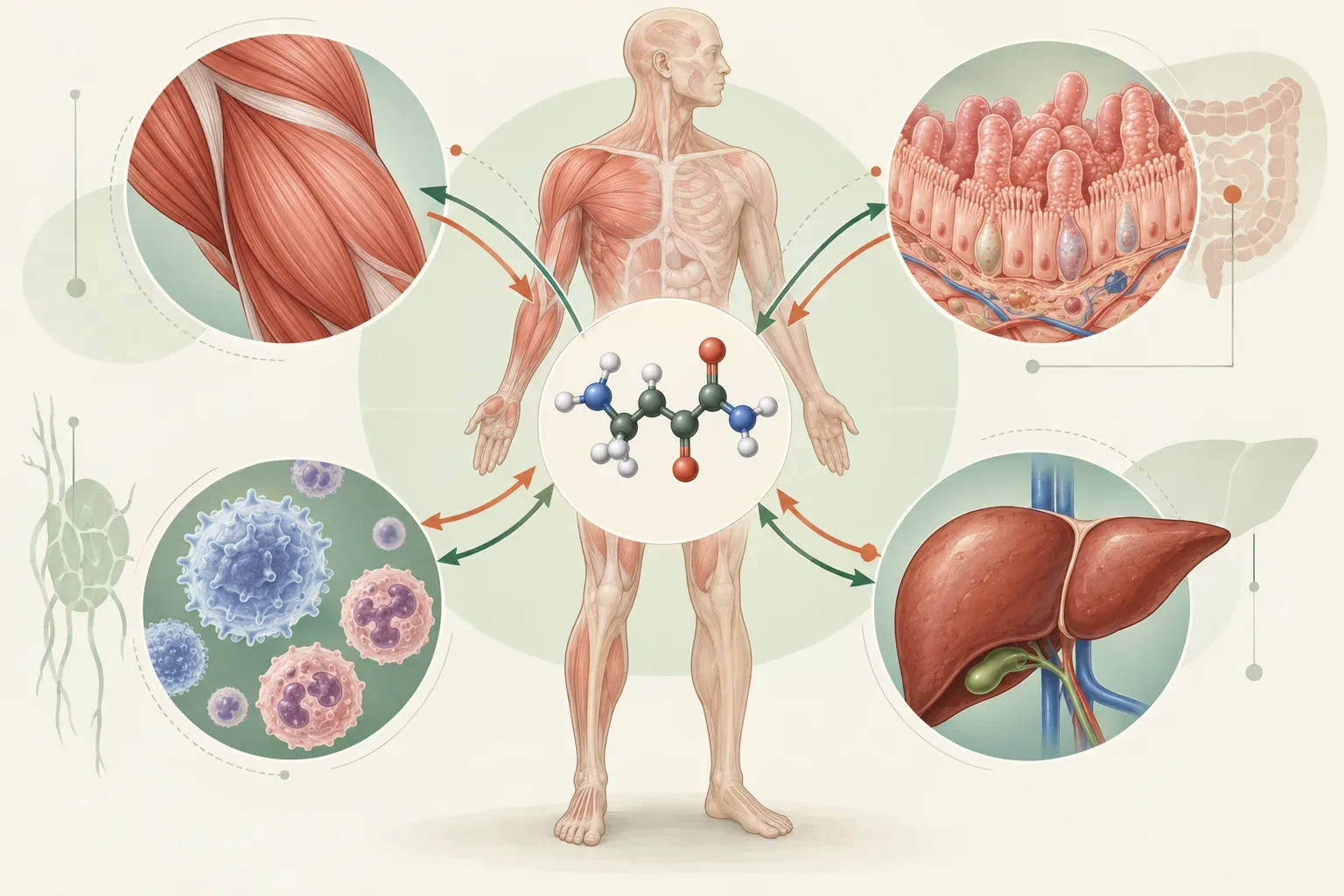
Most of the body's creatine is in skeletal muscle, although other tissues, including the brain, use the same general energy-buffering system. The body makes creatine and food supplies some. Supplementation can increase muscle stores, which is why the research around creatine concerns building and maintaining those stores rather than an immediate stimulant effect.
Why do people take creatine?
| Claimed benefit | Dose / form studied | Research verdict | Evidence strength |
|---|---|---|---|
| Supporting strength and training gains | Usually 3–5 g/day monohydrate, sometimes after loading, alongside resistance training | Monohydrate has the most established training evidence. | Strong |
| Improving recovery after demanding exercise | Small trials used weight-based loading and maintenance; populations and workouts differed | One trial found better force recovery; another found no benefit. | Limited |
| Improving memory or reasoning when rested | Monohydrate, including 5 g/day for six weeks and 10–20 g/day in a separate trial | Positive early findings have been followed by smaller or null results. | Limited |
| Maintaining performance after sleep loss | Single weight-based monohydrate doses or short loading courses | Some tasks improved during total sleep deprivation; a small partial-sleep-restriction study found no benefit. | Limited |
| Easing depressive symptoms alongside treatment | Monohydrate, including 3–5 g/day with an antidepressant or 5 g/day with therapy | Some add-on trials are encouraging, but results vary. | Limited |
The clearest case is repeated high-effort exercise and strength training. Brain research is expanding, with different findings in rested volunteers, people kept awake overnight and patients receiving depression treatment.
When to ask a doctor before taking it
If you have kidney disease, abnormal kidney tests or medicines that affect kidney function, discuss supplementation before starting. Findings in healthy adults cannot simply be carried across to established kidney disease. If you have bipolar disorder or are considering creatine for depression, involve your mental-health clinician: treatment background and a possible shift into abnormally elevated or activated mood matter.
Common dosage
The International Society of Sports Nutrition describes 3–5 g/day of monohydrate as a practical maintenance range. The National Academies have not set a recommended daily amount or official upper limit for creatine.
One loading approach studied in healthy men was 20 g/day for six days, followed by maintenance. In Hultman's study, 3 g/day for 28 days produced a similar roughly 20% increase in muscle creatine. A loading amount is therefore not the everyday serving implied by the maintenance range.
There is no established rule that breakfast, bedtime or a particular meal is necessary. Choose a routine you can sustain and a serving you tolerate. Larger single servings can cause digestive discomfort; taking more does not establish a better result.
How can I tell if I'm low on creatine?
Vegetarian diets generally supply less dietary creatine than diets containing meat and fish. That does not diagnose deficiency, and your body also produces creatine. Some research measures muscle stores with biopsies or specialized imaging. An ordinary blood panel cannot tell you whether those stores are low or saturated.
Forms you can buy
| Form or format | What it changes | What to check |
|---|---|---|
| Monohydrate powder | The reference form used in most training research | Grams per serving and ingredient identity |
| Micronized monohydrate | Finer particle size; the same compound | Whether the convenience justifies the price |
| Monohydrate capsules | Convenience and number of capsules needed | Full serving in grams |
| Creatine HCl | A different compound with mixed small comparative trials | Actual amount, without assuming lower-dose equivalence |
| Ethyl ester | A chemically modified form | No established overall advantage over monohydrate |
| Gummies | A different delivery format | Declared grams and number of gummies per serving |
Monohydrate powder has the most established research on amounts and training results. Our monohydrate-versus-HCl comparison and creatine gummies article address those narrower choices.
What to look for on the label
Which number should I count?
Look for grams of creatine monohydrate per full serving. A 5 g monohydrate serving includes the water that forms part of the compound. Although that contains approximately 4.4 g of creatine itself, studies commonly report grams of monohydrate. Do not reduce the serving to “correct” the study amount.
Misleading labels
A blend weight instead of creatine grams
A 5 g “performance blend” may contain several ingredients. Unless creatine's amount is separately listed, you cannot tell whether it supplies the amount you intended to take.
Capsule count instead of a daily serving
Check how many capsules provide the declared grams. The number of capsules in the container is not the number of days it will last at your chosen serving.
Smaller-dose HCl advertised as equivalent
Hydrochloride, usually shortened to HCl, is a different compound form. Equal-dose comparisons do not prove that a smaller HCl serving replaces 5 g of monohydrate. That lower-dose substitution has not been established.
Gummies assumed to equal powder
A label amount does not establish how much intact creatine remains through storage. That requires measurements of the finished gummy's creatine content over its stated shelf life. Serving size is visible on a label; stability over storage cannot be judged from that label alone. In our creatine gummies article, we look at the available stability measurements. They suggest that at least some finished products remain reasonably stable over the shorter period people typically keep a one-month supply, but those product-specific results cannot describe every gummy.
Common Myths about Creatine
Do I have to load before creatine works?
No. A larger initial amount fills muscle stores faster, but a smaller daily amount reaches a similar increase in overall muscle creatine. Loading is a choice about speed, and in some cases a tradeoff for gut symptoms, not a requirement for benefiting from use.
Does creatine cause hair loss?
The concern originally drew on a small rugby study that measured a hormone, dihydrotestosterone, rather than hair loss. A 12-week randomized trial at 5 g/day later found no group effect on that hormone or measured hair outcomes.
Drawbacks and side effects
| Potential drawback | When/who it affects | Research evidence | Practical implication |
|---|---|---|---|
| Water-related weight gain | Can occur as muscle stores increase, especially during loading | [1] | Consider whether a rapid change matters for your sport or preference |
| Digestive discomfort | More relevant with large single servings | [1] | Loading is optional; do not force a poorly tolerated regimen |
| Harder interpretation of creatinine | Anyone having kidney blood tests while supplementing | [1] | Disclose use and ask your doctor to investigate unexpected results |
Research reviews have not shown that recommended daily amounts damage healthy kidneys. Those findings do not settle use in kidney disease.
The science behind creatine
Why monohydrate is the reference
Monohydrate is the reference because it is the form used to establish how oral creatine raises muscle stores, how quickly loading and daily use work, and whether supplementation adds to resistance training. Harris measured the rise in muscle creatine after oral monohydrate, and Hultman demonstrated both a rapid loading route and a slower daily route. That gives readers tested amounts and timelines against which other forms can be compared.
Training outcomes add a separate reason. A review of 22 trials involving 721 older adults[2] found greater chest-press and leg-press strength gains with creatine than with placebo during resistance training. Lean tissue increased by about 1.4 kg more on average; that measure includes water as well as muscle. Individual studies varied, and the finding concerns supplementation alongside training. The breadth of this monohydrate evidence makes it the practical comparison point, without proving every other form ineffective.
How do HCl and ethyl ester compare?
Three recent small HCl comparisons disagree. Eghbali's eight-week trial in 40 young men and Londoño-Velásquez's eight-week trial in 31 athletes found no clear form advantage. Eghbali compared maintenance amounts of 0.03 g/kg/day for each form, with an additional monohydrate loading arm; Londoño-Velásquez used 5 g/day of each form. Duan's four-week soccer trial also used 5 g/day of each form and favored HCl on several performance tests, but had only ten participants per group. These are comparisons of equal compound weights, not tests of a smaller HCl serving replacing a larger monohydrate serving. That small positive trial is not enough to establish which form works better overall. Two authors in the Londoño-Velásquez trial advised a monohydrate manufacturer; Duan reported no conflicts.
Spillane's ethyl-ester trial did not find an overall advantage over monohydrate and found substantially higher serum creatinine. Laboratory work by Giese also found conversion of the ester to creatinine. Duan's small soccer trial instead found greater gains on several performance tests with ethyl ester than monohydrate.
An older four-week comparison[3] included 1.5 g/day HCl against 5 g/day monohydrate, another 5 g HCl arm and placebo. Its reported improvements were within individual groups, with no significant between-group differences. The study also had inconsistent analyzed counts and used skinfold body-composition estimates. Lower-dose HCl has been tested, but dependable equivalence remains unproved.
Does it improve recovery?
Cooke's small trial in 14 untrained men found better force recovery after deliberately muscle-damaging exercise using 0.3 grams per kilogram of body weight daily before exercise and 0.1 grams per kilogram afterward. For a 70 kg participant, those research amounts would be 21 g and 7 g a day. The supplement supplier funded and supplied the study. Rawson studied 22 trained men using a different workout and shorter supplementation schedule. Recovery was no better with creatine than with placebo. The differing results leave it uncertain whether creatine reliably speeds the return of force after demanding exercise.
Does it help endurance as well as strength?
The result depends on the effort. A 2023 review of 13 placebo-controlled studies[4] in trained participants found no clear overall improvement in endurance performance with monohydrate. Its pooled effect was close to zero, with an interval compatible with a small disadvantage or benefit. That does not contradict creatine's better-established role in repeated, short, hard efforts. A sport can include both sustained aerobic work and sprints, and improving one does not guarantee a faster whole race.
Does creatine strengthen bones or prevent falls?
The larger long-term trials have not shown improved bone mineral density. In a two-year trial of 237 postmenopausal women[5], participants took 0.14 g/kg/day monohydrate or placebo while doing resistance training and walking; both groups also received calcium and vitamin D. Creatine did not improve the primary femoral-neck bone-density outcome, nor hip or spine density. Some measurements of hip-bone geometry and walking speed favored creatine, but these did not establish fewer fractures. Supplement adherence was only about 56% in the creatine group, which limits interpretation. Public research grants funded the study; one author disclosed creatine-industry advisory and research relationships.
A separate two-year trial[6] assigned 200 postmenopausal women with osteopenia to 3 g/day monohydrate or placebo. It also found no benefit for bone density, and no clear difference in falls or fractures. Better strength-training results should therefore not be translated into a claim that creatine treats osteoporosis or prevents a fall.
Can it improve blood sugar in type 2 diabetes?
In a small 12-week trial[7], 25 adults with type 2 diabetes were analyzed after receiving 5 g/day creatine or placebo alongside an exercise program. HbA1c—a blood marker reflecting average blood sugar over roughly two to three months—fell from 7.4% to 6.4% in the creatine group, while the placebo group changed from 7.5% to 7.6%. The estimated difference was 1.1 percentage points favoring creatine. The statistical uncertainty range ran from a smaller 0.4-point benefit to a larger 1.9-point benefit. Some meal-test glucose measures improved, while insulin and other insulin-sensitivity measures did not clearly differ.
That is an encouraging result for creatine added to exercise. A review found only three small trials totaling 87 participants[8], with differing comparators and low certainty. It does not establish creatine as a replacement for diabetes medication, or show the same benefit without the accompanying exercise program.
Does more brain energy mean better mental health?
Creatine's energy role gives researchers a reason to study mood. Nerve cells need a continuous energy supply, and phosphocreatine helps buffer changes in demand. But the word “energy” can describe different things: a chemical measurement inside the brain, how tired you feel, or how well you perform a task.
A useful experiment comes from Kondo and colleagues[9]. They studied adolescent and young adult women whose depression had not responded adequately to an antidepressant. Participants received placebo or 2, 4 or 10 g/day of monohydrate for eight weeks. Twenty-eight of the 34 enrolled participants completed both brain scans. Higher brain phosphocreatine was associated with lower depression scores, but the changes in phosphocreatine and depressive symptoms did not differ significantly between treatment groups.
That association keeps the energy hypothesis interesting. It does not yet show that increasing brain energy caused the improvement in mood. The clinical question is whether people feel and function better with creatine than with otherwise comparable treatment.
Can creatine help with depression?
Some small trials suggest a benefit when creatine is added to treatment. In Lyoo's eight-week trial[10], 52 women with major depression received escitalopram plus either monohydrate or placebo. The creatine schedule was 3 g/day for the first week, then 5 g/day. Depression scores improved more in the creatine group, with differences appearing by week two. By week eight, 13 of 25 women taking creatine and 7 of 27 taking placebo met the study's remission threshold, meaning their scores had fallen into its low-symptom range.
Another trial tested the idea alongside psychological therapy. Sherpa and colleagues[11] randomized 100 adults with depression to 5 g/day of monohydrate or placebo, with both groups receiving cognitive behavioral therapy for eight weeks. Depression questionnaire scores favored creatine. However, about 40% of participants did not complete the trial, making the result less secure than the initial enrollment suggests.
These are encouraging findings for adding creatine to care. They sit alongside less favorable results, including Kondo's dose-ranging trial. The studies also leave a separate question open: whether creatine helps depression when taken on its own.
Bipolar depression needs particular care. In Toniolo's six-week trial[12], 35 patients received their usual medicines plus 6 g/day monohydrate or placebo. The main depression-score comparison was not significant, although a secondary remission analysis favored creatine. Two of the 17 patients assigned creatine switched to hypomania or mania. Two other patients in that group withdrew after worsening depression, one with suicidal ideation and one following a suicide attempt; the study cannot establish that creatine caused those events. This is a reason to discuss mood-directed use with the treating clinician, especially with a history of bipolar disorder.
Does creatine improve memory and concentration?
The results in rested adults are mixed. Rae's early trial[13] found better performance on memory and reasoning tasks after six weeks at 5 g/day in 45 young vegetarians and vegans.
A larger 2023 study by Sandkühler and colleagues[14] tested 123 adults, roughly half vegetarian and half omnivorous. Each person took 5 g/day creatine or placebo for six-week periods. The estimated benefits on remembering digits backward and solving reasoning problems were small, and neither primary comparison reached conventional statistical significance. An additional statistical analysis supported a possible small effect. Eight exploratory tasks showed no improvement.
Vegetarians did not benefit more than omnivores in that study. Lower creatine intake from food therefore does not identify who will get a cognitive benefit from a supplement. The larger trial leaves room for a small effect, while giving less support to the large improvements suggested by the early study.
Can creatine help after sleep loss?
Some of the clearest positive brain experiments have tested people kept awake overnight. In Gordji-Nejad's 2024 crossover study[15], 15 healthy adults received a single 0.35 g/kg dose of monohydrate or placebo during separate sleep-deprivation sessions. Selected memory and processing-speed measures improved, alongside changes in brain energy measurements. The largest cognitive change occurred around four hours after the dose.
The same research group then studied 29 adults using a lower single dose of 0.2 g/kg[16] during 21 hours of wakefulness. Several reasoning, processing-speed and vigilance measures deteriorated less with creatine. These amounts equal 24.5 g and 14 g, respectively, for a 70 kg participant. The two studies were separate experiments, rather than a direct randomized comparison of those doses.
Partial sleep loss produced a different result. Shaw's October 2026 pilot[17] analyzed eight adults who took 20 g/day for seven days, then spent a night with only three hours in bed. Creatine did not improve the measured cognitive tasks, fatigue, sleepiness or brain oxygenation. The small sample could not reliably exclude smaller effects.
Staying awake all night and sleeping for three hours create different conditions. These studies suggest a possible benefit during some forms of sleep loss, but leave its size and reliability uncertain.
Does creatine change sleep itself?
One six-week study in young, naturally menstruating women[18] tested 5 g/day monohydrate against maltodextrin placebo while both groups trained twice weekly. Twenty-one women completed the study; the training-day sleep analysis included 20. A wearable estimated about 48 minutes more sleep on training days in the creatine group, but there was no clear benefit on non-training days, overall weekly sleep duration or the sleep-quality questionnaire. The study was small, used a consumer wearable, and one author disclosed creatine-industry relationships. This is a specific training-day finding, separate from experiments testing thinking after sleep deprivation.
What about perimenopause and brain fog?
Early research is beginning to address women in perimenopause, the transition toward menopause. An October 2026 exploratory study[19] randomized 51 women across creatine plus resistance training, placebo plus the same training, or a non-training control. The supplement groups used a five-day 20 g/day loading phase followed by about 4.5 g/day during six weeks of training.
The published abstract reports greater brain oxygenation and more consistent sleep with creatine than placebo. Reaction time on the Stroop attention task improved over time without a difference between groups. These findings make sleep and brain function worth investigating further, but they are not a clear demonstration of brain-fog relief. Manufacturers supplied the supplements and devices. Authors disclosed financial relationships, and a wearable-company employee was involved in sleep analysis.
Do higher doses work better for the brain?
A higher amount does not consistently produce better cognitive results. Moriarty's six-week trial[20] compared 10 g/day, 20 g/day and placebo in 30 healthy young adults, with ten in each group. Neither creatine amount improved the cognitive tests or the measured oxygenation of the front of the brain.
The dose question therefore depends on the outcome. Five grams has been studied over weeks for cognition and alongside depression treatment; much larger single amounts have been studied during acute sleep deprivation. Those results do not establish a daily brain-maintenance dose, a rule that the brain needs 10 g, or a reliable benefit from escalating to 20 g.
Muscle saturation does not tell us how much creatine reaches the brain. The Alzheimer pilot below measured brain uptake directly, which makes it useful for studying this separate question.
Does creatine help the aging brain or neurological disease?
Neurological-disease results cannot be reduced to one brain-benefit verdict. A large Parkinson disease trial[21] using 10 g/day was stopped because it was not showing the hoped-for clinical benefit.
In an Alzheimer disease pilot[22], 20 patients took 20 g/day for eight weeks. Measured brain creatine rose by about 11%, and some cognitive measures, including working memory, improved, while the Mini-Mental State Examination screening score did not. Everyone received creatine, so practice on the tests and changes unrelated to supplementation could also explain the improvements. It is a useful pilot for a controlled trial, rather than an established Alzheimer treatment.
Muscle and neurological diseases require separate answers
A Cochrane review of 14 trials[23] found an average 8.47% strength advantage in muscular dystrophies across six trials involving 192 participants. The estimate had a statistical uncertainty range of 3.55%–13.38%. Regimens varied; one dystrophy trial used 5 g/day in children and 10 g/day in adults for eight-week periods. In a separate trial of 37 people with polymyositis or dermatomyositis, 20 g/day for eight days followed by 3 g/day, alongside exercise, improved combined walking and stair-test time at six months, but not three months. A separate activity-endurance measure was unchanged.
For metabolic muscle disorders, combining the studies did not show a clear strength benefit. In 19 people with McArdle disease[24], 0.15 g/kg/day during five-week crossover periods increased exercise-related muscle pain and difficulty with daily activities compared with placebo. These different diagnoses and treatment regimens require specialist assessment.
For multiple sclerosis, a five-day trial in 16 adults[25] using 20 g/day monohydrate found no improvement in muscle creatine stores or repeated knee-exercise work compared with placebo. A second crossover trial in 11 adults[26] used a week at 20 g/day followed by a week at 5 g/day, also without clear improvement in muscle performance or everyday fatigue.
An open-label randomized pilot in 39 children and adolescents with traumatic brain injury[27] assigned 20 to 0.4 g/kg/day creatine and 19 to no supplement for six months. Four children died within three months, two in each group. Among surviving follow-up participants, the report found less headache, dizziness and fatigue with creatine. The number assessed differed by symptom and was smaller than the original 39; the exact counts for each symptom remain unclear. This was a small hospital study of substantial injury, without a placebo. Related reports describe these same participants, so they are not independent confirmations.
What you may have heard on podcasts
Rhonda Patrick described 5 g/day on FoundMyFitness on March 31, 2025, and a personal 10 g routine on Diary Of A CEO on July 28, 2025. Darren Candow also described 5 g as a starting point and about 10 g as his personal routine, with larger amounts on travel days.
Andrew Huberman's April 25, 2025 Q&A proposed amounts rising with body weight. Jeff Cavaliere separately discussed larger amounts for heavier people and a smaller HCl dose. Neither conversation identified a trial validating those exact weight cutoffs or the lower-dose HCl substitution. It remains uncertain whether routinely taking more than the usual maintenance range adds meaningful benefit for a given healthy adult.
Lab tests
Creatinine is a breakdown product measured in kidney blood tests, including many comprehensive metabolic panels. Creatine can raise it without a true reduction in kidney filtration. An unexpected result still needs assessment; telling the clinician about supplementation helps them interpret it.
Preparing for a test if you take supplements
Tell the clinician and laboratory which creatine form you take, the daily amount, whether you began with a short period at a higher daily amount (a loading phase), how long you have taken it and when you last took it. Follow their instructions about fasting and any clinician-directed pause. [28]
Muscle creatine stores decline over weeks after stopping. The sports-nutrition position stand[29] gives about 4–6 weeks as a usual return toward baseline.
Muscle-store washout is not the same as preparation for a creatinine blood test. A brief pause should not be assumed to recreate your pretreatment baseline; discuss any pause and retest plan with the clinician interpreting the result.
If a creatinine-based estimate is unexpected, your clinician can decide whether another measure of kidney function is needed.
The bottom line
Creatine monohydrate has well-established evidence for supporting strength and training gains. For a healthy adult who wants that benefit, a plain product and a routine that is easy to keep usually matter more than an elaborate formula. Loading is optional.
The brain research is more varied: promising depression add-on trials, possible benefits during sleep deprivation, and small or absent effects in rested adults. Higher daily amounts have not consistently performed better. Choose the format for convenience, tolerance and cost, and count the actual grams. Mood-directed use needs the clinical context described above; kidney disease and unexpected kidney-test results also deserve individual assessment.
Help us improve this article
Spotted an error or found a source we should consider? Tell us which part of this article needs another look and include a link if you have one. Please leave out personal health details and lab results; we can’t answer individual medical questions.
More about creatine

Explore more in exercise & muscle



More in compounds




References
- Creatine questions and safety review ↩
- review of 22 trials involving 721 older adults ↩
- four-week comparison ↩
- 2023 review of 13 placebo-controlled studies ↩
- two-year trial of 237 postmenopausal women ↩
- separate two-year trial ↩
- small 12-week trial ↩
- review found only three small trials totaling 87 participants ↩
- Kondo: Brain phosphocreatine and depression ↩
- Lyoo: Creatine alongside escitalopram for depression ↩
- Sherpa: Creatine alongside cognitive behavioral therapy ↩
- Toniolo: Bipolar depression trial ↩
- Rae: Vegetarian cognition trial ↩
- Sandkühler: Cognition in vegetarians and omnivores ↩
- Sleep-deprivation experiment ↩
- Gordji-Nejad: Lower single dose during sleep deprivation ↩
- Shaw: Partial sleep restriction pilot ↩
- six-week study in young, naturally menstruating women ↩
- Baker: Perimenopause, cognition and sleep ↩
- Moriarty: 10 g and 20 g cognitive dose comparison ↩
- Parkinson disease trial ↩
- Alzheimer pilot ↩
- Cochrane review of 14 trials ↩
- 19 people with McArdle disease ↩
- a five-day trial in 16 adults ↩
- second crossover trial in 11 adults ↩
- open-label randomized pilot in 39 children and adolescents with traumatic brain injury ↩
- MedlinePlus advises disclosing supplements because they can affect creatinine results ↩
- Sports-nutrition position stand ↩
- Vandenberghe: Muscle phosphocreatine after longer supplementation and stopping
- Harris: Muscle uptake
- Hultman: Loading and slower supplementation
- Spillane: Ethyl ester comparison
- Lak: Hair outcomes
- Eghbali: HCl comparison
- Londoño-Velásquez: HCl comparison
- Duan: Comparative performance trial
- Cooke: Exercise recovery
- Rawson: Exercise recovery
- Pereira: Named gummy trial
Corrections & updates
- Update
Updated the evidence discussion and practical guidance after editorial review.
- Update
Revised the article after editorial review, with clearer evidence explanations and practical guidance.