
What is PQQ?
PQQ, short for pyrroloquinoline quinone, is a compound that some bacteria use to handle energy reactions. Small traces turn up in foods such as kiwi, natto, and parsley. It is not a vitamin: people have no known need for it and no official daily amount.
Supplements usually come as 10 or 20 mg capsules of PQQ disodium salt, sometimes combined with coenzyme Q10 (CoQ10), a different compound involved in cellular energy production. Europe’s food-safety agency found a proposed 20 mg daily intake safe for healthy adults, while excluding pregnancy and breastfeeding from that conclusion. It did not set 20 mg as a nutrient requirement or a formal upper limit. The review put background food intake at no more than about 0.08 mg a day, at least 250-fold below 20 mg.
People take it for memory, energy, “mitochondrial health” (mitochondria are the parts of cells that make energy), and sleep. What is established is thin: three small trials found better memory or attention scores after 12 weeks at about 20 mg a day, all with authors from companies that make PQQ. In a training trial it did not improve fitness more than a placebo.
What people take PQQ for
| Claimed benefit | Dose / form studied | Research verdict | Evidence strength |
|---|---|---|---|
| Improve memory or attention | PQQ disodium preparations, about 20–21.5 mg/day for 12 weeks; healthy adults, including older adults with forgetfulness | Selected test scores improved in small trials; everyday benefit remains uncertain | Limited |
| Improve endurance or energy | 20 mg/day for 6 weeks with endurance training; 23 untrained men | No extra performance or body-composition benefit despite a cellular marker change | Limited |
| Improve sleep or mood | 20 mg/day for 8 weeks; 17 adults without a placebo group | Scores improved from baseline, but the study cannot establish cause | Insufficient |
The positive memory and attention trials involved healthy adults, including people who felt more forgetful; they did not test dementia treatment. Three small trials used about 20 mg a day for 12 weeks, but every trial had authors from PQQ makers. That study setup is too narrow and conflicted to support a general recommendation.
If memory is getting noticeably worse, seek an assessment.
When to ask a doctor before taking PQQ
- Pregnancy or breastfeeding. Europe’s safety approval excludes both, and it has not been studied then; skip it unless a doctor advises otherwise.
- Memory problems that are getting worse. The trials were in healthy people, not in dementia.
- You take any regular medicine. PQQ interactions have not been studied, so ask the prescriber or pharmacist whether the combination raises a concern.
What the 20 mg figure means
There is no recognized recommended daily amount or US upper limit for PQQ. The benefits table separates the roughly 20 mg research exposures. Europe’s safety opinion evaluated a proposed 20 mg/day intake for healthy adults, excluding pregnancy and breastfeeding; it did not establish a benefit dose.
No study has compared times of day.
What you can buy
PQQ is sold as capsules, alone or with CoQ10. The table separates the PQQ amount from other numbers commonly shown on the package.
| Listing | PQQ per unit | Units that supply 20 mg |
|---|---|---|
| PQQ capsules | 20 mg | 1 |
| PQQ capsules | 10 mg | 2 |
| CoQ10 plus PQQ | Varies; some list 20 mg PQQ with 100–200 mg CoQ10 | Check the label; one unit supplies 20 mg only when the PQQ line says 20 mg |
The trials used PQQ disodium salt supplied for the research; none tested a retail brand. A combination capsule does not show that PQQ and CoQ10 work better together.
Is CoQ10 the same as PQQ?
No. They are different molecules. CoQ10 carries electrons inside cells; PQQ is a bacterial compound found in food only in traces. They are often sold together, but the evidence reviewed here does not establish that the pair works better than either alone.
What to pay attention to on the label
Use the Supplement Facts line—not the product name—to find milligrams of PQQ per capsule and per daily serving. A mismatch between the name and that line is a reason to slow down and inspect the label, not to calculate from the name.
Which number on the label is the amount?
Look for PQQ in milligrams on the Supplement Facts panel. Many labels say it comes as pyrroloquinoline quinone disodium salt, the form used in the trials. A 20 mg capsule contains twice the PQQ of a 10 mg capsule.
Misleading labels
“PQQ-10” and other product names
At least one product called “PQQ-10” contains 20 mg of PQQ and 200 mg of CoQ10. Read the milligrams on the Supplement Facts panel, not the product name.
“Mitochondrial vitamin”
PQQ is not a vitamin. Europe reviewed a proposed 20 mg daily use as a new food ingredient; that is a proposed-use safety assessment, not a daily need or formal upper limit.
“Active PQQ”
“Active” does not mean a different or better molecule. No trial has compared one PQQ form with another.
Confusing servings and items per serving
Some manufacturers put 180 capsules on the front, and the back says 3 capsules per serving and 60 servings. The amount on the Supplement Facts panel is for the whole 3-capsule serving.
Manufacturer claims and the studies they may be based on
A “supports memory and focus” line may point to the three 12-week trials, each with authors from a PQQ maker. A “supports mitochondrial health” or “energy” line may point to cell and animal studies, or to a trial where a mitochondria-related protein rose but fitness did not. A “supports restful sleep” line may point to an 8-week study with no placebo group.
How PQQ interacts with other nutrients
PQQ is often sold with CoQ10, as a “mitochondria” pair.
CoQ10
CoQ10 is a different molecule with a different job: it carries electrons in the energy-making chain inside cells. A 2024 review by researchers at a PQQ maker describes studies of 20 mg PQQ with 300 mg CoQ10. One memory benefit appeared at eight weeks but did not persist at 24 weeks. We identified the trial citations, but could not inspect the original reports. The review does not establish that adding CoQ10 works better than PQQ alone.
Common Myths about PQQ
Does PQQ build new mitochondria and boost energy?
Not shown in people. In the one training trial, described below, a protein linked to new mitochondria rose, but fitness did not improve more than with a placebo.
Does PQQ improve sleep?
Not shown. The only sleep study, described below, had no placebo group, and improvement against people’s own starting point can come from time and expectation alone.
Can you get PQQ from food?
Only in traces. Europe’s safety review put background intake at no more than about 0.08 mg a day, compared with 20 mg in a common capsule.
Drawbacks and side effects
| Potential drawback | When/who it affects | Research evidence | Practical implication |
|---|---|---|---|
| Uncertain long-term or higher-dose safety | Use beyond the short trials or above the assessed intake | EFSA assessed 20 mg/day for healthy adults; this is not a benefit dose or universal ceiling | Do not extrapolate that assessment to larger or prolonged use |
| Missing liver and interaction evidence | People with liver concerns or regular medicines | Routine short-term blood tests do not establish liver-specific or drug-interaction safety | Review the uncertainty with the treating clinician |
| Unassessed pregnancy or breastfeeding use | Pregnant or breastfeeding women | These groups were excluded from the European safety assessment | Avoid treating the healthy-adult assessment as pregnancy evidence |
Safety details
There is no official upper limit in the US. Europe’s review judged the proposed 20 mg daily intake safe for healthy adults but noted limited data on how the body absorbs and clears PQQ.
The science behind PQQ
The evidence is three small memory trials with company authors that found benefits, one training trial that did not, and pilot studies without placebo groups.
Memory and attention
In a 2016 trial, 41 healthy older adults took 20 mg of PQQ or a placebo daily for 12 weeks. One attention-test result favored PQQ, but the report does not translate the score difference into an everyday benefit. A test of judging shapes and spatial relationships improved only among the half who started with lower scores. A researcher from Mitsubishi Gas Chemical, which makes PQQ, was an author.
In a 2022 trial, 64 Japanese adults who felt they had become more forgetful took 21.5 mg of PQQ or a placebo daily for 12 weeks; 58 finished, with an average age of about 71. The PQQ group did better on memory, attention, reaction time, and several other test scores. Four authors worked for the company that made the product used.
In a 2023 trial, adults aged 20 to 65 took 20 mg or a placebo daily for 12 weeks. Memory scores improved, and the subgroup aged 20 to 40 showed faster thinking at 8 weeks. The authors worked for Mitsubishi Gas Chemical.
What is still open is whether the memory results hold up when someone other than the makers tests them.
Exercise and energy
In a 2020 trial, 23 untrained men did six weeks of endurance training while taking 20 mg of PQQ or a placebo. A protein linked to making new mitochondria rose with PQQ, but the between-group fitness difference was not statistically clear, and body composition did not differ clearly. The laboratory change did not establish a better training result.
Sleep, mood, and inflammation
A 2012 study gave 17 adults 20 mg a day for eight weeks and found better mood and sleep scores than at the start, with no placebo group and a first author from Mitsubishi Gas Chemical. A 2013 study in 10 adults over a few days found lower blood markers of inflammation. Neither can show that PQQ, rather than time or expectation, caused the change.
The bottom line
PQQ has some positive memory-test findings, but the trials are small and commercially connected. The exercise trial did not find extra training gains, and changes in cellular or inflammation markers do not establish that a supplement creates more useful energy or slows aging.
The small memory studies give researchers a question to pursue, but they do not yet show a dependable benefit in daily life. The evidence for better exercise performance, more energy, or slower aging is weaker still.
Help us improve this article
Spotted an error or found a source we should consider? Tell us which part of this article needs another look and include a link if you have one. Please leave out personal health details and lab results; we can’t answer individual medical questions.
Explore more in energy & fatigue


Nutrient connections worth understanding
 Disputed pairing
CoQ10: Heart Health, Fatigue, Fertility and Forms
Connection details
Context: mitochondrial product pile
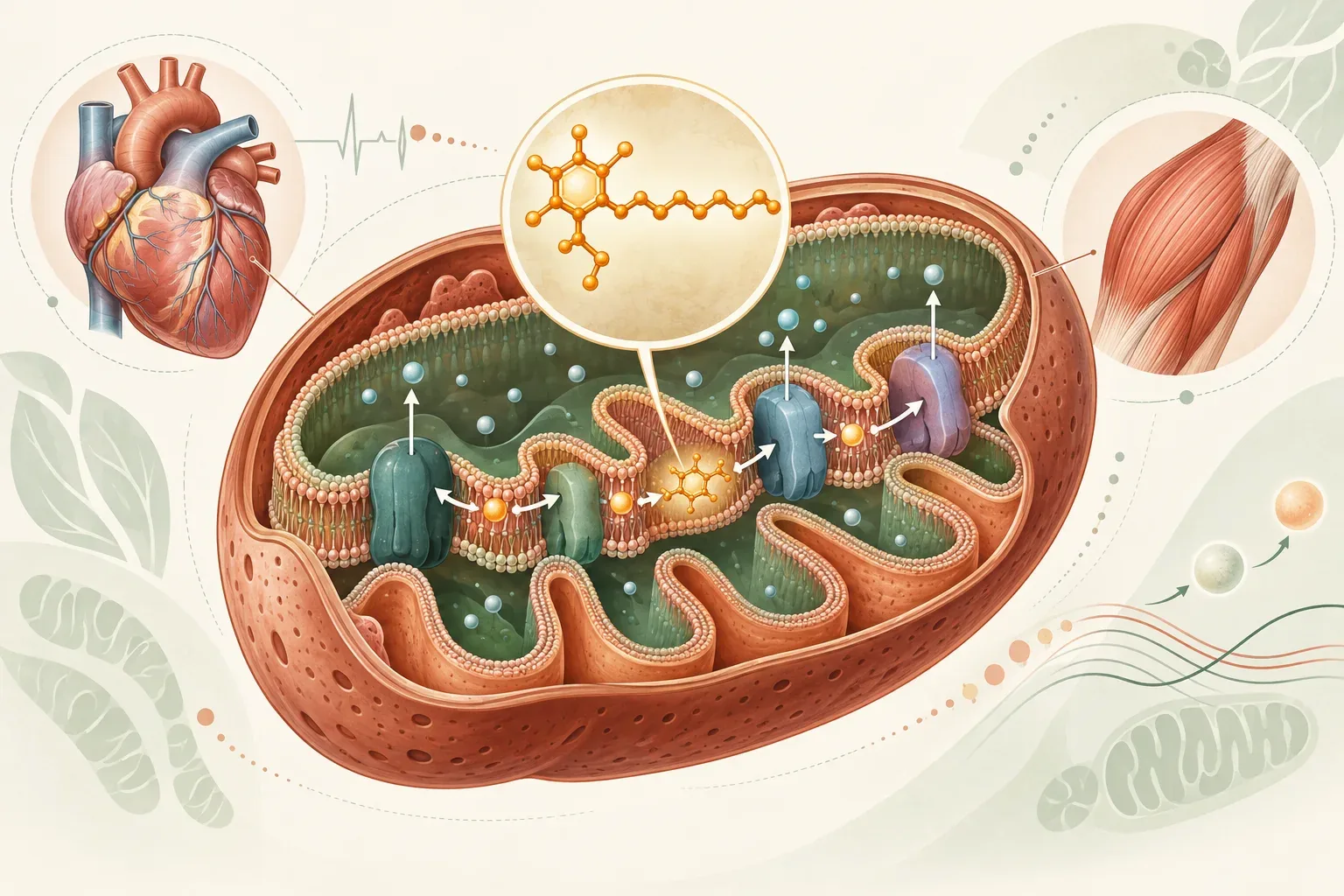
CoQ10 is a different electron-carrier story, not a required pair.
Source for this connection
More in compounds



References
- EFSA: safety of pyrroloquinoline quinone disodium salt as a novel food, 2017
- Itoh et al.: BioPQQ and cognitive function in older adults, 2016
- Shiojima et al.: PQQ disodium salt and cognitive function, 2022
- Tamakoshi et al.: PQQ disodium salt and brain function in younger and older adults, 2023
- Ikemoto et al.: PQQ disodium salt and brain function review, 2024
- Hwang et al.: PQQ and endurance training, 2020
- Nakano et al.: PQQ, stress, fatigue, and sleep, 2012
- Harris et al.: dietary PQQ and inflammation markers in humans, 2013
- NIH Dietary Supplement Label Database: a PQQ 20 mg label
- NIH Dietary Supplement Label Database: a “PQQ-10” label