
What is ornithine?
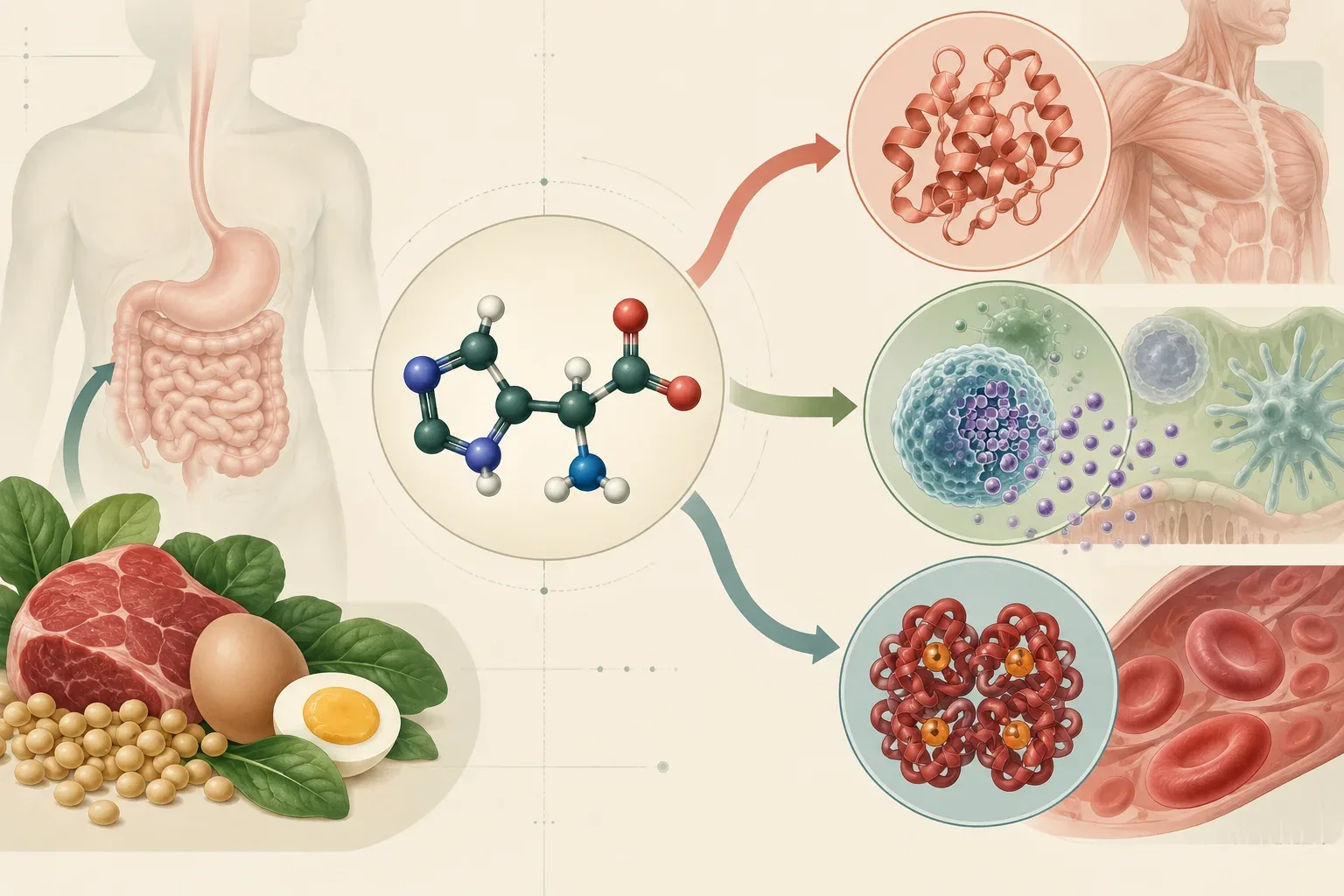
Ornithine is an amino acid the body makes in the urea cycle, the liver pathway that converts ammonia from protein metabolism into urea for removal. It is not used to build protein, and healthy adults have no recognized ornithine requirement or deficiency.
Retail products sell L-ornithine alone or with arginine for sleep, fatigue, liver support, or growth hormone. Those claims draw from very different products and settings: two small stress trials used plain L-ornithine, a liver-disease drug combines ornithine with aspartate, and hospital burn nutrition has used ornithine alpha-ketoglutarate. The forms and evidence are not interchangeable.
What ornithine does in your body
During the urea cycle, ornithine is converted into citrulline and then arginine before being regenerated, allowing the sequence to continue. It also supplies material for polyamines, compounds involved in cell growth and maintenance. [1]
The short version
Unit: milligrams (mg) or grams (g) of L-ornithine; 1 g equals 1,000 mg.
Supplement dose: there is no evidence-based starting amount. The healthy-adult trials were small, short, commercially connected, and used different outcomes.
Typical listings: 500 mg capsules taken once or twice a day, powders of 800 mg to 2 g per serving, and arginine–ornithine combinations.
Skip: liver claims borrowed from the prescription drug form, claims that ornithine clears alcohol faster, and arginine–ornithine “growth hormone” products marketed as muscle builders.
What people take ornithine for
| Claimed benefit | Dose / form studied | Research verdict | Evidence strength |
|---|---|---|---|
| Improve sleep or stress symptoms | L-ornithine 400 mg/day for 8 weeks; 52 adults with mild stress | Some self-rated outcomes improved in a small trial | Limited |
| Reduce fatigue after laboratory stress | L-ornithine 1,600 mg/day for 8 days, with the final serving before the stress test; 65 healthy adults randomized | Some next-morning ratings improved; cortisol, a hormone released during the stress response, did not clearly improve | Limited |
| Recover after alcohol | L-ornithine 400 mg around a single alcohol challenge; small crossover study | Some next-morning ratings improved; alcohol clearance was not faster | Limited |
| Treat liver-related confusion | L-ornithine L-aspartate drug regimens; doses and duration vary under medical care | Disease trials do not establish a dose for plain ornithine supplements | Limited |
The body makes ornithine. Two small Japanese trials reported selected improvements in self-rated sleep, fatigue, or anger, but the studies do not establish a general sleep or stress treatment. Both had company connections, and neither result has been confirmed in a large independent trial.
In advanced cirrhosis, a buildup of ammonia can contribute to hepatic encephalopathy, which may cause confusion. Clinicians in some countries use the combined medicine L-ornithine L-aspartate for that condition. That treatment is different from taking plain L-ornithine from a supplement shop.
When to ask a doctor before taking ornithine
- You have liver disease. The drug form is used in cirrhosis under a doctor's care, and we found no trial of supplement ornithine in liver disease.
Common dosage
There is no recognized daily requirement.
Retail labels suggest 500 mg once or twice a day or 800 mg to 2 g per powder serving, often on an empty stomach or at bedtime.
Which foods contain ornithine?
A food-composition summary in a human study[2] reports the following free ornithine amounts. The fish values varied among samples and species.
| Food analyzed | Source | Ornithine (mg per 100 g) |
|---|---|---|
| Brackish-water clam | Shellfish | 175.8 |
| Scallop | Shellfish | 7.0 |
| Little-neck clam | Shellfish | 6.7 |
| Mahi-mahi | Fish | 2.7–5.5 |
| Yellowfin tuna | Fish | 0.8–7.2 |
For comparison, 175.8 mg is about 0.176 g per 100 g of the clam. The powder servings listed above range from 800 to 2,000 mg.
What you can buy
Ornithine is sold as capsules, powder, and combinations, and the table shows the common listings.
| Listing | Ornithine per serving on the label | Notes |
|---|---|---|
| Capsules | 500 mg | Once or twice a day |
| Powder | 800 mg to 2 g | Check grams per scoop and the label's daily maximum |
| Arginine–ornithine tablets | 1,000 mg per four tablets | Plus 1,500 mg arginine |
| Arginine–ornithine capsules | 293 mg | Plus 625 mg arginine |
What to pay attention to on the label
Which number on the label is the amount?
Find the L-ornithine line on the Supplement Facts panel and its milligrams per serving. On combination products, read the ornithine line separately from the arginine line.
Misleading labels
Arginine–ornithine "growth hormone" products
One tablet product lists 1,500 mg of arginine and 1,000 mg of ornithine per four tablets. Another lists 625 mg of arginine and 293 mg of ornithine per capsule. The one trial of this pairing found higher growth hormone after exercise in 17 athletes; it did not show more muscle.
Confusing servings and items per serving
A label may list 2,500 mg on the front for an arginine–ornithine product, but the serving is four tablets and only 1,000 mg of it is ornithine.
Drawbacks and side effects
| Potential drawback | When/who it affects | Research evidence | Practical implication |
|---|---|---|---|
| Uncertain safety with prolonged high amounts | Use beyond small, short trials | No official upper limit or well-established long-term safety range | A product’s maximum serving is not a proven safe ceiling |
| Wrong formulation for a medical purpose | Using plain ornithine in place of liver treatment | L-ornithine L-aspartate and ornithine alpha-ketoglutarate are different interventions | Keep disease treatment with the treating team |
| Insufficient pregnancy or interaction data | Pregnant or breastfeeding women and people taking medicines | Small wellness studies do not settle these questions | Discuss the exact product before use |
| Stomach cramps or diarrhea | Large single servings of ornithine hydrochloride | [3] | Do not assume a tolerated divided daily amount will be equally tolerated all at once. |
Safety details
There is no official upper limit, and long-term studies have not established a maximum safe amount. A Doctor's Best powder label recorded by NIH[4] says not to exceed 10 g a day but gives no reason for that number. Large single doses around 10–14 g produced cramping or diarrhea in a small human study[5] of ornithine hydrochloride, also described in a 2025 safety review[3], while a 28-day study[2] found that divided doses up to 12 g a day were tolerated by the healthy adults studied. Dose spacing may help explain the different results; neither study identifies the manufacturer's reason for its 10 g instruction or establishes a general safety ceiling.
The science behind ornithine
Stress, fatigue, and sleep
In the 2014 randomized trial[6], 52 Japanese workers with mild stress and fatigue took 400 mg/day L-ornithine or placebo for eight weeks. Selected self-rated outcomes favored ornithine: the insomnia score and sleep-initiation/maintenance score at week four, and perceived sleep length at weeks five to seven. This was not a uniform improvement on every sleep measure or at every visit.
There is also an important difference between the paper's abstract and detailed Results. The abstract describes lower cortisol, but the Results state that the between-group cortisol change was not statistically significant at any measurement point. A ratio combining cortisol with another adrenal hormone, DHEA-S, did differ at week four. A change in that ratio is not the same finding as established cortisol lowering. Several authors were affiliated with Kirin or Kyowa Hakko, and the study used Kyowa Hakko ornithine.
The 2024 trial[7] assigned 65 adults to L-ornithine or placebo. Participants took 1,600 mg of L-ornithine daily after breakfast for seven days, then the same daily amount one hour before a public-speaking and arithmetic stress test on day eight. The test-day serving was that day’s dose, not an extra dose on top of 1,600 mg. Sixty-two started, 57 completed and 55 entered the final analysis. The primary outcome, salivary cortisol response, did not clearly improve.
The next morning, fatigue/inertia and anger/hostility on a mood questionnaire favored ornithine. A separate visual fatigue rating did not show a clear benefit at any time point. That difference matters: the study supports selected secondary questionnaire findings, rather than an unqualified reduction in fatigue or the biological stress response. Kirin Holdings supported the trial, two authors were employees, and a subsidiary supplied the ingredient. Independent replication would help establish whether these selected effects recur.
Both papers contain positive subjective findings, but the selected measures and timing differ. They leave a research question about perceived sleep or mood without establishing that plain ornithine reliably lowers cortisol.
Body-clock timing
In a crossover study of 28 healthy adults[8], 400 mg/day ornithine for seven days delayed the evening rise in melatonin by about fifteen minutes compared with placebo. Researchers measured saliva under dim light to estimate circadian timing.
Liver disease
L-ornithine L-aspartate (LOLA), a drug form, has been tested in people with cirrhosis who develop confusion from ammonia buildup, called hepatic encephalopathy. A 2018 analysis of 10 trials involving 884 patients found better mental state and lower blood ammonia than placebo or no treatment.
A six-month trial[9] tested oral LOLA, 6 g three times daily, after recovery from hepatic encephalopathy. Recurrence occurred in 9 of 73 assessed patients receiving LOLA and 20 of 72 receiving placebo. Mortality did not differ clearly. This is prevention of another episode, a different question from treating severe current confusion.
For acute severe encephalopathy, a 140-person trial[10] added intravenous LOLA, 30 g/day for five days, to lactulose and rifaximin. Improvement in encephalopathy grade was more frequent and 28-day mortality lower than with the same medicines plus placebo. The intravenous route and hospital treatment setting are essential parts of that result.
A 2018 Cochrane review[11], searching through December 2017, was much less confident than some positive reviews: overall estimates favored LOLA, but benefits were not clear when restricted to trials at low risk of bias. The reviewers judged the evidence very uncertain. That review predates the later acute-care trial; neither account should stand in for the other. Plain ornithine supplements are also different from LOLA.
Alcohol recovery
A small 2013 crossover study in Japanese adults who flush after alcohol reported some better next-morning scores and lower cortisol after 400 mg, but no faster acute alcohol metabolism. A separate 16-person experiment found no change in breath alcohol, perceived drunkenness or balance. It used Kyowa Wellness ornithine.
Burns and hospital nutrition
In a 1999 trial[12], 60 people with severe burns received 20 g/day ornithine alpha-ketoglutarate or a calorie-matched placebo for 21 days. The treated group retained more nitrogen, lost less body weight and had better wound-healing scores. Ornithine alpha-ketoglutarate is a combined preparation used here in hospital nutrition; the finding does not establish wound healing from ordinary ornithine capsules.
If a specialist orders amino-acid testing
If a specialist orders blood amino-acid testing, ARUP’s plasma amino-acid panel[13] prefers fasting in adults but specifies no supplement-stop interval. Report ornithine use and follow the specialist’s dose-timing instructions, especially for prescribed treatment.
The bottom line
Ornithine has a few positive findings for self-rated stress, fatigue and sleep, but the studies are small and several involve ingredient manufacturers. Its role in removing ammonia does not establish a general energy, “detox” or recovery benefit from a retail capsule.
For stress or sleep, the small trials leave both the size of the benefit and longer-term use uncertain; stomach tolerance also matters.
Help us improve this article
Spotted an error or found a source we should consider? Tell us which part of this article needs another look and include a link if you have one. Please leave out personal health details and lab results; we can’t answer individual medical questions.
Explore more in sleep



More in compounds


References
- Kokubo et al.: L-ornithine after alcohol consumption, 2013 ↩
- food-composition summary in a human study ↩
- Reported in the human safety review ↩
- NIH Dietary Supplement Label Database: a 2 g L-ornithine powder label ↩
- small human study ↩
- 2014 randomized trial ↩
- 2024 trial ↩
- crossover study of 28 healthy adults ↩
- six-month trial ↩
- 140-person trial ↩
- 2018 Cochrane review ↩
- 1999 trial ↩
- ARUP’s plasma amino-acid panel ↩
- Miyake et al.: L-ornithine, stress markers, and sleep quality in healthy workers, 2014
- Moriyasu et al.: L-ornithine, mental stress, and fatigue after a social stress test, 2024
- Butterworth et al.: L-ornithine L-aspartate for hepatic encephalopathy, meta-analysis, 2018
- Zajac et al.: arginine and ornithine, growth hormone, and IGF-1 after resistance exercise, 2010
- Donati et al.: ornithine alpha-ketoglutarate in severe burn patients, 1999
- Ho et al.: L-ornithine stimulates growth hormone release in rats, 2017
- Taniguchi et al.: growth hormone after oral L-ornithine in mice, 2022
- NIH Dietary Supplement Label Database: a 500 mg L-ornithine capsule label
- NIH Dietary Supplement Label Database: a bedtime L-ornithine capsule label
- NIH Dietary Supplement Label Database: an L-ornithine powder label
- NIH Dietary Supplement Label Database: an arginine and ornithine tablet label
Corrections & updates
- Update
Updated the evidence discussion and practical guidance after editorial review.