
What is vitamin B5?
Vitamin B5, or pantothenic acid, is an essential vitamin that occurs in many animal and plant foods. Calcium D-pantothenate is the common supplement form, and sodium D-pantothenate is another source. For adults, the reference amount is an intake of 5 mg a day from food plus supplements.
People also consider a vitamin B5 supplement for acne, cholesterol, sleep, “adrenal” symptoms, or exercise. Those claims involve different molecules and doses. Pantethine is a related but separate derivative studied for cholesterol markers, while dexpanthenol is used mainly in skin products or injections. Neither is interchangeable with ordinary oral pantothenic acid, and the high amounts studied range from 600 mg of pantethine to 6 g of pantothenic acid.
What vitamin B5 does in your body
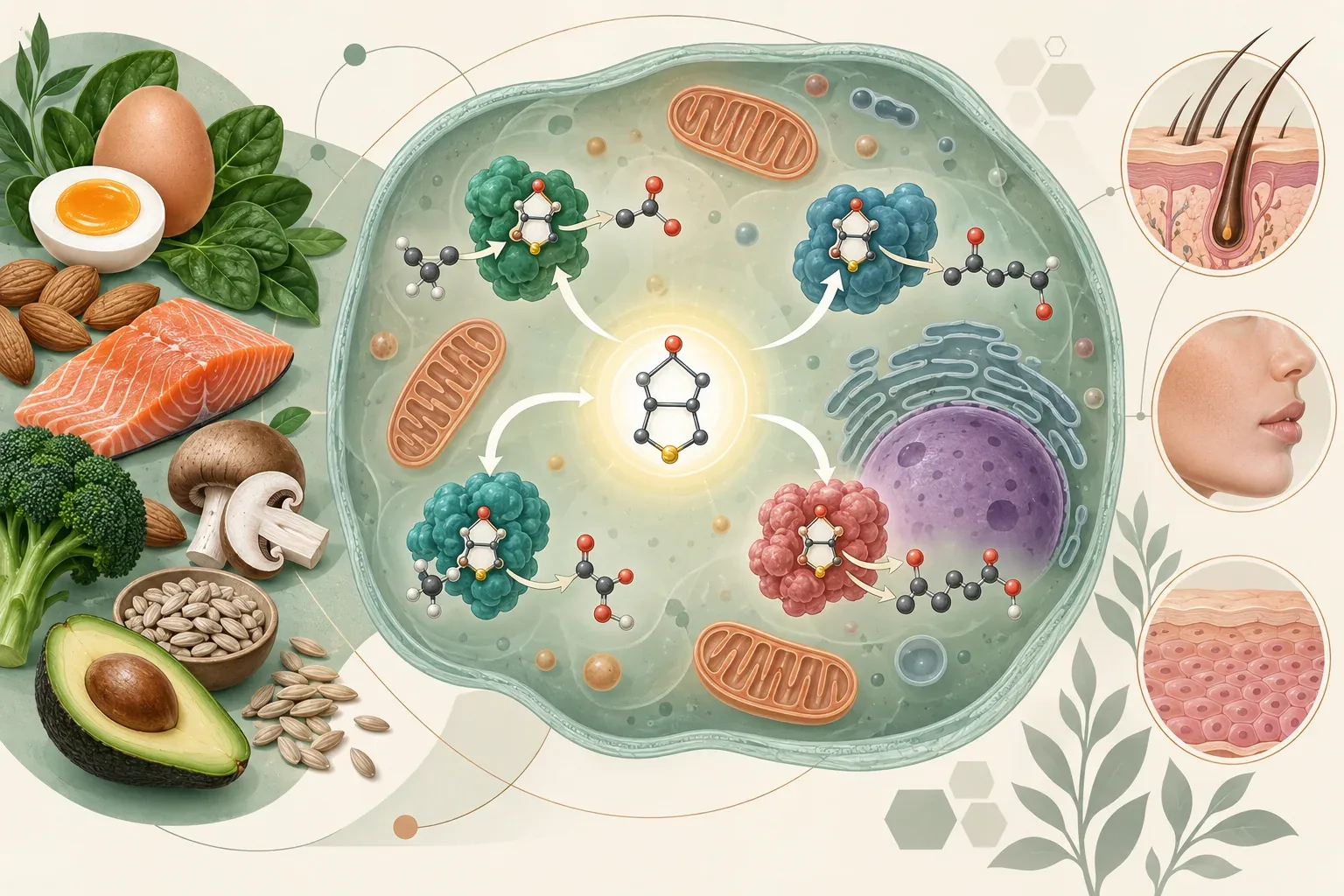
Pantothenic acid is used to make coenzyme A, which carries small groups of carbon atoms from one reaction to another. A familiar example is acetyl-CoA: it links the breakdown of carbohydrate and fat to the cell's energy-producing cycle. Coenzyme A also helps cells build and break down fatty acids.
B5 supplies part of a second helper, acyl-carrier protein, used when the body builds fats. These are the fats needed for ordinary cell structures and metabolism, not just the fat stored under the skin. The vitamin therefore participates in both using fuel and making material that cells need.
The short version
| Form or product type | Ordinary use | What that number means |
|---|---|---|
| Calcium D-pantothenate | About 5–10 mg of pantothenic acid in a daily-nutrition multivitamin or B-complex | Read the declared pantothenic acid milligrams; the calcium salt is the source |
| Sodium D-pantothenate | An ordinary pantothenic acid amount | Changing the source from calcium to sodium does not prove better absorption or stronger effects |
| Pantethine | A separate derivative, not an ordinary daily B5 form | Count it toward the 5 mg intake only if a separate regulated nutrient line declares pantothenic acid |
Unit: Milligrams of pantothenic acid.
Reasonable start: Food first. If your diet is severely restricted or a clinician has identified multiple nutrition gaps, a product supplying about 5 mg of pantothenic acid matches the adult adequate intake.
Typical listings: Multivitamin/mineral products often supply about 10 mg. A mixed U.S. diet is estimated to supply about 6 mg, so exact food-by-food counting is not usually necessary. Check other supplement labels before adding another 10 mg product, which by itself is twice the adult adequate intake.
Skip: a 500–1,000 mg B5 product sold as a stronger version of daily nutrition (some B-complex and single-ingredient labels go that high), and an ad that uses pantethine cholesterol results to sell calcium pantothenate, presents 10,000% Daily Value as 100 times the benefit, or uses coenzyme A chemistry as proof of an “adrenal energy” effect.
What people take vitamin B5 for
| Claimed benefit | Dose / form studied | Research verdict | Evidence strength |
|---|---|---|---|
| Improving acne | A branded pantothenic-acid-based product supplying 2,200 mg/day of pantothenic acid for 12 weeks in adults with mild-to-moderate acne. | One small trial was positive; the full formulation and repeatability remain uncertain. | Limited |
| Improving exercise performance | Pantothenic acid 6,000 mg/day for 16 weeks in 14 trained male cyclists. | The small nonrandomized study found no performance benefit. | Limited |
| Lowering cholesterol | Pantethine 600 mg/day for eight weeks, then 900 mg/day for eight weeks, alongside diet guidance. | Small lipid-marker improvements; cardiovascular events were not measured. | Limited |
| PKAN, a rare inherited disorder that damages nerves and affects movement | A 24-week combination titrated to pantothenate 6 g/day and pantethine 1,200 mg/day, plus omega-3 and vitamin E. | Two of three patients improved without a control group; the effect of pantothenic acid alone cannot be separated. | Very limited |
Severe malnutrition and multiple deficiencies call for clinical evaluation rather than a self-directed 500 mg dose. Rare inherited disorders that prevent the body from using pantothenic acid normally need specialist care; an ordinary over-the-counter dose does not treat them.
When to ask a doctor before taking it
The NIH fact sheet lists no clinically relevant medication interactions for ordinary oral pantothenic acid. That finding does not establish the same interaction record for high-dose pantethine or injected dexpanthenol. If you are considering pantethine for an abnormal cholesterol result, discuss it with the clinician treating your cardiovascular risk rather than replacing proven care with a derivative sold under the B5 name.
Common dosage
As of 2026, vitamin B5 has no Recommended Dietary Allowance. The National Academies set an adequate intake instead: 5 mg a day for adults and adolescents age 14 and older, from food plus supplements. An adequate intake is used when there is not enough evidence to calculate an average requirement; see why the official amount is an adequate intake.
Only the 5 mg adequate intake is a nutrition reference. The larger figures elsewhere in this article—2.2 g of pantothenic acid supplied by a branded acne product, 6 g of pantothenic acid for exercise, 600–900 mg of the separate derivative pantethine for cholesterol, and a 400 mg shelf product in one podcast account—are research exposures, some ineffective, preliminary, molecule-specific, or anecdotal, not amounts to choose from. The science section and the podcast section explain each one.
There is no official upper limit (the reason is under drawbacks and side effects). The missing number does not turn a high dose into an established daily amount.
Outside pregnancy and lactation, the adult amount is not set by sex or body weight.
Morning or night, with food or without?
No morning-versus-evening advantage has been established for meeting the daily amount. Taking a supplement with food may be easier on your stomach.
Am I getting enough vitamin B5 from food?
Most people can cover the adult 5 mg amount with a varied diet. The NIH fact sheet estimates that a typical mixed U.S. diet supplies about 6 mg a day, and pantothenic acid appears in almost all foods.
Selected values from the NIH Office of Dietary Supplements food table[1] show the stated food and preparation. Amounts are per serving.
| Food and preparation | Source | Serving | Vitamin B5 (mg) |
|---|---|---|---|
| Beef liver, boiled | Meat | 3 oz (about 85 g) | 8.3 mg |
| Breakfast cereal, fortified to 100% DV | Fortified | 1 labeled serving | 5.0 mg |
| Shiitake mushrooms, cooked | Plant | ½ cup | 2.6 mg |
| Sunflower seeds | Plant | ¼ cup | 2.4 mg |
| Chicken breast, roasted | Meat | 3 oz (about 85 g) | 1.3 mg |
| Avocado, raw | Plant | ½ whole | 1.0 mg |
| Milk, 2% | Dairy | 1 cup | 0.9 mg |
You do not need one “B5 superfood.” A day that combines several ordinary sources can reach the adequate intake, while severe restriction or malnutrition changes the question from product shopping to overall nutritional assessment. If you still choose a vitamin B5 supplement, use 5 mg as the nutrition reference.
How can I tell if I'm low on vitamin B5?
Pantothenic acid deficiency is exceptionally rare and usually occurs with severe malnutrition or other deficiencies. Human evidence comes largely from experimental depletion and historical malnutrition, rather than a well-defined sequence of mild, moderate and severe stages.
Reported signs and symptoms
Burning or numbness in the hands and feet, headache, fatigue, irritability, restlessness, disturbed sleep and digestive complaints with loss of appetite have been reported. The NIH account explains the evidence behind these symptoms[1]. Burning feet on their own are not enough to identify B5 as the cause; several nerve and metabolic conditions can produce that sensation.
When to seek medical assessment
Ask your doctor before using high-dose B5 to treat persistent numbness, burning feet, fatigue, severe skin symptoms, or unexplained gastrointestinal problems. Those complaints have many possible causes, and the classic B5 symptom picture came largely from artificial depletion studies.
Testing and interpretation
For more information about testing for vitamin B5, see the lab tests and preparation details near the end of this article.
Forms of vitamin B5 you can buy
Oral products use ordinary pantothenic acid sources or pantethine. Dexpanthenol appears mainly in topical and medical products. The form name helps you tell whether evidence applies to daily nutrition, a separate derivative, or a skin or medical product.
D-pantothenic acid
D-pantothenic acid is the biologically active vitamin used to make coenzyme A. It can cover the daily nutrition amount when a transparent label supplies an ordinary dose. “Natural,” “pure,” or “active” does not establish a clinical advantage.
A clear facts line would state the nutrient and amount directly: Pantothenic acid 5 mg — 100% Daily Value.
Calcium D-pantothenate
Calcium D-pantothenate is a stable source of pantothenic acid and the most common oral supplement form named by NIH. Choose it for a clear, ordinary pantothenic acid amount rather than for extra calcium or a claim of superior absorption. No human trial directly comparing equal amounts shows that it produces better health outcomes than D-pantothenic acid itself or sodium D-pantothenate.
A clear facts line would read: Pantothenic acid (as calcium D-pantothenate) 5 mg — 100% Daily Value.
Sodium D-pantothenate
Sodium D-pantothenate is another legitimate nutrient source. Changing the source from calcium to sodium does not show that it releases more slowly or is absorbed better. Choose it only when the label clearly declares the pantothenic acid amount and the rest of the product fits your reason for taking it.
A clear facts line would name both pieces: Pantothenic acid (as sodium D-pantothenate) 5 mg.
Dexpanthenol
Dexpanthenol is a related form of pantothenic acid used mainly in skin products and some medical injections. Skin products and injections each use doses made for that method of delivery. Their findings do not show that an oral B5 product treats acne or heals skin from within, and there is no valid shopper conversion from a cream percentage or injection amount to an oral pantothenic acid dose.
What to pay attention to on the label
The number that counts is the milligrams of pantothenic acid on the Supplement Facts panel. The words after “as” tell you which source supplied it.
Which number on the label is the amount?
A line reading “Pantothenic acid (as calcium D-pantothenate) 5 mg” declares 5 mg of pantothenic acid.
Misleading labels
A front number that may be salt weight
If the front says only “calcium pantothenate 500 mg,” check the Supplement Facts panel. The front number might describe the source compound rather than the vitamin itself, so only a clear nutrient line tells you the pantothenic acid amount.
A serving that contains more than one item
Supplement Facts amounts are usually listed per serving, not necessarily per capsule or tablet. Check serving size before you compare two products or total B5 across a multivitamin, B-complex, and single-ingredient product.
An acne claim attached to a different product
An acne claim may cite a sponsored 12-week study of a branded product supplying 2.2 g a day (2,200 mg) of pantothenic acid. That result does not establish the same effect for a 500 mg calcium-pantothenate tablet. The trial and its limitations are discussed below.
Pantethine evidence attached to pantothenate
An ad that cites cholesterol changes from 600 mg and then 900 mg a day of pantethine does not establish the same effect for calcium D-pantothenate. Pantethine is a derivative with its own study doses. A shared family relationship does not make the molecules clinically interchangeable.
An energy claim based on coenzyme A chemistry
Vitamin B5 helps the body make coenzyme A, but that established role does not show that taking more than you need improves energy. The small 6 g exercise study did not find a performance benefit.
How long should I take vitamin B5 supplements for?
For pantothenic acid, the usual question is whether your continuing diet reaches the 5 mg adult adequate intake. If it does, a separate product has no established store-filling course. If it does not, use the diet or a nutrition-level product to cover the gap while it persists, then reassess when the diet changes. NIH's fact sheet[1] does not provide a reliable depletion rate or a taper schedule after supplementation. The acne, exercise, and cholesterol studies discussed later used particular preparations and durations; those periods do not become a general vitamin B5 schedule.
Common Myths about Vitamin B5
Does more B5 create more energy?
An extra energy or performance benefit has not been established. B5 is essential because the body needs it to make coenzyme A. Once intake covers the daily need, biochemistry alone cannot predict that a larger dose will raise tissue coenzyme A or improve performance. A small, nonrandomized controlled study tested that extrapolation at 6 g a day (6,000 mg) and did not find the expected muscle or exercise benefit.
Is high-dose B5 an established acne or sleep treatment?
No. The acne evidence is a preliminary signal from one small sponsored branded-product study, not a settled dose for ordinary pantothenic acid. The sleep claim does not have a pantothenic-acid-alone placebo-controlled trial in the evidence reviewed here.
Drawbacks and side effects
| Potential drawback | When/who it affects | Research evidence | Practical implication |
|---|---|---|---|
| Diarrhea and digestive distress | Very high pantothenic-acid intake; NIH describes symptoms around 10 g/day. | Reported human effects do not define a safe chronic threshold below that amount. | Do not treat the absence of an upper limit as a reason to escalate. |
| Digestive effects with pantethine | Short trials at 600–900 mg/day. | Diarrhea or flatulence were reported with this derivative. | Do not assume calcium pantothenate has the same tolerability as pantethine at equal milligrams. |
There is no official upper limit, because the evidence was too sparse to establish a safe maximum. The reported symptoms around 10 g/day do not make lower amounts a proven safe range for chronic use; routine long-term safety at 500–1,000 mg a day remains uncertain.
Vitamin B5 during pregnancy and breastfeeding
Women need 6 mg a day during pregnancy and 7 mg a day while breastfeeding, according to the adequate intakes from the National Academies. The pregnancy figure was based on observed intake and rounded upward. The lactation figure accounts for pantothenic acid secreted into human milk and lower maternal blood concentrations at usual intake.
These are adequacy amounts from food plus supplements. The high amounts from acne and exercise studies were not tested in pregnancy and are not prenatal doses. If a prenatal product lists calcium D-pantothenate, read the milligrams on the pantothenic acid line and count that amount toward the daily total.
The science behind pantothenic acid
The evidence changes when the molecule, dose, and outcome change. The National Academies used small intake and urinary-excretion studies to set 5 mg a day for adequacy. A sponsored acne product supplied 2.2 g a day (2,200 mg) of pantothenic acid and reported a positive signal. Pantothenic acid at 6 g a day (6,000 mg) failed a direct muscle and exercise test. Pantethine at 600–900 mg a day produced small changes in lipid markers in industry-linked studies. What remains open is whether a fully specified pantothenic-acid product can reproduce an acne or sleep benefit and whether pantethine changes cardiovascular outcomes rather than only laboratory numbers.
Why the official amount is an adequate intake
The National Academies could not calculate an estimated average requirement because evidence on intake, absorption, storage, and status was too sparse. It chose 5 mg as the midpoint of usual reported intakes of 4–7 mg a day in small groups with no evidence of inadequacy. One supporting study followed intake and urinary excretion in only eight healthy women. The amount is useful for population adequacy, but it is not precision dosing.
The 2.2 g pantothenic-acid acne trial showed a preliminary signal
In 2014, Yang and colleagues enrolled 48 adults with mild-to-moderate facial acne; researchers could analyze results from 41 of them. The placebo-controlled study used four tablets a day of a branded pantothenic-acid-based product supplying 2.2 g (2,200 mg) of pantothenic acid for 12 weeks. In that trial:
- Changes in acne lesion counts and skin-related quality of life favored the product.
- This was a trial of a branded pantothenic-acid-based product, so its result does not establish that any B5 supplement will produce the same effect.
- Avilan Marketing sponsored the study, and Nutraceutical Medical Research paid the article charge. The article separately says the authors declared no conflicts of interest.
- In 2024, the American Academy of Dermatology concluded that the evidence for oral pantothenic acid was insufficient to make a treatment recommendation. “Insufficient” does not erase the positive study; it means that one small product trial has not settled the treatment.
The 6 g exercise study tested the energy extrapolation
Whitfield and colleagues gave 6 g a day (6,000 mg) of pantothenic acid for 16 weeks to seven trained male cyclists and compared them with seven matched controls. In that study:
- The dose did not increase resting skeletal-muscle coenzyme A.
- It did not improve maximal fat oxidation, time to exhaustion, or a 15-minute performance test.
- The study was small and not randomized.
- It did directly test—and fail to support—the claim that a large dose must improve performance because B5 sits in energy metabolism.
Pantethine modestly improved lipid markers; cardiovascular events were not measured
One placebo-controlled trial followed 120 adults for 16 weeks while both groups received diet guidance; participants, clinicians, and outcome assessors did not know the assignments. Pantethine was given at 600 mg a day for eight weeks, then 900 mg a day for eight weeks. At week 16, in that trial:
- LDL, often called “bad” cholesterol, was about 4 milligrams per deciliter (mg/dL) lower with pantethine than with placebo.
- Total and non-HDL cholesterol, two broader cholesterol measures, were about 6 mg/dL lower.
- These were small changes in blood-test markers.
- Triglycerides were not significantly different.
A second study randomized 32 adults and retained 24. It reported an 11% LDL decrease from baseline with pantethine versus a 3% increase with placebo. Both studies had support or personnel tied to Daiichi or Kyowa, and neither measured heart attacks, strokes, or mortality. A 2026 cholesterol guideline from the American College of Cardiology, American Heart Association, and partner medical groups does not recommend dietary supplements for lowering LDL cholesterol or triglycerides because evidence for lipid lowering and cardiovascular benefit is limited or inconsistent.
A combination experiment in PKAN
Pantothenate-kinase-associated neurodegeneration (PKAN) is a rare inherited disease that damages nerves and affects movement. It disrupts pantothenate kinase, an enzyme that helps turn B5 into coenzyme A. In a 2024 pilot[2], three patients whose cells still produced some of the affected enzyme took an oral combination alongside unchanged neurological medicines for 24 weeks. The treatment was intended to support an enzyme that was reduced, rather than completely absent. Pantothenate was gradually increased to 6 g/day, pantethine to 1,200 mg/day, with 2,000 mg/day omega-3 and 400 IU vitamin E three times weekly.
Daily-function scores improved in two patients and stayed unchanged in the third. There was no placebo or untreated comparison, and gastrointestinal symptoms occurred in two patients. Laboratory work on their cells was a separate part of the study. The observations justify further investigation of this specific combination; they cannot establish that ordinary pantothenic acid alone treats PKAN.
Injected dexpanthenol is a different acne question
A 2025 acne trial[3] analysed 59 patients receiving topical adapalene, with or without 500 mg intramuscular dexpanthenol once weekly for two months. Both groups improved, but adding the injections did not significantly improve the measured acne scores or lesion counts. That negative add-on result belongs to an injected derivative used with topical treatment; it does not test swallowed pantothenic acid.
What you may have heard on podcasts
Stasha Gominak told Steven Bartlett on The Diary of a CEO on July 27, 2026, that a book led her to a 400 mg pantothenic acid product because that was the dose on the shelf. She reported that it worsened her restless legs and made her agitated and unable to sleep. She said some patients described similar agitation, “like caffeine,” and stopped the 400 mg dose.
Later in the same interview, Gominak described using B-complex products labeled B100 or B50 in her clinic for about three months before stepping down. Those names are not full ingredient lists, and the account does not establish how much B5 those blends supplied per day. Their B5 exposure therefore cannot be compared directly with her 400 mg pantothenic-acid-alone account. Four hundred milligrams is 80 times the adult 5 mg adequate intake.
Labs
A commercial panel can include B5 alongside other B vitamins, but a test being sold does not mean its result can guide a B5 dose. If severe malnutrition or multiple deficiencies are plausible, a clinician can choose a broader evaluation.
Interpreting the results
Plasma and serum values do not track intake or status well enough to create a simple consumer cutoff. [1]
Before the test if you already supplement
There is no established B5 supplement-stop interval for the research measurements discussed here. If a clinician orders a specific blood or urine assay, get that laboratory’s written instructions and disclose pantothenic acid, pantethine and B-complex use. Ask the ordering clinician before changing your supplement routine.
The bottom line
Ordinary food usually supplies enough vitamin B5. The body’s need for it in energy metabolism has not translated into a demonstrated performance benefit from megadoses or routine supplementation, and the positive acne finding comes from one small branded-product trial.
Pantethine produced small cholesterol-marker improvements in short studies, but those studies did not measure heart attacks or strokes. The separate evidence for pantethine and the preliminary acne finding do not establish a reason for routine high-dose pantothenic acid. For daily nutrition, the adult reference remains 5 mg from food plus supplements.
Source notes
- NIH Office of Dietary Supplements: Pantothenic Acid Fact Sheet for Health Professionals[1]
- [4]
- [5]
- [6]
- [7]
- [8]
- [9]
- [10]
- [11]
- [12]
- [13]
- [14]
Additional outcome sources:
Help us improve this article
Spotted an error or found a source we should consider? Tell us which part of this article needs another look and include a link if you have one. Please leave out personal health details and lab results; we can’t answer individual medical questions.
Explore more in energy & fatigue



More in vitamins


References
- NIH Office of Dietary Supplements food table ↩
- 2024 pilot ↩
- 2025 acne trial ↩
- National Academies: Dietary Reference Intakes chapter on pantothenic acid ↩
- 21 CFR 101.36: Nutrition labeling of dietary supplements ↩
- FDA: Daily Value on nutrition and supplement labels ↩
- Hodges et al. (1958): Pantothenic Acid Deficiency in Man ↩
- Yang et al. (2014): pantothenic-acid-based product and facial acne ↩
- American Academy of Dermatology (2024): acne guideline ↩
- Whitfield et al. (2021): pantothenic acid, muscle coenzyme A, and cycling performance ↩
- Rumberger et al. (2011): pantethine and lipid markers ↩
- Evans et al. (2014): pantethine and lipid markers ↩
- 2026 cholesterol guideline from ACC/AHA and partner medical groups ↩
- Diary of a CEO: Stasha Gominak interview, July 27, 2026 ↩
Corrections & updates
- Update
Updated the evidence discussion and practical guidance after editorial review.
- Update
Revised the article after editorial review, with clearer evidence explanations and practical guidance.