
Do creatine gummies lose potency over time?
Creatine can gradually turn into creatinine, a breakdown product, when it is dissolved. Acidity, temperature and the amount of water available for reactions affect the rate.
But a gummy containing water does not automatically lose a large share of its creatine: the formulation, manufacturing process, packaging and storage conditions matter. The research on creatine stability[1] includes model solutions and gels; their deterioration rates cannot simply be assigned to every retail gummy.
The unresolved question is how much creatine remains over the shelf life of each retail product; a result for one formulation cannot answer that for all brands.
What do studies show about potency over time?
The available examples do not support assuming that every gummy rapidly loses its creatine.
In an internal manufacturer trial published by Swoleys[2], the reported amounts work out to losses of about 2.4% after six months, 5.1% after twelve months and 7.3% after twenty-four months. That trial used pectin button gummies rather than the company's retail bears, and the page does not provide full storage conditions or independent replication. Swoleys is also a different brand from SWOLY in our comparison table.
An older patent's gummy-like formulation[3] reportedly showed no measurable loss over 35 days at 35°C. These are isolated, formulation-specific results—one an internal trial and the other a patent applicant's report.
These two trials do not establish a deterioration rate for all creatine gummies, but they do show why rapid loss should not be treated as inevitable.
A small trial found better jump performance
A 2026 randomized study followed 32 female beach-volleyball athletes for ten weeks. Seventeen received Create gummies reported to supply 5 g of creatine monohydrate daily; fifteen received no supplement. Jump height increased by 2.1 cm in the gummy group and fell by 1.7 cm in controls. Change-of-direction performance also favored the gummy group. Lean mass—the estimated body mass excluding fat, including muscle—and reaction time did not show a clear difference in change between groups.
There was no placebo gummy, powder comparison, or muscle-creatine measurement. The researchers also had not publicly registered the study plan before the trial began, which makes it harder to check whether the reported outcomes match what they originally planned to measure. Create donated product, and an author disclosed an advisory role with the company. Those limits make the result preliminary evidence for that preparation and population. It does not establish that gummies outperform or equal powder, or that every retail gummy retains its claimed amount. [4]
The trial's 5 g daily amount also differs from the 4.5 g label example below. The published result belongs to the preparation and amount supplied in that experiment. Its performance findings, a certification listing and a storage assay answer three different questions: whether a trial regimen helped, whether a named product or lot met a certification program, and how its measured content changed during storage.
What a useful product test report should tell you
A useful report identifies:
- The finished product's exact name, flavor, and batch or lot.
- The laboratory, test date, and measured creatine amount with clear units.
- Results that distinguish creatine from creatinine.
- The sample's age and storage conditions, with evidence relevant to the claimed shelf life.
This is our checklist for interpreting a report. A measurement made immediately after production alone cannot establish the amount remaining at expiry. A report about a different flavor or an unidentified batch leaves a different gap.
Independent certification can add useful checks. On October 20, 2026, the NSF Certified for Sport directory[5] listed Create Wellness Creatine Gummies Sour Green Apple, with these lot numbers: 2526196-GM36, 2333295-GM36 and 2332096-GM36. The listed serving is three gummies; the linked product label[6] declares 4.5 g creatine monohydrate. The entry also lists 5 g total sugar and 60 Calories per serving.
The finding is that this named product and these lots appear in the certification directory. The public entry does not give a numerical creatine test result or an end-of-shelf-life measurement. The 4.5 g is the label declaration, not a measured result we can quote from that page. Match the flavor and lot on your package to the current entry rather than assuming every Create gummy is covered.
NSF Certified for Sport[7] includes content and quality checks plus screening for banned substances. It does not establish that a gummy produces the same performance results as powder.
How much do creatine gummies cost?
A jar's piece count can make it look like better value than it is, while the creatine you'll be getting is the same creatine you could be getting in a powder or a tablet.
Here are some examples checked on October 20, 2026, before taxes and shipping, using one-time prices rather than subscriptions. The 30-day and yearly comparisons prorate package prices to 150 g and 1,825 g of declared creatine. They compare equal quantities; they are not whole-jar purchase costs or directions to eat fractional gummies.
| Create Sour Green Apple gummies | SWOLY Strawberry gummies | Metabolic Nutrition Creatine5000 tablets | Metabolic Nutrition creatine powder | |
|---|---|---|---|---|
| Package | 90 gummies | 150 gummies | 90 tablets | 100 g powder |
| Listed package price | $49.98 | $32.98 | $26.99 | $10.99 |
| Full labeled serving | 3 gummies | 5 gummies | 3 tablets | 1 scoop (5 g) |
| Creatine per serving | 4.5 g | 4 g | 5 g | 5 g |
| Creatine per piece | 1.5 g | 0.8 g | About 1.67 g | Not applicable |
| Servings per package | 30 | 30 | 30 | 20 |
| Total creatine monohydrate | 135 g | 120 g | 150 g | 100 g |
| Approximate price per serving | $1.67 | $1.10 | $0.90 | $0.55 |
| Approximate price per gram | $0.37 | $0.27 | $0.18 | $0.11 |
| Prorated cost of 150 g (30-day benchmark) | $55.53 | $41.23 | $26.99 | $16.49 |
| Prorated cost of 1,825 g (yearly benchmark) | $675.66 | $501.57 | $328.38 | $200.57 |
The product and price references are Create at Walmart[8], SWOLY[9], Creatine5000 tablets[10] and the 100 g powder option[11]
The 150-gummy jar and the 90-tablet bottle both provide 30 servings, despite their different piece counts. The tablet serving also declares more monohydrate than either gummy serving. Price per gram puts those unequal servings on the same basis.
When would gummies be worth choosing?
Gummies can make sense if you strongly prefer chewing to swallowing tablets or mixing powder, and that makes creatine easier to take consistently. Look for a clear monohydrate amount and a serving you are comfortable eating. Our checks do not establish either compared gummy’s content at expiry: Create has a certification listing for the named lots, while the stability reports concern other preparations. Check the sugars and other ingredients for the whole serving.
Then decide whether that convenience is worth the cost. In the examples above, gummies cost more per declared gram than the tablets or powder. A lower gummy price does not settle the choice if its potency evidence is weaker; equally, a higher price is not proof of better testing.
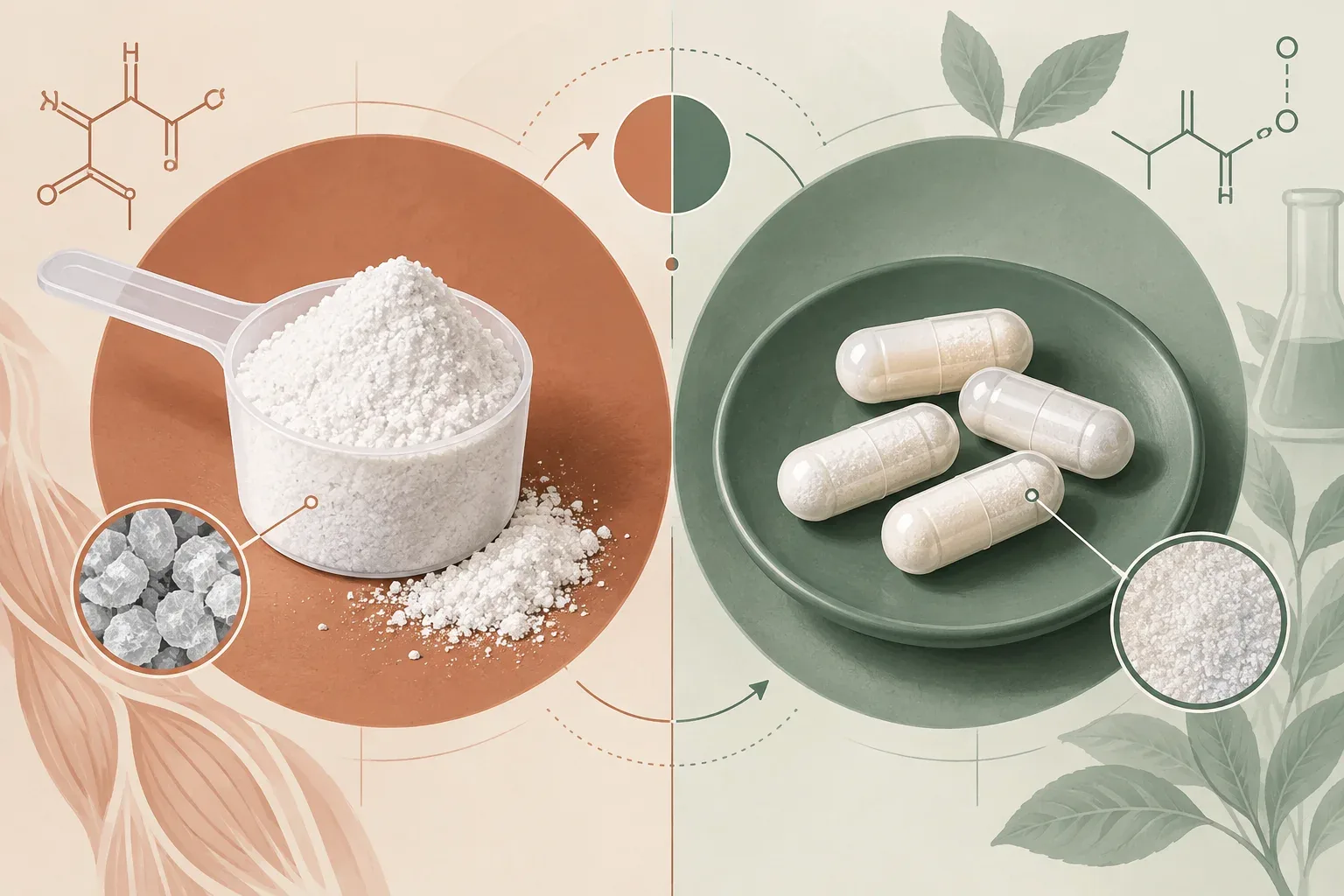
If powder suits you, it avoids the need to chew several gummies or swallow several tablets. If you want something portable without mixing, tablets offer another option. Their dry format avoids the moisture-related formulation questions discussed for gummies, though swallowing several tablets may be less convenient for you.
For the wider evidence on creatine and its use, see our creatine guide or the monohydrate-versus-HCl comparison to read more about the chemical forms of creatine. The NSF Certified for Sport guide explains how to check the certification.
The bottom line
We still do not know enough to give all creatine gummies one verdict. Gummies are a newer mainstream option with much less published research than creatine powder. The limited trial and stability findings show that some formulations can work and retain creatine, but cannot tell us how every brand or batch will perform after storage.
A hypothetical 5% loss would reduce 5 g to 4.75 g, a difference of 0.25 g. The twelve-month example above belongs to one manufacturer’s preparation and test conditions; it does not establish the age or loss rate of another package.
Would you notice that in your training? A 5% reduction in creatine content does not establish a 5% reduction in benefit.
The clearer difference is cost. At the same prorated yearly quantity benchmark, the Create example costs about $676 per year, compared with $201 for the powder—roughly 3.4 times as much, or $475 extra each year. The other gummy example is about 2.5 times the powder's cost. Whether that convenience is worth paying for depends on how much you value the convenience of a chewable format and whether it makes the routine easier to keep. Tablets offer another portable option if you would rather avoid mixing powder.
Help us improve this article
Spotted an error or found a source we should consider? Tell us which part of this article needs another look and include a link if you have one. Please leave out personal health details and lab results; we can’t answer individual medical questions.
More about creatine

Explore more in exercise & muscle


More in compounds




References
- research on creatine stability ↩
- internal manufacturer trial published by Swoleys ↩
- patent's gummy-like formulation ↩
- Pereira and colleagues, 2026 ↩
- NSF Certified for Sport directory ↩
- linked product label ↩
- NSF Certified for Sport ↩
- Create at Walmart ↩
- SWOLY ↩
- Creatine5000 tablets ↩
- the 100 g powder option ↩
Corrections & updates
- Update
Updated the evidence discussion and practical guidance after editorial review.
- Update
Revised the article after editorial review, with clearer evidence explanations and practical guidance.