
What is lysine?
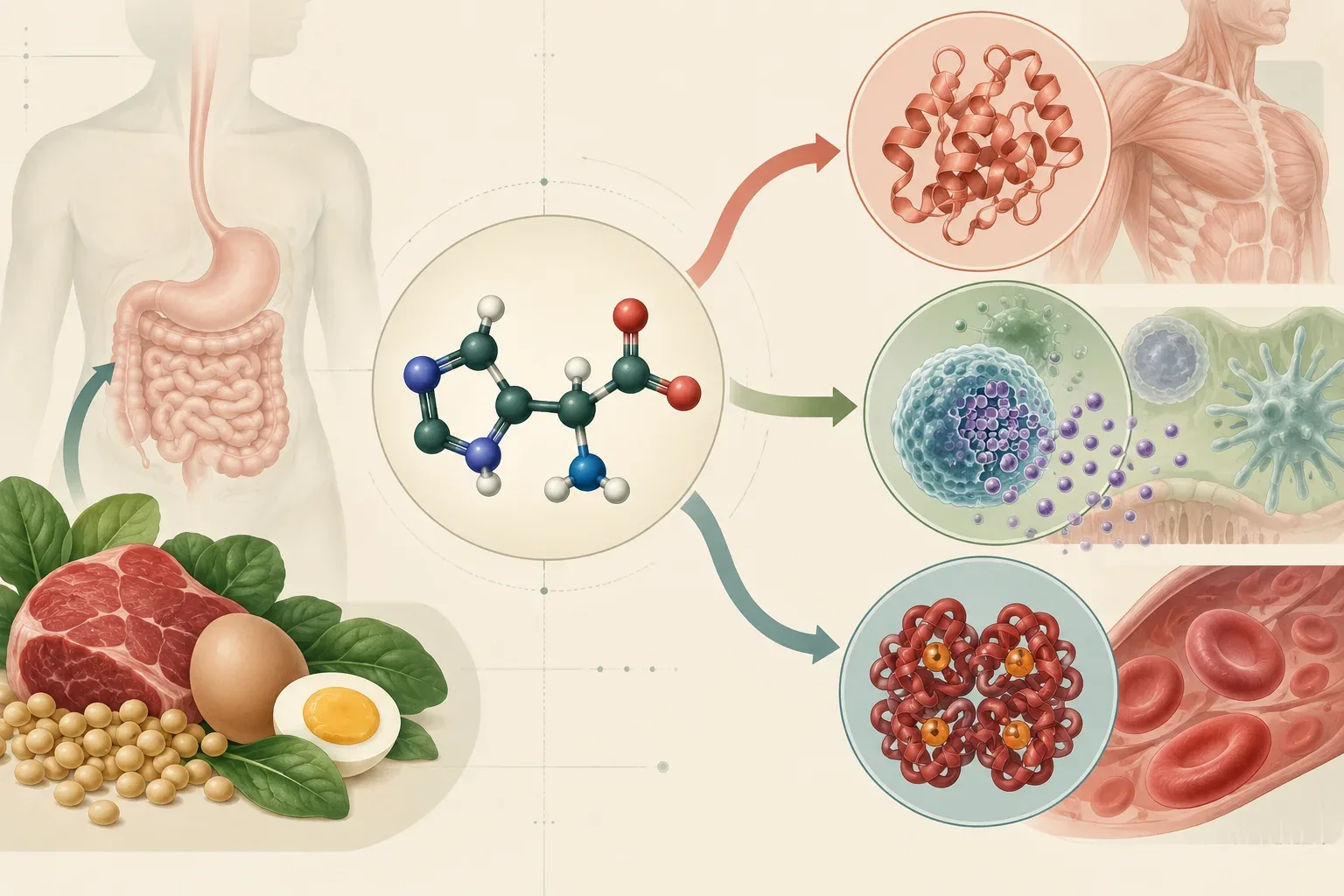
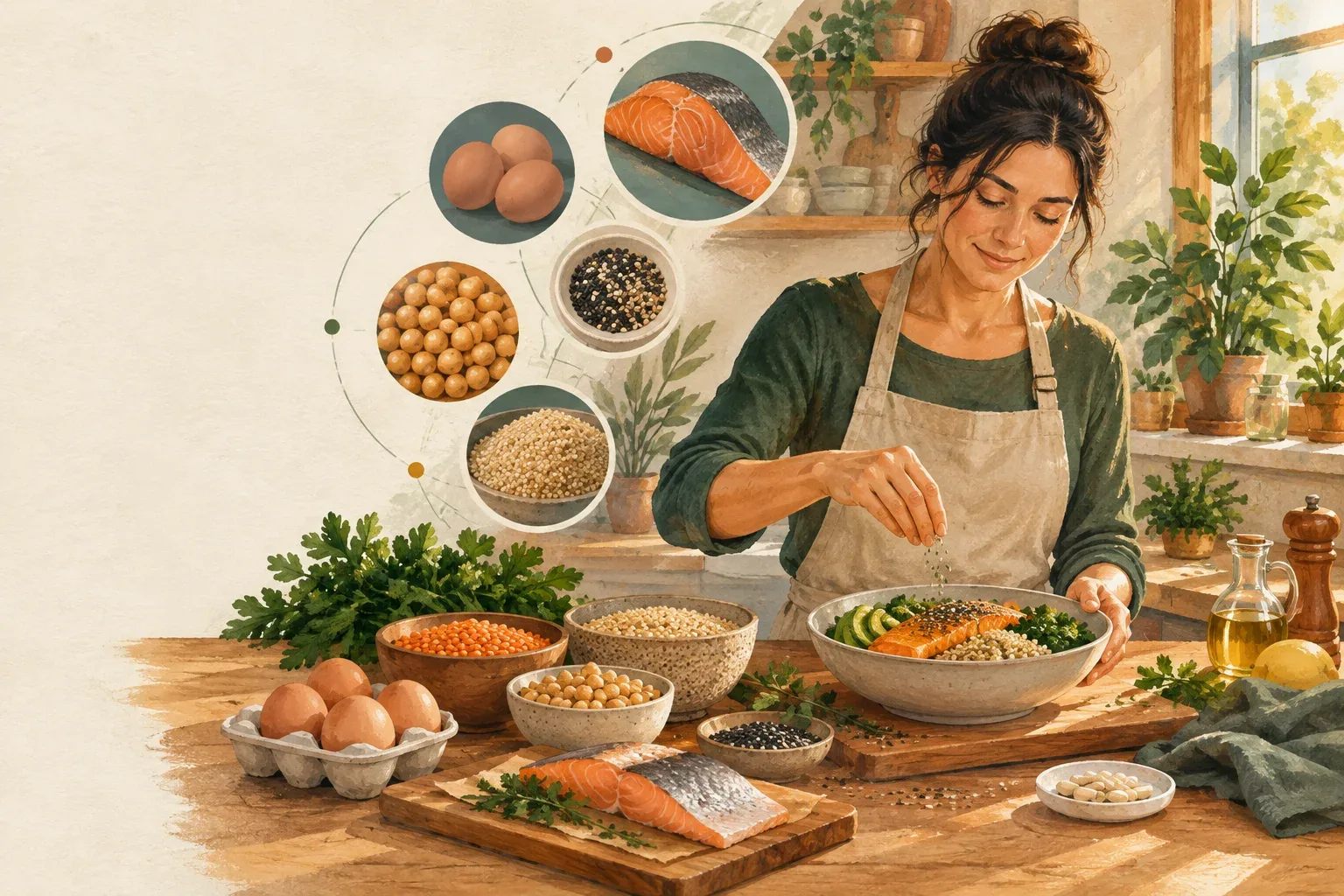
Lysine is one of the nine essential amino acids, meaning the body has to get it from food. It helps build proteins and is also used to make carnitine, which helps the body use fats for energy, and maintain collagen, a structural protein in skin and other tissues. Meat, fish, dairy, eggs, beans, and lentils are useful sources; grains tend to contain less.
L-lysine supplements are sold mainly for cold sores. The proposed explanation involves competition with arginine, another amino acid involved in viral replication. One small trial at 3 g a day was positive, another at 1.2 g was not, and a Cochrane review found no evidence that lysine prevents cold sores.
What lysine does in your body
Lysine is incorporated into proteins as the body builds and repairs tissues. In collagen, modified lysine helps form links between protein chains that give connective tissue strength.
The body also uses material from lysine to make carnitine, which helps move fats into the parts of cells that release their energy. These different roles all begin with an adequate amino-acid supply from food.
What people take lysine for
| Claimed benefit | Dose / form studied | Research verdict | Evidence strength |
|---|---|---|---|
| Reduce anxiety symptoms | Lysine plus arginine for 7–10 days; not isolated lysine | A short trial favored the combination on anxiety scores; hormone responses differed by context | Review pending |
| Prevent cold sores | 1 g three times daily for 6 months in 52 completers; a separate 1.2 g/day trial in 21 people was negative | Small trials disagree; Cochrane found no evidence of efficacy | Limited |
“Review pending” means we have not finished assessing the research. The anxiety studies described here are short, and the capsule trials tested lysine together with arginine.
Most people do not need a lysine supplement because ordinary protein-rich foods cover the requirement. There is no general supplement starting amount. Someone eating very little protein, or relying heavily on grains with few beans, dairy products, eggs, fish, or meat, should correct that broader food gap rather than assume a cold-sore supplement is the answer.
When to ask a doctor before taking lysine
- You get frequent or severe cold sores, or are unsure the lesion is a cold sore. A clinician can diagnose it and discuss antiviral treatment.
- You have heart or gallbladder disease. A cold-sore review raised a theoretical concern about lysine’s interaction with arginine, which supports blood-vessel function. This was a precaution, not a measured increase in heart or gallbladder harm.
Which foods supply lysine?
Amounts below are in grams (g); 1 g is 1,000 milligrams (mg). These ordinary foods contain lysine as part of their protein. The amounts are calculated from the USDA FoodData Central SR Legacy records[1] for the stated edible portions and rounded to 0.01 g.
| Food and preparation | Source | Serving | Lysine (g) |
|---|---|---|---|
| [2] | Meat | 3 oz (about 85 g) | 2.24 |
| [3] | Fish | 3 oz (about 85 g) | 2.19 |
| [4] | Meat | 3 oz (about 85 g) | 1.78 |
| [5] | Plant | 1 cup (about 198 g) | 1.25 |
| [6] | Plant | ½ cup (about 126 g) | 1.11 |
| [7] | Dairy | 1 cup (about 244 g) | 0.64 |
| [8] | Egg | 1 large (about 50 g) | 0.45 |
| [9] | Plant | 1 oz (about 28 g) | 0.35 |
| [10] | Plant | 1 oz (about 28 g) | 0.16 |
On a vegan diet built mostly around grains, nuts and small portions of protein foods, lysine can be the amino acid most worth checking. The table shows why the food choices matter: a cup of lentils or half cup of tofu supplies roughly 1.1–1.3 g lysine, while an ounce of almonds supplies 0.16 g. Plant foods still supply lysine; the question is whether your full day includes enough legume, soy or other lysine-rich protein to meet your needs.
How can I tell if I'm low on lysine?
There is no routine blood test used to decide whether a healthy person needs a lysine supplement. The practical check is dietary intake: record a few typical days and look for regular servings of beans, lentils, dairy products, eggs, fish, or meat. Adults need 38 milligrams per kilogram (mg/kg) of body weight a day—about 2.7 g at 154 lb (70 kg). A very limited diet is a reason to review the whole protein pattern with a clinician or registered dietitian, not to diagnose a lysine deficiency from symptoms.
What you can buy
Lysine is sold as tablets, capsules, and powder, and the table shows the common listings.
| Listing | Lysine per serving on the label | Notes |
|---|---|---|
| Tablets or capsules | 500 mg | Check whether directions are once, twice, or three times daily |
| Capsules | 1,000 mg | Some labels allow one or two capsules per dose |
| Two-capsule servings | 1,000 mg per two capsules | 500 mg each |
| Powder | One label lists about 435 mg per quarter teaspoon | Use your product’s serving information; powders can differ |
Use the table to compare the amount of lysine actually declared per serving, not to recreate the positive trial. A 500 mg serving, a 1,000 mg two-capsule serving, and 3 g a day in one old trial are different exposures.
What to pay attention to on the label
Which number on the label is the amount?
Find the L-lysine line on the Supplement Facts panel and read the amount per serving, then check how many capsules make that serving. Most products use lysine hydrochloride. U.S. facts panels generally declare the lysine amount, but if a label gives only the weight of the full hydrochloride compound, lysine is about 80% of that weight: 1,000 mg of lysine hydrochloride contains roughly 800 mg of lysine.
Misleading labels
Two label patterns deserve a second look:
- A 500 mg daily serving promoted with the positive 3 g trial is not the amount that was studied.
- A title may say “L-Lysine 1000 mg” even when two 500 mg capsules make the serving.
Manufacturer claims and the studies they may be based on
“Supports lip health” or “immune support for the lips” may echo the positive 1987 trial or a 1983 user survey. The survey had no comparison group, so it cannot show that lysine prevented an outbreak. The European Food Safety Authority also found the immune-defence claim unsubstantiated: the controlled herpes trial did not measure the relevant immune changes.
Common Myths about Lysine
Does a survey showing 84% success prove it works?
No. In 1983, 1,543 lysine users answered a mailed questionnaire and 84% said it helped. With no randomly assigned comparison group, the survey cannot separate lysine from normal changes in outbreaks.
Does lysine calm anxiety?
Unclear. Two short capsule studies combined lysine with arginine; a separate food-fortification trial studied lysine alone in a population whose wheat-based diet was low in lysine. One study of 108 healthy adults used the pair for a week and reported lower anxiety scores; another study of 29 adults used them for 10 days and found higher stress hormones during public speaking. Their short durations and different measurements do not show that lysine alone treats anxiety.
Drawbacks and side effects
| Potential drawback | When/who it affects | Research evidence | Practical implication |
|---|---|---|---|
| Nausea, stomachache or diarrhea | Supplement users across varied amounts and courses | Gut symptoms were the main events in a 71-study safety review | Stomach symptoms were the main reported adverse effects. |
| Uncertain condition-specific risk | Heart or gallbladder disease; pregnancy or breastfeeding | Cold-sore review raised theoretical cautions; pregnancy safety data are absent | Discuss these contexts with a clinician. |
Understanding these risks
The evidence does not define a long-term safe ceiling. A 2019 review of 71 human studies, covering 3,357 people and amounts from 16.8 mg to 17.5 g a day over one day to three years, found nausea, stomachache, and diarrhea were the main reported problems. It proposed 6 g a day as a no-observed-adverse-effect level for gastrointestinal symptoms, but that is not an official upper limit or a recommended intake. The International Council on Amino Acid Science funded the safety review; its authors declared no conflicts. A separate cold-sore review[11] based its caution on arginine’s roles in blood-vessel function and other body processes, alongside the proposed lysine–arginine competition. Its risk paragraph does not explain a separate gallbladder mechanism or give a numerical risk for these conditions.
The science behind lysine
Cold sores
The idea behind taking extra lysine for cold sores is that it might compete with arginine, an amino acid involved in viral replication. This is a proposed supplement effect, separate from lysine's established role in making protein. It needs clinical outbreak evidence, rather than a biochemical explanation alone.
The controlled trials are small, old, and point in different directions. In 1987, 52 people with frequent herpes simplex outbreaks completed a six-month double-blind trial of 1 g three times a day or placebo. The trial reported fewer outbreaks, milder symptoms, and faster healing with lysine. In 1984, DiGiovanna and Blank’s double-blind trial in 21 people used 400 mg three times a day and found no meaningful benefit.
A 2017 narrative review argued that amounts below 1 g a day appear ineffective and that amounts around 3 g or more may improve the subjective experience of outbreaks, but it also called for longer controlled trials above 1.2 g a day. A 2015 Cochrane review of 32 randomized prevention trials covering many treatments—not 32 lysine trials— found a modest benefit from long-term oral antivirals and no evidence of efficacy for lysine. For lysine, that conclusion came from the first period of Thein and Hurt’s separate 1984 trial of 1 g/day in which participants switched between lysine and placebo: a difference of −0.04 recurrences per person per month, with a 95% confidence interval from −0.37 to 0.29. The interval includes both fewer and more outbreaks. The review did not directly test the positive 3 g regimen.
Thein and Hurt’s trial[12] followed 26 completers taking 1 g/day and placebo in separate six-month periods. It reported a favorable pattern of recurrences with lysine, especially in an analysis related to blood lysine levels. However, there was no treatment-free interval between the periods; the Cochrane reviewers used the first period rather than treating the whole crossover as a clean comparison.
The older trials enrolled recurrent herpes simplex patients with differing outbreak sites, rather than one uniform group with lip cold sores. These design and population differences help explain why positive individual reports do not automatically become reliable evidence for cold-sore prevention. Comparing a positive 3 g trial with a negative 1.2 g trial is not a randomized dose-response experiment.
Anxiety: lysine with arginine
The main anxiety experiments tested a combination, which matters when assessing a bottle containing only lysine. In a 2007 randomized trial[13], 108 healthy Japanese adults were assigned to placebo or a mixture described in the methods as 2.64 g lysine hydrochloride plus 2.64 g arginine daily for one week; 104 completed the analysis. Participants did not have diagnosed psychiatric disorders.
After treatment, scores reflecting a general tendency toward anxiety were lower with the mixture than placebo. Ratings of anxiety during a laboratory stress task also favored the mixture. These short-term score changes do not establish treatment of an anxiety disorder. Resting cortisol, a hormone involved in the body’s stress response[14], fell in men, but not women, and the result was not a general reduction of every stress-hormone measurement. All authors were affiliated with Ajinomoto, which supplied the amino acids. No treatment-related side effects or withdrawals were reported over that week.
An earlier trial in 29 adults with high trait anxiety[15] used 3 g of each amino acid daily for ten days. Some hormone responses to public-speaking stress increased rather than decreased. A cortisol rise during a stress task and a lower resting anxiety score are different outcomes; neither can be reduced to a claim that lysine always lowers cortisol. These short combination studies provide a research lead for anxiety, but do not establish isolated lysine as an anxiety treatment.
Lysine-fortified food in a population with low intake
A three-month randomized trial in rural Syria[16] compared ordinary wheat flour with flour fortified with 4.2 g lysine hydrochloride per kilogram. Ninety-three households remained at the end of the study. This addressed a diet heavily dependent on cereals, with low lysine availability, rather than adding capsules to an already adequate diet.
Anxiety scores improved in men, with the effect concentrated among those starting with higher anxiety; women’s anxiety scores did not improve. Stress responses also differed by sex: cortisol responses to blood sampling decreased in women, while a skin-conductance measure decreased in men. This test records changes in how readily the skin conducts electricity as sweating changes during stress; the researchers used it as a measure of nervous-system arousal. The household total is not the denominator for each test; the male anxiety comparison included 42 men measured before and after fortification. Ajinomoto Co., Inc. provided financial support. The result suggests that correcting low dietary lysine can matter in that setting, but does not establish isolated lysine capsules as treatment for an anxiety disorder.
The bottom line
Most adults can meet their lysine needs through food. The conflicting cold-sore findings do not support buying lysine for dependable prevention. If outbreaks are frequent or troublesome, ask a clinician about proven antiviral prevention.
Help us improve this article
Spotted an error or found a source we should consider? Tell us which part of this article needs another look and include a link if you have one. Please leave out personal health details and lab results; we can’t answer individual medical questions.
Explore more in immunity & colds




More in compounds


References
- USDA FoodData Central SR Legacy records ↩
- Chicken breast, roasted ↩
- Sockeye salmon, cooked ↩
- Ground beef patty, 90% lean, cooked ↩
- Lentils, boiled ↩
- Firm tofu, calcium-set, raw ↩
- Whole milk ↩
- Egg, hard-boiled ↩
- Pumpkin seed kernels, dried ↩
- Almonds ↩
- separate cold-sore review ↩
- Thein and Hurt: lysine in recurrent herpes simplex, 1984 ↩
- Smriga et al.: L-lysine and L-arginine, anxiety, and cortisol in healthy adults, 2007 ↩
- cortisol, a hormone involved in the body’s stress response ↩
- earlier trial in 29 adults with high trait anxiety ↩
- three-month randomized trial in rural Syria ↩
- EFSA: L-lysine health-claim opinion, 2011
- National Academies: Dietary Reference Intakes for energy, carbohydrate, fiber, fat, fatty acids, cholesterol, protein, and amino acids, 2005
- National Academies: adult amino-acid requirements, Essential Guide (2006), Appendix E, pp. 463–464
- Griffith et al.: L-lysine therapy in frequently recurrent herpes simplex, 1987
- DiGiovanna and Blank: failure of lysine in frequently recurrent herpes simplex, 1984
- Chi et al.: interventions for prevention of herpes simplex labialis, Cochrane review, 2015
- Mailoo and Rampes: lysine for herpes simplex prophylaxis, review, 2017
- Walsh et al.: subjective response to lysine in herpes simplex, survey, 1983
- Hayamizu et al.: safety assessment of L-lysine oral intake, systematic review, 2019
- Jezova et al.: L-lysine and L-arginine and the stress response, 2005
- NIH Dietary Supplement Label Database: a 500 mg L-lysine tablet label
- NIH Dietary Supplement Label Database: an "L-Lysine 1000 mg" two-capsule label
- NIH Dietary Supplement Label Database: a 1 g L-lysine capsule label
- NIH Dietary Supplement Label Database: an L-lysine powder label
Corrections & updates
- Update
Updated the evidence discussion and practical guidance after editorial review.