
What is phenylalanine?
Phenylalanine is one of the nine essential amino acids, meaning the body has to get it from food. Protein foods supply the L form, and the sweetener aspartame is another source. The body uses L-phenylalanine to make protein.
Supplements sell L-phenylalanine and a half-L, half-D mixture called DL-phenylalanine or DLPA. People buy them for mood, pain, alertness, appetite control or vitiligo, a condition that causes patches of skin to lose pigment. The treatment trials are old, small or unable to isolate phenylalanine's effect; the appetite experiments measured short-term food intake rather than weight loss. People with phenylketonuria (PKU) cannot process phenylalanine normally and must not use these supplements.
What phenylalanine does in your body
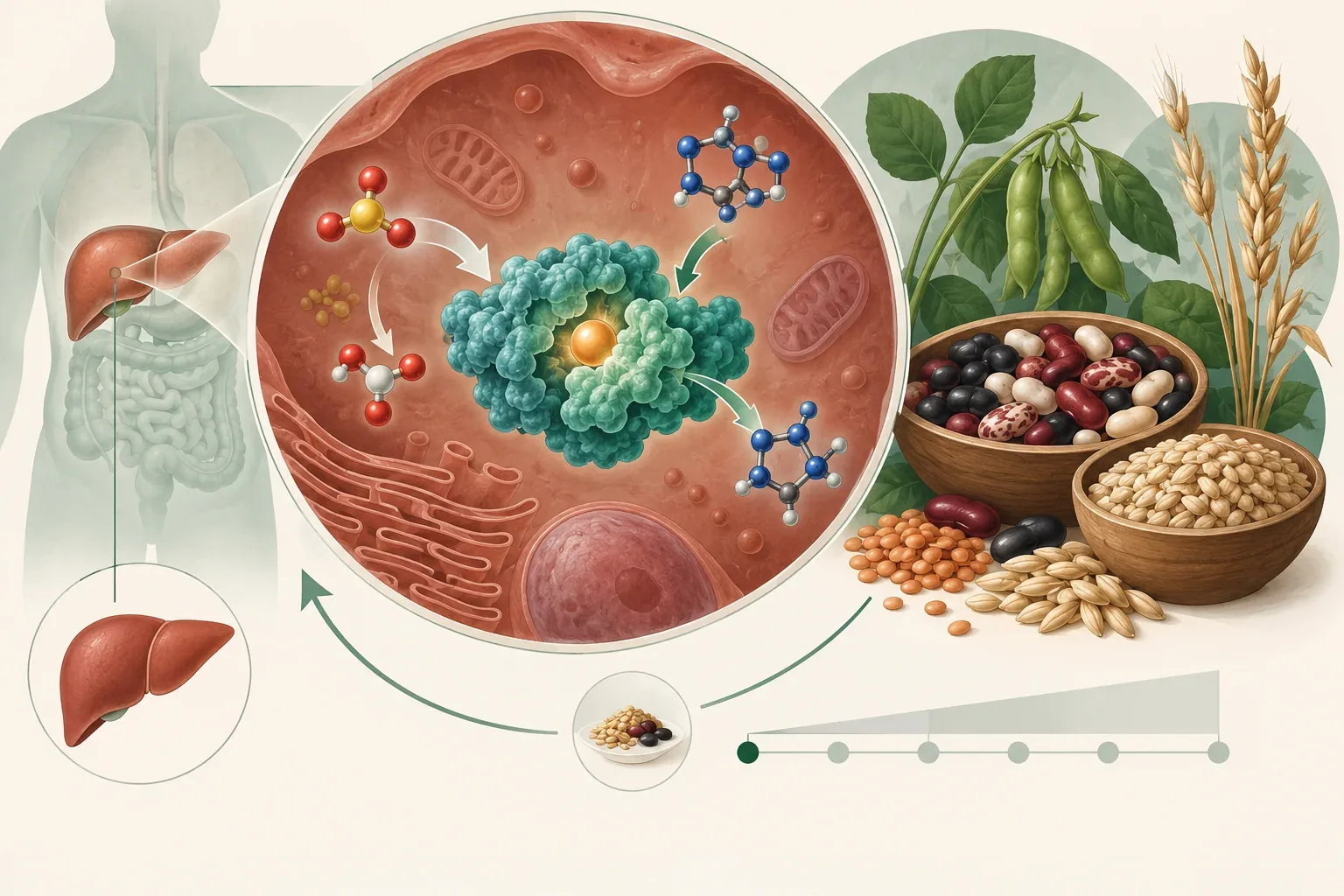
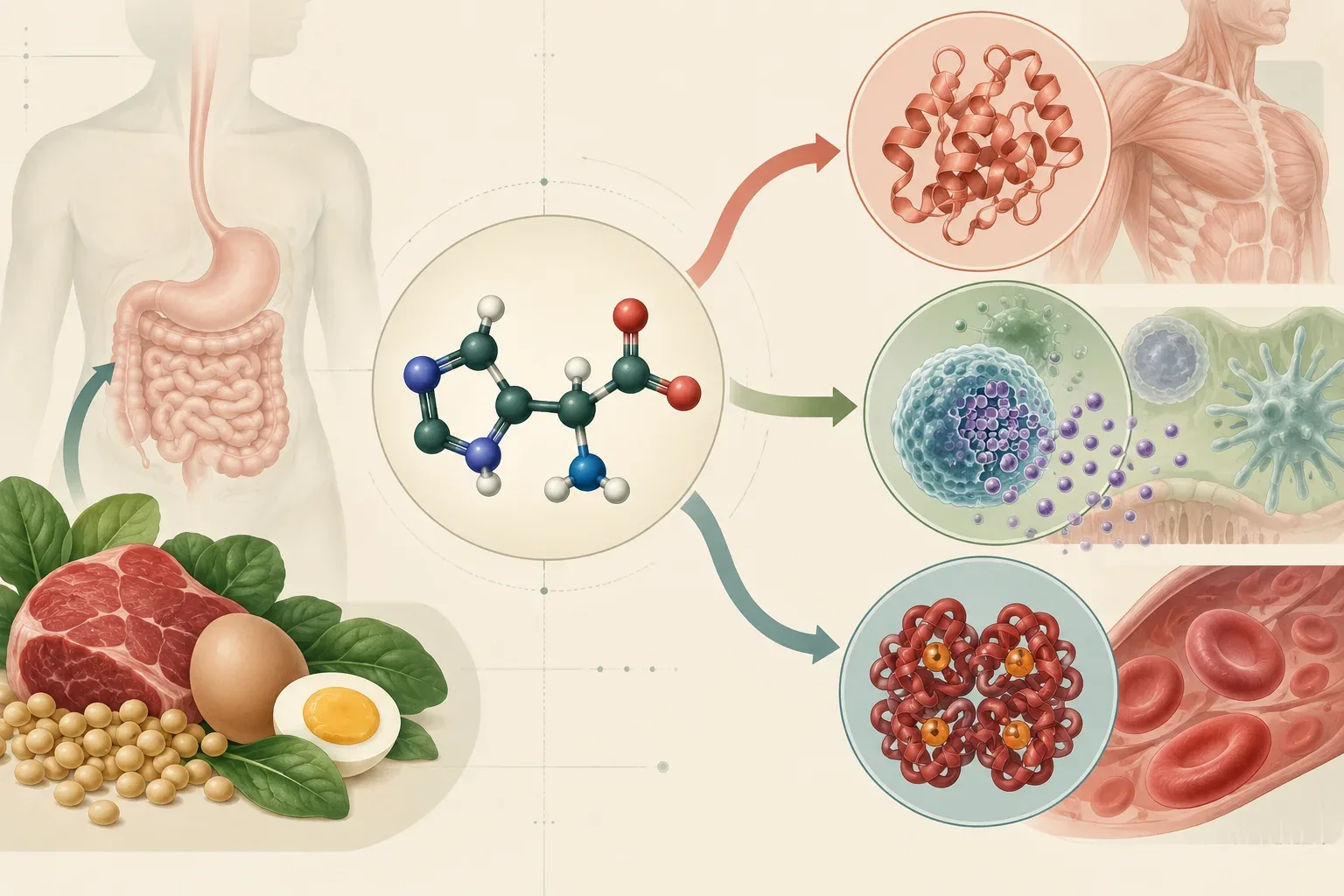
The body incorporates L-phenylalanine into proteins and converts some into tyrosine. Tyrosine can then supply material for chemical messengers such as dopamine and norepinephrine, as well as for other substances. Each conversion is regulated.
Phenylalanine handling is especially important in phenylketonuria, or PKU. In that inherited condition, the usual conversion is impaired and phenylalanine can accumulate to harmful levels.
The D form and mixed DL supplements are different exposures from the L form used in ordinary protein. D-phenylalanine has been studied separately for proposed pain effects. [1]
The short version
Unit: milligrams (mg) of L-phenylalanine or DL-phenylalanine.
Reasonable start: there is no evidence-based supplement starting amount. Protein-rich foods normally cover the combined phenylalanine-and-tyrosine requirement.
Typical listings: L-phenylalanine capsules or powder, and DLPA capsules, tablets or powder. The label comparison below shows their amounts.
Skip: every phenylalanine or DLPA supplement if you have PKU. For other buyers, matching a product to a study does not establish benefit: the pain trial was negative, the mood comparison lacked placebo, and the skin studies combined treatments.
What people take phenylalanine for
| Claimed benefit | Dose / form studied | Research verdict | Evidence strength |
|---|---|---|---|
| Reduce food intake at one meal | 5 or 10 g L-phenylalanine delivered into the stomach; 16 healthy men in the 2020 experiment | Less food at the next meal with 10 g; 5 g did not show a clear effect | Review pending |
| Reduce food intake across a test day | 5 or 10 g L-phenylalanine before each of two meals; 32 women in the 2008 experiment | No overall reduction; neither experiment tested sustained weight loss | Review pending |
| Relieve chronic pain | D-phenylalanine 250 mg four times daily for 4 weeks per crossover period; 30 patients | No significant pain benefit over placebo | Limited |
| Treat depression | DL-phenylalanine 150–200 mg/day for 30 days; small comparison with imipramine | No placebo group, so an antidepressant effect was not established | Insufficient |
| Restore skin color in vitiligo | L-phenylalanine 50–100 mg/kg/day with UVA or other treatments; courses varied under medical care | Combination studies cannot isolate the supplement’s contribution | Insufficient |
“Review pending” for appetite means we have not finished assessing the research. The two rows describe brief experiments in different populations; neither tested sustained weight loss.
Most people do not need phenylalanine pills because protein-rich foods cover the requirement and the supplement claims rest on weak evidence. People with PKU must avoid them because phenylalanine can build to brain-damaging levels. Someone considering phenylalanine for vitiligo should discuss it with a dermatologist: the studies paired it with ultraviolet A (UVA) light, sunlight, topical phenylalanine, or a steroid cream rather than testing a capsule by itself.
When to ask a doctor before taking phenylalanine
- You have PKU. Do not take phenylalanine supplements; your specialist sets how much phenylalanine you get from food. US law requires foods with aspartame to say "PHENYLKETONURICS: CONTAINS PHENYLALANINE."
- You take levodopa for Parkinson's disease. Large neutral amino acids, including phenylalanine, compete with levodopa for transport into the brain; ask the prescriber before changing supplemental intake.
- You have schizophrenia, tardive dyskinesia (an involuntary-movement disorder), or take an antipsychotic. Small challenge studies in psychiatric patients linked high test amounts with abnormal-movement responses; those studies do not define a safe supplement amount.
- You take an antidepressant. We found no controlled study of phenylalanine added to an antidepressant, so ask the prescriber.
- You plan to treat vitiligo with it. The studies paired it with UVA light or sunlight and other treatments.
- You are pregnant or breastfeeding. We found no safety data on phenylalanine pills during these periods; do not add one without clinical guidance. Pregnancy with PKU requires specialist-directed phenylalanine control.
Common dosage
These numbers answer different questions and are not interchangeable.
| Amount | Form and purpose | What it does not establish |
|---|---|---|
| 33 milligrams per kilogram (mg/kg) a day from food | National Academies adult requirement for phenylalanine plus tyrosine; about 2.3 g total at 70 kg | A phenylalanine-pill target |
| 400 mg to 1 g per serving | Common DLPA labels; only half is L-phenylalanine | Benefit for pain or mood |
L-phenylalanine labels commonly suggest 500 mg once to three times a day, while some DLPA labels reach 2 g a day. These are retail directions, not official requirements or proven treatment doses. No trial established a best time of day.
Which foods supply phenylalanine?
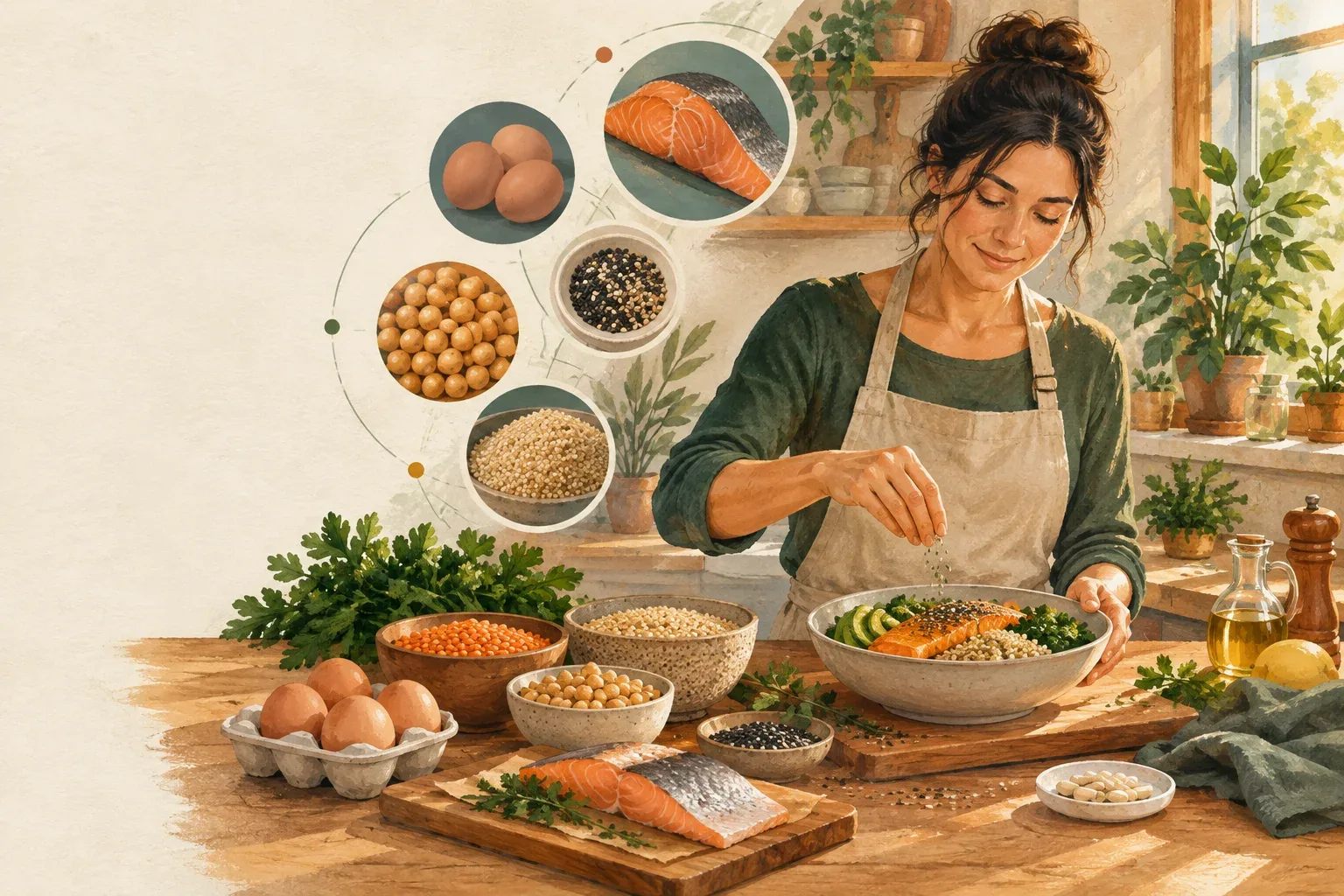
These ordinary foods contain phenylalanine as part of their protein. The amounts are calculated from the USDA FoodData Central SR Legacy records[2] for the stated edible portions and rounded to 0.01 g.
| Food and preparation | Source | Serving | Phenylalanine (g) |
|---|---|---|---|
| [3] | Plant | ½ cup (about 126 g) | 1.05 |
| [4] | Meat | 3 oz (about 85 g) | 1.05 |
| [5] | Fish | 3 oz (about 85 g) | 0.92 |
| [6] | Plant | 1 cup (about 198 g) | 0.88 |
| [7] | Meat | 3 oz (about 85 g) | 0.84 |
| [8] | Plant | 1 oz (about 28 g) | 0.49 |
| [9] | Dairy | 1 cup (about 244 g) | 0.40 |
| [10] | Egg | 1 large (about 50 g) | 0.33 |
| [11] | Plant | 1 oz (about 28 g) | 0.32 |
A food's amino-acid content can vary by product and preparation.
How can I tell if I'm low on phenylalanine?
There is no routine test used to decide whether a healthy adult needs a phenylalanine supplement. For a rough screen of usual protein intake, record a few typical days and look for foods such as dairy products, eggs, fish, meat, beans, soy, or mixed plant proteins. If several days contain little protein or the diet is highly restricted, review overall protein and nutrition with a clinician or registered dietitian.
What the test measures
Newborn screening for PKU looks for impaired phenylalanine handling and high levels, not a supplement deficiency.
What you can buy
Phenylalanine is sold as L-phenylalanine and as DLPA. DLPA is half L-phenylalanine and half D-phenylalanine, a mirror-image form the body does not use to build protein. The table shows the common listings.
| Listing | Per serving on the label | L-phenylalanine per serving |
|---|---|---|
| L-phenylalanine capsules | 500 mg | 500 mg |
| L-phenylalanine powder | 500 mg | 500 mg |
| DLPA capsules or tablets | 1,000 mg per two capsules or tablets | About 500 mg |
| DLPA powder | 400 mg | About 200 mg |
What to pay attention to on the label
Which number on the label is the amount?
Find the phenylalanine line on the Supplement Facts panel, check whether it says L-phenylalanine or DL-phenylalanine, and note how many capsules make a serving. Only the L half of DLPA is used to build protein, so 1 g of a true 50:50 DLPA mixture contains about 500 mg of L-phenylalanine.
Misleading labels
DLPA sold for pain
If you're considering buying DLPA for pain, know that the one placebo-controlled trial tested D-phenylalanine, the half of DLPA thought to work on pain, and found no benefit.
Labels that just say "phenylalanine"
One DLPA product's facts panel lists "phenylalanine 1,000 mg" per two capsules, while the product name says DL. Check the name and the panel together to know which form you are getting.
Confusing servings and items per serving
That same product lists 1,000 mg per serving of two capsules and suggests two servings a day, so the daily total is 2 g, not the 1,000 mg on the panel.
Drawbacks and side effects
| Potential drawback | When/who it affects | Research evidence | Practical implication |
|---|---|---|---|
| Harm from phenylalanine accumulation | People with phenylketonuria (PKU) | The underlying disorder requires phenylalanine restriction | Do not add phenylalanine outside the specialist diet plan |
| Interference with levodopa treatment | People taking levodopa | Competition for transport can matter for treatment | Ask the prescriber before adding an amino-acid supplement |
| Uncertain long-term safety | High-dose or prolonged use; pregnancy | No official upper limit; limited reports cannot establish broad safety | Do not treat a high-dose combination study as a safe daily target |
Safety details
People with PKU face the decisive hazard: phenylalanine can build to levels that harm the brain, which is why specialist-directed restriction begins early and continues for life. For people without PKU, reliable side-effect rates and a long-term safe maximum have not been established. The small benefit studies do not supply enough symptom or duration data to fill that gap. One uncontrolled vitiligo study at 100 mg/kg a day reported no blood-test abnormalities, but that narrow observation cannot define general safety.
The science behind phenylalanine
Pain: no clear benefit in the controlled chronic-pain trial
D-phenylalanine was proposed as a pain reliever because animal work suggested it might slow the breakdown of enkephalins, compounds involved in the body's pain control. In a 1986 trial with treatment identity concealed from participants and researchers, 30 people with chronic pain that had not responded to other treatments took 250 mg four times a day and placebo for four weeks each. On one questionnaire, 25% reported more relief with D-phenylalanine, 22% with placebo, and 53% no difference; on a scale where participants marked their pain intensity along a line, 47% favored D-phenylalanine and 53% placebo. The investigators found no significant overall pain-relieving effect in this chronic-pain trial.
Other pain experiments do not resolve the clinical question
An eight-volunteer experiment[12] reported less pressure-related pain during a tourniquet test with D-phenylalanine, while pain from restricted blood flow did not improve significantly. That laboratory response differs from treating ongoing pain. A nine-patient terminal-cancer series[13] reported relief in seven people receiving D-phenylalanine 250 mg three times daily in 15-day courses separated by ten-day pauses. Patients already had other pain treatments, and there was no control group. The observation cannot establish what D-phenylalanine added.
In a 14-day study of sixty healthy women[14], 2 g/day phenylalanine did not improve tolerance of experimentally induced burning pain compared with the other study groups, including placebo. The abstract does not identify whether the phenylalanine was L, D or DL. It therefore cannot answer the isolated L-form question. The small positive reports and the study with an unidentified form do not resolve the lack of a clear benefit in the controlled D-phenylalanine chronic-pain trial.
Mood: the controlled comparison lacked placebo
In a 1979 trial, 40 people with depression took DLPA or the antidepressant imipramine, each at 150 to 200 mg a day, for 30 days; 27 finished. The available abstract reports no significant difference between groups and says imipramine eased anxiety faster, but does not give the depression-score means. Without placebo, the study cannot separate a DLPA effect from time, attention, dropout, or expectation; the nonsignificant comparison does not establish equal benefit.
Older mood reports used different forms and combinations
A 1986 report[15] described mood improvement in 31 of forty depressed patients given L-phenylalanine, but its abstract does not supply a controlled treatment comparison, dose or course. A 155-patient report[16] combined 250 mg/day L-phenylalanine with 5–10 mg/day deprenyl, an MAO-inhibiting drug. The high response proportions reported for that combination cannot identify the amino acid's contribution.
An earlier 23-person report[17] used D- or DL-phenylalanine, 50 or 100 mg/day for fifteen days, after unsuccessful antidepressant treatment. It described improvement without a placebo comparison. A small adult-attention-disorder study[18] initially found a mood signal with DL-phenylalanine, but responders lost the benefit during open follow-up; a later open L-form trial showed no clinical effect. These are preliminary reports in different populations and forms, not dependable evidence for an L-phenylalanine antidepressant dose.
Vitiligo: studies combined phenylalanine with other treatments
Vitiligo studies used L-phenylalanine with light rather than testing it alone. A 1994 report described a 149-person study where treatment was known and a 32-person study where treatment identity was concealed. Both combined oral L-phenylalanine with UVA. The maximum reported share of affected skin that regained pigment was 77% in the first study and 60% in the second study; the abstract did not say how many people reached those maxima. Increasing the phenylalanine amount raised blood levels but did not improve clinical repigmentation, and the authors judged the best amount to be below 50 mg/kg a day. In 2002, an uncontrolled 70-person study combined oral and topical phenylalanine, sunlight or UVA, and a steroid cream. With several treatments and no untreated comparison group, phenylalanine's contribution cannot be isolated.
An earlier four-month series[19] likewise combined 50 mg/kg oral phenylalanine with timed UVA exposure over 32 treatments.
Appetite: a short-term meal effect is not weight loss
In a 2020 crossover experiment[20], 16 healthy men received 5 g or 10 g L-phenylalanine or control directly into the stomach through a tube on separate visits. At a buffet 30 minutes later, the 10 g condition reduced intake by about 184 calories, or 17%, compared with control. The 5 g condition did not show a statistically clear reduction. There was no excess nausea in that experiment.
An earlier crossover study in 32 women with overweight or obesity[21] found no overall reduction in food intake after oral phenylalanine before lunch and dinner. Before each meal, the high condition supplied 10 g; the low condition used 5 g plus 5 g glucose; the control was 10 g glucose. A favorable result appeared only in a later subgroup analysis based on questionnaire scores for deliberate control of eating, and 10 g increased nausea ratings.
The trials differ in population, delivery and meal design. Both concern short-term eating under study conditions; neither establishes sustained weight loss, a daily appetite regimen or an appropriate dose for a retail product.
Movement disorders: challenge studies
A 312-patient study[22] gave a single 100 mg/kg phenylalanine challenge to psychiatric patients with and without tardive dyskinesia, involuntary movements associated with some psychiatric medicines. Men with the movement disorder had higher post-challenge phenylalanine measurements than men without it; the same pattern was not found in women.
A placebo-controlled challenge in 25 patients[23] related changes in involuntary movements to starting amino-acid levels and movement severity. It raises a concern about giving a high test amount of phenylalanine to people with these conditions, without defining a safe everyday supplement amount or proving that everyone’s movements worsen. Discuss phenylalanine supplements with the clinician treating a movement disorder.
PKU: mood and attention during increased intake
In a small crossover study[24], nine adults with treated PKU completed four-week periods of extra phenylalanine or placebo alongside their usual restricted diet. Capsules raised total dietary-plus-supplement intake to roughly 2.5–5 g/day according to sex and weight. Overall mood and sustained attention were worse during phenylalanine; participants reported more fatigue and less vigor. The depression subscore alone did not reach statistical significance. This was deliberate loading in people whose metabolism differs from that of the general population.
A 2024 crossover trial[25] recruited thirty early-treated adults with PKU and used 1.5–3 g/day additional phenylalanine for four weeks. Working-memory accuracy met the researchers’ preset test: any disadvantage versus placebo was smaller than a four-percentage-point margin. That does not mean the treatments were identical or that all thinking skills were unaffected. Mood and depression showed no statistically clear difference. Sustained attention was worse with phenylalanine than placebo[26]: performance improved during placebo and worsened slightly during phenylalanine. The authors did not know whether that difference mattered in everyday life. Adverse events were more frequent with phenylalanine. This four-week comparison neither establishes the safety of relaxing a lifelong PKU diet nor cancels the earlier mood finding.
If a specialist orders an amino-acid test
If a specialist orders blood amino-acid testing, ARUP’s plasma amino-acid panel[27] prefers fasting in adults but specifies no supplement-stop interval. Report phenylalanine use and follow the specialist’s dose-timing instructions, especially for prescribed treatment.
The bottom line
Phenylalanine is necessary in dietary protein, but extra L-, D- or DL-phenylalanine has not been established as a useful general treatment for pain or mood. The vitiligo reports combined it with other treatments, leaving its contribution uncertain. For appetite, one experiment found less food eaten at the next meal, while the study in women found no overall reduction; neither establishes sustained weight loss.
We would not choose a form simply because its proposed pathway sounds relevant to a symptom. The forms have different research histories, and their amounts are not interchangeable. For people with PKU, phenylalanine restriction belongs to specialist care.
Help us improve this article
Spotted an error or found a source we should consider? Tell us which part of this article needs another look and include a link if you have one. Please leave out personal health details and lab results; we can’t answer individual medical questions.
Explore more in mood

More in compounds


References
- National Academies: the essential guide to nutrient requirements ↩
- USDA FoodData Central SR Legacy records ↩
- Firm tofu, calcium-set, raw ↩
- Chicken breast, roasted ↩
- Sockeye salmon, cooked ↩
- Lentils, boiled ↩
- Ground beef patty, 90% lean, cooked ↩
- Pumpkin seed kernels, dried ↩
- Whole milk ↩
- Egg, hard-boiled ↩
- Almonds ↩
- eight-volunteer experiment ↩
- nine-patient terminal-cancer series ↩
- 14-day study of sixty healthy women ↩
- 1986 report ↩
- 155-patient report ↩
- 23-person report ↩
- small adult-attention-disorder study ↩
- earlier four-month series ↩
- Fitzgerald et al.: phenylalanine, energy intake and post-meal glucose, 2020 ↩
- Pohle-Krauza et al.: phenylalanine and energy intake in women, 2008 ↩
- 312-patient study ↩
- placebo-controlled challenge in 25 patients ↩
- small crossover study ↩
- 2024 crossover trial ↩
- Sustained attention was worse with phenylalanine than placebo ↩
- ARUP’s plasma amino-acid panel ↩
- National Academies: adult amino-acid requirements, Essential Guide (2006), Appendix E, pp. 463–464
- US Code of Federal Regulations, 21 CFR 172.804: aspartame labeling
- Walsh et al.: D-phenylalanine in chronic pain patients, 1986
- Beckmann et al.: DL-phenylalanine versus imipramine, 1979
- Siddiqui et al.: L-phenylalanine and UVA in vitiligo, 1994
- Camacho and Mazuecos: oral and topical L-phenylalanine with light for vitiligo, 2002
- Nutt et al.: plasma large neutral amino acids and the response to levodopa, 1989
- Richardson et al.: phenylalanine kinetics and tardive dyskinesia, 1999
- Schultz et al.: phenylalanine-induced abnormal movements in schizophrenia, 2001
- NIH Dietary Supplement Label Database: a 500 mg L-phenylalanine capsule label
- NIH Dietary Supplement Label Database: an L-phenylalanine powder label
- NIH Dietary Supplement Label Database: a DL-phenylalanine capsule label
- NIH Dietary Supplement Label Database: a DL-phenylalanine powder label
Corrections & updates
- Update
Updated the evidence discussion and practical guidance after editorial review.