
What is siberian ginseng?
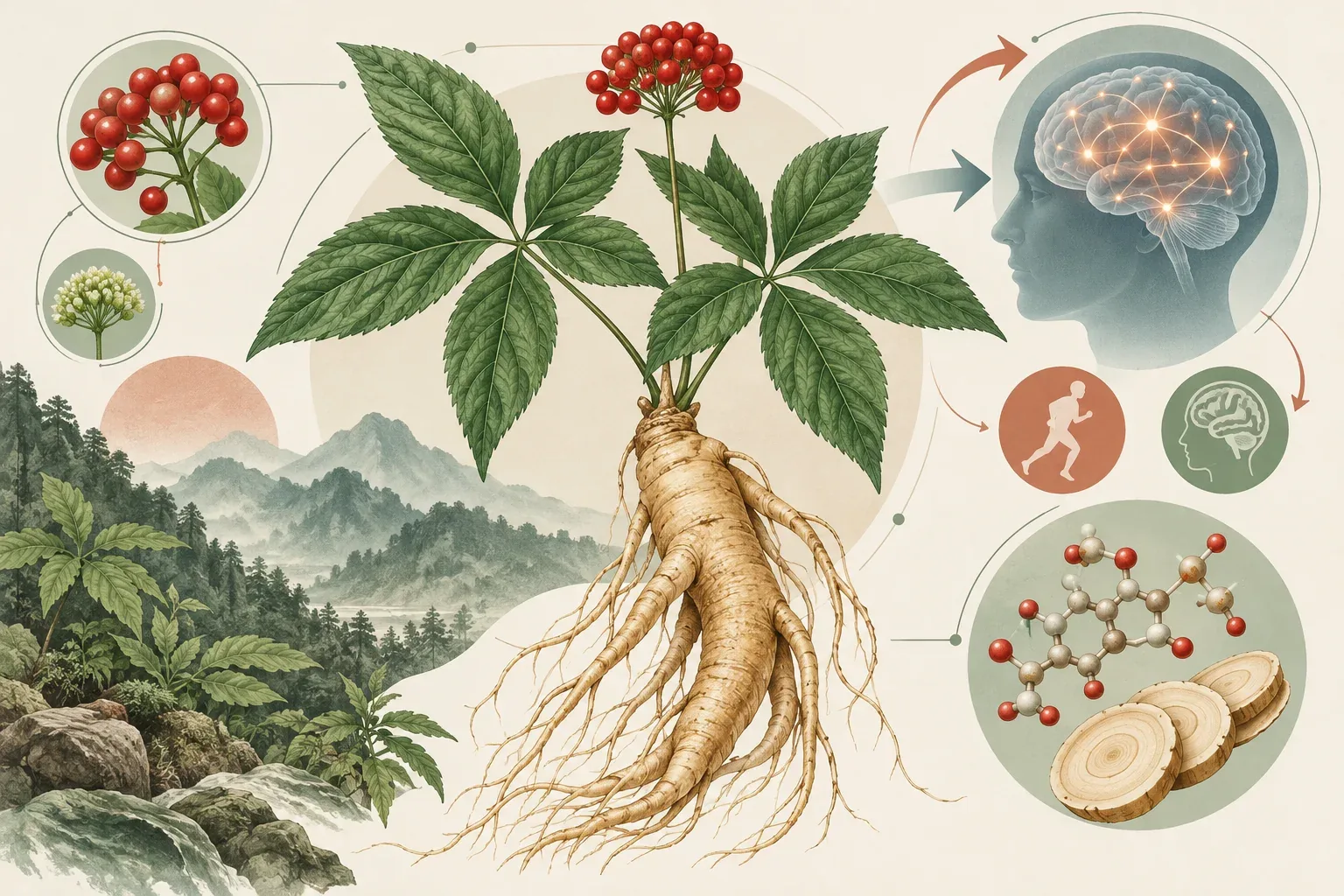
Siberian ginseng, also sold as eleuthero, is the root of Eleutherococcus senticosus. Despite the name, it is not Panax ginseng. The plants belong to different genera, and eleuthero contains marker compounds called eleutherosides rather than the ginsenosides in Panax.
People take eleuthero for tiredness, stress, and stamina. The European Medicines Agency (EMA) permits traditional use for tiredness and weakness because the herb has been used for a long time—not because trials proved that it works. The fatigue trials did not establish a clear lasting benefit. Exercise studies have mixed results, including a positive small trial in trained young men.
Historical uses and modern supplements
The EMA overview[1] describes traditional preparations of dried root as tea, powdered root, and liquid or dry extracts made with water or ethanol. Its traditional-use pathway requires at least 30 years of medicinal use, including 15 within the EU.
“Adaptogen” is a research term for substances proposed to increase resistance to stress. The EMA's reflection paper[2] traces it to Lazarev in 1947 and discusses later stress research. That idea helped shape modern stress and stamina claims.
What people take siberian ginseng for
| Claimed benefit | Dose / form studied | Research verdict | Evidence strength |
|---|---|---|---|
| Persistent unexplained fatigue | Extract 2 g/day, supplying 2.24 mg eleutherosides B and E, for 2 months in symptomatic adults | Fatigue improved in both groups without an overall placebo difference. | Limited |
| Stress-related fatigue | Root extract 120 mg/day for 8 weeks in adults; compared with stress-management training | Adding eleuthero did not clearly help; there was no placebo group. | Limited |
| Quality of life in older adults | Extract 300 mg/day for 8 weeks; 20 adults over 65 with hypertension taking digoxin | A social-functioning change at week 4 was gone by week 8. | Limited |
| Exercise endurance | 800 mg/day for 8 weeks in nine trained young men; other trials used different extracts and schedules | One small trial was positive; runner and cyclist trials found no performance advantage. | Review pending |
| Memory with a two-plant product | 203 mg eleuthero leaf extract plus 20 mg Drynaria rhizome extract daily for 12 weeks | One visual-recall result favored the mixture; this was not eleuthero root alone. | Limited |
The studies ask different questions: relief of persistent fatigue, performance during exercise, and changes on cognitive tests. A result in one group does not answer the others.
When to ask a doctor before taking Siberian ginseng
- You have a heart rhythm problem or high blood pressure. The EMA lists a fast heartbeat as a possible side effect. Whether eleuthero raises blood pressure has not been properly tested.
- You take heart medicines such as digoxin. One small trial found no statistically clear difference in digoxin levels, but 20 people are too few to settle interaction safety.
- You have trouble sleeping or use other stimulants. Insomnia and irritability are listed side effects.
- Your tiredness has lasted more than 2 weeks. The European Medicines Agency advises seeing a doctor, since tiredness can have many causes.
Traditional-use directions
The EMA monograph[3] lists 0.75 to 3 g of powdered root a day, 2 to 3 mL of a specified 1:1 liquid extract, and particular dry extracts at amounts corresponding to 0.5 to 4 g of dried root. These are directions for the specified preparations accepted under its traditional-use pathway, which recognizes a long history of use when clinical evidence is insufficient. They are not proven effective doses for every retail extract. The monograph limits use to two months and advises seeking medical advice if fatigue persists beyond two weeks.
All forms at a glance
This full table keeps root weight, extract weight, and liquid volume separate. The EMA amounts are traditional-use references, not proven effective doses. For a dry extract, 4:1 means 4 g of root was used to make 1 g of extract. In the EMA’s liquid notation, 1:1 means about 1 g of root per 1 mL of liquid.
| Form | Reference amount | Label check | What the evidence can and cannot show |
|---|---|---|---|
| Powdered root | 0.75–3 g a day (EMA) | Eleutherococcus senticosus root | Traditional use only |
| Dry extract | Equal to 0.5–4 g root a day (EMA) | Concentration ratio | Ratios do not show eleutheroside content |
| Liquid extract | 2–3 mL of 1:1 a day (EMA), equal on paper to 2–3 g root | Ratio and alcohol content | Traditional use only |
| Trial extracts | 120–2,000 mg a day | Product identity, ratio, and eleutherosides | Different extracts cannot be compared by milligrams alone; results differ by outcome and preparation |
US labels in this review listed about 425 to 850 mg of root per serving or concentrated extracts. There is no official US daily amount and no official upper limit.
What to pay attention to on the label
First confirm the Latin name, Eleutherococcus senticosus. For plain root, compare grams. For an extract, keep its milligrams beside its concentration ratio and any declared eleutherosides.
Which number on the label is the amount?
One product lists 425 mg of Eleutherococcus senticosus root per capsule and 850 mg per two-capsule serving. The first amount is below the EMA low end of 750 mg; the second is just above it. None of the US labels checked listed eleutherosides.
Labels that are easy to misread
Front milligrams versus the milligrams that count
One capsule lists 500 mg of a 4:1 extract “equivalent to 2,000 mg” of root. That ratio describes the starting root weight used to make the extract; it does not put 2 g of root powder in the capsule. Another label lists 250 mg of a 50:1 extract, or 12.5 g root equivalent on paper. Neither ratio tells us that the product matches the specific extracts, solvents or daily amounts in the EMA monograph. Compare the actual extract amount and eleutheroside declaration when available; do not treat a calculated root equivalent as a trial dose or safety threshold.
“Ginseng” without the Latin name
A bottle that says only “ginseng” could be Panax or eleuthero. The two are not interchangeable.
Confusing servings and items per serving
Some manufacturers put 180 capsules on the front, and the back says 3 capsules per serving and 60 servings. The amount on the Supplement Facts panel is for the whole 3-capsule serving.
Manufacturer claims and the studies they may be based on
A “supports a healthy stress response” or “energizes body and mind” line may point to the EU traditional-use listing, which relies on historic use, not trials.
What common claims leave out
Is Siberian ginseng a milder version of Panax ginseng?
No. It is a different plant. The shared name is a marketing label.
Is eleuthero a stimulant?
Whether it acts as a stimulant is not settled by the studies reviewed here. Insomnia, irritability, and a fast heartbeat are listed side effects. If you use eleuthero despite the uncertain benefit, avoid taking it near bedtime and stop if those effects occur.
Does it treat chronic fatigue?
The main trials did not establish a clear overall benefit.
Drawbacks and side effects
| Potential drawback | When/who it affects | Research evidence | Practical implication |
|---|---|---|---|
| Insomnia, irritability, headache or fast heartbeat | Reported with medicinal eleuthero; frequency unknown | [1] | Reassess use if these symptoms occur. |
| Unknown longer-term safety | Beyond the EMA two-month traditional-use limit | [1] | Persistent tiredness needs evaluation, not an extended supplement course. |
Pregnancy
The European Medicines Agency does not recommend eleuthero during pregnancy or breastfeeding because there are no safety data.
The science behind Siberian ginseng
The fatigue studies, exercise experiments and two-plant memory trial used different preparations and measured different outcomes.
Fatigue
In a 2004 US trial[4], 96 adults with unexplained fatigue for at least six months took 2 g a day of Siberian ginseng extract or placebo for two months; 76 provided the two-month follow-up. The extract supplied 2.24 mg of eleutherosides B and E. Frontier Herbs supplied both treatments; National Institutes of Health and family-medicine grants supported the research. Fatigue fell in both groups, without a clear difference in the full sample. Among 45 participants with less severe fatigue, a preselected subgroup comparison favored eleuthero; the result for longer-lasting fatigue was not statistically clear. The researchers tested several subgroups, increasing the chance of an isolated positive result, and did not account for those extra comparisons in the reported result.
In a 2013 German trial[5], 144 adults with stress-related fatigue received 120 mg a day of root extract, a two-day stress-management course, or both, for eight weeks. Adding the extract to training favored mental fatigue at week two, but it was not better than training alone on the evaluated measures at week eight. The combination also did better than extract alone on some measures, which does not show that the extract added value to training. Participants knew their treatment, there was no placebo group, and a manufacturer sponsored the study.
Older adults
In a 2004 Italian trial, 20 people over 65 with high blood pressure who were taking digoxin, a heart drug, took 300 mg of extract or placebo for eight weeks. One social-functioning score was better than placebo at four weeks, but the difference was gone at eight. Digoxin levels did not differ significantly between groups. Most people taking the extract, but few people taking placebo, guessed which treatment they had, which may have biased the results.
Exercise endurance
A 2010 crossover trial[6] tested 800 mg a day for eight weeks in nine recreationally trained male college students. Each participant received both eleuthero and placebo in separate periods, with a four-week break between them. The paper reported improved cycling endurance and peak oxygen consumption with eleuthero. This positive result came from a very small group of trained young men.
Other experiments were negative. In 20 highly trained distance runners[7], 3.4 mL of extract daily for six weeks did not improve treadmill performance over placebo. A seven-day crossover trial in nine highly trained men[8] used 1,200 mg daily and found no advantage in a 10-km cycling time trial after two hours of steady cycling. The extracts, training backgrounds and treatment lengths differed, so these studies do not show that taking a larger dose or taking it longer solves the inconsistent results.
Memory research uses a two-plant mixture
A 2020 trial[9] assigned 31 healthy adults aged 40–80 to placebo or a daily combination of 203 mg eleuthero leaf extract and 20 mg Drynaria fortunei rhizome extract for 12 weeks. The mixture favored one visual-recall test, but the overall cognitive score was not reported as different between groups. Many scores were tested without adjustment for multiple comparisons. This is a limited signal for that mixture, not a demonstrated memory benefit from eleuthero root alone.
Medicines: a small drug-metabolism study
In a study of 12 healthy volunteers[10], 485 mg of a standardized extract twice daily for 14 days did not significantly change the measured processing of dextromethorphan and alprazolam. These drugs were used to examine two pathways the body uses to break down medicines, CYP2D6 and CYP3A4. The comparison was with each person's starting measurements, without a placebo group. It does not settle interactions involving other pathways, other products or digoxin.
What is still open
The studies leave different questions unresolved: whether any fatigue subgroup reliably benefits, whether the positive exercise finding can be repeated, and whether eleuthero root alone improves cognition. The small digoxin trial and the two drug probes also leave important interaction questions open.
The bottom line
Siberian ginseng has a history of use for tiredness, but the fatigue trials did not establish a clear lasting benefit. Exercise research is mixed, and the memory signal comes from a two-plant product containing eleuthero leaf.
We would not buy eleuthero expecting a reliable fix for persistent fatigue: the two main fatigue trials did not show a clear overall advantage. If you still choose to try it, check the botanical name, root material, extract amount and any eleutheroside declaration rather than relying on “ginseng” or a root-equivalent number. The EMA traditional-use directions apply to specified preparations and call for medical advice when fatigue persists beyond two weeks; a clinician can help look for its cause.
Help us improve this article
Spotted an error or found a source we should consider? Tell us which part of this article needs another look and include a link if you have one. Please leave out personal health details and lab results; we can’t answer individual medical questions.
Explore more in energy & fatigue

More in herbs



References
- European Medicines Agency: eleuthero root ↩
- EMA: reflection paper on the adaptogenic concept ↩
- European Medicines Agency: eleuthero root monograph ↩
- 2004 US trial ↩
- Schaffler et al.: eleuthero and stress-management training, 2013 ↩
- Kuo et al.: exercise endurance, 2010 ↩
- Dowling et al.: exercise performance, 1996 ↩
- Eschbach et al.: cycling performance, 2000 ↩
- Tohda et al.: two-plant cognitive trial, 2020 ↩
- Donovan et al.: drug-metabolism study, 2003 ↩
- Hartz et al.: Siberian ginseng for chronic fatigue, 2004
- Cicero et al.: Siberian ginseng and quality of life in older adults, 2004
- NIH Dietary Supplement Label Database: a root powder label
- NIH Dietary Supplement Label Database: a 4:1 extract label
- NIH Dietary Supplement Label Database: a 50:1 extract label
Corrections & updates
- Update
Updated the evidence discussion and practical guidance after editorial review.