
What daily amount are we trying to reach?
For healthy adults, the recommended daily amount from the National Academies is 2.4 micrograms. The label Daily Value is also 2.4 micrograms. These examples cover ages 19–50 and exclude pregnancy and breastfeeding, which have higher amounts. [1]
Start with the source you will actually keep eating
The seafood, dairy and egg groups offer different amounts at ordinary portions. The unfortified tofu and lentil rows are useful comparisons: they are protein foods, but that does not make them reliable B12 replacements. Fortified foods belong in a separate group because the added amount depends on the product.
The following are selected foods, grouped by how they fit a meal. They are not an exhaustive list or a ranking of every food. Weights are edible portions in the stated preparation; grams of dry grain are not grams of cooked grain. Calories describe the food portion, not calories that must be added to your current diet.
Meat and seafood
| Food and preparation | Vitamin B12 per 100 g | Edible portion | Vitamin B12 in portion | Calories |
|---|---|---|---|---|
| [2] | 8.94 mcg | 85 g (3.0 oz) | 7.6 mcg | 177 kcal |
| [3] | 4.47 mcg | 100 g (3.5 oz) | 4.47 mcg | 156 kcal |
| [4] | 1.05 mcg | 100 g (3.5 oz) | 1.05 mcg | 105 kcal |
| [5] | 24 mcg | 85 g (3.0 oz) | 20.4 mcg | 146 kcal |
| [6] | 17.5 mcg | 85 g (3.0 oz) | 14.88 mcg | 87 kcal |
| [7] | 2.79 mcg | 100 g (3.5 oz) | 2.79 mcg | 204 kcal |
| [8] | 0.34 mcg | 100 g (3.5 oz) | 0.34 mcg | 165 kcal |
Ounce equivalents are approximate weights; calculations use the gram amounts.
Eggs and dairy
| Food and preparation | Vitamin B12 per 100 g | Edible portion | Vitamin B12 in portion | Calories |
|---|---|---|---|---|
| [9] | 1.11 mcg | 50 g (1.8 oz) | 0.56 mcg | 78 kcal |
| [10] | 0.45 mcg | 244 g (8.6 oz) | 1.1 mcg | 149 kcal |
| [11] | 0.37 mcg | 170 g (6.0 oz) | 0.63 mcg | 104 kcal |
| [12] | 1.1 mcg | 30 g (1.1 oz) | 0.33 mcg | 121 kcal |
Fortified foods
| Food and preparation | Vitamin B12 per 100 g | Edible portion | Vitamin B12 in portion | Calories |
|---|---|---|---|---|
| [13] | 1.11 mcg | 244 g (8.6 oz) | 2.71 mcg | 81 kcal |
| [14] | 0 mcg | 28 g (1.0 oz) | 0 mcg | 101 kcal |
Beans, grains, nuts and seeds
| Food and preparation | Vitamin B12 per 100 g | Edible portion | Vitamin B12 in portion | Calories |
|---|---|---|---|---|
| [15] | 0 mcg | 150 g (5.3 oz) | 0 mcg | 216 kcal |
| [16] | 0 mcg | 150 g (5.3 oz) | 0 mcg | 174 kcal |
The fortified-oat example is a comparison, not a promise of added Vitamin B12. Foods can be fortified with other nutrients; use the actual amount listed for the nutrient you are counting.
Which animal foods do the most work?
These specific USDA records show why “I eat animal foods” does not by itself tell you your B12 intake. Each row calculates the amount needed to supply the full 2.4 micrograms alone; contributions from other foods would reduce that amount.
In the tables, mg means milligrams, mcg means micrograms, and kcal means food calories. Calcium sulfate is a calcium-containing ingredient used to set tofu; the amount in the finished tofu still varies by product.
| Food and preparation | B12 per 100 g | Amount for about 2.4 micrograms | Calories in that amount |
|---|---|---|---|
| [10] | 0.45 micrograms | 533 g | 325 |
| [9] | 1.11 micrograms | 216 g | 335 |
| [3] | 4.47 micrograms | 54 g | 84 |
| [8] | 0.34 micrograms | 706 g | 1,165 |
The milk quantity is about 2.2 of the record's 244 g cups. The egg quantity is a little over four 50 g large eggs. The chicken quantity is substantial because this particular food has much less B12 per gram than the salmon. None of those rows is a recommendation to rely on one food every day.
What happens in a day of an unfortified vegan diet?
This example day supplies 1,957 calories and still provides no reliable B12 source. Every ingredient is listed; the absence is not a consequence of eating very few calories.
| Meal | Ingredients |
|---|---|
| Breakfast | 60 g (2.1 oz) dry unfortified oats, prepared with water; 118 g (4.2 oz) edible banana |
| Lunch | 150 g (5.3 oz) firm calcium-set tofu, weighed as sold; 250 g (8.8 oz) cooked brown rice; 100 g (3.5 oz) raw carrot; 15 g (0.5 oz) olive oil |
| Snack | 182 g (6.4 oz) apple with skin; 30 g (1.1 oz) almonds |
| Dinner | 200 g (7.1 oz) cooked lentils; 250 g (8.8 oz) baked potato with skin; 100 g (3.5 oz) raw tomato; 20 g (0.7 oz) olive oil |
The tofu record is for firm tofu prepared with calcium sulfate; that does not make it B12-fortified. No additional cooking fat, sauces, salt or drinks are counted. Weigh the tofu before cooking, as listed, and use that starting amount in the calculation even if cooking changes its weight.
The listed unfortified plant foods do not provide a dependable B12 source, so eating more of them does not close the gap in this calculation. NIH identifies animal foods and B12-fortified foods as sources. We count no B12 from the unfortified plant foods considered here; occasional trace measurements would not by themselves establish a dependable source. Other foods would need their own evidence. [1]
How does allowing eggs and milk change the day?
Removing 150 g tofu and 30 g almonds, then adding 100 g hard-boiled eggs and 488 g whole milk, changes the day to a lacto-ovo vegetarian example. Keep the other ingredients unchanged. Split the milk between breakfast and a later drink; the eggs can replace the tofu at lunch.
The eggs contribute 1.11 micrograms and the milk contributes 2.196 micrograms, for 3.306 micrograms B12. Energy rises by about 63 calories, to 2,020. That fits the example's 1,900–2,100-calorie comparison range, although individual energy needs differ.
| Whole-day measure | Unfortified vegan | Egg-and-milk version |
|---|---|---|
| Reliable B12 contribution | 0 micrograms | 3.31 micrograms |
| Calories | 1,957 | 2,020 |
| Protein | 74.8 g | 70.6 g |
| Fiber | 50.0 g | 42.8 g |
| Calcium | 1,280 mg | 776 mg |
| Vitamin C | 65.5 mg | 65.2 mg |
| Sodium, before any added salt | 142 mg | 454 mg |
The calcium result deserves attention. Removing this calcium-set tofu lowers calcium even after adding milk. The changed day falls below the 1,000 mg target used for adults 19–50. Neither version reaches the men's 90 mg vitamin C target. Solving B12 did not solve every nutrient. [17], [18]
What if you want to keep the day vegan?
Allowing fortification creates another numerical route. The historical USDA record for unsweetened fortified soymilk[13] contains 1.11 micrograms B12 and 33 calories per 100 g. Those historical generic values need checking against the B12 amount on the carton you buy.
Starting from the vegan day, remove the 30 g almonds, add 300 g of that modeled drink, and increase the day's olive oil from 35 to 38 g to keep calories within the comparison range. Split the drink between breakfast and the snack, and put the extra 3 g oil at dinner. The resulting calculation supplies 3.33 micrograms B12 at 1,909 calories, with 77.1 g protein, 47.7 g fiber, 1,571 mg calcium and 65.5 mg vitamin C. Its counted sodium is 252 mg before any added salt.
For a real product, calculate in the carton's own serving units. As a hypothetical example, a label giving 50% of the 2.4-microgram Daily Value per 240 mL would supply 1.2 micrograms in that volume. Two measured 240 mL servings would supply 2.4 micrograms; use that product's calories and other nutrients when updating the menu. If you exclude fortified foods as well as animal foods, this food-only calculation has no reliable B12 solution, meaning we couldn't find a clear path to hitting the RDA without a supplement.
What does the food total leave unanswered?
Adequate intake does not guarantee adequate absorption. For example, pernicious anemia is an autoimmune condition that prevents normal B12 absorption and can cause deficiency despite adequate intake. A known absorption problem needs its own clinical plan. [1]
The three versions above show how adding eggs, milk or a fortified drink changes the calculated B12 intake; they do not measure how much B12 a particular person absorbs.
What changes on a vegetarian or vegan diet?
The dairy-and-egg day uses chickpeas at lunch and milk, yogurt and eggs across the day; the seafood day instead uses sardines at lunch. It is a lacto-ovo vegetarian example, not a vegan menu. Its B12 comes mainly from those animal foods; chickpeas do not replace the missing chicken B12.
For a vegan pattern, choose foods whose labels actually list B12. Nutritional yeast may be fortified or unfortified, and different products can provide very different quantities. Write down the labeled amount and serving weight, then multiply by what you eat. If the package provides 1.2 micrograms in a serving you eat twice in the day, those two servings contribute 2.4 micrograms. That is illustrative label arithmetic, not a claim about every yeast or plant drink.
Two fully itemized days
These are constructed food-composition examples, not observed diets or tested recipes. Only the foods shown are counted. Water is uncounted; unlisted sauces, snacks and caloric drinks would change the totals. The salt row is the total added across the day. The linked food records specify which ingredients are cooked without salt; the separate salt row accounts for the added seasoning.
| Meal | Seafood day | Dairy-and-egg day |
|---|---|---|
| Breakfast | Regular oats, dry, unfortified 60 g (2.1 oz); Whole milk, unfortified 244 g (8.6 oz); Banana, peeled 118 g (4.2 oz) | Regular oats, dry, unfortified 60 g (2.1 oz); Whole milk, unfortified 350 g (12.3 oz); Banana, peeled 118 g (4.2 oz) |
| Lunch | Brown long-grain rice, cooked 250 g (8.8 oz); Carrot, raw 100 g (3.5 oz); Olive oil 15 g (0.5 oz); Atlantic sardines in oil, drained, bones eaten 100 g (3.5 oz) | Brown long-grain rice, cooked 250 g (8.8 oz); Carrot, raw 100 g (3.5 oz); Olive oil 15 g (0.5 oz); Chickpeas, boiled without salt 150 g (5.3 oz) |
| Snack | Apple, raw with skin 182 g (6.4 oz); Plain whole-milk yogurt 170 g (6.0 oz) | Apple, raw with skin 182 g (6.4 oz); Plain whole-milk yogurt 170 g (6.0 oz) |
| Dinner | Hard-boiled egg 100 g (3.5 oz); Potato, baked with skin 250 g (8.8 oz); Tomato, raw 100 g (3.5 oz); Olive oil 20 g (0.7 oz) | Hard-boiled egg 150 g (5.3 oz); Potato, baked with skin 250 g (8.8 oz); Tomato, raw 100 g (3.5 oz); Olive oil 20 g (0.7 oz) |
| Seasoning across the day | Table salt 2 g | Table salt 2 g |
What the whole day contributes
| Measure | Seafood day | Dairy-and-egg day |
|---|---|---|
| Vitamin B12 (mcg) | 11.78 | 3.87 |
| Energy (kcal) | 1,951 | 2,131 |
| Protein (g) | 75.3 | 73.6 |
| Fiber (g) | 27 | 38.4 |
| Calcium (mg) | 1,050 | 887 |
| Sodium (mg) | 1,506 | 1,317 |
| Vitamin D (mcg) | 7.41 | 3.82 |
| Vitamin C (mg) | 63.1 | 65 |
Every nutrient shown in this daily table has a value for each listed food. Other nutrients may still lack measurements; a missing measurement would not mean zero. These totals describe food content, not amounts absorbed.
Seafood day supplies a Vitamin B12 total of 11.78 mcg. That is 491% of the 2.4 mcg adult reference used here. These references are for healthy, nonpregnant adults ages 31–50.
Dairy-and-egg day supplies a Vitamin B12 total of 3.87 mcg. That is 161% of the 2.4 mcg adult reference used here. These references are for healthy, nonpregnant adults ages 31–50.
What still needs attention
Seafood day: 7.41 mcg vitamin D, compared with 15 mcg; 63.09 mg vitamin C, compared with 90 mg (75 mg for women).
Dairy-and-egg day: 886.55 mg calcium, compared with 1,000 mg; 3.82 mcg vitamin D, compared with 15 mcg; 65.04 mg vitamin C, compared with 90 mg (75 mg for women).
These checks cover only the named nutrients. Meeting the main nutrient target does not show that the whole diet meets your needs.
Use a current package label when a fortified food is essential to the result. The historical USDA examples are not a check of today’s supermarket products. If a different food, preparation or portion is used, replace that entry and recalculate; do not carry the original daily total forward.
Why an intake total is different from an absorption plan
B12 in ordinary animal foods is bound to food proteins and must be released during digestion. Added B12 in fortified foods is already free of those food proteins. Atrophic gastritis, a condition in which the stomach lining thins and makes less acid, and other causes of malabsorption can therefore change the usefulness of a food calculation. Pernicious anemia is not solved by choosing a higher row in a food table. [1]
Do not multiply the food values by a single absorption percentage. The amount absorbed depends on the form, dose and person. Nor should a very large liver portion be treated as a precise weekly replacement for a daily pattern; this guide has calculated food content, not an individual absorption schedule.
Make the replacement explicit
The sardine day shows a compact seafood option. The dairy-and-egg day shows how several smaller sources can add up without fish or meat. Removing the milk and eggs from that second day would change the answer; a plant drink only replaces their B12 if its actual fortification does the required work.
Check the portion you consume, not just the percentage on the carton. A splash in coffee is not a full glass. Use a repeatable food routine, and keep a clinician-directed plan separate if you have known deficiency, gastrointestinal surgery or another reason to suspect poor absorption.
Source notes
Calculations use USDA SR Legacy records retained on October 24, 2026. In addition to the linked animal foods and historical soymilk, the examples use oats[19], banana[20], calcium-set tofu[15], brown rice[21], carrot[22], olive oil[23], apple[24], almonds[25], lentils[16], baked potato[26] and tomato[27]. Different preparations and formulations need their own values.
Food composition: USDA SR Legacy, April 2018 release, retained for these calculations. Exact records for the menu ingredients: [24], [20], [22], [28], [9], [10], [19], [23], [26], [21], [29], [2], [27], [11]
Help us improve this article
Spotted an error or found a source we should consider? Tell us which part of this article needs another look and include a link if you have one. Please leave out personal health details and lab results; we can’t answer individual medical questions.
More about vitamin B12
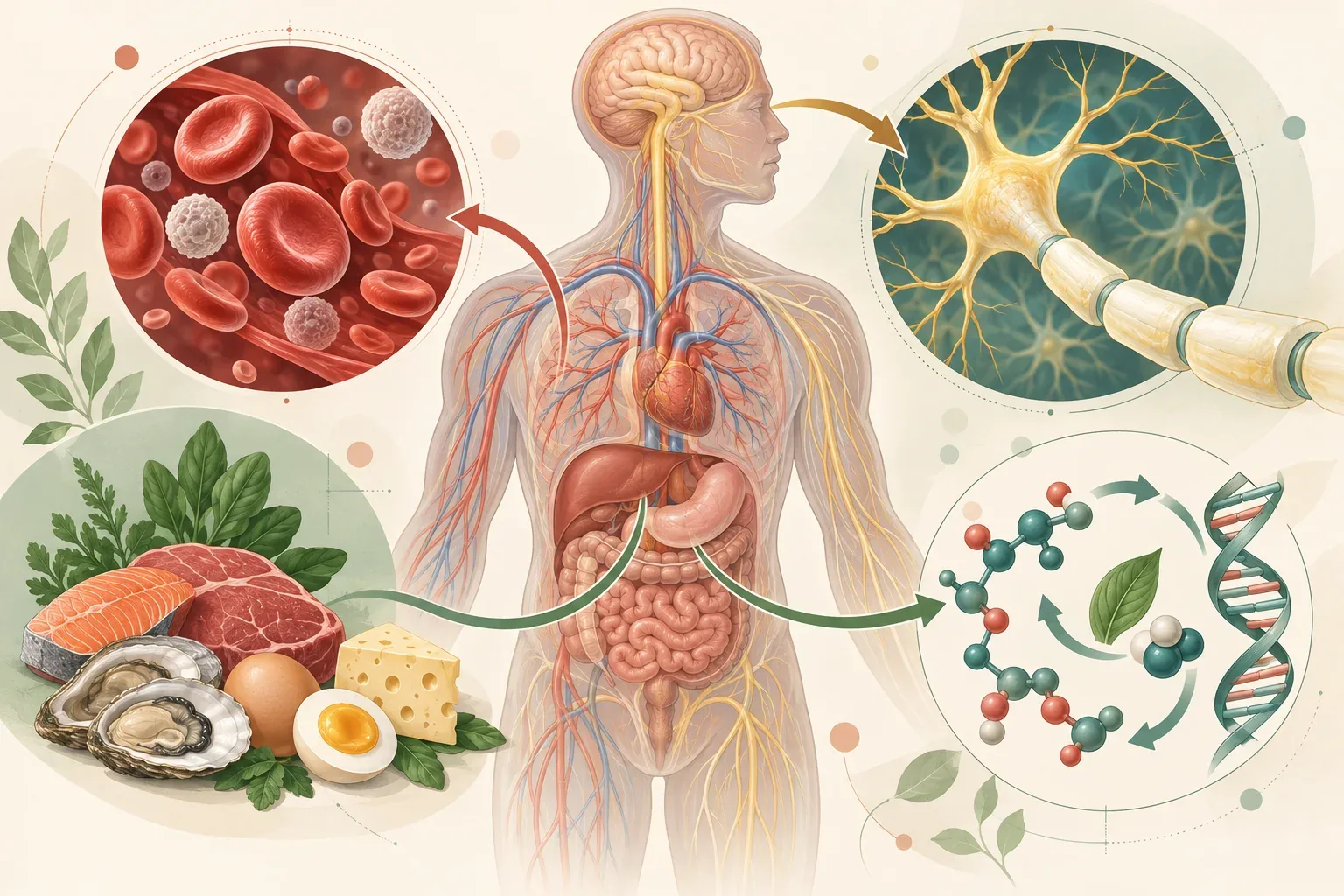
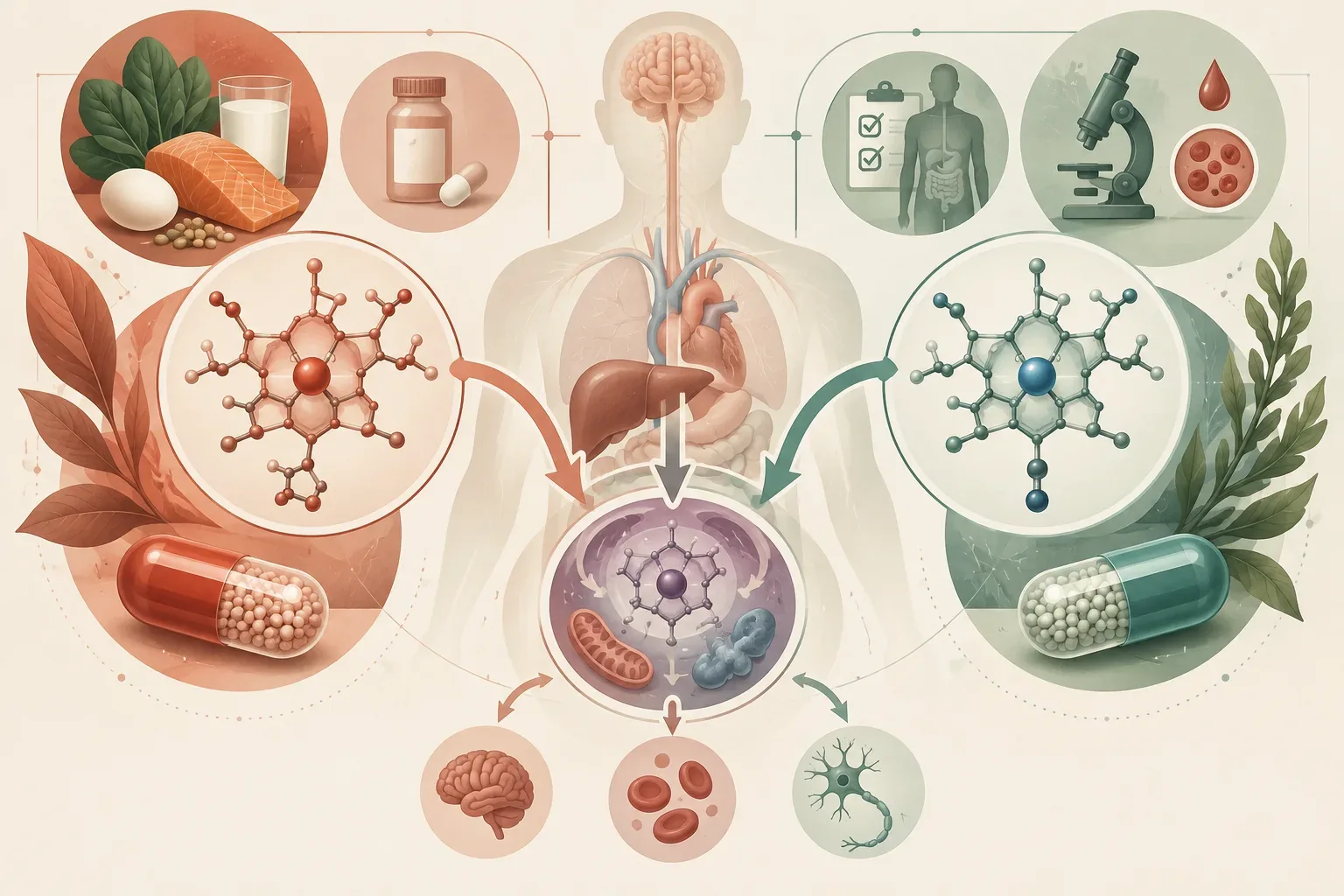
Food sources & dietary alternatives


Nutrient connections worth understanding
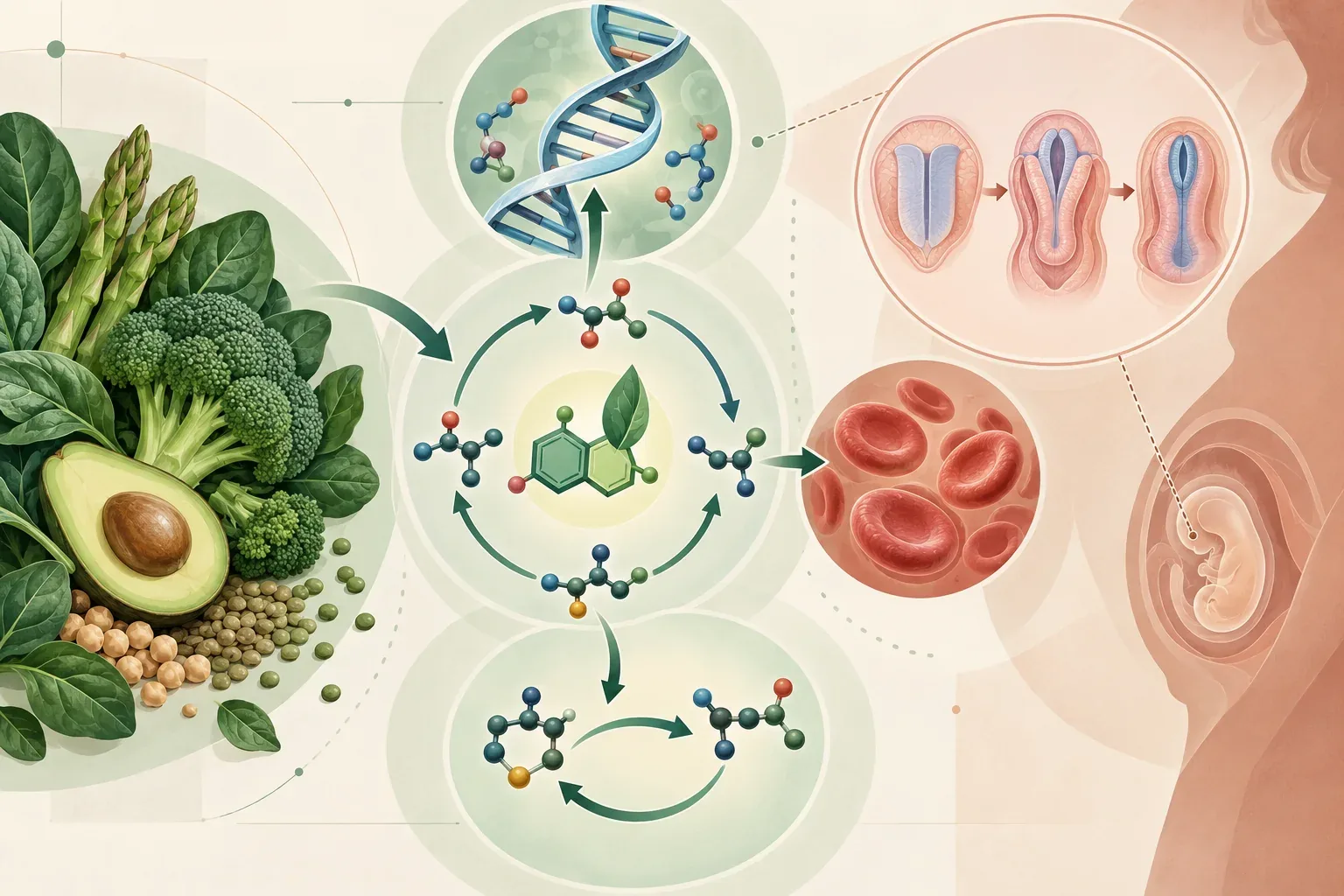 Absorption & use · Lab interpretation
Vitamin B9 (Folate and Folic Acid): Benefits, Forms, and Dosage
Connection details
Context: physiologic amounts
Folate and B12 at physiologic amounts sit on the same methyl map.
Source for this connectionContext: folic acid / high folate with B12 deficiency
Folate can correct the anemia picture while nerve damage continues.
Source for this connection
References
- NIH B12 reference amounts ↩
- Atlantic sardines in oil, drained, bones eaten ↩
- Sockeye salmon, cooked dry heat ↩
- Atlantic cod, cooked dry heat ↩
- Blue mussels, cooked moist heat ↩
- Eastern wild oysters, cooked moist heat ↩
- 90% lean ground beef, pan-broiled ↩
- Chicken breast, meat only, roasted ↩
- Hard-boiled egg ↩
- Whole milk, unfortified ↩
- Plain whole-milk yogurt ↩
- Cheddar ↩
- Unsweetened soy beverage with added A, D and calcium ↩
- Instant fortified oats, dry ↩
- Firm tofu, calcium sulfate, uncooked ↩
- Lentils, boiled without salt ↩
- NIH calcium ↩
- NIH vitamin C ↩
- oats ↩
- banana ↩
- brown rice ↩
- carrot ↩
- olive oil ↩
- apple ↩
- almonds ↩
- baked potato ↩
- tomato ↩
- Chickpeas, boiled without salt ↩
- Table salt ↩
Corrections & updates
- Update
Revised the article after editorial review, with clearer evidence explanations and practical guidance.