
How much are we trying to get?
For this example, the target is 90 mg a day for a healthy, nonsmoking adult man. The recommended daily amount from the National Academies is 75 mg for adult women. People who smoke need 35 mg more. Pregnancy and breastfeeding have different amounts and are outside these examples. NIH vitamin C reference amounts[1]1
A fruit-and-vegetable choice, not a fruit quota
The table separates vegetables rich in vitamin C from fruit and foods that contribute smaller amounts. A banana or apple can fit a varied diet without doing the same vitamin C job as an orange. The amounts below let you make that distinction before trying to solve the gap with a larger portion.
The following are selected foods, grouped by how they fit a meal. They are not an exhaustive list or a ranking of every food. Weights are edible portions in the stated preparation; grams of dry grain are not grams of cooked grain. Calories describe the food portion, not calories that must be added to your current diet.
Vegetables, fruit and other plants
| Food and preparation | Vitamin C per 100 g | Edible portion | Vitamin C in portion | Calories |
|---|---|---|---|---|
| [2] | 127.7 mg | 100 g (3.5 oz) | 127.7 mg | 26 kcal |
| [3] | 53.2 mg | 131 g (4.6 oz) | 69.69 mg | 62 kcal |
| [4] | 64.9 mg | 150 g (5.3 oz) | 97.35 mg | 52 kcal |
| [5] | 17.8 mg | 100 g (3.5 oz) | 17.8 mg | 36 kcal |
| [6] | 9.6 mg | 250 g (8.8 oz) | 24 mg | 232 kcal |
| [7] | 13.7 mg | 150 g (5.3 oz) | 20.55 mg | 27 kcal |
| [8] | 9.8 mg | 90 g (3.2 oz) | 8.82 mg | 21 kcal |
| [9] | 19.6 mg | 150 g (5.3 oz) | 29.4 mg | 135 kcal |
| [10] | 8.7 mg | 118 g (4.2 oz) | 10.27 mg | 105 kcal |
| [11] | 5.9 mg | 100 g (3.5 oz) | 5.9 mg | 41 kcal |
| [12] | 4.6 mg | 182 g (6.4 oz) | 8.37 mg | 95 kcal |
Ounce equivalents are approximate weights; calculations use the gram amounts.
Whole milk, unfortified example
| Food and preparation | Vitamin C per 100 g | Edible portion | Vitamin C in portion | Calories |
|---|---|---|---|---|
| [13] | 0 mg | 244 g (8.6 oz) | 0 mg | 149 kcal |
Chicken breast, meat only, roasted example
| Food and preparation | Vitamin C per 100 g | Edible portion | Vitamin C in portion | Calories |
|---|---|---|---|---|
| [14] | 0 mg | 100 g (3.5 oz) | 0 mg | 165 kcal |
Instant fortified oats, dry example
| Food and preparation | Vitamin C per 100 g | Edible portion | Vitamin C in portion | Calories |
|---|---|---|---|---|
| [15] | 0 mg | 28 g (1.0 oz) | 0 mg | 101 kcal |
The fortified-oat example is a comparison, not a promise of added Vitamin C. Foods can be fortified with other nutrients; use the actual amount listed for the nutrient you are counting.
What do useful portions look like?
The table uses specific USDA foods and calculates how much of each would supply the entire 90 mg target by itself. Your other food would normally contribute too. Grams mean edible food: peel, cores and discarded stalks are excluded where appropriate.
In the tables, mg means milligrams, mcg means micrograms, and kcal means food calories. Calcium sulfate is a calcium-containing ingredient used to set tofu; the amount in the finished tofu still varies by product.
| Food and preparation | Vitamin C per 100 g | Amount for about 90 mg | Calories in that amount |
|---|---|---|---|
| [2] | 127.7 mg | 70 g | 18 |
| [3] | 53.2 mg | 169 g | 80 |
| [4] | 64.9 mg | 139 g | 49 |
| [12] | 4.6 mg | 1,957 g | 1,017 |
For example, 90 ÷ 127.7 × 100 gives 70.5 g of red pepper. That is roughly three-quarters of the USDA record's 92 g cup of sliced pepper. The orange amount is just under its 180 g cup of sections; the broccoli amount is about nine-tenths of its 156 g cup.
The apple example shows why “eat more fruit” can be too vague or outright unrealistic. Almost two kilograms (about 4.3 lb) of apples would be an excessive way to pursue vitamin C.
Can one change fix a whole day's vitamin C total?
Yes, in this example day. Here is every ingredient in the starting day, which contains roughly 2,000 calories.
| Meal | Starting ingredients |
|---|---|
| Breakfast | 60 g (2.1 oz) dry unfortified oats, prepared with water; 244 g (8.6 oz) whole milk without added vitamins; 118 g (4.2 oz) edible banana |
| Lunch | 150 g (5.3 oz) roasted chicken breast; 250 g (8.8 oz) cooked brown rice; 100 g (3.5 oz) raw carrot; 15 g (0.5 oz) olive oil |
| Snack | 182 g (6.4 oz) apple with skin; 170 g (6.0 oz) plain whole-milk yogurt |
| Dinner | 100 g (3.5 oz) hard-boiled egg, without shell; 250 g (8.8 oz) baked potato with skin; 100 g (3.5 oz) raw tomato; 20 g (0.7 oz) olive oil |
Replace only the lunch carrot with 100 g raw red pepper—about one cup sliced. No salt, sauces, other drinks or additional cooking fats are included in either calculation.
The carrot supplies 5.9 mg vitamin C; the replacement pepper supplies 127.7 mg. Using rounded figures, the whole-day calculation is 63.1 − 5.9 + 127.7 = 184.9 mg. These are estimates from food-composition records; real groceries vary.
| Whole-day measure | Before | After |
|---|---|---|
| Vitamin C | 63.1 mg | 184.9 mg |
| Calories | 1,991 | 1,976 |
| Protein | 97.3 g | 97.3 g |
| Fiber | 27.0 g | 26.3 g |
| Calcium | 690 mg | 664 mg |
| Sodium, before any added salt | 534 mg | 469 mg |
Does the change make the whole diet complete?
It fixes this vitamin C calculation, while leaving other work to do. Calcium falls slightly and remains below the 1,000 mg target used for adults 19–50. Removing carrot also lowers the day's vitamin A contribution from about 1,205 to 527 micrograms of retinol activity equivalents—the unit that accounts for the vitamin's different food forms. That creates a vitamin A shortfall against the men's 900-microgram target and the women's 700-microgram target. Missing food measurements also prevent complete checks of iodine and several other nutrients. [16], [17]
What changes if you avoid particular foods?
You have more than one ingredient route, as vitamin C is abundant in many foods. Pepper, orange and broccoli can all fit vegan or vegetarian eating.
Storage and preparation still affect real food values, particularly because vitamin C is sensitive to heat.
What changes when the vegetable is cooked?
Cooking and storage can reduce vitamin C, and some can move into discarded cooking water. These effects depend on the food and method. The boiled broccoli entry already describes cooked, drained broccoli; taking another fixed percentage off that value would count an assumed loss twice. A raw pepper weighed before cooking needs a cooked record or a calculation using evidence for how much vitamin C remains after that particular recipe is cooked if you want to count what remains.
For meal planning, keep a source you enjoy eating in its measured preparation. Raw pepper alongside lunch avoids a cooking conversion. A cooked broccoli portion is equally usable when it is matched to the cooked record. An orange eaten separately can preserve the carrot in a meal where the carrot was doing a different nutritional job.
Two ways to keep vitamin C in the day
The first day retains the original pepper-for-carrot substitution. The second spreads sources across a lentil lunch, broccoli dinner and orange snack. It shows how several sources can contribute across meals, while keeping pepper in the lunch. Both days are fully itemized below, including oil and salt.
The second day is lower in energy than the first. If you increase a grain or oil portion to suit your needs, recalculate its contribution rather than treating the displayed daily total as unchanged.
Two fully itemized days
These are constructed food-composition examples, not observed diets or tested recipes. Only the foods shown are counted. Water is uncounted; unlisted sauces, snacks and caloric drinks would change the totals. The salt row is the total added across the day. The linked food records specify which ingredients are cooked without salt; the separate salt row accounts for the added seasoning.
| Meal | Day 1 | Day 2 |
|---|---|---|
| Breakfast | Regular oats, dry, unfortified 60 g (2.1 oz); Whole milk, unfortified 244 g (8.6 oz); Banana, peeled 118 g (4.2 oz) | Regular oats, dry, unfortified 60 g (2.1 oz); Unsweetened soy beverage with added A, D and calcium 244 g (8.6 oz); Banana, peeled 118 g (4.2 oz) |
| Lunch | Chicken breast, meat only, roasted 150 g (5.3 oz); Brown long-grain rice, cooked 250 g (8.8 oz); Olive oil 15 g (0.5 oz); Red sweet pepper, raw 100 g (3.5 oz) | Lentils, boiled without salt 200 g (7.1 oz); Brown long-grain rice, cooked 200 g (7.1 oz); Red sweet pepper, raw 100 g (3.5 oz); Olive oil 15 g (0.5 oz) |
| Snack | Apple, raw with skin 182 g (6.4 oz); Plain whole-milk yogurt 170 g (6.0 oz) | Almonds 28 g (1.0 oz); Orange, peeled 180 g (6.3 oz) |
| Dinner | Hard-boiled egg 100 g (3.5 oz); Potato, baked with skin 250 g (8.8 oz); Tomato, raw 100 g (3.5 oz); Olive oil 20 g (0.7 oz) | Firm tofu, calcium sulfate, uncooked 150 g (5.3 oz); Potato, baked with skin 200 g (7.1 oz); Broccoli, boiled and drained 150 g (5.3 oz); Olive oil 15 g (0.5 oz) |
| Seasoning across the day | Table salt 2 g | Table salt 2 g |
What the whole day contributes
| Measure | Day 1 | Day 2 |
|---|---|---|
| Vitamin C (mg) | 184.89 | 353.58 |
| Energy (kcal) | 1,976 | 1,883 |
| Protein (g) | 97.3 | 82.8 |
| Fiber (g) | 26.3 | 52.1 |
| Calcium (mg) | 665 | 1,653 |
| Sodium (mg) | 1,245 | 990 |
| Vitamin D (mcg) | 2.76 | 2.93 |
Every nutrient shown in this daily table has a value for each listed food. Other nutrients may still lack measurements; a missing measurement would not mean zero. These totals describe food content, not amounts absorbed.
Day 1 supplies a Vitamin C total of 184.89 mg. That is 205% of the men’s 90 mg reference and 247% of the women’s 75 mg reference. These references are for healthy, nonpregnant adults ages 31–50.
Day 2 supplies a Vitamin C total of 353.58 mg. That is 393% of the men’s 90 mg reference and 471% of the women’s 75 mg reference. These references are for healthy, nonpregnant adults ages 31–50.
What still needs attention
Day 1: 664.77 mg calcium, compared with 1,000 mg; 2.76 mcg vitamin D, compared with 15 mcg; 526.64 mcg RAE vitamin A, compared with 900 mcg RAE (700 mcg RAE for women).
Day 2: 2.93 mcg vitamin D, compared with 15 mcg; 297.84 mcg RAE vitamin A counted so far, compared with 900 mcg RAE (700 mcg RAE for women).
These checks cover only the named nutrients. Meeting the main nutrient target does not show that the whole diet meets your needs.
Use a current package label when a fortified food is essential to the result. The historical USDA examples are not a check of today’s supermarket products. If a different food, preparation or portion is used, replace that entry and recalculate; do not carry the original daily total forward.
When the food list needs to change
A restriction on citrus still leaves peppers and broccoli. A restriction on raw vegetables still leaves cooked options with their own composition values. The useful replacement is one you can repeatedly eat, not necessarily the food with the highest number per 100 g.
The adult recommendations used here are 90 mg for men and 75 mg for women; smokers need another 35 mg. These examples are not a pregnancy or therapeutic diet. A modeled intake above the target cannot tell whether an absorption disorder has been corrected.
Source notes
Calculations use USDA SR Legacy records used for these food calculations on October 24, 2026. In addition to the linked comparison foods, the daily totals use oats[18], whole milk[13], banana[10], chicken breast[14], brown rice[19], carrot[11], olive oil[20], yogurt[21], hard-boiled egg[22], baked potato[6] and tomato[7]. The figures describe those preparations; they are not measurements of your groceries.
Food composition: USDA SR Legacy, April 2018 release, retained for these calculations. Exact records for the menu ingredients: [23], [12], [10], [4], [14], [22], [24], [25], [13], [18], [20], [3], [2], [6], [19], [26], [27], [7], [21]
Help us improve this article
Spotted an error or found a source we should consider? Tell us which part of this article needs another look and include a link if you have one. Please leave out personal health details and lab results; we can’t answer individual medical questions.
Keep exploring
 Nutrient connections worth understanding · Nutrient use
Collagen Peptides: Skin, Joints and Comparing Product Amounts
Connection details
Context: collagen recipes
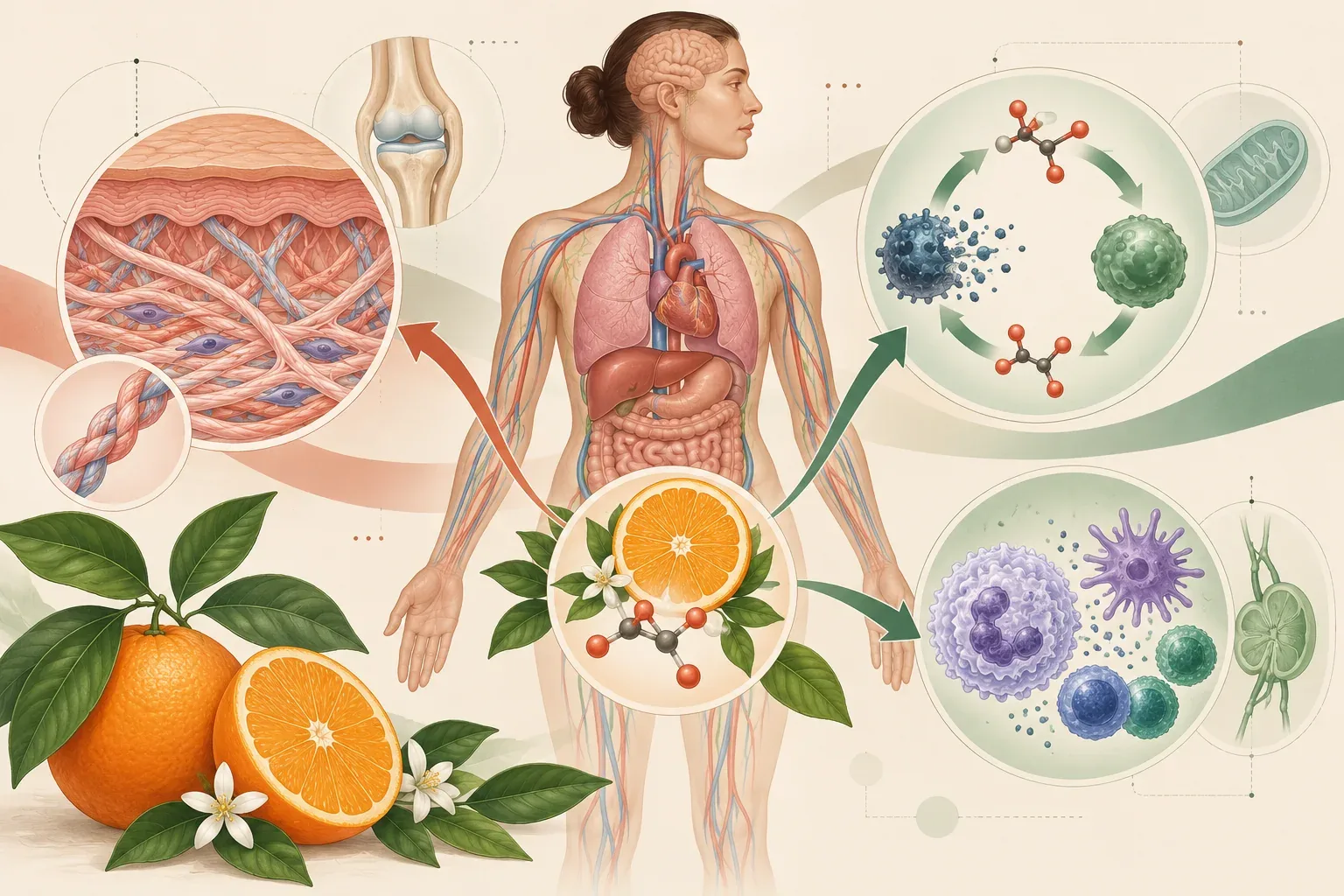
Vitamin C is a hydroxylase cofactor in collagen recipes not a branded kit.
Source for this connection
References
- NIH vitamin C reference amounts ↩
- Red sweet pepper, raw ↩
- Orange, peeled ↩
- Broccoli, boiled and drained ↩
- Kale, boiled and drained ↩
- Potato, baked with skin ↩
- Tomato, raw ↩
- Spinach, boiled and drained ↩
- Sweet potato, baked flesh ↩
- Banana, peeled ↩
- Carrot, raw ↩
- Apple, raw with skin ↩
- Whole milk, unfortified ↩
- Chicken breast, meat only, roasted ↩
- Instant fortified oats, dry ↩
- NIH calcium reference amounts ↩
- NIH vitamin A amounts and units ↩
- oats ↩
- brown rice ↩
- olive oil ↩
- yogurt ↩
- hard-boiled egg ↩
- Almonds ↩
- Unsweetened soy beverage with added A, D and calcium ↩
- Lentils, boiled without salt ↩
- Table salt ↩
- Firm tofu, calcium sulfate, uncooked ↩
Corrections & updates
- Update
Revised the article after editorial review, with clearer evidence explanations and practical guidance.