
What is NMN?
NMN is short for nicotinamide mononucleotide. The body can use it to make NAD, a molecule cells need to release energy from food and carry out repairs. Food contains NMN only in tiny amounts. Supplements commonly provide 150 to 500 mg per serving. Trials have used 250 to 2,000 mg a day. There is no official daily amount or upper limit.
The clear human result is narrow: supplements raise NAD in the blood. Pooled trials have not found clear improvements in blood sugar, cholesterol, weight, muscle, or strength. One small trial did find better insulin sensitivity in muscle, but other metabolic measures did not improve. No trial has tested whether NMN slows aging or extends life.
What NMN does in your body
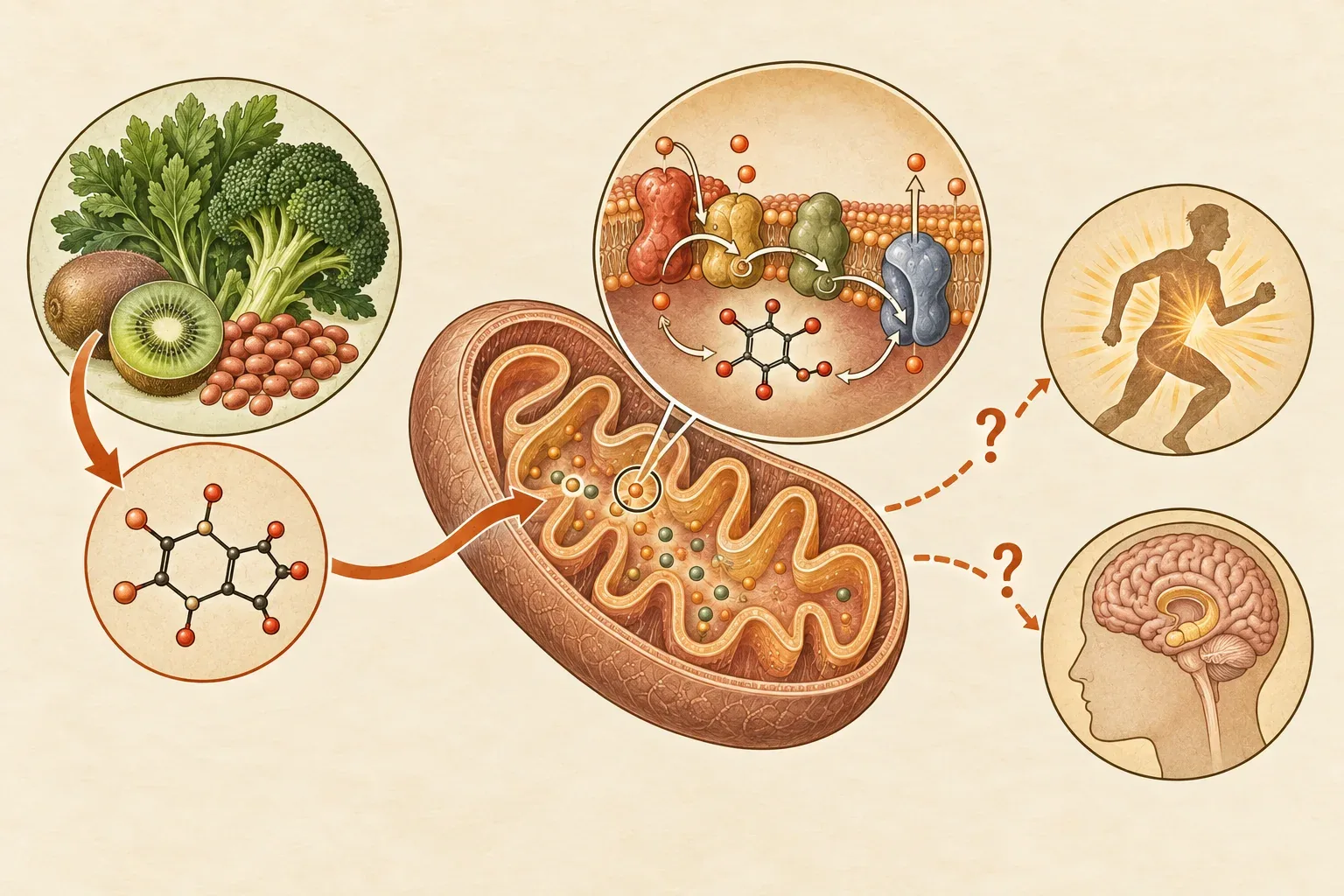
Nicotinamide mononucleotide, or NMN, is an intermediate in the body's production of NAD, a helper molecule used in cellular reactions. Cells continually use and remake NAD, including through pathways that recycle components of vitamin B3.
NAD accepts and passes on electrons in reactions that help cells use fuel. Other enzymes consume NAD during processes involved in signaling and DNA repair. These are established functions of the cellular NAD system.
Exercise also affects this system without an NMN capsule. In a human training study[1], resistance training increased measured muscle NAD and enzymes involved in its recycling in middle-aged, previously untrained adults. A 24-person crossover experiment[2] found that a bout of exercise changed NAD-related signals in blood immune cells. Those are tissue and marker findings, not proof that exercise and NMN are interchangeable interventions; exercise has a much broader evidence base for health than a rise in blood NAD alone.
For a swallowed NMN product, the important additional questions are how it is processed and which tissues change. A rise in blood NAD does not demonstrate the same increase in every organ. [3]
What people take NMN for
| Claimed benefit | Dose / form studied | Research verdict | Evidence strength |
|---|---|---|---|
| Improve insulin sensitivity | 250 mg/day for 10 weeks; 25 postmenopausal women with prediabetes | Muscle insulin sensitivity improved; blood sugar and other metabolic outcomes did not | Limited |
| Improve walking performance | 250–900 mg/day in small 8–12-week trials | One trial improved six-minute distance; another missed its primary stepping test but found a secondary four-meter walking signal | Limited |
| Extend life or slow human aging | No established dose or duration | Higher blood NAD or an age-calculator score is not evidence of longer life | Insufficient |
NMN has no established use for a healthy person and is not a treatment for diabetes or aging. Someone may still value the chance to raise blood NAD, but the scattered walking and sleep findings have not become a consistent improvement in daily function or a demonstrated long-term health benefit. That makes the decision less about finding the right dose and more about whether a blood-marker change with uncertain practical value is worth the cost.
When to ask a doctor before taking NMN
- You have diabetes or prediabetes. The one positive trial was small, pooled trials found no benefit on blood sugar, and NMN does not replace diabetes care.
- You are pregnant or breastfeeding. It has not been studied during pregnancy or breastfeeding.
- You take regular medicines. Interactions have not been studied.
Common dosage
There is no recognized recommended daily amount or upper limit for NMN. The benefits table lists trial doses and populations. A safety review combined 15 trials using 250–2,000 mg/day for up to 24 weeks; this does not establish an effective dose or a long-term ceiling.
No trial has shown that morning, evening, or taking NMN under the tongue changes its effects.
Can I be low in NAD?
There is no agreed clinical definition of NAD deficiency. Experts disagree about how much blood NAD changes with age, no routine medical test diagnoses a low level, and a higher blood result has not been shown to mean better health.
Before the test if you already supplement
If you arrange a blood NAD test while taking NMN, get written preparation instructions from the ordering clinician and report your dose and last dose. There is no established general NMN-stop interval for interpreting an untreated NAD level. A short pause does not make an NAD result a validated measure of supplement need or biological age.
What you can buy
NMN is sold as capsules and powder. This complete listing table compares the common formats with the research; it does not rank brands.
| Listing | NMN per serving | Compared with trials |
|---|---|---|
| NMN capsules | 150 mg | Below the 250 mg trial |
| NMN capsules | About 200–300 mg | Near the 250–300 mg trials |
| “Liposomal” NMN | 500 mg per 2 capsules | Within the trial range; liposomal form not tested |
| NMN with other ingredients | Varies | Adds ingredients the trials did not test |
The trials used their own products; none tested a brand you can buy.
How is NMN different from NR, niacinamide, and NAC?
NMN and NR (nicotinamide riboside) are both building blocks the body uses to make NAD, and niacinamide is a form of vitamin B3 that feeds the same pathway; they are not interchangeable milligram for milligram, and no trial has compared NMN with NR head to head. NAC only sounds similar: it supplies cysteine, an amino acid the body uses to make the antioxidant glutathione, and has nothing to do with NAD.
What to pay attention to on the label
The number to find is milligrams of NMN, often listed as beta-nicotinamide mononucleotide.
Which number on the label is the amount?
Look for NMN or beta-nicotinamide mononucleotide in milligrams on the Supplement Facts panel. Check the serving size before comparing products: a front-label number may apply to two or three capsules rather than one.
Is NMN legal to sell?
NMN can currently be marketed as a dietary supplement in the United States. In September 2025, the FDA reversed its 2022 position after concluding that NMN had been sold as a supplement before researchers received permission to study it as a drug.
That decision did not approve NMN, find it safe, or show that it works. Products still have to follow the laws for dietary supplements. The FDA's public list records at least one company's required notice about selling NMN as a new supplement ingredient, with an agency response in January 2026; filing that notice is not approval. Rules outside the United States may differ.
Misleading labels
Anti-aging and lifespan claims
No human trial has tested whether NMN slows aging or extends life.
“Liposomal” NMN
No trial has shown that liposomal NMN works better than plain NMN.
Confusing servings and items per serving
Some manufacturers put 180 capsules on the front while the Supplement Facts panel defines a serving as 3 capsules. That bottle has 60 servings, and the listed NMN amount applies to all three capsules together.
Manufacturer claims and the studies they may be based on
A “supports healthy aging” or “cellular energy” line may rest on animal research or the rise in blood NAD rather than a demonstrated benefit. A blood-sugar claim may trace to the 2021 trial in 25 women. A “biological age” claim may trace to a 2023 trial that used a company calculator, not a lifespan measure.
How NMN interacts with other nutrients
NMN is often paired with resveratrol, a compound from grapes, in “longevity” stacks.
Resveratrol
The idea that NMN needs resveratrol to work comes from mouse research. No human trial has tested the pair or shown they work better together.
Common Myths about NMN
Did the FDA ban NMN because it works?
No. The dispute concerned whether supplement marketing or an authorized drug investigation came first. The FDA reversed its exclusion decision in 2025.
Does NMN raise NAD in muscle?
Not shown. In the 2021 trial, NAD rose in blood cells but not in thigh muscle.
Does NMN build muscle or strength in older adults?
Not shown. A 2025 review found no effect on muscle mass, grip strength, walking speed, or leg strength.
Drawbacks and side effects
| Potential drawback | When/who it affects | Research evidence | Practical implication |
|---|---|---|---|
| Unknown long-term or high-dose harms | Use beyond the short trials, or repeated amounts above those studied | Trials up to 24 weeks found no increase in adverse events; they do not establish lifetime safety | Do not treat 2,000 mg as an official safe ceiling |
| Unstudied medicine or pregnancy effects | People taking medicines; pregnant or breastfeeding women | These uses remain poorly studied | Review the exact product and situation with a clinician |
Safety details
There is no official upper limit, so the amount that becomes harmful is unknown. A 2026 review of 15 trials using 250 to 2,000 mg a day for up to 24 weeks found no increase in side effects or liver enzymes. That is reassuring only for the doses, participants, and short follow-up studied. Long-term use, pregnancy, breastfeeding, and interactions with medicines remain poorly studied.
The science behind NMN
Across the research, the dependable result is higher blood NAD. The unresolved question is whether that change improves health.
A 2026 head-to-head study[4] adds a useful distinction. In 65 healthy adults, 14 days of NMN and nicotinamide riboside (NR) raised circulating NAD similarly; nicotinamide did not have the same sustained effect. In separate laboratory experiments, human-derived gut microbes converted NMN and NR into nicotinic acid. The authors proposed that microbial conversion may help explain the blood result, but the trial did not show how much of each person's swallowed NMN was converted by their gut microbes inside the body. Most authors worked for Nestlé Research or related companies. This is a mechanism lead, not a reason to favor one retail form or claim a clinical benefit.
Blood sugar and metabolism
In a 2021 trial, 25 postmenopausal women with prediabetes took 250 mg or a placebo daily for 10 weeks. Among the 13 assigned NMN, insulin sensitivity in muscle improved while it did not change with placebo. Body fat, blood pressure, fasting blood sugar, cholesterol, and insulin sensitivity in the liver and fat did not improve, and NAD did not rise in muscle. Two authors held NMN patents or received licensing income.
Reviews in 2024 (8 trials) and 2025 (12 trials) found blood NAD rises but no benefit on fasting blood sugar, insulin, HbA1c (a three-month blood sugar average), insulin resistance, or cholesterol. Two 2026 reviews, the 15-trial safety review and a separate 10-trial review of blood pressure, both found diastolic blood pressure (the bottom number) slightly lower; the blood-pressure review put the drop at about 2 mm Hg, larger in people over 60. Beyond the rise in NAD itself, that small effect is the only benefit that shows up when trials are combined, and what it means for health is unclear.
Energy and walking
In a 2023 trial funded by an NMN maker, 80 healthy middle-aged adults took 300, 600, or 900 mg or a placebo for 60 days. Blood NAD and distance on a six-minute walking test rose more with NMN, but insulin resistance did not improve. The trial's “biological age” result came from a company calculator, not a lifespan measure.
A 2024 trial in older adults[5] tested 250 mg daily for 12 weeks. Its primary stepping-test result did not differ from placebo. A shorter time on a four-meter walk and higher blood NAD were secondary findings. That makes the walking signal worth checking in larger studies, while the failed primary test keeps it from becoming a general mobility recommendation.
Muscle
A 2025 review of trials in older adults found no effect on muscle mass or strength. The 2024 walking signal does not reverse that pooled muscle finding. What is still open is whether raising NAD this way changes any health outcome in people.
What you may have heard on podcasts
Podcast claims about NMN run far ahead of the trials, and the speakers disagree with one another.
David Sinclair (FoundMyFitness, 6 November 2019) said NAD falls with age, to about half by 50, and that he takes 1 g of NMN each morning with resveratrol. He co-founded a company developing NMN as a drug.
Charles Brenner (FoundMyFitness, 10 February 2026) said blood NAD does not decline with age, that NMN has to be converted to nicotinamide riboside (NR) to enter cells, and discussed NR at 500 to 1,000 mg. He advises a company that sells NR.
Andrew Huberman (Huberman Lab, 31 October 2023) said he took 500 mg of NR plus 1 to 2 g of NMN under the tongue, for energy rather than lifespan. Peter Attia (Huberman Lab, 29 July 2024) said he does not take NR, NMN, or NAD.
None of those personal amounts has been shown to produce a health benefit. The only positive metabolic trial used 250 mg, and its finding has not become a consistent pooled result.
The bottom line
NMN reliably raises NAD in the blood, but the health benefit of that increase remains much less clear. A few small trials found improvements in selected measurements, without establishing that it slows human aging or makes a healthy person feel and function better over time.
The practical question is whether that uncertainty is worth the ongoing cost to you. A higher NAD result or a younger-looking age score is not enough on its own to answer it. There is also much less information about long-term use than the anti-aging marketing can suggest.
Help us improve this article
Spotted an error or found a source we should consider? Tell us which part of this article needs another look and include a link if you have one. Please leave out personal health details and lab results; we can’t answer individual medical questions.
Explore more in healthy aging

More in compounds



References
- human training study ↩
- 24-person crossover experiment ↩
- Yoshino et al.: NMN and muscle insulin sensitivity in prediabetic women, 2021 ↩
- Christen et al.: head-to-head NAD precursors and gut-microbe experiments, 2026 ↩
- Igarashi et al.: NMN, walking and sleep outcomes in older adults, 2024 ↩
- Yi et al.: NMN in healthy middle-aged adults, 2023
- Irie et al.: single doses of NMN in healthy men, 2020
- Yang et al.: NMN safety and metabolism meta-analysis, 2026
- Chen et al.: NMN and glucose and lipids meta-analysis, 2024
- Zhang et al.: NMN and glucose and lipids meta-analysis, 2025
- Prokopidis et al.: NMN and NR on muscle meta-analysis, 2025
- Zhang et al.: NMN and blood pressure meta-analysis, 2026
- FDA final response on the NMN citizen petition, 29 September 2025
- FDA: submitted new-dietary-ingredient notifications
- FoundMyFitness: David Sinclair, 6 November 2019
- FoundMyFitness: Charles Brenner, 10 February 2026
- Huberman Lab: AMA #12, longevity supplements, 31 October 2023
- Huberman Lab: Peter Attia on supplements for longevity, 29 July 2024
- NIH Dietary Supplement Label Database: an NMN label