
Find the magnesium line and its serving size
Use the amount beside Magnesium on Supplement Facts. That is the elemental amount, meaning the magnesium itself. The form in parentheses tells you which compound supplies it. A line saying “Magnesium 50 mg, as magnesium oxide” contributes 50 mg to your intake calculation; you do not reduce it by a chemical percentage. [1]
Then read the serving size. If a panel declares 400 mg across three tablets, one tablet supplies about 133 mg. Taking three tablets gives the declared 400 mg, not 1,200 mg. The serving calculation tells you what the product contributes; it does not decide how much you need.
Compare products on the same daily basis
The following labels span a broad multi, a capsule multi and two mineral combinations. Amounts were checked against manufacturer sources on October 21, 2026. These are examples of formula differences, not recommended daily regimens.
| Product | Basis shown | Elemental magnesium | Calculated share of Daily Value | Magnesium sources declared |
|---|---|---|---|---|
| Centrum Silver Adults 50+ | 1 tablet; labeled daily amount | 50 mg | About 12% | Oxide |
| Thorne Basic Nutrients 2/Day | Full 2-capsule serving | 20 mg | About 5% | Bisglycinate |
| Solgar Calcium Magnesium Plus Zinc | 3 tablets; labeled daily amount | 400 mg | About 95% | Oxide, gluconate, citrate |
| NOW Magnesium & Calcium | 3 tablets; labeled daily amount | 800 mg | About 190% | Oxide, glycinate, taurinate, citrate, seaweed-derived minerals |
Label sources: [2], [3], Solgar[4] and NOW[5]. The manufacturer-hosted Centrum PDF carries a 2023 copyright; verify your package matches. These source links are not affiliate links.
Both mineral-combination examples exceed the adult 350 mg supplemental upper limit at their labeled daily amounts. Their inclusion shows why reading the label matters; a manufacturer's serving instruction can exceed the supplemental upper limit.
Daily Value and the supplemental limit count different things
The FDA magnesium Daily Value is 420 mg, a reference for comparing labels within the total diet. The official upper limit from the National Academies is 350 mg daily from supplements and magnesium-containing medicines for adults. Magnesium naturally present in food does not count toward that supplemental limit. [6]; [1]
This explains the apparent contradiction in a 400 mg product: it supplies about 95% of the Daily Value but exceeds the supplemental limit by 50 mg. The percentage is neither an absorption estimate nor a safety score.
The limit was based on diarrhea. Crossing it is not the same as an immediate toxic dose, but it is a reason to review the amount rather than assume an ordinary retail serving suits everyone. Kidney impairment increases the risk from excess magnesium. [1]
A named form does not tell you how much you will absorb
The elemental amount and the source form answer different questions. One tells you the declared quantity. The other helps interpret how it may dissolve, be absorbed or affect your digestion.
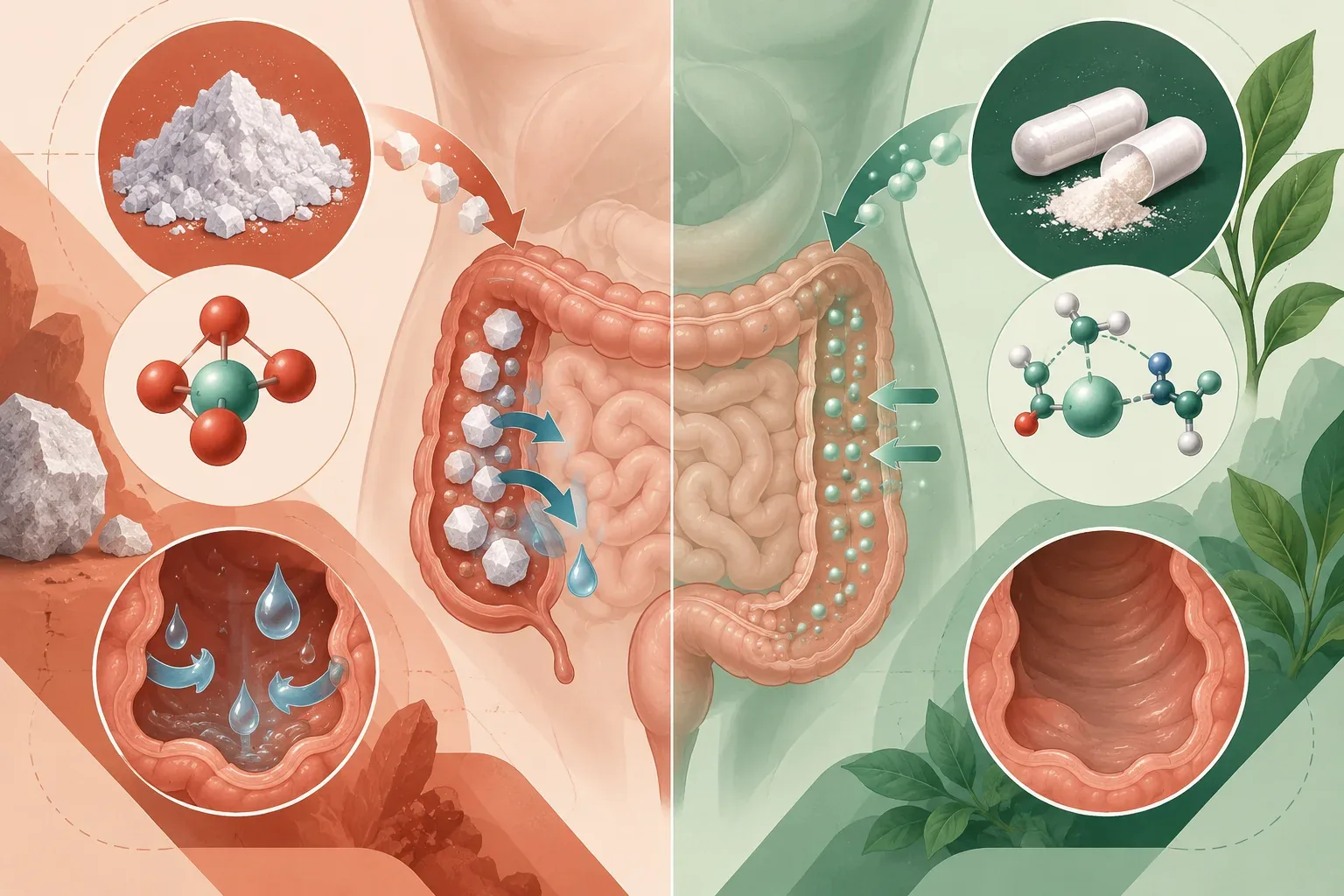
NIH reports that citrate, aspartate, lactate and chloride generally have better bioavailability than oxide and sulfate.
Mixed-form declarations leave another question open. If a manufacturer lists oxide, gluconate and citrate but gives only one magnesium total, you know the combined amount. You do not know how much each form supplies. The presence of citrate somewhere in that list cannot establish that most of the magnesium is citrate.
A particular magnesium form cannot make up for an amount that is too small for your needs. A modest elemental amount remains modest. Do not multiply a whole multi's serving just to increase its magnesium; that also multiplies every other vitamin and mineral it contains.
Why a multivitamin can contain so little magnesium
A multivitamin has limited space for all its ingredients. Magnesium supplied in hundreds of elemental milligrams requires substantial material, with additional mass from the compound carrying it. Small amounts can therefore coexist with an extensive vitamin and trace-mineral list.
To estimate a gap in magnesium intake, compare magnesium from your usual food portions and current supplements with the age- and life-stage amount in the NIH recommended-intake table[7], rather than treating the label Daily Value as your personal target. A dietitian can help estimate food intake; this comparison does not diagnose deficiency. A small amount may be enough alongside food. It may be inadequate if you chose the product to supply a much larger, specific magnesium amount. NIH likewise highlights low calcium, magnesium and potassium amounts as a common feature to check in multis. [8]
Add every supplement before choosing another
Make one magnesium subtotal for supplements and medicines. Include the multi, standalone magnesium, electrolyte powder and bone-health formula if their labels declare magnesium. For medicines, check whether the active-ingredient amount describes elemental magnesium or the whole compound. If only the compound weight is listed, ask a pharmacist for the elemental amount in the dose you take before completing the subtotal; the conversion depends on the compound.
Here is a hypothetical daily combination:
| Product | Elemental magnesium actually taken |
|---|---|
| Multivitamin | 50 mg |
| Standalone magnesium | 200 mg |
| Electrolyte product | 100 mg |
| Supplement subtotal | 350 mg |
That combination already reaches the adult supplemental limit. Food still contributes to nutritional intake, but it does not belong in this particular subtotal. A second serving of the electrolyte product would raise the supplement total to 450 mg.
Low magnesium in your multivitamin is therefore not, by itself, a reason to add another product. Check the food contribution and the rest of your supplements first. If you need to adjust magnesium without changing other nutrients, a separate magnesium product gives you that flexibility and might be a better choice overall.
Check medicines and tolerance before changing the amount
Magnesium can cause diarrhea, nausea and cramping. It can also reduce absorption of certain antibiotics and oral osteoporosis medicines; the timing requirements depend on the drug. Ask a pharmacist to check the whole formula against your medicine instructions, especially when it includes calcium or zinc as well. [1]
Can a small multivitamin amount deliver the benefits in magnesium studies?
It can contribute to your daily intake, but the amount and preparation still matter. The bisglycinate sleep trial[9] used 250 mg elemental magnesium daily for four weeks, in a preparation also supplying about 1.5 g of glycine. Its modest improvement in reported insomnia symptoms versus placebo cannot be assigned to a multivitamin containing 20 or 50 mg magnesium in a different mixture.
Nor does a larger blend automatically reproduce a trial. In a 24-week study[10], citrate, oxide and sulfate each supplied 450 mg magnesium daily; none improved blood pressure or arterial stiffness compared with placebo. The full-serving amount helps you judge the product's nutritional contribution. It is not a score for how many extra benefits the bottle delivers.
The bottom line
For magnesium in multivitamins, the useful comparison is the amount you actually take, in the form declared, added to the rest of your day.
Help us improve this article
Spotted an error or found a source we should consider? Tell us which part of this article needs another look and include a link if you have one. Please leave out personal health details and lab results; we can’t answer individual medical questions.
More about magnesium




Nutrient connections worth understanding
 Nutrient balance
Potassium: Food, Supplement Amounts and When to Seek Advice
Connection details
Context: hypomagnesemia with low potassium
Hypomagnesemia makes low potassium hard to fix.
Source for this connection
 Nutrient use · Disputed pairing
Vitamin D: Daily Needs, Blood Tests and the Limits of Higher Doses
Connection details
Context: vitamin D enzymes
Vitamin D enzymes use magnesium.
Source for this connectionContext: D fails if magnesium is low
That is not the same sentence as D fails if magnesium is low. A D3 capsule can still raise 25-hydroxyvitamin D.
Source for this connection
More in minerals




References
Corrections & updates
- Update
Updated the evidence discussion and practical guidance after editorial review.
- Update
Revised the article after editorial review, with clearer evidence explanations and practical guidance.