
What magnesium oxide and glycinate are
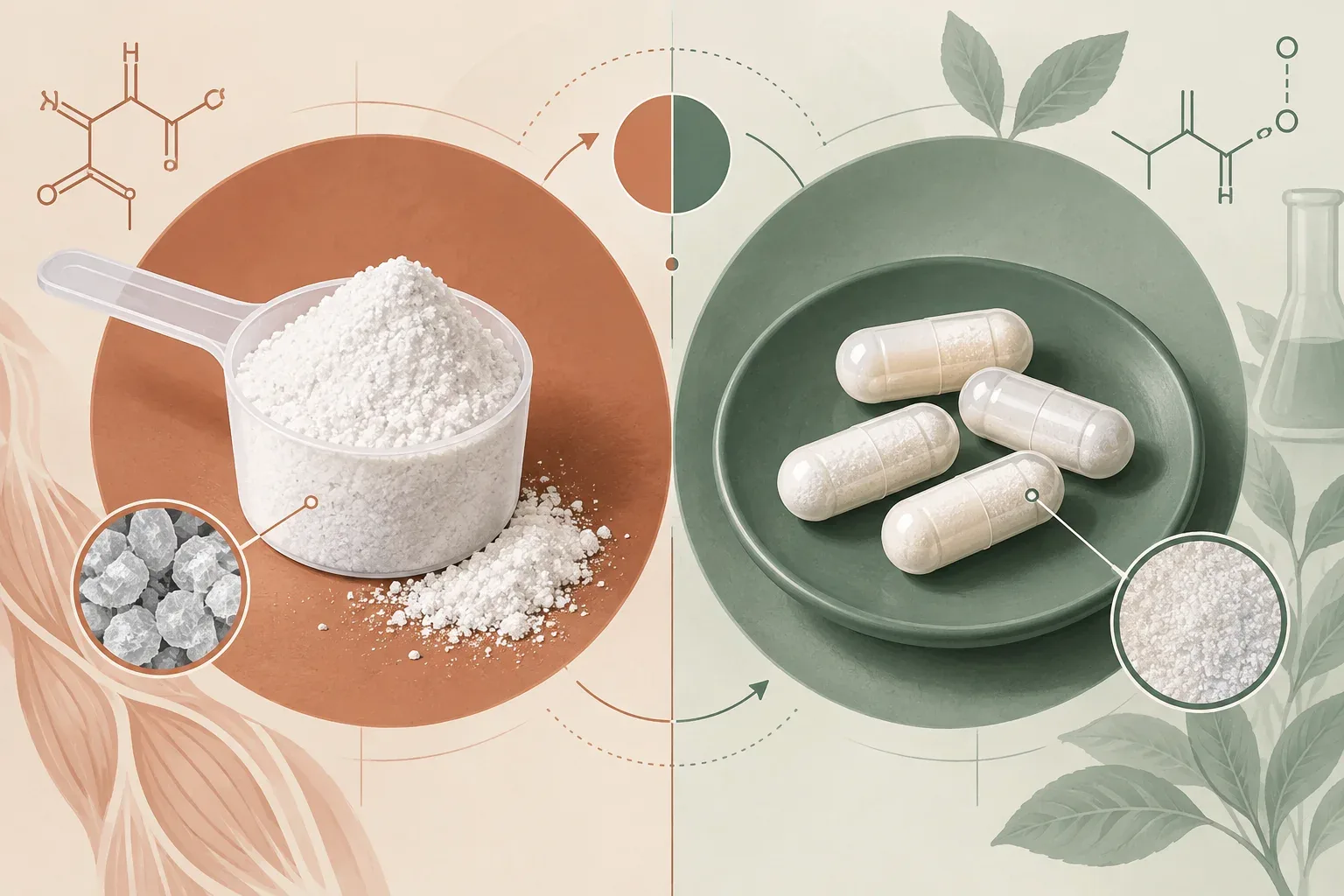
- Magnesium oxide is magnesium bound to oxygen. It is a small, cheap compound, about 60 percent magnesium by weight, and it dissolves poorly, so much of it stays in the bowel and loosens stool.
- Magnesium glycinate (also sold as bisglycinate) is magnesium bound to glycine, an amino acid. It is heavier, about 14 percent magnesium if pure, and has limited direct evidence on gut tolerance compared with oxide.
Magnesium oxide has evidence as a laxative. Glycinate may be an alternative when oxide causes stomach trouble, but direct evidence that it is gentler comes from a small study after intestinal surgery. For daily supplementation, compare the elemental amount—the magnesium itself, rather than the weight of the whole compound—and how you tolerate it; neither form has a proven absorption advantage for every person.
For daily magnesium needs, food sources, timing and the wider choice of forms, see our magnesium guide.
Oxide and glycinate at a glance
| Magnesium oxide | Magnesium glycinate (bisglycinate) | |
|---|---|---|
| Magnesium by weight | About 60 percent | About 14 percent if pure |
| Typical label amount | 400 mg or more of magnesium per labeled serving | 100 to 200 mg of magnesium per labeled serving |
| Absorption | Usually lower than citrate; one 12-person study after intestinal surgery found similar absorption to glycinate overall | In that special-population study, similar overall; better in the four people with the lowest oxide absorption |
| Gut effect | Can loosen stools or cause cramps and diarrhea | Better tolerated in one 12-person study after intestinal surgery; broader advantage uncertain |
| Use to consider | Constipation, following the laxative label or medical advice | An alternative when oxide causes gut symptoms; individual tolerance still matters |
| Limitation | Can worsen existing loose stools | No established evidence as a constipation treatment |
The label amount and gut effect decide the choice
Why the oxide label shows more magnesium
Oxide is a small molecule, so about 60 percent of its weight is magnesium. Glycinate binds magnesium to the amino acid glycine, which is heavier, so pure bisglycinate is about 14 percent magnesium. That is why one oxide capsule can list 420 mg of magnesium while a glycinate capsule lists 125 mg. The label number tells you how much magnesium is in the pill, not how much you absorb.
How much is absorbed
Oxide dissolves poorly, and comparisons with citrate have generally favored citrate. In Firoz and Graber’s 2001 study of commercial products, the roughly 4 percent absorption estimate for oxide came from the extra magnesium excreted in urine after dosing. That is an indirect estimate for the tested product and protocol, not a fixed percentage for every oxide tablet.
Schuette’s 1994 comparison with a glycinate-type chelate (magnesium bound to glycine) used a different method and population: 12 people who had part of their small intestine removed, a group prone to low magnesium. Each took 100 mg of magnesium from both forms, tagged with a traceable form of magnesium so absorption could be measured:
- Overall, absorption was nearly the same: 22.8 percent from oxide and 23.5 percent from the chelate.
- In the four people whose oxide absorption was lowest, the chelate gave 23.5 percent versus 11.8 percent from oxide, a possible advantage in that small subgroup.
- The chelate was better tolerated in these patients.
The urinary estimate and the traceable-magnesium measurement are not interchangeable. Different methods, products, and participants help explain why the oxide numbers differ. The surgical study found no overall absorption advantage for glycinate; its tolerance result needs confirmation in a broader population. Oxide can cause cramping and diarrhea, especially at higher doses, so the elemental amount matters as well as the form.
Constipation
Oxide's poor absorption is an advantage here: magnesium left in the bowel draws in water. In a 2021 trial of 90 adults with long-term constipation, 1.5 g of magnesium oxide a day (about 900 mg of magnesium) for 4 weeks improved symptoms in 68 percent, compared with 12 percent on placebo and 69 percent taking the laxative senna. The similar percentages do not prove that oxide and senna work equally well. That dose is well above the supplement upper limit described below. Laxative doses are a separate use, and ongoing constipation or repeated high-dose use needs medical advice. This trial did not test glycinate.
In Mori's four-week placebo-controlled study[1], 34 women were randomized and 33 analyzed. At 1.5 g magnesium oxide compound daily, 12 of 17 reported overall constipation improvement, compared with 4 of 16 taking placebo. Bowel movements without an extra laxative increased. However, there was no clear difference in how many women met the study’s improvement target for movements that left them feeling fully emptied. This supports limited, but promising evidence for short-term overall relief; it does not mean every constipation measure improved or supply evidence for glycinate as a laxative.
The upper limit applies to both
The official upper limit from the National Academies is 350 mg of magnesium a day from supplements, set to avoid diarrhea; food does not count. It applies to the magnesium on the label, however well it is absorbed. One oxide capsule listing 420 mg of magnesium is above that limit in a single daily dose. For daily supplement use, choose a smaller amount so the total from supplements stays at 350 mg or less, or ask your doctor. Some researchers argued in 2023 that the limit should be re-evaluated, but it has not been changed.
Read one label before choosing the form
- Blends led by glycinate. Some "magnesium complex" products list glycinate first and oxide later. The elemental total, the magnesium itself as listed on the "Magnesium (as ...)" line, may come mostly from oxide. A combined amount and ingredient order do not tell you how much magnesium each form supplies.
- "High-potency" oxide. A high number on the “Magnesium” line is real elemental magnesium and counts toward the 350 mg supplement limit; it does not prove that more will be absorbed. Oxide can pack more elemental magnesium into a pill because the compound is about 60 percent magnesium by weight.
- Compound weight on glycinate. One label lists 1,600 mg of magnesium bisglycinate monohydrate but 200 mg on the elemental-magnesium line. “Monohydrate” means the compound includes one water molecule, which adds weight; read the elemental line.
Who should check with a doctor first
- People with advanced kidney disease. Magnesium can build up when the kidneys cannot clear it; supplements need a doctor's approval.
- People using oxide as a laxative beyond the label directions. Do not extend a trial-scale laxative dose beyond the labeled or clinician-directed period. Ongoing constipation needs a doctor's assessment, and very large doses of magnesium laxatives and antacids have caused magnesium poisoning.
- People taking certain antibiotics or osteoporosis drugs. Magnesium can reduce absorption of tetracycline and quinolone antibiotics and bisphosphonates; space them as your pharmacist advises.
The bottom line
For constipation, oxide has direct trial evidence; ongoing symptoms need assessment. For daily magnesium, glycinate is an option if oxide causes gut symptoms, with limited evidence for a general tolerance advantage. Choose by the elemental-magnesium line and keep the total from supplements at 350 mg a day or less unless a doctor directs otherwise. There is no brand recommendation here; compare the stated magnesium amount and form before buying.
Help us improve this article
Spotted an error or found a source we should consider? Tell us which part of this article needs another look and include a link if you have one. Please leave out personal health details and lab results; we can’t answer individual medical questions.
More about magnesium





Explore more in gut & digestion





Nutrient connections worth understanding
 Nutrient balance
Potassium: Food, Supplement Amounts and When to Seek Advice
Connection details
Context: hypomagnesemia with low potassium
Hypomagnesemia makes low potassium hard to fix.
Source for this connection
 Nutrient use · Disputed pairing
Vitamin D: Daily Needs, Blood Tests and the Limits of Higher Doses
Connection details
Context: vitamin D enzymes
Vitamin D enzymes use magnesium.
Source for this connectionContext: D fails if magnesium is low
That is not the same sentence as D fails if magnesium is low. A D3 capsule can still raise 25-hydroxyvitamin D.
Source for this connection
References
- Mori's four-week placebo-controlled study ↩
- Office of Dietary Supplements: Magnesium, health professional fact sheet
- Schuette et al.: magnesium diglycinate vs oxide in patients with ileal resection, 1994
- Lindberg et al.: magnesium bioavailability from citrate and oxide, 1990
- Pardo et al.: bioavailability of magnesium food supplements, systematic review, 2021
- Firoz and Graber: bioavailability of US commercial magnesium preparations, 2001
- Morishita et al.: senna vs magnesium oxide for chronic constipation, 2021
- Costello et al.: call to re-evaluate the magnesium upper limit, 2023
- NIH Dietary Supplement Label Database: a magnesium oxide label
- NIH Dietary Supplement Label Database: a magnesium glycinate capsule label
- NIH Dietary Supplement Label Database: a magnesium bisglycinate powder label
Corrections & updates
- Update
Updated the evidence discussion and practical guidance after editorial review.
- Update
Revised the article after editorial review, with clearer evidence explanations and practical guidance.