
Why two magnesium numbers can both be correct
A magnesium compound includes magnesium attached to other material. Its total weight can therefore be much larger than the weight of the magnesium alone.
For example, Life Extension's Neuro-Mag capsule label provides a useful real example. Its three-capsule serving contains 144 mg magnesium from 2,000 mg Magtein magnesium L-threonate. Both numbers describe the same serving. The manufacturer's directions specify three capsules daily.
Here is the arithmetic from that label, checked on 12 October 2026:
| What you are counting | Amount |
|---|---|
| Magnesium L-threonate compound per serving | 2,000 mg |
| Elemental magnesium per serving | 144 mg |
| Capsules per serving | 3 |
| Elemental magnesium per capsule | 144 ÷ 3 = 48 mg |
| Days in a 90-capsule bottle at the labeled three daily | 90 ÷ 3 = 30 days |
Work from the serving to your daily total
Check how many capsules make a serving before comparing two products. It is easy to read “200 mg” and assume that is what one capsule gives you, even when the serving takes two or three.
Suppose a label lists 200 mg magnesium per two capsules:
- One capsule supplies 100 mg.
- Two capsules supply 200 mg.
- Two full servings supply 400 mg.
The last calculation shows why “twice daily” matters when you total what you take.
For overlapping supplements, add the elemental amounts you actually take from each. A multivitamin contributing 100 mg and a separate supplement contributing 200 mg make 300 mg from supplements. Keep magnesium-containing antacids and laxatives in the account too; ask a pharmacist if their medicine labels use unfamiliar units.
Why a percentage calculator can give the wrong answer
You can sometimes work it out from the compound weight, but only if you know exactly which compound you have.
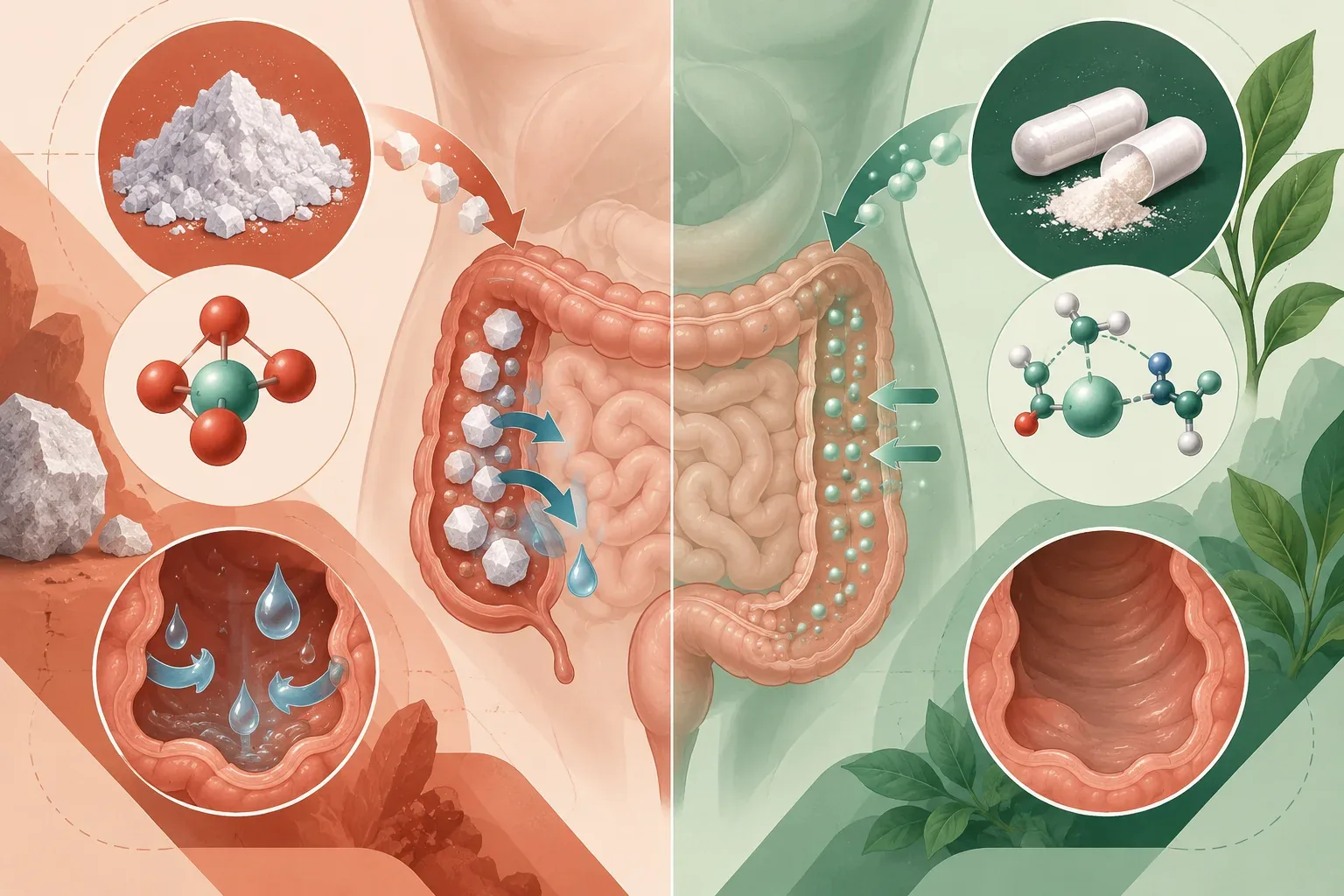
Pure magnesium bisglycinate is roughly 14% magnesium by weight, while magnesium oxide is roughly 60%. Magnesium citrate varies with the water incorporated in its chemical structure. Commercial “glycinate” products can also contain mixtures, so one percentage cannot reliably convert every form listed on a label.
These percentages describe composition, not the share your body absorbs. A higher magnesium fraction does not automatically make a form more effective, as taking a larger amount of a less well-absorbed form of magnesium could yield the same or lower results in terms of how much your body is actually getting.
If the facts panel already gives elemental magnesium, use it directly. A compound weight alone does not provide a reliable elemental-magnesium amount. Guessing from the form name can turn an uncertain label into a falsely precise dose.
Daily Value, daily need, and the supplement limit are different
The Daily Value is 420 mg on general US labels for adults and children aged four and older. It is a comparison reference. For example, 200 mg is about 48% of that Daily Value; it does not mean that 48% will be absorbed.
For nonpregnant adults, the recommended daily amount from the National Academies ranges from 310 to 420 mg depending on age and sex, counting food and supplements together. The official upper limit from the National Academies is 350 mg a day from supplements and medicines for adults; food magnesium is excluded.
That explains the apparent mismatch: a supplement can be below 100% Daily Value yet exceed the supplemental limit. The limit concerns digestive effects and is not a line below which every person is safe. Kidney disease requires medical advice before supplementation. [1]
The bottom line
Use the magnesium amount in the Supplement Facts panel to compare products, then multiply it by the servings you would actually take.
Once that arithmetic is clear, you still have to decide whether you need a supplement and which form fits. Count other supplements and medicines toward the supplemental total. A product can be below the Daily Value and still exceed the separate supplement limit; those numbers answer different questions.
Help us improve this article
Spotted an error or found a source we should consider? Tell us which part of this article needs another look and include a link if you have one. Please leave out personal health details and lab results; we can’t answer individual medical questions.
More about magnesium




Nutrient connections worth understanding
 Nutrient balance
Potassium: Food, Supplement Amounts and When to Seek Advice
Connection details
Context: hypomagnesemia with low potassium
Hypomagnesemia makes low potassium hard to fix.
Source for this connection
 Nutrient use · Disputed pairing
Vitamin D: Daily Needs, Blood Tests and the Limits of Higher Doses
Connection details
Context: vitamin D enzymes
Vitamin D enzymes use magnesium.
Source for this connectionContext: D fails if magnesium is low
That is not the same sentence as D fails if magnesium is low. A D3 capsule can still raise 25-hydroxyvitamin D.
Source for this connection
References
Corrections & updates
- Update
Revised the article after editorial review, with clearer evidence explanations and practical guidance.