

What is alpha-GPC?
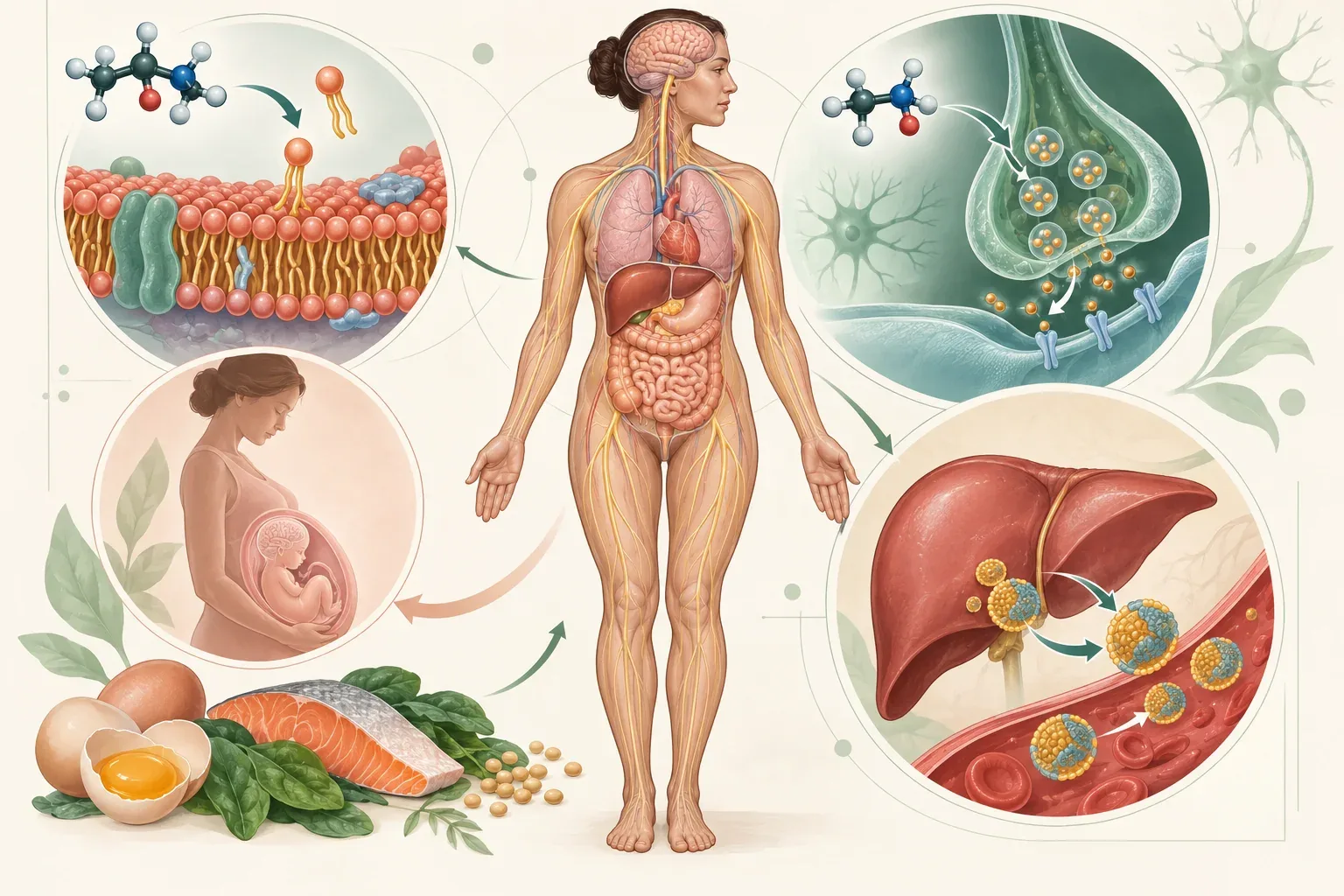
Alpha-GPC is L-alpha-glycerylphosphorylcholine, also called choline alfoscerate. It is a choline-containing compound used in supplements marketed for cognition and exercise. Choline is needed to make cell-membrane components and acetylcholine, a chemical messenger involved in memory and muscle activation. The choline guide covers those nutritional roles and food requirements.
Alpha-GPC has some positive human cognitive findings, including small studies beyond dementia treatment. The important limits are the specific task measured, whether participants had cognitive impairment, and how long they took it. A large observational study has also raised a stroke-safety question that short performance trials cannot settle.
How much choline is in alpha-GPC?
Pure alpha-GPC is approximately 40.5% choline by molecular mass. That makes 300 mg of pure alpha-GPC equivalent to about 122 mg of its choline component, and 600 mg about 243 mg. These are calculations from molecular weights, not finished-product assays or measurements of brain delivery [1], [2].
This is why “alpha-GPC 300 mg” and “choline 300 mg” mean different amounts. If the Supplement Facts panel separately declares a nutrient amount such as “Choline 120 mg,” use that declared amount for nutrient accounting rather than multiplying it by 40.5% again [3].
Also distinguish active alpha-GPC from a carrier mixture: one trial used 350 mg of a 90% material to deliver 315 mg active alpha-GPC [4].
Does it improve focus in healthy adults?
A 2024 crossover trial gave 20 resistance-trained men 315 mg alpha-GPC, 630 mg or placebo on separate visits. Testing surrounded an exercise session. Both amounts improved a Stroop attention-test score more than placebo.
Working memory and perceived concentration, motivation and mood did not improve. This industry-supported, single-dose study made many comparisons without strong protection against chance findings. Its registration came after the study began, making it harder to check which analyses were planned in advance [4].
What about mild cognitive impairment and Alzheimer disease?
A 2024 trial randomized 100 adults with mild cognitive impairment to a preparation providing 600 mg alpha-GPC or placebo daily for 12 weeks. The alpha-GPC group improved more on the primary Alzheimer's Disease Assessment Scale cognitive score [5].
An older placebo-controlled trial in 261 patients with mild to moderate Alzheimer disease used 400 mg three times daily for 180 days and reported improvement on cognitive scales. The trial enrolled patients with diagnosed disease and used a total of 1,200 mg daily [6].
These findings make alpha-GPC a legitimate research question in cognitive impairment. Changing memory warrants assessment. Evidence for dementia prevention is limited.
Is alpha-GPC a useful pre-workout supplement?
The exercise evidence is small and inconsistent across tests.
In a crossover experiment with 13 college-aged men, 600 mg daily for six days improved a lower-body isometric pulling test compared with placebo. The upper-body comparison was not statistically significant, and the first single dose did not improve either test. Ingredient supplier Chemi Nutra funded the study [7].
The newer 20-man study found no significant group benefit for its physical-performance measurements or growth hormone, despite the attention-test signal [4].
The study measured force against a fixed bar.
Two “600 mg” labels may describe different amounts
For illustration, “600 mg of a 50% alpha-GPC preparation” means 300 mg active alpha-GPC. “600 mg alpha-GPC, supplied by a 50% preparation” declares 600 mg active and would require twice as much of the mixture.
Does alpha-GPC increase stroke risk?
A South Korean study followed health records from more than 12 million adults aged 50 or older. People prescribed alpha-GPC had a higher subsequent stroke rate. The adjusted hazard ratio was 1.46 in the full cohort, meaning a 46% higher relative rate during follow-up; the association remained after matching users and nonusers on measured characteristics [8].
This was not a randomized trial. The reasons someone was prescribed alpha-GPC, underlying health differences and factors not captured in the records could contribute to the association. It also does not provide a numerical risk estimate for a young person taking an occasional supplement.
It is still a material safety signal for repeated use, especially because small trials lasting days or weeks cannot assess a long-term stroke outcome. A 2026 correction fixed which diagnostic codes were described as identifying each stroke type; it did not announce replacement overall outcome estimates [9].
What other side effects have been reported?
The acute exercise study recorded nausea, regurgitation, headache and lightheadedness, with similar proportions between treatments. Researchers attributed most events to the exercise or blood collection [4].
The 12-week mild-cognitive-impairment trial reported no serious adverse events and no withdrawals caused by adverse events [5].
Alpha-GPC, citicoline or ordinary dietary choline?
Start with the reason you want it.
| Your purpose | What determines the choice |
|---|---|
| Filling a dietary choline gap | Compare your food intake with the amount of choline declared per serving |
| Healthy focus or pre-workout use | Small, task-specific findings and mixed exercise results |
| Diagnosed memory impairment | The actual diagnosis, preparation and clinical evidence, reviewed with the treating clinician |
| Choosing between alpha-GPC and citicoline | Alpha-GPC has small attention-test and clinical signals; citicoline has mixed memory-test findings. A direct comparison is still missing |
In a manufacturer-funded trial, 100 adults aged 50–85 with age-associated memory impairment took 500 mg of citicoline a day or placebo for 12 weeks. The groups did not differ on the primary spatial-memory test. Citicoline did better on an episodic-memory test and a composite memory score. The trials studied different people and tasks. A fair comparison would test both products in the same population [10].
Pure alpha-GPC supplies more choline per gram than citicoline.
The bottom line
If you get enough choline from food, you can skip an alpha-GPC supplement. Foods such as eggs, fish and soybeans all count toward your daily intake. Choline in common foods
If you want to fill a choline gap
Compare the milligrams of choline per serving. A capsule containing 300 mg of pure alpha-GPC supplies about 122 mg of choline. If the label lists choline separately, use that figure when adding up your daily intake.
For everyday focus
There’s little reason to take alpha-GPC for sharper concentration at work or school. In a study of 20 men who trained with weights, a single dose improved scores on a brief attention test. The men rated their concentration about the same on alpha-GPC and placebo [4].
As a pre-workout
The strength results are mixed. In one study, 13 men pulled harder against a fixed bar after six days of alpha-GPC than after placebo. A later single-dose study found no consistent advantage across its exercise tests [7], [4].
For diagnosed memory impairment
People with mild cognitive impairment affecting memory scored better on cognitive tests after 12 weeks of alpha-GPC than with placebo. An older six-month trial in people with mild to moderate Alzheimer’s disease also found better scores [5], [6].
If you’re considering regular use for either diagnosis, discuss your stroke risk with your clinician. In South Korean health records, adults aged 50 and older who were prescribed alpha-GPC had a higher stroke rate over ten years. Differences in the patients’ underlying health could explain some of that association [8].
Source notes
- NIH Office of Dietary Supplements: choline [3].
- PubChem: alpha-GPC [1] and choline [2] molecular weights.
- Kerksick: acute cognitive and physical-performance trial [4].
- Jeon: mild cognitive impairment trial [5].
- Alpha-GPC in Alzheimer disease [6].
- Bellar: six-day isometric-strength trial [7].
- Lee: prescription alpha-GPC and subsequent stroke [8] and 2026 correction [9].
Help us improve this article
Spotted an error or found a source we should consider? Tell us which part of this article needs another look and include a link if you have one. Please leave out personal health details and lab results; we can’t answer individual medical questions.
More about choline

Food sources & dietary alternatives

Nutrient connections worth understanding
 Disputed pairing
Vitamin B12 (Cobalamin)
Connection details
Context: megadose B12 with grams of choline
Choline and B12 share methyl metabolism, but that physiology does not justify milligram B12 with gram-dose choline compounds.
Source for this connection
 Disputed pairing
Vitamin B9 (Folate)
Connection details
Context: megadose folate with grams of choline
Choline and folate share methyl metabolism, but that physiology does not justify megadosing either nutrient.
Source for this connection