
What is selenium?
Selenium is an essential mineral and most of it comes from food. Seafood, meat, poultry, eggs, and grains carry the ordinary amounts. Plant foods change with the soil they grew in. Brazil nuts are the outlier: one ounce averages hundreds of micrograms, and one nut in the same bag can be almost empty or extremely high.
A selenium supplement is usually L-selenomethionine, selenium yeast, sodium selenite, or sodium selenate. The recommended daily amount for adults is 55 mcg a day from food and supplements together. A multivitamin or a standalone capsule can supply that amount, and a handful of Brazil nuts can supply several times more. People buy selenium for prostate prevention, for thyroid antibodies, or because it is already in a multivitamin.
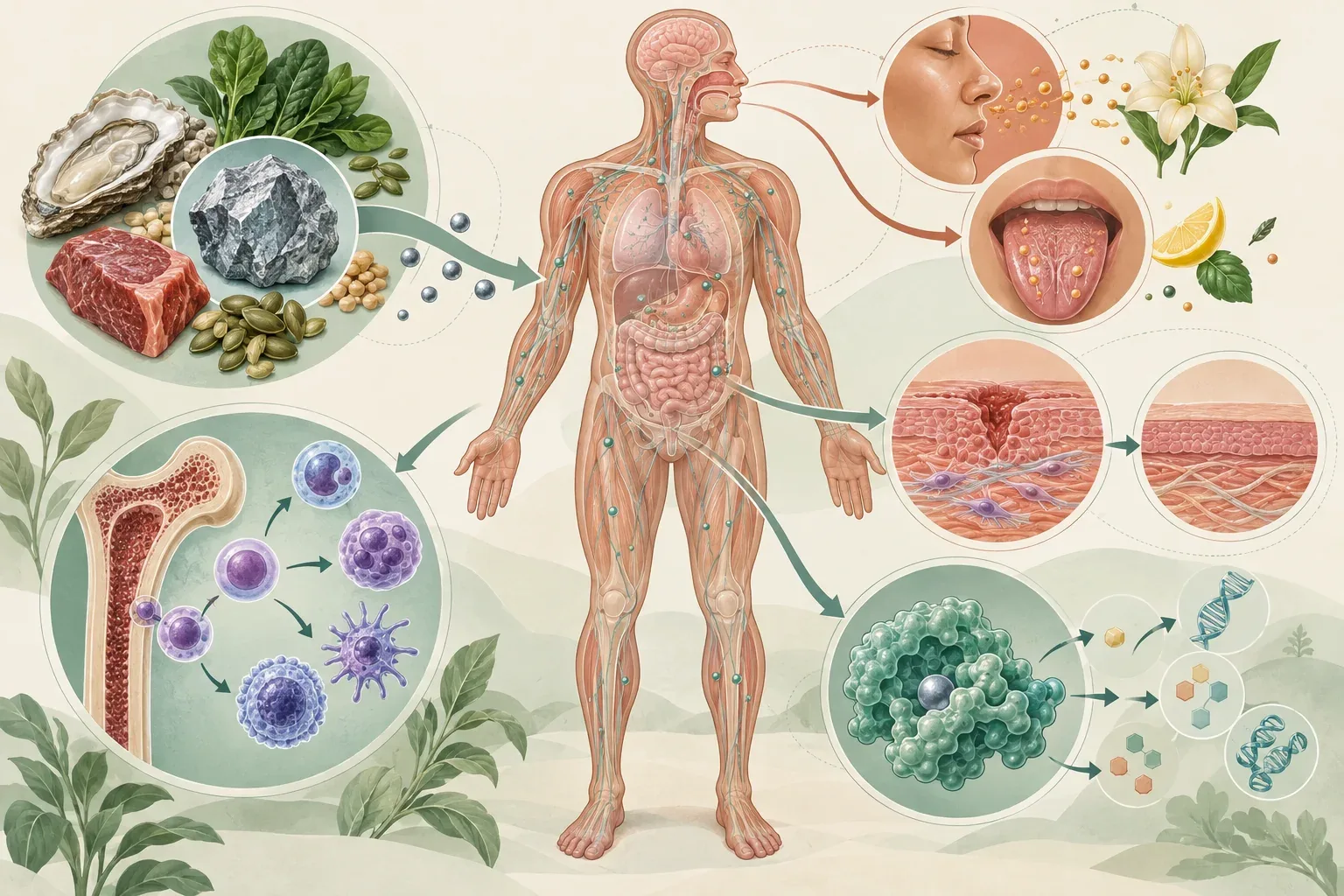
Your body uses selenium in a small set of proteins that limit oxidative damage and help convert thyroid hormone from the storage form to the active form. You also need it for DNA synthesis and for normal reproduction and immune function. The body eliminates excess selenium in urine and, at higher exposures, through breath and skin.
What selenium does in your body
The body uses selenium to make selenoproteins, proteins with selenium built into their working structure. Some help break down peroxides and regulate the chemical balance inside cells. This protects normal cell components from excessive oxidative damage without making selenium a universal shield against disease.
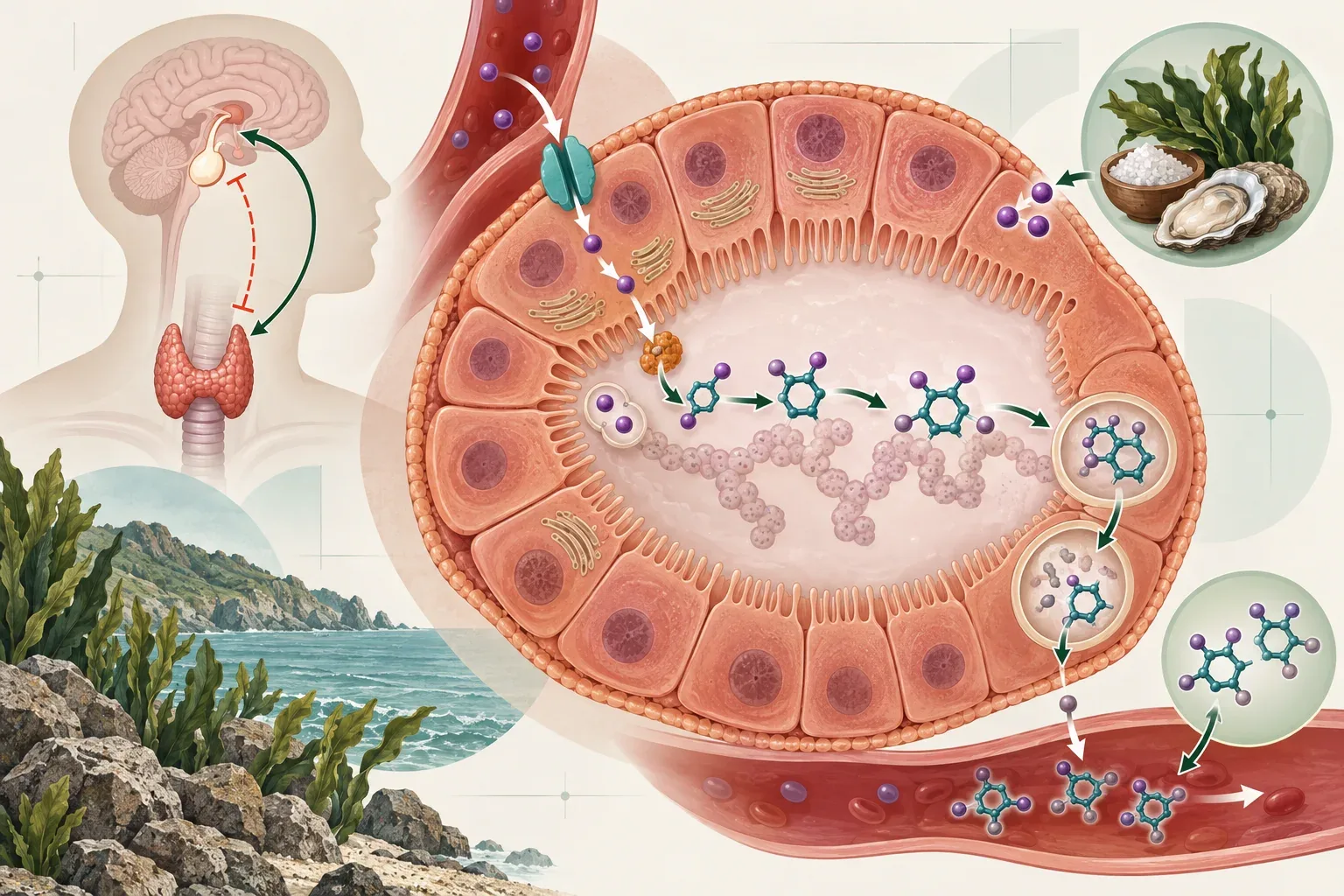
Other selenoproteins help activate and deactivate thyroid hormones. That gives selenium a different thyroid role from iodine: iodine supplies part of the hormone itself, while selenium-containing enzymes help determine how the hormone is processed. Selenium-dependent proteins also contribute to reproduction and other cellular functions.
The relevant biology is the supply needed to produce and maintain these proteins. A fall in a thyroid antibody measurement after supplementation is a separate finding and does not, by itself, show that these processes or a person's symptoms improved. [1]
The short version
Unit: micrograms of selenium. One milligram is 1,000 mcg. If a facts line already says 100 mcg of selenium, that is the amount. Do not convert it again.
Reasonable start: food first. Most US diets already cover the 55 mcg adult amount. If yours does not, fill only the measured gap; use a clinician's plan for a low blood result.
| Form | Common supplement dosage | What that number means |
|---|---|---|
| L-selenomethionine | 55 mcg in many multivitamins; about 100 mcg on a selenium-only bottle | Micrograms of selenium |
| Selenium yeast | The same ordinary microgram labels | Micrograms of selenium supplied by selenium-enriched yeast |
| Sodium selenite or sodium selenate | The same ordinary microgram labels | Micrograms of selenium |
Skip: a 200 mcg “prostate support” bottle, a 400 mcg selenium-only bottle, a plan that adds either of those to daily Brazil nuts, and any claim that one nut equals 55 mcg.
What people take selenium for
| Claimed benefit | Dose / form studied | Research verdict | Evidence strength |
|---|---|---|---|
| Preventing prostate cancer | L-selenomethionine supplying 200 mcg/day selenium; SELECT median follow-up 5.46 years in generally healthy men. | The large prevention trial found no benefit, despite an earlier secondary yeast-trial signal. | Strong |
| Feeling better with Hashimoto hypothyroidism | Selenium yeast supplying 200 mcg/day for 12 months, added to levothyroxine. | Antibodies fell, but quality of life and hormone dose did not improve. | Moderate |
| Raising low selenium status | 100 mcg/day elemental selenium as selenomethionine or two variable-selenium Brazil nuts for 12 weeks in New Zealand adults. | Both raised selenium markers; nuts did not provide a predictable dose. | Moderate |
A supplement bottle is a reasonable consideration when your diet is actually low, a clinician is following a low plasma or serum result, or if you're on a restricted diet or already under medical care. Hemodialysis, which filters the blood when the kidneys cannot do the job, can lower selenium and also restrict what you eat. If you're going through dialysis procedures, this conversation should be had with the clinician who manages the dialysis.
Taking a 200 mcg product to prevent prostate cancer, or to treat the autoimmune thyroid condition Hashimoto’s in place of the replacement medicine levothyroxine, is a different goal from covering 55 mcg. Large trials at 200 mcg did not cut cancer counts, did not make people with Hashimoto’s feel better, and did not lower their thyroid-hormone dose.
When to ask a doctor before taking selenium
Ask the clinician who prescribes cisplatin before you add selenium. Cisplatin, a platinum chemotherapy drug, can lower selenium in hair and serum. It is not known whether that drop changes your care. Small studies have looked at selenium to blunt chemotherapy side effects, and a Cochrane review found the evidence insufficient.
Common dosage
The recommended daily amount from the National Academies is 55 mcg a day for everyone age 14 and older, counting food and supplements. Men and women share that number. It is not set by body weight.
The official upper limit from the National Academies is 400 mcg a day from food and supplements from age 14, including pregnancy and lactation. That number is the US safety boundary.
Younger amounts on the same US sheet:
| Age | Recommended amount | Upper limit |
|---|---|---|
| Birth to 6 months | 15 mcg | 45 mcg |
| 7–12 months | 20 mcg | 60 mcg |
| 1–3 years | 20 mcg | 90 mcg |
| 4–8 years | 30 mcg | 150 mcg |
| 9–13 years | 40 mcg | 280 mcg |
The infant figures are adequate intakes, set from typical breast-milk intake, not from a separate recommended-amount study in babies. Sex does not split these childhood numbers.
For an adult supplement, take it once a day, at whatever hour you will remember. The fact sheet does not tie selenium to an empty stomach, a meal, or a morning-versus-night schedule.
Food and selenium
Average US intake is about 108 mcg a day from food and beverages from age 2 upward, and about 116 mcg when supplements are included. Adult men average about 132 mcg from food and women about 94 mcg, both above the 55 mcg recommendation. Your own diet can differ.
Selected values from the NIH Office of Dietary Supplements food table[1] show the stated food and preparation.
| Food and preparation | Source | Serving | Selenium (mcg) |
|---|---|---|---|
| Brazil nuts | Plant | 1 oz (6–8 nuts) | 544 mcg |
| Yellowfin tuna, cooked | Fish | 3 oz (about 85 g) | 92 mcg |
| Sardines, canned | Fish | 3 oz (about 85 g) | 45 mcg |
| Shrimp, cooked | Shellfish | 3 oz (about 85 g) | 42 mcg |
| Pork chop, broiled | Meat | 3 oz (about 85 g) | 37 mcg |
| Spaghetti, cooked | Plant | 1 cup | 33 mcg |
Brazil nuts vary widely between nuts and growing regions. One ounce already exceeds the US adult upper limit of 400 mcg, so this average is not a measured daily dose.
A 3-ounce serving of cooked yellowfin tuna has about 92 mcg; canned sardines about 45 mcg; one large egg about 15 mcg; 3 ounces of roasted turkey about 26 mcg; and a cup of cooked spaghetti about 33 mcg. Meals containing foods like these can cover the daily amount without a capsule.
Brazil nuts are the exception to ordinary food arithmetic. One ounce averages 544 mcg—above the adult US ceiling—and individual nuts vary too much to function as measured doses. Treat them as an occasional food rather than a daily capsule substitute. If your diet rarely includes the foods above or is medically restricted, we recommend doing diet review and, when appropriate, a plasma or serum test before choosing a supplement.
How can I tell if I'm low on selenium?
Selenium deficiency alone rarely produces obvious illness. Its best-known clinical consequences come from particular low-selenium regions and additional contributing factors, rather than a universal symptom sequence. [1]
Low status without a distinctive symptom
Biochemical changes can occur without a recognizable illness. There is no established minor or moderate deficiency checklist, and fatigue alone is not a useful selenium test.
Serious disease associated with very low intake
Keshan disease is a heart-muscle disorder associated with very low selenium intake in particular regions of China. Kashin-Beck disease affects joints and has been associated with low-selenium and low-iodine regions.
Testing and interpretation
For more information about testing for selenium, see the lab tests and preparation details near the end of this article.
Selenium forms you can buy
L-selenomethionine, selenium yeast, sodium selenite, and sodium selenate all supply selenium. If you buy one to close a food gap, compare its micrograms with the amount that is actually missing; if a low blood result is the reason, use the clinician's plan. All four can be absorbed at up to about 90% according to the NIH fact sheet. No head-to-head trial has ranked them for prostate cancer, diabetes, or Hashimoto quality of life at the same micrograms. Pick by the microgram line and by whether you already eat a high-selenium food, not by a yeast-versus-salt slogan.
L-selenomethionine
This was the form in the large prostate-prevention trial. A label that reads “Selenium 100 mcg (as L-selenomethionine)” supplies 100 mcg of selenium; the source name does not change the arithmetic.
Selenium yeast
Yeast grown in a high-selenium medium is mostly selenomethionine, and the label still states micrograms of selenium. The skin-cancer trial used high-selenium yeast; the Hashimoto trial used a named yeast supplied by its manufacturer.
Sodium selenite and sodium selenate
These are inorganic salts. Historical programs used selenite in regions with severe dietary shortage. A line reading “Selenium 100 mcg (as sodium selenite)” supplies 100 mcg of selenium. It is not a gentler high dose or a detoxification protocol.
Can you take two selenium products the same day?
Possibly, but first ask whether the second product fills a real gap. Add food, multivitamins, stand-alone products, and Brazil nuts, then compare the total with the US and European upper limits.
What to pay attention to on the label
Which number on the label is the amount?
If you're considering buying a product that says selenium 100 mcg (as L-selenomethionine), the amount is 100 mcg of selenium. The words in parentheses name the source. A line in milligrams would be a thousand-fold jump, because 1 mg is 1,000 mcg. Percent Daily Value uses 55 mcg as its base for adults and for children age 4 and older.
Misleading labels
Prostate support at 200 mcg
A “prostate support” label that lists 200 mcg is using the research dose, not the everyday 55 mcg amount. The large prevention trial at that dose did not prevent prostate cancer.
A Brazil nut counted as 55 mcg
The USDA average is 544 mcg in one ounce, about six to eight nuts, which is already above the 400 mcg adult ceiling. The NIH fact sheet also cites analyses around 68–91 mcg per nut, and one tested batch found two nuts averaging 53 mcg. No single nut can be counted as a 55 mcg dose.
Yeast and selenomethionine treated as the same product
A yeast tablet and an L-selenomethionine capsule can each supply 200 mcg of selenium; that number tells you the selenium amount, not that the preparations are identical. The capsule supplies the named compound L-selenomethionine. Selenium-enriched yeast is grown with selenium and contains a mixture of selenium compounds, predominantly selenomethionine, whose proportions can vary between products. Both forms are absorbed, but a result from a yeast trial should not automatically be assigned to a pure selenomethionine capsule, or vice versa. [1]; a human comparison[2] found that plasma selenium tracked the selenomethionine content of the yeast preparation.
Manufacturer claims and the studies they may be based on
A prostate claim on a 200 mcg label may be leaning on a secondary finding from an older yeast trial in people who already had skin cancer. It is probably not leaning on the later prevention trial, which did not show a benefit. A thyroid claim may be leaning on studies that moved antibody levels.
How long should I take selenium supplements for?
If diet is low in selenium, including because of local food sources or restrictions, the aim is an ordinary continuing intake, not a large initial dose. Once food and any supplement cover that need, there is no established taper to finish. Selenium status and the risk from excess depend on form and sustained exposure; a short blood change is not a reason to keep taking a trial-sized amount. NIH's review[1] does not give a universal depletion clock or a safe course length for high-dose prevention claims. Add selenium from multivitamins and Brazil nuts when checking total intake.
How selenium interacts with other nutrients
Iodine
Iodine and selenium both sit in thyroid hormone production. The useful pairing is each mineral at its own recommended daily amount. For selenium that is 55 mcg in adults. For iodine it is 150 mcg in adults. Low selenium can make a severe iodine shortage worse, including the risk of congenital hypothyroidism in infants in regions where both are scarce.
Common Myths about Selenium
Is 200 mcg a harmless prostate dose?
The dose people still see on prostate bottles is 200 mcg. In the large prevention trial, men assigned to 200 mcg of selenium as L-selenomethionine developed prostate cancer about as often as men assigned to placebo, and the earlier yeast trial's prostate finding was secondary. The counts are in prostate cancer and the 200 mcg dose.
Does one Brazil nut equal the recommended daily amount?
No. The ounce average, the per-nut estimates, and the tested batch disagree with each other, and none of them makes a nut a 55 mcg capsule. The numbers are under a Brazil nut counted as 55 mcg, and the tested batch is in Brazil nuts are not a precise dose capsule.
If thyroid antibodies drop, is selenium treating Hashimoto’s?
Antibodies can move without a change in how people feel or in the levothyroxine dose; the year-long yeast trial and the Cochrane review are in thyroid antibodies and how people feel.
Drawbacks and side effects
| Potential drawback | When/who it affects | Research evidence | Practical implication |
|---|---|---|---|
| Hair and nail damage, metallic taste or digestive effects | Excess selenium over time, organic or inorganic forms. | Recognized selenosis; US adult limit is 400 mcg/day and EFSA uses 255 mcg/day. | Count food, nuts and supplements together. |
| Possible diabetes risk | Long-term 200 mcg/day elemental selenium from selenium yeast, particularly with high baseline status. | A secondary randomized-trial analysis found more diabetes; SELECT was not statistically clear. | Do not assume 200 mcg is harmless or necessary when intake is already adequate. |
| Acute poisoning from a misformulated product | Exposure far above the labelled amount. | A documented outbreak involved roughly 200-fold label error. | After a suspected large accidental dose, stop using the product and seek urgent medical advice. |
What a high dose usually does
Too much selenium causes hair loss and nails that turn brittle or fall out. Earlier signs are breath that smells like garlic and a metallic taste. People can also develop a rash, nausea, diarrhea, fatigue, irritability, or nervous-system symptoms. Chronic high intakes of the organic and inorganic forms look similar.
The US upper limit is 400 mcg a day from food and supplements (see common dosage). In 2023 the European Food Safety Authority set an adult upper limit of 255 mcg a day, including pregnant and lactating women, using hair loss in the large trial that gave men 200 mcg of selenium as selenomethionine to try to prevent prostate cancer. The lowest observed adverse level in that file was 330 mcg, and the European ceiling applies an uncertainty factor. The United States has not adopted 255 mcg. Because the ceiling counts food too, a 400 mcg capsule on top of a typical US diet (about 108 mcg from food) puts you above both the US and European limits.
Children’s ceilings are much lower, down to 45 mcg in early infancy. The US ceiling does not apply when a physician is directing the dose for a medical reason.
When too much is dangerous
Acute poisoning is possible. In a 2008 outbreak, a misformulated liquid contained about 200 times the labeled selenium and sickened 201 people. One person was hospitalized; none died. Digestive symptoms, fatigue, hair loss and nail changes were common, and some symptoms persisted for months. This was a major manufacturing overdose, not an ordinary 55 mcg capsule. [3]
Selenium during pregnancy and breastfeeding
For pregnant women, the recommended daily amount from the National Academies is 60 mcg a day. For lactation it is 70 mcg. Those figures count food and supplements. The adult upper limit stays 400 mcg in the US tables and 255 mcg in the 2023 European opinion.
The American Thyroid Association has a weak recommendation against selenium supplementation for pregnant women who have thyroid peroxidase antibodies. The NIH fact sheet summarizes one trial in which women with those antibodies and marginal selenium status took 200 mcg a day of selenium as selenomethionine from early pregnancy through 12 months after delivery. Fewer of them developed postpartum thyroid disorders than the women on placebo. That research dose is not the 60 mcg amount. The pregnancy trials are mixed, and the association still recommends against using selenium for thyroid autoimmunity in pregnancy. Read the selenium line on a prenatal in micrograms, next to food, instead of assuming the capsule is 60 mcg or 200 mcg.
The science behind selenium
The trials answer three separate questions. Preventing cancer at 200 mcg did not hold up in the large selenomethionine trial, after a smaller yeast trial had looked encouraging on a secondary prostate count. Lowering thyroid antibodies did not improve quality of life or reduce the thyroid-hormone dose.
Prostate cancer and the 200 mcg dose
The trial built to answer the prostate question gave 35,533 men 200 mcg a day of selenium as L-selenomethionine, with or without 400 IU of vitamin E, or placebo. Prostate-cancer counts were 432 on selenium and 416 on placebo, and the range around the risk estimate included no difference. Follow-up still showed no selenium benefit; the vitamin E arm, not the selenium arm, later showed more prostate cancers.
An earlier trial is why the 200 mcg selenium dose supplied by yeast stayed on labels. It gave high-selenium yeast to 1,312 adults with prior nonmelanoma skin cancer. Recurrent skin cancer did not fall. A secondary analysis reported fewer prostate cancers mainly among men whose starting plasma selenium was below 10.6 mcg/dL, with no effect above 12.3 mcg/dL.
That secondary cut is what the larger trial failed to confirm. A Cochrane review of randomized trials using 200 to 500 mcg of selenium, mostly as selenomethionine, found little or no effect on cancer incidence or death. The FDA’s qualified-claim decision is that a prostate-cancer benefit is highly unlikely.
More diabetes cases occurred in the selenium-yeast trial
A secondary analysis of that yeast trial counted 58 new diabetes cases on selenium and 39 on placebo: 12.6 versus 8.4 cases for every 1,000 people followed for one year. The extra cases were concentrated among people whose plasma selenium was already in the top third at the start.
In the selenomethionine prevention trial, diabetes was about 7% more frequent in the selenium-only arm than in the placebo arm, but the difference was small enough to be compatible with chance. The yeast analysis is a reason not to treat 200 mcg as harmless by default.
Thyroid antibodies and how people feel
The year-long trial added 200 mcg a day of selenium from selenium yeast (SelenoPrecise) or placebo to usual levothyroxine in adults with thyroid peroxidase antibodies; the manufacturer supplied the tablets. After 12 months, quality-of-life scores were 28.8 versus 28.0, the levothyroxine dose did not fall, and antibody levels were lower. An earlier Cochrane review found antibody changes that could not be combined reliably and clinical results too thin to recommend supplementation.
A separate trial in healthy older adults used 100, 200, or 300 mcg of selenium from selenium yeast for six months and found no change in thyroid function. The mixed pregnancy trials are in selenium during pregnancy and breastfeeding. More research would be needed, by sex and by starting selenium level, before a 200 mcg add-on became ordinary thyroid care.
Brazil nuts are not a precise dose capsule
A 12-week trial in New Zealand compared two Brazil nuts a day, 100 mcg of selenium as selenomethionine, and placebo. Investigators expected each two-nut daily serving to supply about 100 mcg, but the tested batches averaged 53 mcg per two-nut serving and ranged from about 20 to 84 mcg per serving. Individual nuts varied even more. Plasma selenium rose with both nuts and the capsule, but the wide variation prevents a reliable 55 mcg serving calculation without testing the bag.
What you may have heard on podcasts
On 30 March 2026, Rhonda Patrick pointed at selenium on a typical supplement-facts panel and described it as helping enzymes involved in metabolism, making nerve-signaling chemicals, immune function, and liver function. She was talking about the selenium line on a multivitamin label, not a separate 200 mcg capsule.
On 27 July 2026, Stasha Gominak put selenium among minerals she said gut bacteria have been managing all along. She treated long mineral-deficiency lists as often downstream of a damaged microbiome, which points away from adding a separate supplement for each mineral.
Labs
For recent-intake testing, results often come back in ng/mL or μg/L; those units are numerically equal. Use the plasma or serum cutoff in the table below, and treat a lower result as a reason to discuss diet and whether a nutrition-sized supplement makes sense—not as an automatic prescription for the 200 mcg trial dose.
Interpreting the results
Serum or plasma selenium is useful for assessing recent intake; whole blood reflects a longer interval. Specialist tests of selenium-containing proteins can also be affected by inflammation, so they do not automatically settle an uncertain result. [1]
| Reading | Value | What the fact sheet says |
|---|---|---|
| Plasma or serum selenium | 8 mcg/dL or higher (80 ng/mL, about 1.0 µmol/L) | Usually enough to build the proteins that use selenium |
| Whole-blood selenium | no line on the sheet | Reflects a longer stretch of intake |
Before the test if you already supplement
Tell the clinician your selenium dose, last dose and regular Brazil-nut intake. Ask whether to continue your usual routine if the test is following treatment or investigating excess; there is no general one-day pause that recreates an untreated baseline. Check whether the ordered specimen is serum or plasma, which reflects more recent intake, or whole blood, which reflects a longer interval. Compare the result with the range for that specimen. Consumer hair tests are not substitutes for these blood measurements.
The bottom line
Selenium is essential, but extra selenium did not prevent prostate cancer in the large trial, and lower thyroid antibodies did not translate into feeling better in the Hashimoto study. Correcting a genuine shortfall is a different question from taking more for prevention.
Count all sources before choosing a supplement, including Brazil nuts and any multivitamin. Nuts can supply a lot, but not a predictable dose from one nut to the next. We would not chase an antibody result or an antioxidant promise by steadily increasing intake; excess selenium can create the very hair and nail problems people hope supplements will solve.
Help us improve this article
Spotted an error or found a source we should consider? Tell us which part of this article needs another look and include a link if you have one. Please leave out personal health details and lab results; we can’t answer individual medical questions.
Explore more in thyroid

More in minerals

References
- NIH Office of Dietary Supplements: Selenium — Health Professional Fact Sheet ↩
- a human comparison ↩
- Original outbreak investigation ↩
- National Academies: Dietary Reference Intakes, selenium chapter
- European Food Safety Authority: selenium upper limit, 2023
- Clark et al.: selenium yeast and skin cancer
- Stranges et al.: selenium yeast and type 2 diabetes
- Lippman et al.: selenomethionine, vitamin E, and prostate cancer
- Klein et al.: follow-up after the prevention trial stopped
- Vinceti et al.: Cochrane review of selenium for cancer prevention
- Thomson et al.: Brazil nuts and selenomethionine
- van Zuuren et al.: Cochrane review of selenium for Hashimoto’s thyroiditis
- Larsen et al.: selenium yeast, quality of life, and thyroid antibodies