
How does that differ from a tradition of tonics, teas and homemade extractions?
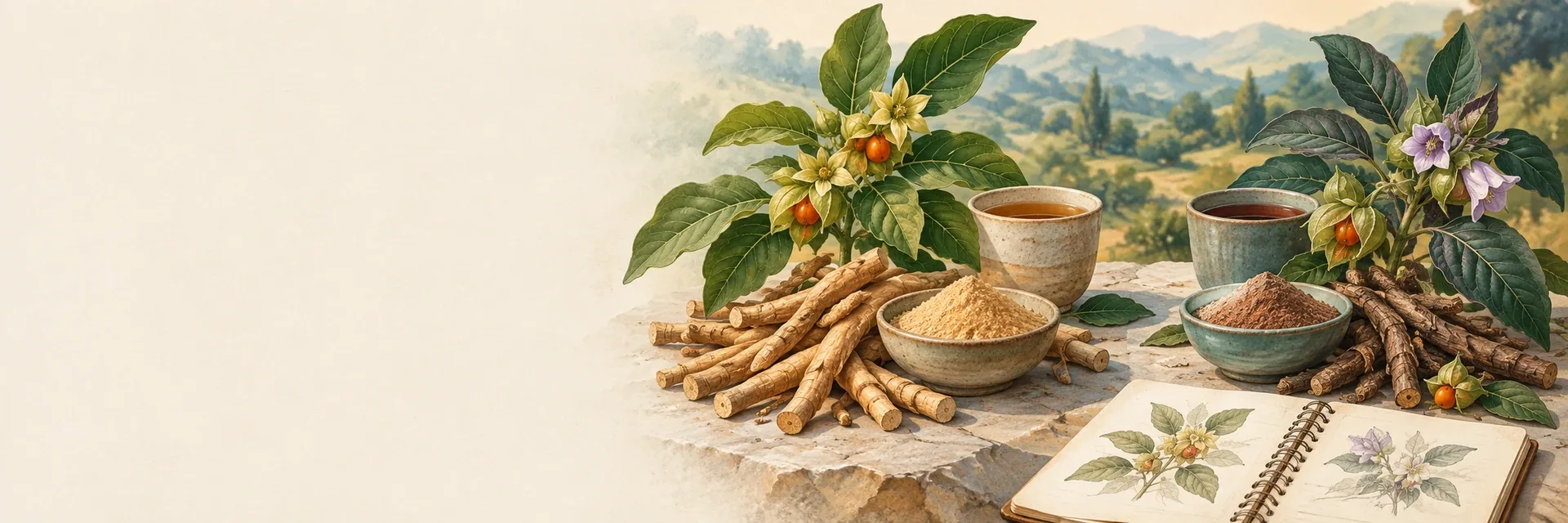
An older category may include goals broader than a modern study can measure. Ayurveda's rasayana tradition talks about rejuvenation and maintaining health. The CCRAS account of ashwagandha[1] describes its place in that tradition, including uses associated with strength and vitality.
Asian ginseng has its own history in Chinese medicine. Its root was simmered in water or made into tea, and red and white ginseng were prepared differently. NCCIH[2] describes its tonic and calming uses. Modern trials often give people a measured powder or extract instead of a homemade drink. Holy basil leaf tea in South Asia and rhodiola root infusions in northern Eurasia are other older practices that now sit under the newer “adaptogen” label.
Putting these different plants under one name raises a research question: do they share an effect on responses to stress?
| Plant | Earlier preparation and purpose | Modern trial preparation and measured effect |
|---|---|---|
| Ashwagandha | Root preparations in Ayurvedic rasayana practice, associated with strength and vitality | A 60-day KSM-66 trial[3] found lower stress scores than placebo; a ten-week study[4] found a modest difference in time to fall asleep. Both tested defined extracts, not tea. |
| Asian ginseng | Root decoctions or teas, including differently prepared white and red roots, for fatigue or vitality | A 2013 fatigue trial[5] and a 2020 fatigue trial[6] did not clearly improve their main fatigue scores. A separate 12-week Korean red-ginseng trial[7] found fewer people reporting a respiratory illness, without shortening or easing those illnesses. |
| Rhodiola | Root/rhizome preparations for tiredness in regional traditions | In one 28-day SHR-5 trial[8], burnout and some attention measures improved; a six-week trial of another extract[9] found fatigue and vitality scores favored placebo. |
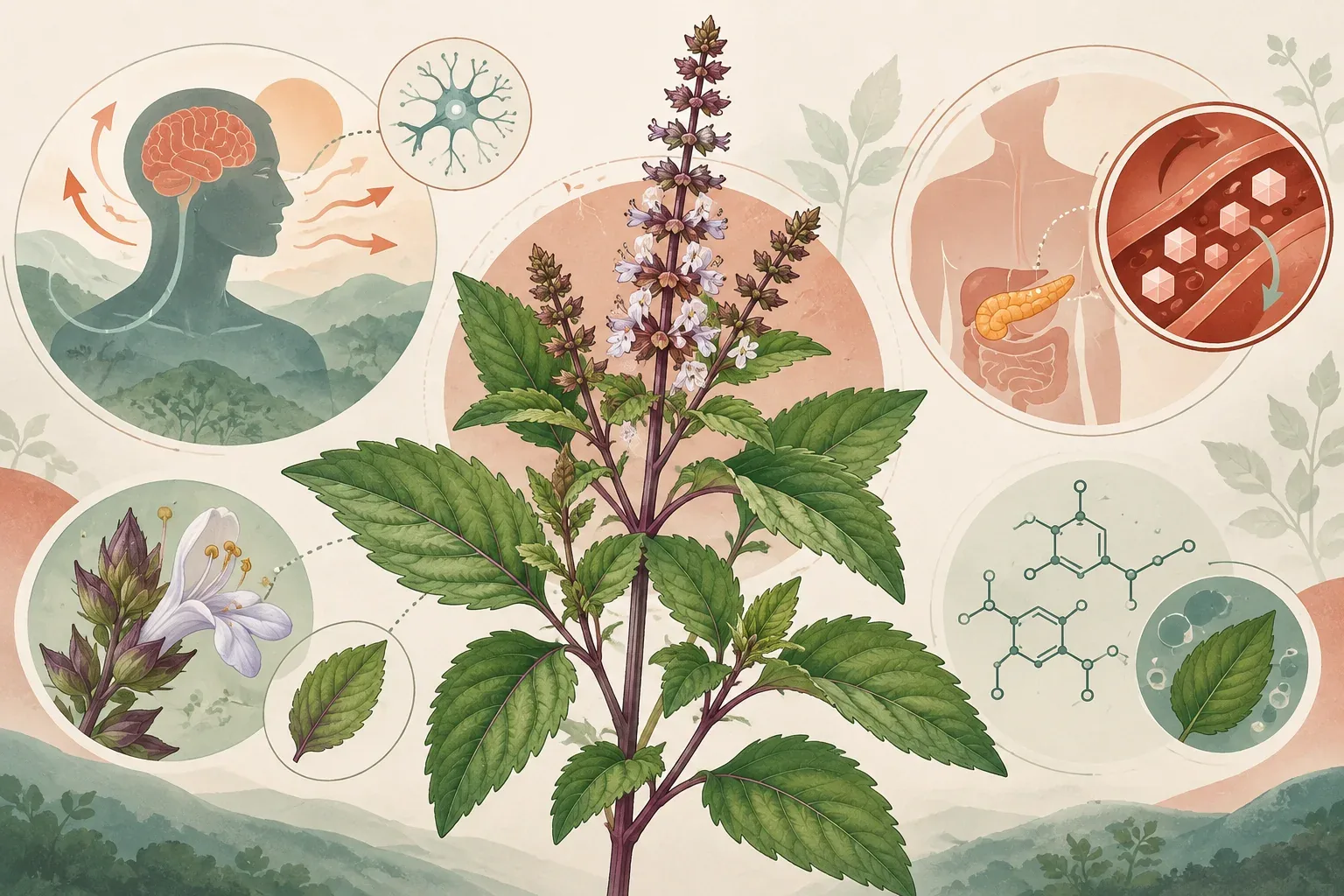
| Holy basil | Leaf infusions in South Asian household and Ayurvedic practices | OciBest[10] and Holixer[11] improved self-rated stress in separate six- and eight-week trials. In the Holixer trial, one sleep questionnaire improved, while another and the wrist tracker did not clearly differ. |
The traditional column records use, not a controlled effect. The modern column records what investigators actually compared; it cannot validate every old indication or home preparation.
Where did the term come from?
The European Medicines Agency's 2008 reflection paper[12] traces the term to Lazarev in 1947 and describes the proposal that a substance could increase resistance to different adverse influences. “Nonspecific resistance” meant a response extending beyond one particular stressor.
Brekhman and Dardymov's 1969 paper[13], titled New substances of plant origin which increase nonspecific resistance, records the later development of that research program. These are twentieth-century scientific sources, rather than translations of an ancient herbal category.
That history matters when a label presents “adaptogen” as if it were a single inherited medical tradition. Researchers applied a newer concept to substances with different backgrounds. The proposed shared effect is greater resistance to stress; the category does not establish that every member produces it in people.
What have the modern experiments actually measured?
“Stress” may mean a demanding week, insomnia, an anxiety questionnaire, a cortisol measurement or a response to a laboratory challenge. These are not equivalent outcomes. The same applies to fatigue and “energy”: one trial may recruit people with a diagnosed condition, another healthy adults who feel tired. A plant extract that changes one score may or may not help with the problem a reader means. These differences explain why you cannot select a dose for one herb from another herb's study. Even within a plant, the extract and the outcome can differ.
The studies below measure narrower outcomes than whether a herb helps someone “adapt” to everything. Stress trials commonly ask people how stressed they feel; some also measure hormones or responses to a defined challenge. These are different questions, and each result needs to be read on its own terms.
| Plant | What was tested for | What the evidence can address | What remains separate |
|---|---|---|---|
| Ashwagandha | Perceived stress and insomnia | Some preparations may improve these symptoms, according to NCCIH[14]. | Effects of other preparations, longer-term safety and claims about longevity. |
| Rhodiola | Fatigue and exhaustion | Specific extracts have been studied; the 2024 European assessment[15] found trial quality insufficient for well-established use. | A general improvement in stress resistance across situations. |
| Asian ginseng | Fatigue and physical performance | Pooled fatigue trials[16] suggest a modest symptom signal in some disease-related settings. | An effect from any ginseng tea or on every kind of fatigue. |
| Eleuthero, also called Siberian ginseng | Chronic fatigue | A 96-person trial[17] found no clear overall advantage over placebo. | Whether another preparation benefits a different group. |
| Holy basil | Perceived stress and sleep | A trial of the Holixer extract[18] found improved questionnaires; wrist-tracker sleep results did not clearly differ. | The same effect from tea or longer-term outcomes. |
| Maca | Sexual function and mood, rather than a general stress challenge | Small trials ask these narrower questions. | Evidence for a nonspecific adaptation effect. |
| Bacopa | Memory and attention, rather than generic resilience | Trials focus on cognitive tests over weeks. | Treating a memory finding as proof of hormone or stress normalization. |
Mushroom tonic claims need their own comparisons
Reishi and cordyceps have different histories and experiments in the tonic discussion. In Tang's 2005 reishi trial[19], Ganopoly, an extract containing complex carbohydrates called polysaccharides, improved fatigue and wellbeing measures over eight weeks. That is a narrower finding than longer life or an ability to normalize every response to stress.
For cordyceps, Chen's 2010 pilot[20] used fermented Cs-4 rather than the wild fungus–insect material described in its historical account. Fifteen participants completed the study. Some exercise measurements improved within the active group, but maximum oxygen uptake did not change and the overall controlled comparison did not establish an advantage over placebo.
| Mushroom or extract | Tested preparation and outcome | What remains open |
|---|---|---|
| Reishi | Ganopoly polysaccharide extract for fatigue and wellbeing questionnaires in an eight-week trial | Whether other extracts, teas or long-term use reproduce it |
| Cordyceps | Fermented Cs-4 for exercise measures in a small pilot | A clear controlled performance benefit and transfer to wild material |
| Lion's mane | Specific preparations for memory or mood tests | Whether those outcomes reflect a general “stress adaptation” effect |
| Chaga | Mostly laboratory and animal work | A human trial establishing a tonic or fatigue benefit |
Does traditional use prove that it works?
A traditional-use listing applies a different standard from well-established clinical use. For eleuthero[21], the European Medicines Agency describes long-standing use for tiredness and weakness, plausible effectiveness and insufficient trial evidence for a firm conclusion.
That position can coexist with the negative overall result in a modern fatigue trial. The history supports why the preparation has been used; the trial tests how it performs in a comparison under defined conditions.
Rhodiola's assessment makes the distinction similarly explicit. A defined extract can have a documented use history while the available trials still leave uncertainty.
What would test a claim to normalize stress or hormones?
A claim to normalize a system needs a clear definition of normal, a specified starting condition and measurements chosen before the experiment. If a claim promises to raise a low response and lower a high one, a study should test those conditions rather than reporting only an average change across everyone.
A lower cortisol result is therefore one observation to interpret. To show that cortisol caused a symptom improvement, researchers need evidence beyond the fact that both changed. To show broader adaptation, they would need defined challenges and outcomes that match that claim. The same logic applies to claims about energy or immune balance: first specify what will count as success.
That is a way to make a broad idea testable. It also protects a potentially useful finding from being stretched into an explanation the experiment never examined.
Can a traditional practice help without a complete mechanism?
Traditional practice can be a reason to investigate a preparation and, for an individual, a way of making a familiar drink or routine. A mechanism need not be completely known before a treatment can show a benefit in a controlled trial. For example, the named holy-basil extract improved some stress questionnaires even though that trial did not establish a full biological explanation; the reishi extract improved fatigue measures without proving a universal “tonic” mechanism. The useful question is whether the same preparation and outcome have been tested well enough for the use you have in mind. A tradition alone does not answer that question, and lack of a complete mechanism does not erase a measured result.
The bottom line
If you are considering an “adaptogen,” start with the result you want and look for the named plant, preparation and daily amount. For stress, a 60-day KSM-66 ashwagandha study and an eight-week Holixer holy-basil study found improvements on stress questionnaires at 600 mg and 250 mg a day, respectively. For fatigue, one SHR-5 rhodiola trial was encouraging while a trial of another extract found scores favoring placebo.
Check safety for the actual ingredient as well as its claimed benefit. NCCIH[14] reports liver-injury cases and thyroid-related concerns with ashwagandha. If a blend hides the amount of each herb, we'd generally recommend avoiding it, since a longer list alone gives little reason to expect a better result.
Help us improve this article
Spotted an error or found a source we should consider? Tell us which part of this article needs another look and include a link if you have one. Please leave out personal health details and lab results; we can’t answer individual medical questions.
Explore more in stress



References
- CCRAS account of ashwagandha ↩
- NCCIH ↩
- 60-day KSM-66 trial ↩
- ten-week study ↩
- 2013 fatigue trial ↩
- 2020 fatigue trial ↩
- 12-week Korean red-ginseng trial ↩
- 28-day SHR-5 trial ↩
- six-week trial of another extract ↩
- OciBest ↩
- Holixer ↩
- European Medicines Agency's 2008 reflection paper ↩
- Brekhman and Dardymov's 1969 paper ↩
- NCCIH ↩
- 2024 European assessment ↩
- Pooled fatigue trials ↩
- 96-person trial ↩
- trial of the Holixer extract ↩
- Tang's 2005 reishi trial ↩
- Chen's 2010 pilot ↩
- eleuthero ↩