
What is a prenatal supplement?
A prenatal supplement is a combination of nutrients intended for use around pregnancy, but there is no one standard formula. Some contain iron and fish oil; others omit iron, use algae-derived DHA, or supply very little calcium and choline. Choosing one means comparing its full daily serving across products, then checking how it fits your food intake and stage of pregnancy.
The clearest early action is folic acid before conception and during early pregnancy. Other decisions depend more on diet, test results, local guidance and the actual product. A longer ingredient list or a higher percentage on the label does not settle those questions. NIH prenatal overview[1] · USPSTF folic acid recommendation[2]
This guide covers adults aged 19–50. Previous neural-tube-defect pregnancy, bariatric surgery, diagnosed deficiencies and significant thyroid or kidney disease need a separate clinical plan.
Which daily nutrient amounts change before, during and after pregnancy?
The table below gives total daily intake references from food and supplements for adults aged 19–50. An RDA is a recommended dietary allowance. An AI is an adequate intake used when evidence is insufficient to set an RDA. These are intake references, not instructions for every prenatal to contain the full amount. A Daily Value (DV) is the comparison number used for label percentages; a pregnancy/breastfeeding DV can differ from the reference for your current stage. For example, 55 mg choline is 10% of the 550 mg label DV but about 12% of the 450 mg pregnancy AI. Units and abbreviations are explained below.[^units]
| Nutrient | Type | Before pregnancy | Pregnancy | Breastfeeding | Adult upper limit and what counts |
|---|---|---|---|---|---|
| [3] | RDA | 400 mcg DFE | 600 mcg DFE | 500 mcg DFE | 1,000 mcg synthetic folate from supplements/fortified foods; count actual amount, not DFE |
| [4] | RDA | 18 mg | 27 mg | 9 mg | 45 mg total |
| [5] | RDA | 150 mcg | 220 mcg | 290 mcg | 1,100 mcg total; thyroid guidance can be stricter |
| [6] | RDA | 700 mcg RAE | 770 mcg RAE | 1,300 mcg RAE | 3,000 mcg RAE of preformed A, food plus supplements |
| [7] | RDA | 15 mcg / 600 IU | 15 mcg / 600 IU | 15 mcg / 600 IU | 100 mcg / 4,000 IU oral total |
| [8] | RDA | 1.3 mg | 1.9 mg | 2.0 mg | US: 100 mg total; EFSA: 12 mg total[^b6-limit] |
| [9] | RDA | 8 mg | 11 mg | 12 mg | 40 mg total |
| [10] | RDA | 2.4 mcg | 2.6 mcg | 2.8 mcg | No established upper limit |
| [11] | AI | 425 mg | 450 mg | 550 mg | 3,500 mg total |
| [12] | RDA | 1,000 mg | 1,000 mg | 1,000 mg | 2,500 mg total |
| [13] | RDA | 310 mg at 19–30; 320 mg at 31–50 | 350 mg at 19–30; 360 mg at 31–50 | 310 mg at 19–30; 320 mg at 31–50 | 350 mg from supplements/medicines; food excluded |
| [14] | AI | 1.1 g | 1.4 g | 1.3 g | No established upper limit |
[^b6-limit]: The US and European Food Safety Authority (EFSA) limits differ because they assessed nerve-damage evidence differently. EFSA set its 12 mg limit in 2023; neither upper limit is a routine-use target. [15]
[^units]: mcg means micrograms; 1,000 mcg equals 1 mg. RAE compares vitamin A activity from different sources. DFE adjusts folate amounts for differences in absorption. ALA is a plant omega-3; DHA and EPA are longer-chain omega-3s found in fish and some algae. ALA conversion to DHA is limited, and the US has no separate DHA or EPA RDA or AI.
Folic acid: the number behind the DFE
Why is folic acid added to a prenatal?
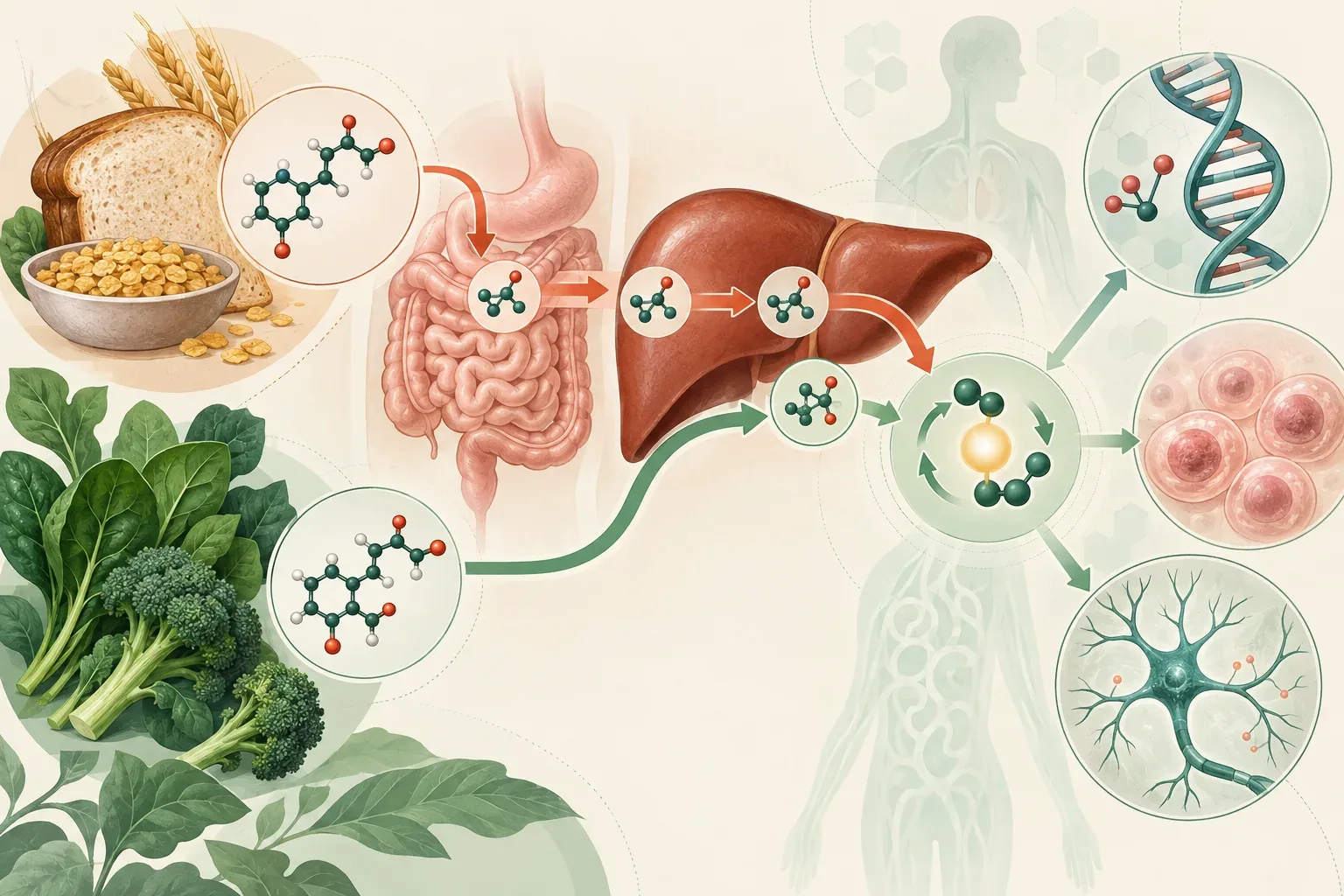
Folate supports DNA synthesis and rapid cell division in both the pregnant person and the developing embryo. Adequate folic acid before conception and in early pregnancy reduces neural tube defects, which affect development of the brain and spinal cord before many people know they are pregnant. The USPSTF recommends[2] 400–800 mcg folic acid daily for those planning or capable of pregnancy, starting at least one month before conception and continuing through the first two to three months. Folate needs continue later in pregnancy, although the specific neural-tube prevention window is early.
Form, absorption and amount
Natural folate in food and synthetic folic acid do not have identical absorption. Dietary folate equivalents (DFE) put them on a comparable scale: 1 mcg food folate equals 1 mcg DFE, while 1 mcg folic acid taken with food counts as about 1.7 mcg DFE. Thus a label can show 680 mcg DFE from 400 mcg folic acid.
Cautions and higher-risk pregnancies
A previous pregnancy affected by a neural tube defect changes the plan. In the original MRC recurrence trial, women with a prior affected pregnancy who received 4 mg folic acid daily had fewer recurrences than those not assigned folic acid. That is a high-risk treatment setting and should be planned before conception with a maternity clinician.
Iron and iodine: different jobs and different guidance
Iron
Why is iron added to a prenatal?
Pregnancy expands the mother's blood supply and requires iron for making hemoglobin, the oxygen-carrying protein in red blood cells. Iron also supports the placenta and fetal growth. The pregnancy RDA rises from 18 to 27 mg total daily iron. This is a target for intake from food plus supplements, not an anemia-treatment prescription. [4]
Form, absorption and amount
Use the elemental iron number in Supplement Facts. Ferrous fumarate and ferrous bisglycinate are different compounds carrying iron; the weight of the whole compound is not the iron dose. Absorption varies with iron status and the meal: vitamin C can improve nonheme iron absorption, while calcium and phytates can reduce it. A prenatal's 27 mg should therefore be read as supplied iron, not a promise that the body absorbs 27 mg. [4]
Cautions and differing policies
WHO recommends 30–60 mg supplemental elemental iron plus 400 mcg folic acid during pregnancy as a population policy, with the higher amount where anemia is a severe public-health problem. UK RCOG guidance does not advise routine extra iron for most women and instead discusses assessment and treatment when anemia or increased risk is present. Those differences reflect different populations and policies, while the US 27 mg RDA is a total-intake reference. Iron can cause nausea or constipation. Diagnosed deficiency or anemia may require a separate treatment amount and follow-up. [16], [17]
Iodine
Why is iodine added to a prenatal?
The mother needs iodine to make thyroid hormones, which help regulate her metabolism and support fetal brain and nervous-system development. Early in pregnancy the fetus depends on maternal thyroid hormone; later it begins making its own but still needs iodine. The US total-intake RDA is 220 mcg in pregnancy and 290 mcg while breastfeeding. [5]
Form, absorption and amount
A prenatal often supplies 150 mcg iodine as potassium iodide. Seaweed iodine contents vary greatly, so its presence in a prenatal supplement cannot be counted as a fixed dose without a measured amount. [5]
Cautions and the 2026 thyroid guidance
The American Thyroid Association's 2026 guidance describes a 250 mcg total daily goal and suggests 150 mcg supplementation for women at risk of iodine deficiency because of geography, dietary restriction or poor absorption, ideally beginning at least three months before pregnancy and continuing through lactation. That is narrower than older advice that broadly recommended 150 mcg supplementation. The same 2026 table advises avoiding sustained intake above 500 mcg daily in pregnancy without a medical indication, stricter than the US 1,100 mcg population upper limit. [18]
Vitamin A and D: forms and purpose matter
Vitamin A
Why is vitamin A added to a prenatal?
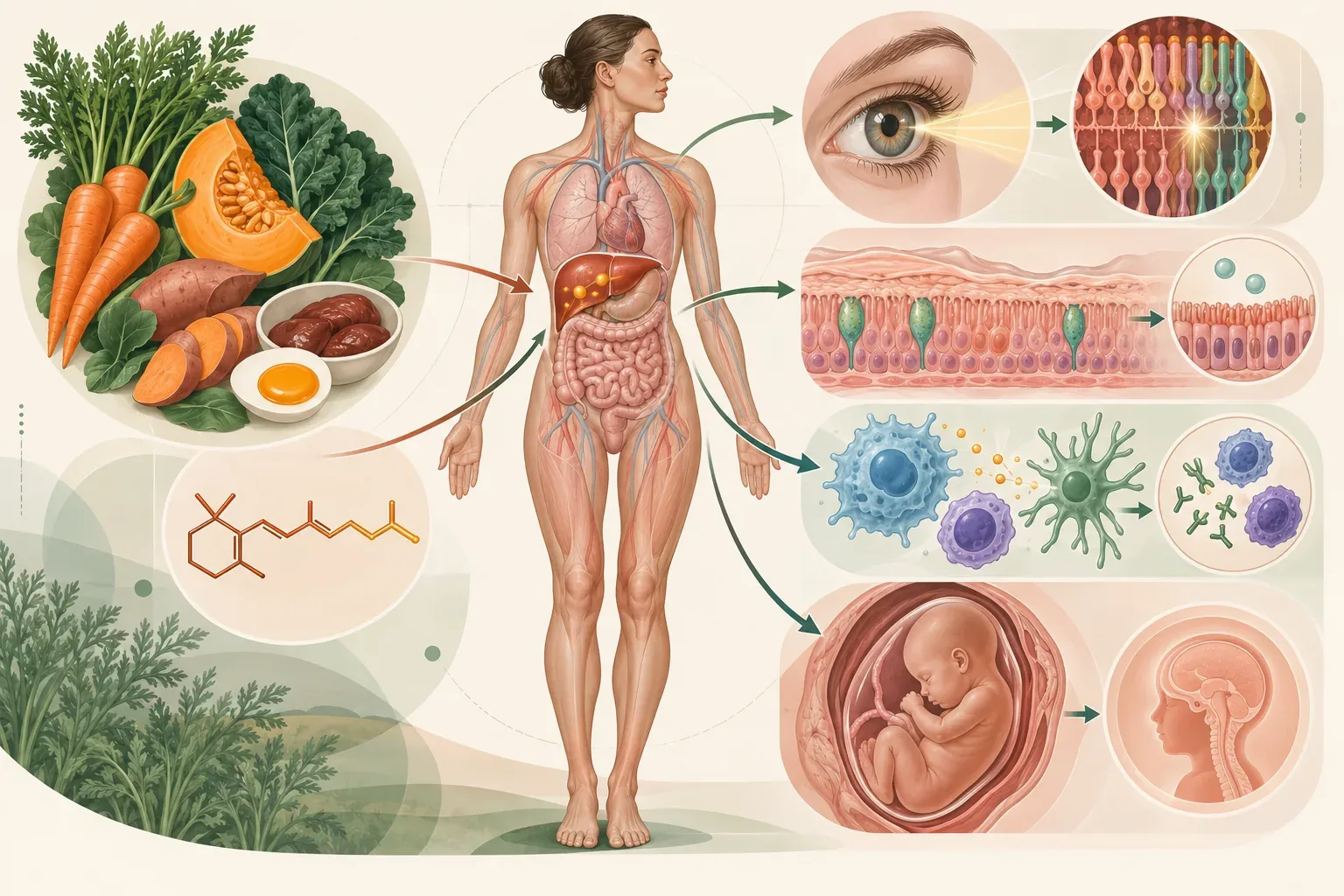
Vitamin A supports the mother's vision and immune function and the baby's growth and organ development. The pregnancy RDA is 770 mcg RAE from food and supplements. RAE is a unit for comparing vitamin A activity from different sources. [6]
Form, absorption and amount
Preformed vitamin A appears as retinol or retinyl acetate/palmitate; beta-carotene is a precursor that the body converts to vitamin A. Both contribute to the RAE number, but they have different safety implications. Check the form behind a product's vitamin A total, especially if you also use cod liver oil or eat liver. [6]
Cautions
Too much preformed vitamin A during pregnancy can cause birth defects. The adult upper limit is 3,000 mcg RAE of preformed A daily, counting food and supplements. Beta-carotene is excluded from that particular limit, but that does not make an extra high-dose beta-carotene product better. [6]
Vitamin D
Why is vitamin D added to a prenatal?
Vitamin D helps the mother absorb calcium and supports bone mineralization for both mother and baby. The ordinary pregnancy RDA is 15 mcg (600 IU) total daily intake. [7]
Form, absorption and amount
Labels may use mcg or IU: 25 mcg equals 1,000 IU, and 50 mcg equals 2,000 IU. D3 in a prenatal can come from lanolin or lichen; the source matters for dietary preference, while the declared amount is what counts toward intake. [7]
Cautions and pregnancy-outcome evidence
WHO does not recommend vitamin D supplementation for all pregnant women to improve pregnancy outcomes. The Endocrine Society's 2024 guideline conditionally suggests supplementation in pregnancy based on low-certainty evidence and advises against routine vitamin D testing in otherwise healthy pregnancy. Neither statement means a diagnosed deficiency should go untreated, and neither makes the largest retail dose the default. The adult upper limit is 100 mcg (4,000 IU) daily. [19], [20]
Choline: a highlighted ingredient can still be a small contribution
Why is choline added to a prenatal?
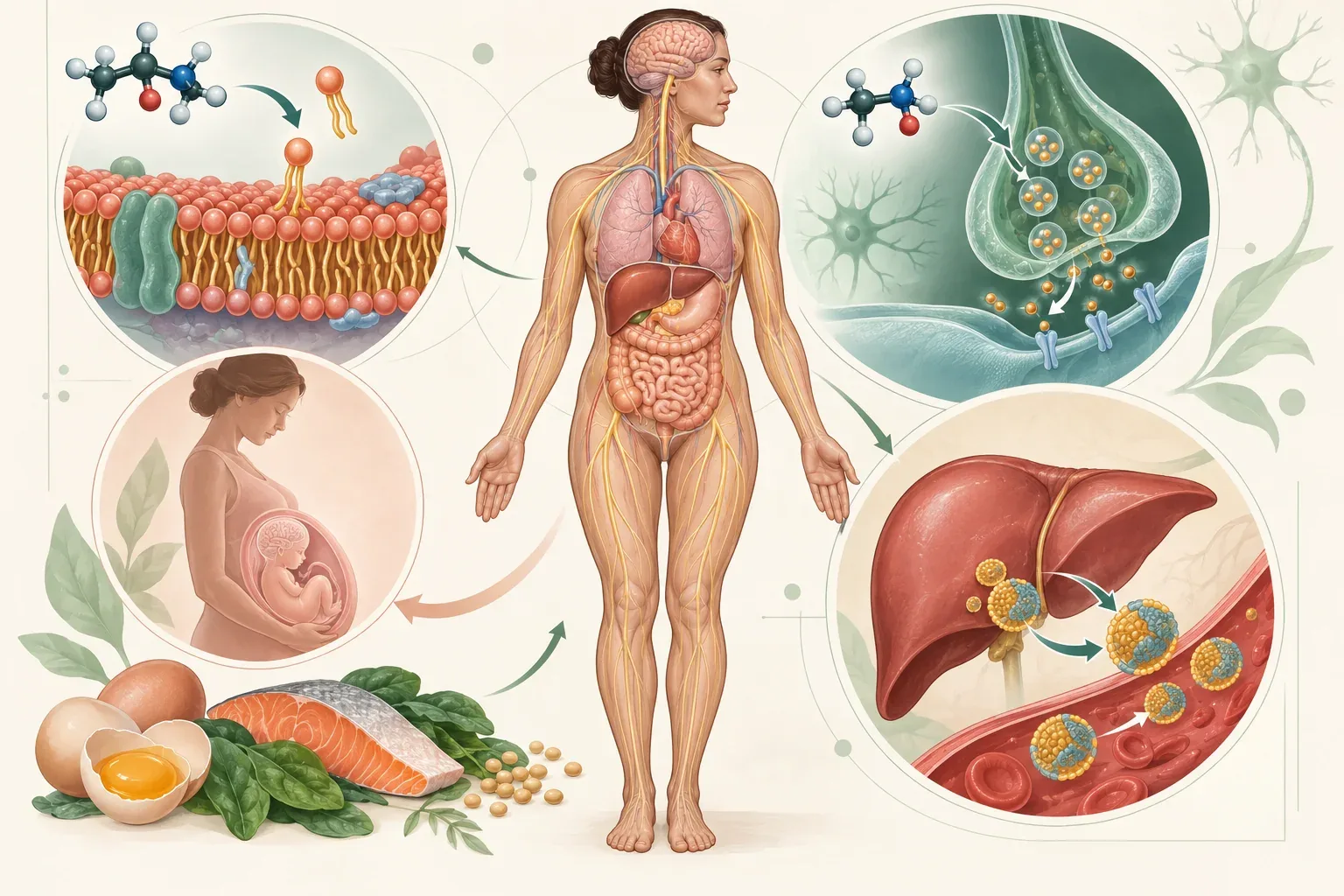
Choline helps form cell membranes and the neurotransmitter acetylcholine, and it supports fetal brain and spinal-cord development. The pregnancy AI is 450 mg total daily intake, above the 425 mg AI for nonpregnant adult women. The AI is an intake reference, not a proven optimum for a child's later cognition. [11]
Form, food and amount
Two products in the comparison below supply 55 mg choline as bitartrate. That is about 12% of the pregnancy AI; food or a separate choline product would need to supply the rest if the diet is otherwise short.
| Food and preparation | Choline |
|---|---|
| One large hard-boiled egg | 147 mg |
| Roasted soybeans, half a cup | 107 mg |
| Canned kidney beans, half a cup | 45 mg |
| 1% milk, one cup | 43 mg |
Two eggs, that cup of milk and 55 mg from a prenatal supply about 392 mg, leaving 58 mg before counting other food. The arithmetic shows why a 55 mg label can be meaningful in one diet and small in another. [11]
Choline during pregnancy: what the trials tested
In a controlled feeding trial, 26 women received either 480 or 930 mg total choline daily in the third trimester. The higher-intake group’s infants performed faster on a visual reaction task among 24 infants tested, but a spatial-memory measure did not improve. The extra choline was supplied as choline chloride. A follow-up found better sustained attention among 20 children at age seven from the same trial; it is not an independent replication. Funding included agricultural nutrition groups and Balchem in the follow-up. [21], [22]
A different trial randomized 140 women to 750 mg supplemental choline as phosphatidylcholine or placebo; 99 infants were tested. It found no significant improvement on the assessed infant development and memory outcomes. The two programs differed in total intake, form, timing and tests. Together they do not establish an optimal high-dose retail regimen or a cognitive benefit from a 55 mg prenatal addition. [23]
Cautions
Count the full day's choline if combining a prenatal and separate product. The adult upper limit is 3,500 mg total daily intake; the higher-intake trials above are research exposures, not amounts to copy without a reason. [11]
Calcium and magnesium: how food changes the supplement decision
Calcium
Why is calcium added to a prenatal?
Calcium supports the baby's developing bones and teeth and the mother's muscle and nerve function. The mother's body also adapts calcium absorption during pregnancy, so the adult pregnancy RDA remains 1,000 mg total daily intake, not a higher number just because she is pregnant. [12]
Form, food and amount
The compared prenatals supply 0–150 mg calcium per full serving. Dairy, calcium-set tofu and fortified plant milks can provide much more of a day's total. The mineral is bulky, which is one reason a small capsule often contributes only a fraction of the RDA. Count elemental calcium from the full serving and relevant foods before deciding whether a separate calcium product has a job. [12]
Cautions and pre-eclampsia evidence
WHO recommends 1.5–2.0 g supplemental elemental calcium for pregnant populations with low dietary calcium intake to reduce pre-eclampsia risk. That is a population intervention for a specific risk, not a target for everyone eating enough calcium. A 2025 Cochrane update reassessed the trials and found an uncertain overall result (risk ratio 0.83; 95% interval 0.67–1.04, which includes no effect). A 2026 methodological critique argues that including two excluded studies strengthens the benefit estimate. High-dose use should follow local maternity guidance and account for food and other supplements. [24], [25], [26]
Magnesium
Why is magnesium added to a prenatal?
Magnesium supports normal muscle and nerve function, energy production and the baby's tissue growth. The pregnancy RDA rises to 350 mg at ages 19–30 or 360 mg at 31–50, compared with 310 or 320 mg before pregnancy. That is total intake, mostly expected from food. [13]
Form, food and amount
The three compared prenatals supply only 32–45 mg magnesium. Beans, nuts, seeds, whole grains and leafy greens can contribute more. Labels may name oxide, citrate or malate; compare the separately declared elemental magnesium amount, because the whole compound weights are not equivalent. Our magnesium guide explains these forms. [13]
Cautions
The US 350 mg upper limit applies to magnesium from supplements and medicines, not magnesium naturally present in food. Larger supplemental servings can cause diarrhea; kidney disease changes the safety assessment. A prenatal's small magnesium entry is not evidence that the diet is inadequate. [13]
DHA: oil weight is not the active amount
Why is DHA considered in pregnancy?
DHA is a long-chain omega-3 fat used in the developing brain and retina. A mother's diet supplies the fetus during pregnancy and the infant through breast milk afterward. The US sets an AI for ALA, a different omega-3, but no separate RDA or AI for DHA or EPA. [14]
Form, food and amount
Fish oil and algal oil can both supply DHA; total oil weight is not the DHA amount. The gummy below has 263 mg fish oil but only 58 mg DHA and 12 mg EPA. FDA/EPA advice for pregnancy and breastfeeding is 8–12 ounces weekly of varied lower-mercury fish; salmon, sardines and shrimp are among the “Best Choices.” If fish is not part of your diet, an algal DHA product offers another source; compare its declared DHA amount. [27]
Cautions and birth-outcome evidence
The ORIP trial assigned 5,544 pregnancies to approximately 800 mg DHA plus 100 mg EPA daily or a low-omega-3 control, from before 20 weeks until 34 weeks or delivery. Early preterm birth occurred in 2.2% versus 2.0%: no clear overall reduction on the main outcome. Minor digestive effects were more common with omega-3. An observed increase in very large babies was a secondary signal among many outcomes and remains uncertain. ORIP does not settle whether selected people with low baseline intake benefit.[28]
What do trials of whole prenatal combinations show?
A 2019 review drew results from 20 trials involving 141,849 pregnant women, mostly in lower- and middle-income countries. The usual question was whether adding more vitamins and minerals to iron and folic acid improved outcomes compared with iron alone or iron plus folic acid. One UK trial used a placebo instead. The supplements were not identical: the three examples below show some of the formulas researchers compared. The review's full table[29] lists the other interventions.
| Trial formula in the review | What the combination included | Main comparison |
|---|---|---|
| UNIMMAP formula used in multiple trials | 15 nutrients: vitamins A, D, E, C, B1, B2, B3, B6 and B12; folic acid; iron, zinc, copper, selenium and iodine. The standard formula had 30 mg iron and 400 mcg folic acid. | Iron with or without folic acid |
| Fawzi 2007 | Iron and folic acid with vitamins C, E, B1, B2, B3, B6 and B12; no vitamin A or iodine in the reviewed intervention table. | Iron and folic acid |
| Christian 2003 | Iron and folic acid with vitamins A, C, D, E, B1, B2, B3, B6 and B12, plus additional minerals; a different combination from UNIMMAP. | Iron and folic acid |
| Birth outcome | What happened with the multiple-nutrient group compared with iron with or without folic acid |
|---|---|
| Low birthweight | About 12% lower relative risk in the pooled estimate. This is a comparison of groups, not 12 fewer low-weight babies out of every 100 pregnancies. |
| Small for gestational age | About 8% lower relative risk in the pooled estimate. |
| Preterm birth overall | No clear difference in the pooled estimate. |
| Death around birth or in the newborn period | No reduction was shown in the pooled estimates. |
These results support considering a defined multiple-nutrient program in settings with nutritional gaps. WHO's current guidance keeps multiple-micronutrient supplementation in the context of rigorous research because effects may differ across settings, particularly where diets are already adequate. It does not treat extra premium ingredients in a US bottle as proven to improve birth outcomes. [30], [31]
Three actual products, compared by the full daily serving
Amounts below are supplement contents declared on their respective labels. This is not a ranking. The table focuses on nutrients that matter to the choices discussed above.[^product-labels]
| Per full daily serving | Nature Made Prenatal Folic Acid + DHA softgel | Nature Made Prenatal Folic Acid + DHA + Choline gummies | Ritual Essential Prenatal, citrus |
|---|---|---|---|
| Serving / days in selected bottle | 1 softgel / 60 days | 2 gummies / 30 days | 2 vegan capsules / 30 days |
| Folate | 1,330 mcg DFE; 800 mcg folic acid | 600 mcg DFE; 360 mcg folic acid | 1,000 mcg DFE as 5-MTHF; no folic acid listed |
| Iron | 27 mg, ferrous fumarate | None listed | 18 mg, ferrous bisglycinate |
| Iodine | 150 mcg, potassium iodide | 150 mcg, potassium iodide | 150 mcg, potassium iodide |
| Choline | None listed | 55 mg, bitartrate | 55 mg, bitartrate |
| Calcium | 150 mg, carbonate | 130 mg, tricalcium phosphate | No quantified amount |
| Magnesium | 45 mg, oxide | 40 mg, citrate | 32 mg, dimagnesium malate |
| Vitamin A | 770 mcg RAE, beta-carotene | 650 mcg RAE, retinyl acetate | None listed |
| Vitamin D3 | 25 mcg / 1,000 IU | 25 mcg / 1,000 IU | 50 mcg / 2,000 IU, lichen-derived |
| B12 | 5.2 mcg, cyanocobalamin | 5.2 mcg, cyanocobalamin | 8 mcg, methylcobalamin |
| DHA / EPA | 200 / 60 mg | 58 / 12 mg | 350 mg algal DHA; no EPA listed |
| Other practical differences | Fish oil and gelatin | Fish oil, gelatin, 5 g added sugar | Vegan label; no A, C, zinc or several B vitamins listed |
| One-time price / daily cost | $26.99 / $0.45 | $20.59 / $0.69 | $44.32 / $1.48, before shipping |
[^product-labels]: Complete manufacturer labels: [32], Nature Made gummy[33], and Ritual Essential Prenatal[34]. Check the current package before buying because formulas and prices can change.
Nature Made Prenatal Folic Acid + DHA softgel supplies 27 mg iron but no listed choline. Nature Made Prenatal Folic Acid + DHA + Choline gummies supply choline but no iron, and their 360 mcg folic acid is below the USPSTF lower bound. Ritual Essential Prenatal supplies algal DHA and a vegan capsule, but lists 5-MTHF rather than folic acid and supplies 18 mg iron before food is counted.
What did certification directories and product testing show?
A certification listing and a product test answer related but different questions. USP Verified means a named product meets the program’s standards for labeled ingredients and manufacturing under its verification process. Consumer Reports’ September 2026 testing reported at least one nutrient outside USP tolerance in the sampled Nature Made prenatal gummies despite their certification listing. The accessible report did not identify the specific nutrient and direction clearly enough for us to repeat it here. Consumer Reports did not test Ritual because its capsule-within-capsule design could not be handled by that analysis. [35], [36]
How does your diet change the choice?
A vegan pregnancy can be well planned, but a vegan prenatal does not automatically cover what the diet supplies less readily. B12 needs a reliable fortified-food or supplement source. Then compare actual food and label amounts for iodine, iron, calcium and choline; use iodized salt and fortified foods only at their declared amounts. If fish is absent, check the DHA amount from algae rather than counting plant ALA as an equal DHA serving. A vegetarian who eats eggs or dairy may get more choline, iodine or calcium from food, but still needs to count actual portions. [1]
Can partial servings make a simpler combination?
A prenatal may cover most of the chosen nutrients but leave one specific gap. A complementary product or food change can fill it if the prenatal's other amounts fit your stage and diet. The following arithmetic uses the dated labels above and Ritual Natal Choline[37], whose two-capsule serving supplies 550 mg choline. One capsule is half that serving, or 275 mg.
| Example daily pair | Folate form and amount | Iron | Iodine | Choline | DHA | Main remaining question |
|---|---|---|---|---|---|---|
| 1 Nature Made Prenatal Folic Acid + DHA softgel plus 1 Ritual Natal Choline capsule (half its labeled serving) | 800 mcg folic acid | 27 mg | 150 mcg | 275 mg | 200 mg | Can food supply about 175 mg more choline, and is 800 mcg folic acid appropriate alongside fortified foods? |
| 2 Ritual Essential Prenatal capsules plus 1 Ritual Natal Choline capsule (half its labeled serving) | 1,000 mcg DFE as 5-MTHF; no folic acid listed | 18 mg | 150 mcg | 330 mg | 350 mg | Can food supply about 120 mg more choline and the remaining iron; how will the preconception folic-acid recommendation be handled? |
The second pair does not supply the USPSTF's specified folic-acid amount merely because its DFE number is large. Partial servings also do not solve every gap: use the full label to check vitamin A, vitamin D and other overlapping ingredients before building a routine.
What if only one nutrient is missing?
A separate, single-nutrient product is easier to calculate than a second full prenatal. The examples below are label arithmetic, not instructions to add iron or folic acid without considering your diet and care plan.
| Specific gap and products | Added quantity | New total from the named supplements | What still needs checking |
|---|---|---|---|
| Nature Made prenatal gummies (2 daily) plus Nature Made folic acid 400 mcg tablet[38] | 400 mcg folic acid | 760 mcg folic acid (360 + 400) | Fortified-food folic acid counts toward the 1,000 mcg upper limit; the gummy still has no iron. |
| Nature Made prenatal gummies (2 daily) plus 1 of 2 Nature Made Iron 18 mg + Vitamin C gummies[39] | 9 mg elemental iron plus 20 mg vitamin C | 9 mg iron from these supplements | Food must supply the rest of the 27 mg pregnancy RDA if that is the plan; diagnosed anemia may need a different treatment amount. The prenatal still has only 360 mcg folic acid. |
If the missing nutrient is iron, a maternity clinician can decide whether food, a modest addition or treatment of deficiency is appropriate. If folic acid is the issue, check the actual folic acid line and fortified-food intake before adding another tablet.
Taking the product: nausea, tolerance and medicine timing
If nausea makes taking pills difficult, compare the number and type of pills, the amount per pill and the product directions. Taking a prenatal with a little food or at night may help; changing to gummies may make the serving easier to take, but can also mean less folic acid and DHA or no iron, as the product table shows. If you vomit soon after a dose, you may not have kept down the full serving; ask your maternity team how to handle missed doses rather than assuming it was absorbed or taking another full serving. Persistent vomiting, inability to keep fluids down, dark or reduced urine, dizziness or weight loss needs medical assessment. [40], [41]
If you take levothyroxine, the American Thyroid Association advises separating it from prenatal vitamins by at least four hours, because calcium and iron can interfere with absorption. A combined prenatal is still a valid format; the timing instruction concerns the medicine. [42]
What changes after delivery?
If breastfeeding, the choline AI rises from 450 to 550 mg because choline is transferred into breast milk and contributes to the infant's intake. The iodine RDA rises from 220 to 290 mcg because breast milk supplies the infant's iodine for thyroid-hormone production. The ordinary iron RDA falls from 27 to 9 mg: breast milk carries little iron, and many people temporarily stop menstruating while exclusively breastfeeding.
A product labeled “prenatal” may no longer be the best fit after delivery. Compare its choline, iodine and iron amounts with the new stage's reference amounts, changes in your food intake and any individual treatment plan if you have one after the birth.
The bottom line
Before buying a prenatal, check the full daily serving. For most people who plan to or could become pregnant, the USPSTF recommends 400–800 mcg of actual folic acid each day. Start at least a month before conception when possible and continue through the first two to three months of pregnancy. Since your body's needs change as the pregnancy progresses, reassess your exact needs with your ob-gyn as time goes on.
Then compare the iron, iodine, choline, DHA and preformed vitamin A amounts with your diet, stage of pregnancy and any diagnosed need. The three products above show the trade-offs: the gummy has no iron, the softgel lists no choline, and Ritual uses 5-MTHF instead of folic acid. If one nutrient is missing, a single-nutrient addition or food may be an easier fix than taking two complete prenatal supplements.
Help us improve this article
Spotted an error or found a source we should consider? Tell us which part of this article needs another look and include a link if you have one. Please leave out personal health details and lab results; we can’t answer individual medical questions.
More in vitamins

References
- NIH prenatal overview ↩
- USPSTF folic acid recommendation ↩
- Folate ↩
- Iron ↩
- Iodine ↩
- Vitamin A ↩
- Vitamin D ↩
- B6 ↩
- Zinc ↩
- B12 ↩
- Choline ↩
- Calcium ↩
- Magnesium ↩
- Omega-3 ALA ↩
- EFSA opinion ↩
- WHO recommendation ↩
- RCOG guidance ↩
- ATA 2026 table ↩
- WHO guidance ↩
- Endocrine Society guideline ↩
- Original trial ↩
- follow-up ↩
- Cheatham trial ↩
- WHO recommendation ↩
- Cochrane update ↩
- methodological critique ↩
- FDA fish advice ↩
- ORIP original report ↩
- review's full table ↩
- Cochrane review ↩
- WHO guidance and implementation context ↩
- Nature Made softgel ↩
- Nature Made gummy ↩
- Ritual Essential Prenatal ↩
- USP verification program ↩
- Consumer Reports testing ↩
- Ritual Natal Choline ↩
- Nature Made folic acid 400 mcg tablet ↩
- Nature Made Iron 18 mg + Vitamin C gummies ↩
- MedlinePlus prenatal advice ↩
- RCOG pregnancy sickness ↩
- ATA medicine guidance ↩
Corrections & updates
- Update
Updated the evidence discussion and practical guidance after editorial review.