
What is chamomile?
Chamomile is a flowering herb commonly brewed as tea and sold as a concentrated flower extract. One common species is German chamomile, Matricaria chamomilla, also called Matricaria recutita. Roman chamomile is a different species.
People take it for calm, sleep and digestive comfort. A cup of tea is a familiar way to use the flowers; an extract capsule provides a different, more concentrated exposure, and as we'll explore in the science section, with greater effects than a regular tea. Chamomile preparations are also used on the skin and as mouth rinses.
How chamomile has been used historically
Chamomile appears in Greek and Roman medical writing, including descriptions by Dioscorides and Pliny. Those accounts show a long history of using the flower for bodily complaints. [1]
The modern European Medicines Agency (EMA) recognizes traditional use of German chamomile flower preparations for minor digestive complaints such as bloating and mild spasms, as well as minor mouth, throat and skin inflammation. The agency describes teas, oral liquids, mouth rinses and topical preparations separately. [2]
Why do people take chamomile?
| Claimed benefit | Dose / form studied | Research verdict | Evidence strength |
|---|---|---|---|
| Reduce generalized anxiety symptoms | Two different German-chamomile extracts, tested in 2009 and 2016–17 | An eight-week placebo trial[3] favored extract on its main anxiety score; a later continuation trial[4] improved some scores but did not clearly prevent relapse. | Limited |
| Improve sleep | Extract capsules and tea in different populations | A 34-person insomnia pilot[5] missed its sleep outcomes; postnatal tea[6] and older-adult extract[7] studies reported some improvement. These do not establish an insomnia treatment. | Limited |
| Improve depression alongside anxiety | The same program, during a phase in which everyone knew they received chamomile | Exploratory findings[8] need a controlled depression trial. | Limited |
| Ease minor digestive discomfort | German chamomile tea or oral preparations in traditional use | EMA recognizes traditional use[2] for bloating and mild spasms; a trial of a many-herb digestive product cannot isolate chamomile’s effect. | Insufficient for chamomile alone |
When to ask a doctor before taking it
Review concentrated chamomile with a pharmacist if you take warfarin, sedatives or medicines whose levels require careful control. NIH describes reported interactions as well as theoretical concerns; they do not all have the same degree of clinical evidence.
Common dosage and timing
As of 2026, there is no recognized recommended daily amount for chamomile. The NIH fact sheet and clinical papers reviewed here provide preparation-specific exposures rather than a nutritional target.
What the anxiety and sleep trials found
Anxiety
A 2009 placebo-controlled trial had 57 adults with mild to moderate generalized anxiety disorder. An extract given at 220–1,100 mg daily for eight weeks improved the main clinician-rated anxiety score more than placebo; the proportion with a 50% response was not clearly different. [3]
The later, longer anxiety trial began with 179 adults receiving chamomile openly. Only responders who agreed to continue entered the randomized phase: 46 continued chamomile and 47 switched to placebo. That design asks whether continuing helps people who initially improved.
Relapse occurred in 7 of 46 versus 12 of 47. The difference was not statistically conclusive, although some symptom scores favored chamomile. It is a useful preliminary signal, with a narrower meaning than “chamomile works for anxiety.”
The depression paper came from the open-label program, so it does not add an independent placebo-controlled confirmation. The two anxiety trials used different extracts, and neither tells us how a nightly cup compares.
Sleep
For chronic insomnia, a 34-person pilot gave 270 mg extract twice daily for 28 days. Participants recorded how long they slept and what proportion of their time in bed they spent asleep. Neither primary measure differed clearly from placebo. In contrast, a study of 80 postnatal women found better scores on one sleep-inefficiency measure after two weeks of tea than with usual postpartum care. By week four, the groups had similar sleep, fatigue and depression scores. A study of older adults using 200 mg extract twice daily also reported improved sleep quality, but the preparation and population differed again. [5], [6], [7]
What did chamomile tea change in people with type 2 diabetes?
In an eight-week trial, 64 adults with type 2 diabetes drank either chamomile tea or water after meals. The tea group brewed 3 g of chamomile in 150 mL of water three times daily. Their HbA1c, a measure of average blood sugar, fell more than in the water group. The study measured short-term blood markers. Whether drinking the tea affects diabetes complications remains an open question. [9]
How did mouth rinses and skin creams perform?
A trial involving 164 people receiving fluorouracil chemotherapy found that adding a chamomile rinse to mouth cooling offered no clear relief from mouth inflammation compared with a placebo rinse. A smaller trial compared chamomile ice with plain ice during chemotherapy. The chamomile group reported less mouth pain on day eight, but the difference was uncertain on days 15 and 22. Mouthwash trial[10] · Ice trial[11]
For eczema, researchers compared a chamomile cream with its cream base on different sides of the body. After two weeks they described the difference from the base as marginal, leaving little reason to attribute the improvement to chamomile itself. [12]
Does tea work like an extract?
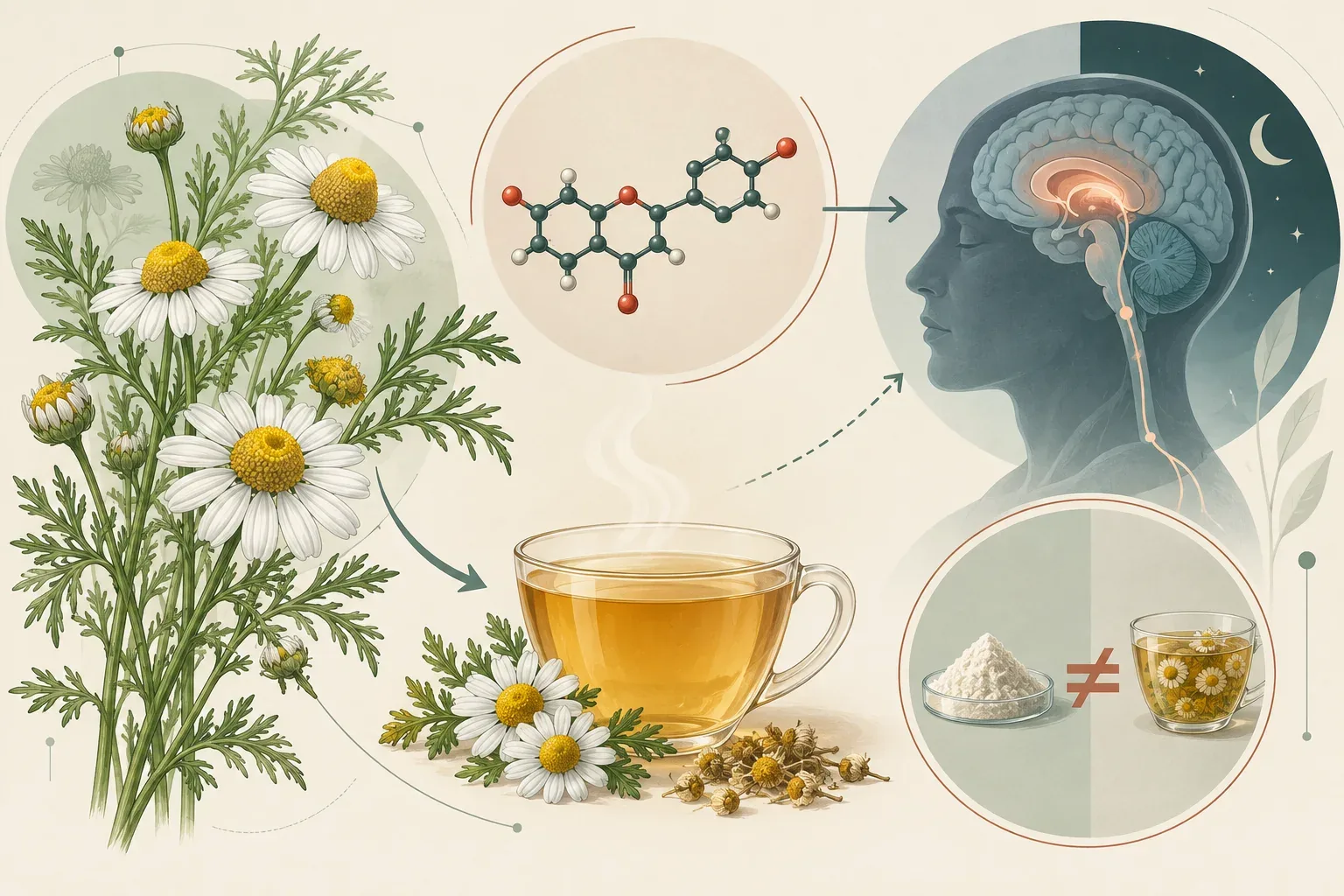
A tea infusion extracts some flower constituents into water. The amount depends on the flower weight, brewing time and preparation. A dry extract has its own manufacturing process and chemical profile. You cannot count cups and reliably reproduce a capsule trial.
The anxiety study used a pharmaceutical-grade extract called SHC-1. “Chamomile 500 mg” on another label might mean flower powder or a different extract. The shared plant name does not establish an equivalent dose.
What should the label tell you?
Look for the species, flower as the plant part, and whether the amount means dried flowers or extract. For an extract, look for a specific preparation name, such as SHC-1, and its extraction details. Standardization means the manufacturer targets a stated amount or percentage of a constituent; it helps describe composition, without proving equivalence to another extract. Check the full daily serving, especially if the front label highlights an amount supplied by several capsules.
A sleep blend containing chamomile and several other ingredients needs evidence for that whole formula. It cannot borrow the full effects of every ingredient's separate trial while supplying unknown amounts of each.
Drawbacks and side effects
| Potential drawback | When/who it affects | Research evidence | Practical implication |
|---|---|---|---|
| Nausea or dizziness | Some oral supplement users | Reported in the NIH summary | Reconsider use if symptoms appear. |
| Allergic reaction | Especially people sensitive to related plants such as ragweed | Rare severe reactions are documented | Avoid it after a prior chamomile reaction; breathing trouble needs urgent care. |
| Medicine interaction | Warfarin and some liver-metabolized medicines; possible sedation | Mixed clinical and theoretical evidence | Have the preparation checked before adding it. |
The bottom line
Chamomile has a long tradition of use for digestive symptoms and some topical applications, but modern research is strongest for specific anxiety extracts. One small anxiety trial favored extract, while a later continuation trial missed its relapse outcome. Sleep studies are mixed across tea and capsule preparations. The label’s species and preparation matter more than the shared name “chamomile.”
Help us improve this article
Spotted an error or found a source we should consider? Tell us which part of this article needs another look and include a link if you have one. Please leave out personal health details and lab results; we can’t answer individual medical questions.
Explore more in anxiety




More in herbs

References
- AHPA: chamomile in historical sources ↩
- EMA: traditional uses of German chamomile flower ↩
- Amsterdam 2009: placebo-controlled anxiety trial ↩
- Mao 2016: randomized anxiety continuation trial ↩
- Zick 2011: chronic-insomnia pilot ↩
- Chang 2016: postnatal tea trial ↩
- Adib-Hajbaghery 2017: older-adult sleep trial ↩
- Amsterdam 2020: open-label depression subgroup analysis ↩
- Tea trial ↩
- Mouthwash trial ↩
- Ice trial ↩
- Eczema cream trial ↩
- NCCIH: chamomile